About this book
Julien Sorel climbs from sawmill to salon, torn between the red of the army and the black of the church. Stendhal's 1830 novel, free to read online.
IV A FATHER AND A SON
E sara mia colpa, Se cosi è ?
M a c h i a v e l l i .
M y w i f e r e a l l y h a s a g r e a t d e a l o f h e a d ! s a i d , t h e n e x t d a y a t s i x o ' c l o c k i n t h e m o r n i n g , t h e m a y o r o f V e r r i è r e s , a s h e w e n t d o w n t o P è r e S o r e l ' s s a w m i l l . A l t h o u g h I t o l d h e r s o , t o p r e s e r v e t h e s u p e r i o r i t y w h i c h b e l o n g s t o m e , I h a d n o t t h o u g h t t h a t i f I d o n o t t a k e t h i s l i t t l e a b b é S o r e l , w h o , t h e y s a y , k n o w s L a t i n l i k e a n a n g e l , t h e d i r e c t o r o f t h e d é p ô t , t h a t r e s t l e s s s o u l , m i g h t w e l l h a v e t h e s a m e i d e a a s I h a v e a n d t a k e h i m f r o m m e . W i t h w h a t a t o n e o f s e l f - s u f f i c i e n c y h e w o u l d s p e a k o f h i s c h i l d r e n ' s t u t o r ! . . . T h i s t u t o r , o n c e h e i s m i n e , w i l l h e w e a r t h e s o u t a n e ?
M. de Rênal was absorbed in this doubt when he saw in the distance a peasant, a man of nearly six feet, who, from the first light of day, seemed very busy measuring pieces of timber laid along the Doubs, on the towpath. The peasant did not look very pleased to see M. le maire approaching; for these pieces of timber obstructed the path, and had been deposited there in contravention of the rules.
Père Sorel, for it was he, was very surprised and still more pleased by the singular proposal which M. de Rênal made to him for his son Julien. He none the less listened to it with that air of dissatisfied sadness and disinterestedness which the cunning of the inhabitants of these mountains knows so well how to assume. Slaves in the time of Spanish domination, they still preserve this trait of the physiognomy of the Egyptian fellah.
Sorel's reply was at first only the long recitation of all the formulas of respect which he knew by heart. While he repeated these vain words, with an awkward smile which increased the air
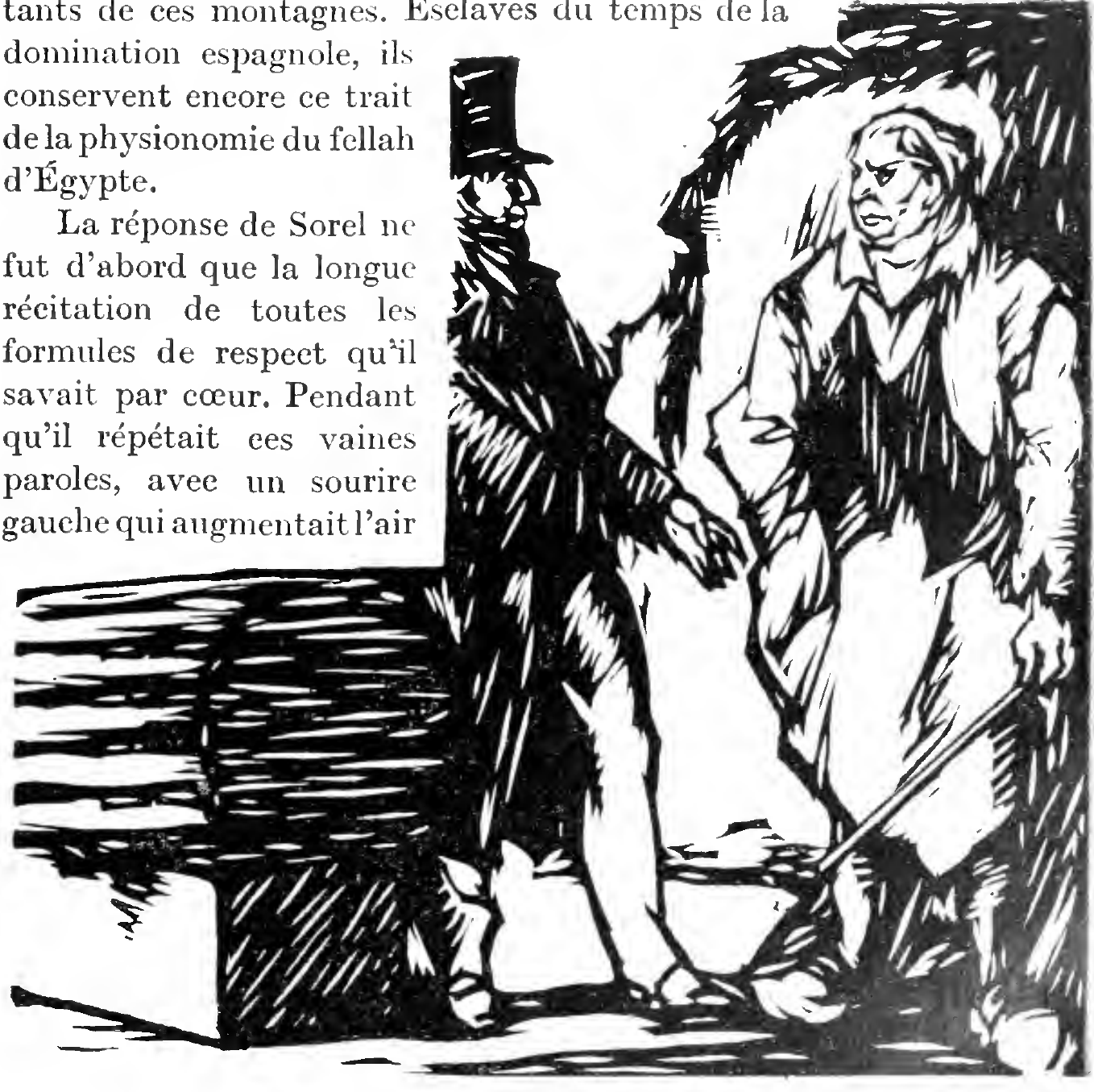
of falseness and almost of knavery natural to his physiognomy, the active mind of the old peasant sought to discover what reason could lead so considerable a man to take into his house his good-for-nothing son. He was very dissatisfied with Julien, and it was for him that M. de Rênal was offering the unhoped-for wages of 300 francs a year, with food and even clothing. This last claim, which Père Sorel had had the genius to put forward suddenly, had been granted in the same way by M. de Rênal.
This demand struck the mayor. Since Sorel is not delighted and overwhelmed by my proposal, as naturally he ought to be, it is clear, he said to himself, that offers have been made to him from another quarter; and from whom can they come, if not from Valenod? It was in vain that M. de Rênal pressed Sorel to conclude on the spot: the cunning of the old peasant obstinately refused. He wished, he said, to consult his son, as if, in the provinces, a rich father consulted a son who has nothing, otherwise than for form's sake.
A sawmill consists of a shed beside a stream. The roof is supported by a frame resting on four stout wooden pillars. Eight or ten feet up, in the middle of the shed, one sees a saw going up and down, while a very simple mechanism pushes a piece of timber against this saw. It is a wheel set in motion by the stream that drives this double mechanism: that of the saw which goes up and down, and that which gently pushes the piece of timber toward the saw, which cuts it into planks.
Approaching his factory, old Sorel called Julien in his stentorian voice; no one answered. He saw only his elder sons, a breed of giants who, armed with heavy axes, were squaring the pine trunks that they were to take to the saw. Entirely occupied in following exactly the black line traced on the piece of wood, each blow of their axe separated enormous chips from it. They did not hear their father's voice. The latter made his way toward the shed; on entering it, he sought in vain for Julien in the place he should have occupied, beside the saw. He caught sight of him five or six feet higher up, straddling one of the roof beams. Instead of attentively watching the action of the whole mechanism, Julien was reading. Nothing was more antipathetic to old Sorel; he might perhaps have forgiven Julien his slender build, little suited to work of strength, and so different from that of his elder brothers; but this mania for reading was odious to him: he himself did not know how to read.
It was in vain that he called Julien two or three times. The attention the young man was giving to his book, far more than the noise of the saw, prevented him from hearing his father's terrible voice. At last, in spite of his age, the latter leaped nimbly onto the beam subjected to the action of the saw, and from there onto the crossbeam that supported the roof. A violent blow sent flying into the stream the book Julien was holding; a second blow, equally violent, dealt on his head in the manner of a cap, made him lose his balance. He was about to fall twelve or fifteen feet lower, into the midst of the levers of the machine in motion, which would have broken him to pieces, but his father caught hold of him with his left hand as he was falling:
-
— Well, lazybones! So you will always be reading your damned books, while you are on guard at the saw? Read them in the evening, when you go wasting your time at the cure's, that's the time for it.
Julien, though stunned by the force of the blow, and covered with blood, went back to his official post beside the saw. He had tears in his eyes, less because of the physical pain than because of the loss of his book, which he adored.
"Come down, animal, I want to speak to you." The noise of the machine again prevented Julien from hearing this order. His father, who had comedown, not wishing to take the trouble to climb up on the mechanism again, went to fetch a long pole used for knocking down walnuts, and struck him on the shoulder with it. Scarcely was Julien on the ground when old Sorel, driving him roughly before him, pushed him towards the house. God knows what he is going to do to me! said the young man to himself. As he passed, he looked sadly at the stream into which his book had fallen; it was the one of all others that he loved most, the Memorial of Saint Helena.
He had crimson cheeks and downcast eyes. He was a small young man of eighteen or nineteen, frail in appearance, with irregular but delicate features, and an aquiline nose. Large black eyes, which in calm moments announced reflection and fire, were animated at this instant with the expression of the most ferocious hatred. Dark chestnut hair, planted very low, gave him a small forehead, and in moments of anger, a wicked air. Among the innumerable varieties of the human physiognomy, there is perhaps not one that has been distinguished by a
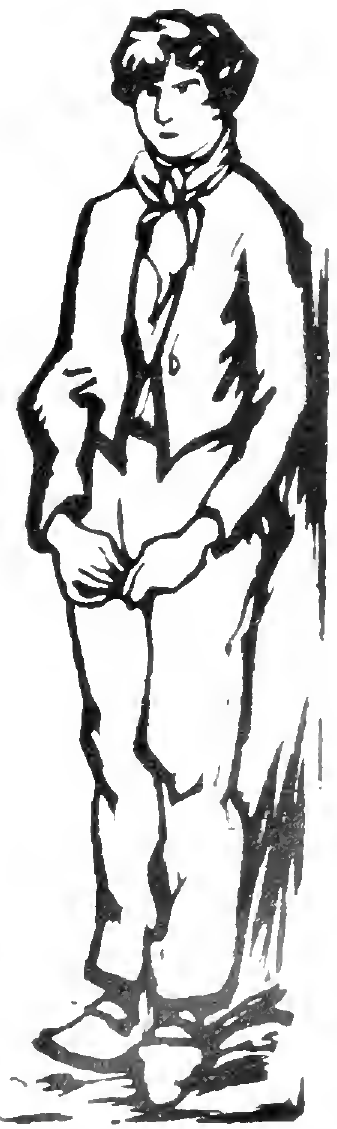
more striking speciality. A slender and well-shaped figure announced more lightness than vigour. From his earliest youth, his extremely pensive air and his great pallor had given his father the idea that he would not live, or that he would live to be a burden to his family. The object of everyone's contempt at home, he hated his brothers and his father; in the Sunday games, on the public square, he was always beaten.
It was not a year since his pretty face had begun to win him some friendly voices among the young girls. Despised by everyone as a weak creature, Julien had adored that old surgeon-major who one day dared to speak to the mayor about the plane trees.
This surgeon sometimes paid old Sorel the day's wages of his son, and taught him Latin and history, that is to say what he knew of history, the campaign of 1796 in Italy. When dying, he had bequeathed him his cross of the Legion of Honour, the arrears of his half-pay, and thirty or forty volumes, the most precious of which had just taken its leap into the public stream, diverted by the credit of M. the mayor.
Scarcely had he entered the house when Julien felt his shoulder seized by the powerful hand of his father; he trembled, expecting some blows.
— Answer me without lying, the harsh voice of the old peasant cried in his ears, while his hand turned him round as a child's hand turns a lead soldier. Julien's large black eyes, filled with tears, found themselves facing the little grey eyes of the old carpenter, who seemed to want to read to the very bottom of his soul.