About this book
Julien Sorel climbs from sawmill to salon, torn between the red of the army and the black of the church. Stendhal's 1830 novel, free to read online.
A DUNGEON
The tomb of a friend.
STERNE.
He heard a great noise in the corridor; it was not the hour at which they came up to his prison; the osprey flew away screeching, the door opened, and the venerable curé Chélan, all trembling and with his cane in his hand, threw himself into his arms.
— Ah! great God! is it possible, my child... Monster! I ought to say.
And the good old man could not add a word. Julien feared that he would fall. He was obliged to lead him to a chair. The hand of time had grown heavy upon this man, once so energetic. He appeared to Julien no more than the shadow of himself.
When he had recovered his breath: — Only the day before yesterday I received your letter from Strasbourg, with your five hundred francs for the poor of Verrières; it was brought to me in the mountain at Liveru where I am staying with my nephew Jean. Yesterday I learned of the catastrophe... O heaven! is it possible! And the old man wept no longer; he seemed bereft of thought, and added mechanically: You will be needing your five hundred francs, I have brought them back to you.
"I need to see you, Father!" cried Julien, deeply moved. "I have money left over."
But he could no longer get any sensible answer. From time to time, M. Chélan shed a few tears that ran silently down his cheek; then he would look at Julien and seem dazed to see him take his hands and carry them to his lips. That face, so vivid once, which had painted the noblest feelings with such energy, no longer emerged from its apathetic air. A sort of peasant soon came to fetch the old man. "You must not tire him," he said to Julien, who understood that this was the nephew. This apparition left Julien plunged in a cruel misery that drove away tears. Everything seemed sad to him and without consolation; he felt his heart frozen in his breast.
This instant was the cruelest he had experienced since the crime. He had just seen death, and in all its ugliness. All the illusions of greatness of soul and generosity had scattered like a cloud before the storm.
This dreadful situation lasted several hours. After moral poisoning, physical remedies and champagne are needed. Julien would have considered himself a coward
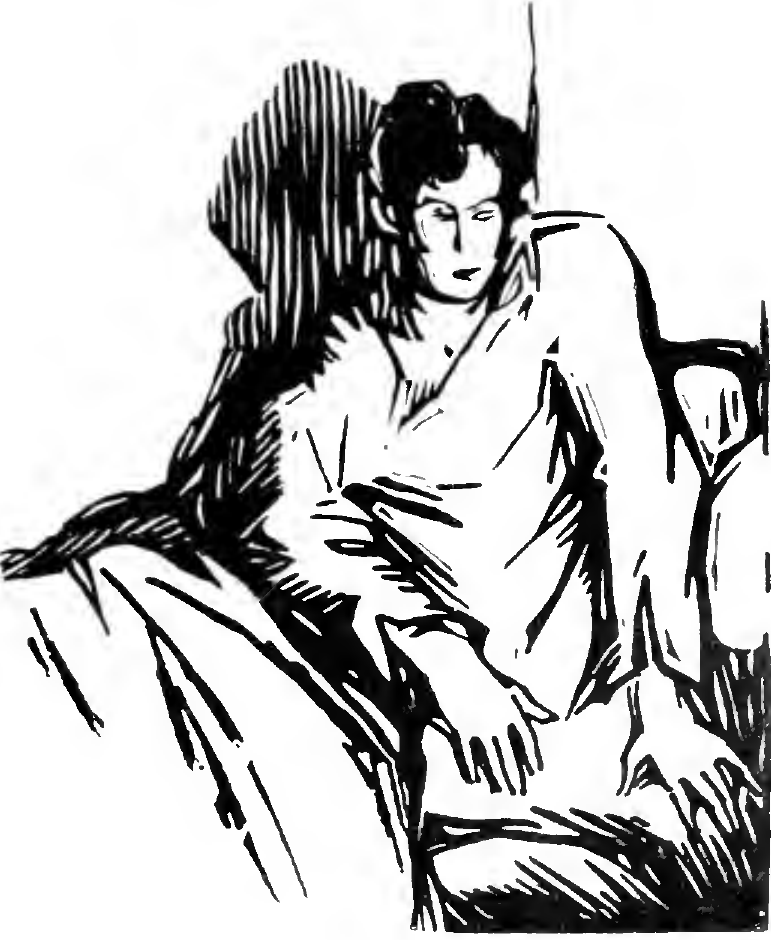
to resort to them. Toward the end of a horrible day, spent entirely in pacing within his narrow keep: "How mad I am!" he cried. "It is precisely in the case where I ought to die like anyone else that the sight of this poor old man should have cast me into this dreadful sadness; but a rapid death and in the flower of my years puts me precisely out of reach of that sad decrepitude."
Whatever reasoning he made, Julien found himself softened like a pusillanimous being, and consequently wretched from this visit.
There was nothing harsh or grand left in him, no more Roman virtue; death appeared to him at a great height, and as a less easy thing.
"That will be my thermometer," he said to himself. "This evening I am ten degrees below the courage that brings me level with the guillotine. This morning I had that courage. After all, what does it matter? provided it returns to me at the necessary moment." This idea of a thermometer amused him and finally managed to distract him.
The next day on waking, he was ashamed of the previous day. "My happiness, my tranquillity are at stake." He almost resolved to write to the attorney general to ask that no one be admitted to see him. And Fouqué? he thought. If he can bring himself to come to Besançon, what would his grief not be!
It was perhaps two months since he had thought of Fouqué. "I was a great fool at Strasbourg, my thoughts went no further than the collar of my coat." The memory of Fouqué occupied him a great deal and left him more softened. He paced with agitation. "Here I am decidedly twenty degrees below the level of death... If this weakness increases, it will be better to kill myself. What joy for the abbés Maslon and the Valenods if I die like a pedant!"
Fouqué arrived; this simple and good man was beside himself with grief. His only idea, if he had one, was to sell all his property to bribe the jailer and help Julien escape. He spoke to him at length of M. de Lavalette's escape.
!
"You pain me," Julien said to him; "M. de Lavalette was innocent, I am guilty. Without intending to, you make me think of the difference..."
But, is it true? What! you would sell all your property? said Julien, suddenly becoming observant and mistrustful again.
Fouqué, delighted to see his friend at last respond to his dominant idea, detailed to him at length, and to within a hundred francs, what he would get from each of his properties.
"What a sublime effort in a country property owner!" thought Julien. "What economies, what little petty meannesses, which made me blush so much when I saw him do them. He sacrifices them for me! One of those handsome young men I saw at the Hôtel de La Mole, and who read RENÉ, would have none of these absurdities; but except for those who are very young and still enriched by inheritance, and who do not know the value of money, which of these handsome Parisians would be capable of such a sacrifice?"
All of Fouqué's faults of French, all his common gestures, disappeared; he threw himself into his arms. Never has the provinces, compared to Paris, received a finer homage. Fouqué, delighted by the moment of enthusiasm he saw in his friend's eyes, took it for consent to flight.
This sight of the sublime restored to Julien all the strength that the apparition of M. Chélan had made him lose. He was still very young; but, in my opinion, this was a fine plant. Instead of moving from tenderness to cunning, like most men, age would have given him a goodness easily moved to tenderness; he would have cured himself of a mad mistrust... But what is the use of these vain predictions?
The interrogations became more frequent, despite Julien's efforts, all of whose answers tended to shorten the affair:
"I have killed or at least I have wished to give death, and with premeditation," he repeated every day. But the judge was formalist above all. Julien's declarations did not shorten the interrogations at all; the judge's self-esteem was piqued. Julien did not know that they had wanted to transfer him
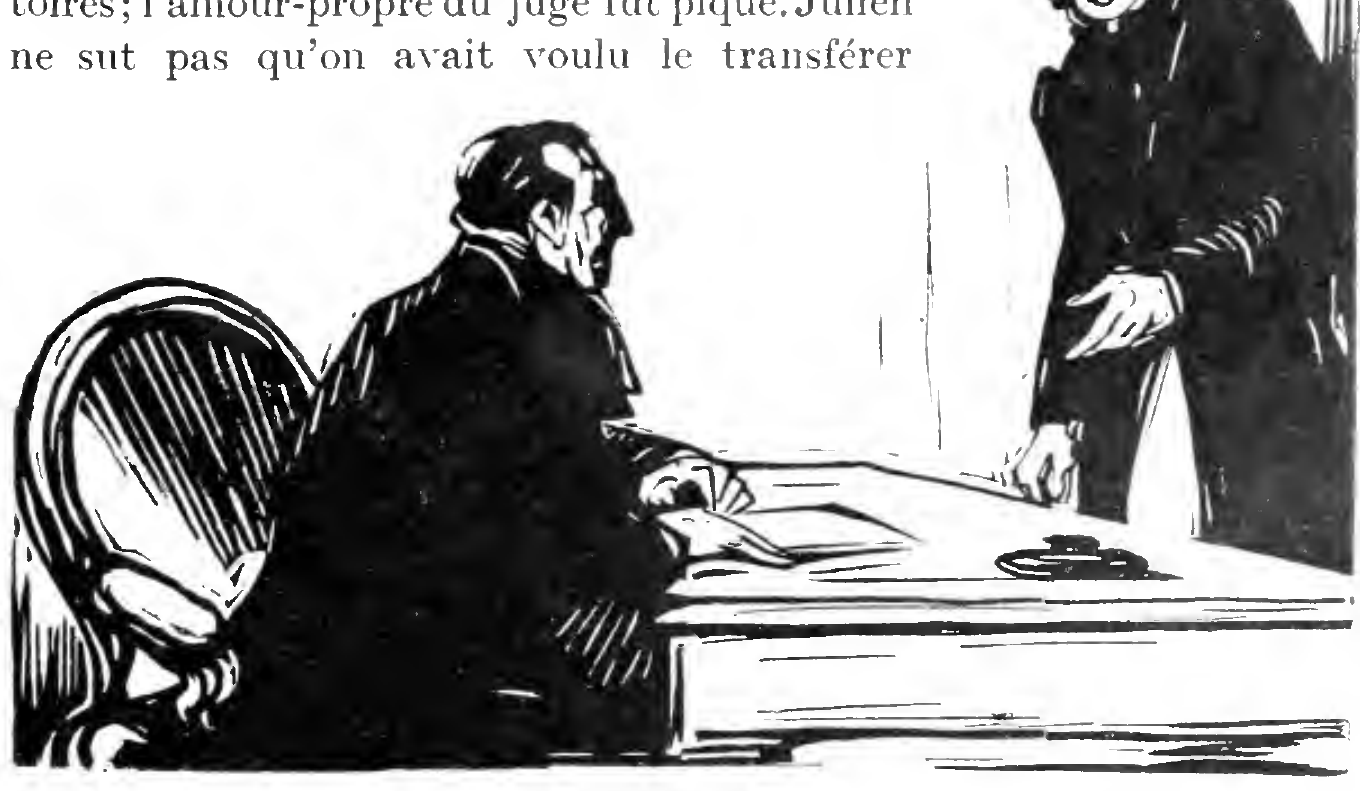
to a dreadful dungeon, and that it was thanks to Fouqué's efforts that he was left his pretty room at a height of one hundred and eighty steps.
M. l'abbé de Frilair was among the important men who entrusted Fouqué with their supply of firewood. The good merchant managed to reach the all-powerful grand vicar. To his inexpressible delight, M. de Frilair announced to him that, touched by Julien's good qualities and the services he had formerly rendered to the seminary, he intended to recommend him to the judges. Fouqué glimpsed the hope of saving his friend, and on leaving, and prostrating himself to the ground, begged M. the grand vicar to distribute in masses, to implore the acquittal of the accused, a sum of ten louis.
Fouqué was strangely mistaken. M. de Frilair was not a Valenod. He refused and even tried to make the good peasant understand that he would do better to keep his money. Seeing that it was impossible to be clear without imprudence, he advised him to give this sum in alms, for the poor prisoners, who, in fact, lacked everything.
"This Julien is a singular being, his action is inexplicable," thought M. de Frilair, "and nothing should be so for me... Perhaps it will be possible to make a martyr of him... In any case, I shall know the end of this affair and perhaps find an occasion to frighten that Madame de Rênal, who does not esteem us, and at bottom detests me... Perhaps I might encounter in all this a means of striking reconciliation with M. de La Mole, who has a weakness for this little seminarian."
The transaction concerning the lawsuit had been signed a few weeks earlier, and the abbé Pirard had left Besançon, not without having spoken of Julien's mysterious birth, on the very day when the unfortunate man assassinated Madame de Rênal in the church of Verrières.
Julien now saw only one disagreeable event between himself and death, and that was his father's visit. He consulted Fouqué about the idea of writing to the attorney general, to be exempted from all visits. This horror at the sight of a father, and at such a moment, deeply shocked the honest and bourgeois heart of the wood merchant.
He thought he understood why so many people passionately hated his friend. Out of respect for misfortune, he concealed his way of feeling.
"In any case," he answered coldly, "this order for secrecy would not be applied to your father."