About this book
Julien Sorel climbs from sawmill to salon, torn between the red of the army and the black of the church. Stendhal's 1830 novel, free to read online.
A STORM
My God, give me mediocrity.
MIRABEAU.
Her soul was absorbed; he only half responded to the keen tenderness she showed him. He remained silent and somber. Never had he appeared so great, so adorable in Mathilde's eyes. She dreaded some subtlety of his pride that would come to disturb the whole position.
Almost every morning she saw the abbé Pirard arrive at the mansion. Through him could not Julien have penetrated something of her father's intentions? Could not the Marquis himself, in a moment of caprice, have written to him? After such great happiness, how explain Julien's severe air? She did not dare to question him.
She did not dare! she, Mathilde! From that moment there was, in her feeling for Julien, something vague, unforeseen, almost terror. This dry soul felt of passion all that is possible in a being raised amid that excess of civilization which Paris admires.
The next day, very early, Julien was at the abbé Pirard's presbytery. Post horses were arriving in the courtyard with a dilapidated chaise, hired from the neighboring post station.
"Such an equipage is no longer in season," the severe abbé told him, with a grumpy air. "Here are twenty thousand francs, with which M. de La Mole makes you a gift; he urges you to spend them within the year, but while trying to give yourself as few ridiculous appearances as possible." (In such a large sum, thrown to a young man, the priest saw only an occasion to sin.)
The Marquis adds: "M. Julien de La Vernaye will have received this money from his father, whom it is useless to designate otherwise. M. de La Vernaye will perhaps judge it fitting to make a gift to M. Sorel, carpenter at Verrières, who cared for his childhood..." I can take charge of this part of the commission, added the abbé; I have at last determined M. de La Mole to negotiate with that abbé de Frilair, so Jesuit. His credit is decidedly too strong for ours. The implicit recognition of your high birth by this man who governs Besançon will be one of the tacit conditions of the arrangement. Julien was no longer master of his transport; he embraced the abbé; he saw himself recognized.
"For shame!" said M. Pirard, repelling him; "what does this worldly vanity mean?... As for Sorel and his sons, I will offer them, in my own name, an annual pension of five hundred francs, which will be paid to each of them as long as I am satisfied with them."
:
:
:
Julien was already cold and haughty. He thanked him, but in very vague terms that committed him to nothing. Could it really be possible, he said to himself, that I am the natural son of some great lord exiled in our mountains by the terrible Napoleon? At every moment this idea seemed to him less improbable... My hatred for my father would be a proof... I would no longer be a monster!
A few days after this monologue, the fifteenth regiment of hussars, one of the most brilliant in the army, was drawn up in battle order on the parade ground at
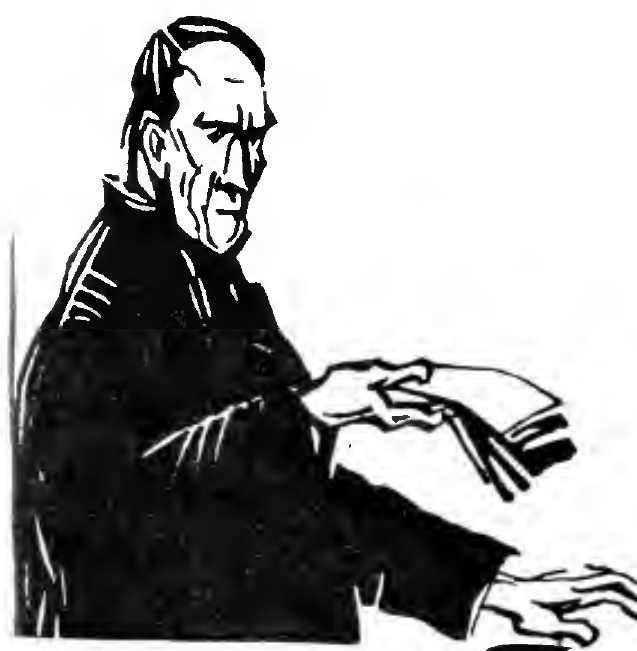
Strasbourg. M. le chevalier de La Vernaye rode the finest horse in Alsace, which had cost him 6,000 francs. He was received as lieutenant, without ever having been a second lieutenant except on the rolls of a regiment of which he had never heard.
:
His impassive air, his stern and almost wicked eyes, his pallor, his unshakeable composure began his reputation from the very first day. Shortly afterwards, his perfect and wholly measured politeness,his skill with the pistol and with weapons, which he made known without too much affectation, drove away the idea of joking aloud at his expense. After five or six days of hesitation, the regiment's public opinion declared in his favor. There is everything in this young man, said the old mocking officers, except youth.
From Strasbourg, Julien wrote to M. Chélan, the former curé of Verrières, who was now nearing the bounds of old age:
"You will have learned with a joy that I do not doubt of the events that have led my family to enrich me. Here are five hundred francs which I beg you to distribute without noise, and without any mention of my name, to the unfortunate, poor now as I once was, and whom doubtless you succor as formerly you succored me."
Julien was drunk with ambition and not with vanity; nevertheless he gave a great part of his attention to outward appearance. His horses, his uniforms, the liveries of his people were kept with a correctness that would have done honor to the punctuality of a great English lord. Barely a lieutenant, by favor and for two days, he was already calculating that, in order to command in chief at thirty at the latest, like all the great generals, he must at twenty-three be more than a lieutenant. He thought only of glory and of his son.
It was in the midst of the transports of the most unbridled ambition that he was surprised by a young valet from the Hôtel de La Mole, who arrived as a courier.
"All is lost," Mathilde wrote to him; "hurry here as fast as possible, sacrifice everything, desert if you must. Hardly arrived, wait for me in a cab, near the little garden door, at no. ... of the rue ... I will come to speak to you; perhaps I may be able to get you into the garden. All is lost, and I fear it, beyond remedy; count on me, you will find me devoted and steadfast in adversity. I love you."
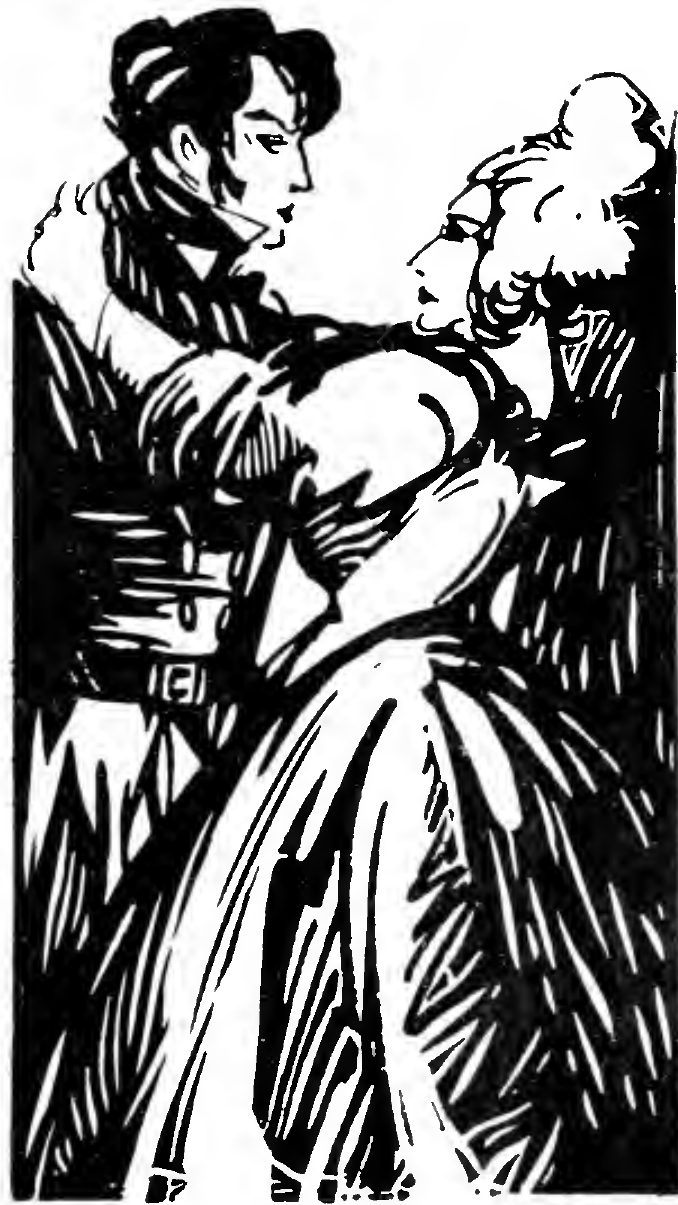
In a few minutes, Julien obtained a leave of absence from the colonel, and departed from Strasbourg at full gallop; but the dreadful anxiety that devoured him did not permit him to continue this mode of traveling beyond Metz. He threw himself into a post chaise; and it was with almost incredible rapidity that he arrived at the appointed place, near the little garden gate of the Hôtel de La Mole. This gate opened, and at that instant Mathilde, forgetting all human respect, threw herself into his arms. Fortunately it was only five o'clock in the morning and the street was still deserted.
"All is lost; my father, fearing my tears, left during the night of Thursday. Where for? no one knows. Here is his letter; read it." And she got into the hackney coach with Julien.
"I could have forgiven everything, except the project of seducing you because you are rich. There, unhappy girl, is the dreadful truth. I give you my word of honor that I will never consent to a marriage with this man. I assure him ten thousand livres a year if he will live far away, beyond the frontiers of France, or better still in America. Read the letter I receive in answer to the information I had requested. The impudent fellow had himself urged me to write to Madame de Rênal. Never will I read a line from you relating to this man. I hold
Paris and you in horror. I advise you to cover with the greatest secrecy what must happen. Renounce frankly a vile man, and you will find a father again."
"Where is Madame de Rênal's letter?" said Julien coldly.
"Here it is. I did not wish to show it to you until you had been prepared."
LETTER
"What I owe to the sacred cause of religion and morality obliges me, Monsieur, to take the painful step which I am now accomplishing with regard to you; a rule, which cannot fail, commands me at this moment to harm my neighbor, but in order to avoid a greater scandal. The grief that I feel must be overcome by the sense of duty. It is only too true, Monsieur, the conduct of the person concerning whom you ask me the whole truth may have appeared inexplicable or even honorable. It may have been thought proper to conceal or disguise a part of the reality; prudence demanded it as well as religion. But this conduct, which you desire to know, has in fact been extremely blameworthy, and more than I can say. Poor and greedy, it is by the aid of the most consummate hypocrisy, and by the seduction of a weak and unhappy woman, that this man has sought to make a position for himself and to become something. It is a part of my painful duty to add that I am obliged to believe that M. J... has no principle of religion. In conscience, I am constrained to think that one of his means for succeeding in a household is to seek to seduce the woman who has the principal credit there. Covered by an appearance of disinterestedness and by novelistic phrases, his great and sole object is to succeed in disposing of the master of the house and of his fortune. He leaves behind him unhappiness and eternal regrets, etc., etc., etc."
This extremely long letter, half obliterated by tears, was indeed in Madame de Rênal's hand; it was even written with more care than usual.
"I cannot blame M. de La Mole," said Julien after having finished it; "he is just and prudent. What father would wish to give his cherished daughter to such a man! Adieu!"
Julien leaped down from the hackney coach, and ran to his post chaise, which had stopped at the end of the street. Mathilde, whom he seemed to have forgotten, took a few steps to follow him; but the glances of the shopkeepers who were advancing
rapidly, he could not write to Mathilde as he had planned, his hand formed on the paper only illegible strokes.
He arrived at Verrières on a Sunday morning. He entered the gunsmith's shop of the town, who overwhelmed him with compliments on his recent fortune. It was the news of the country.
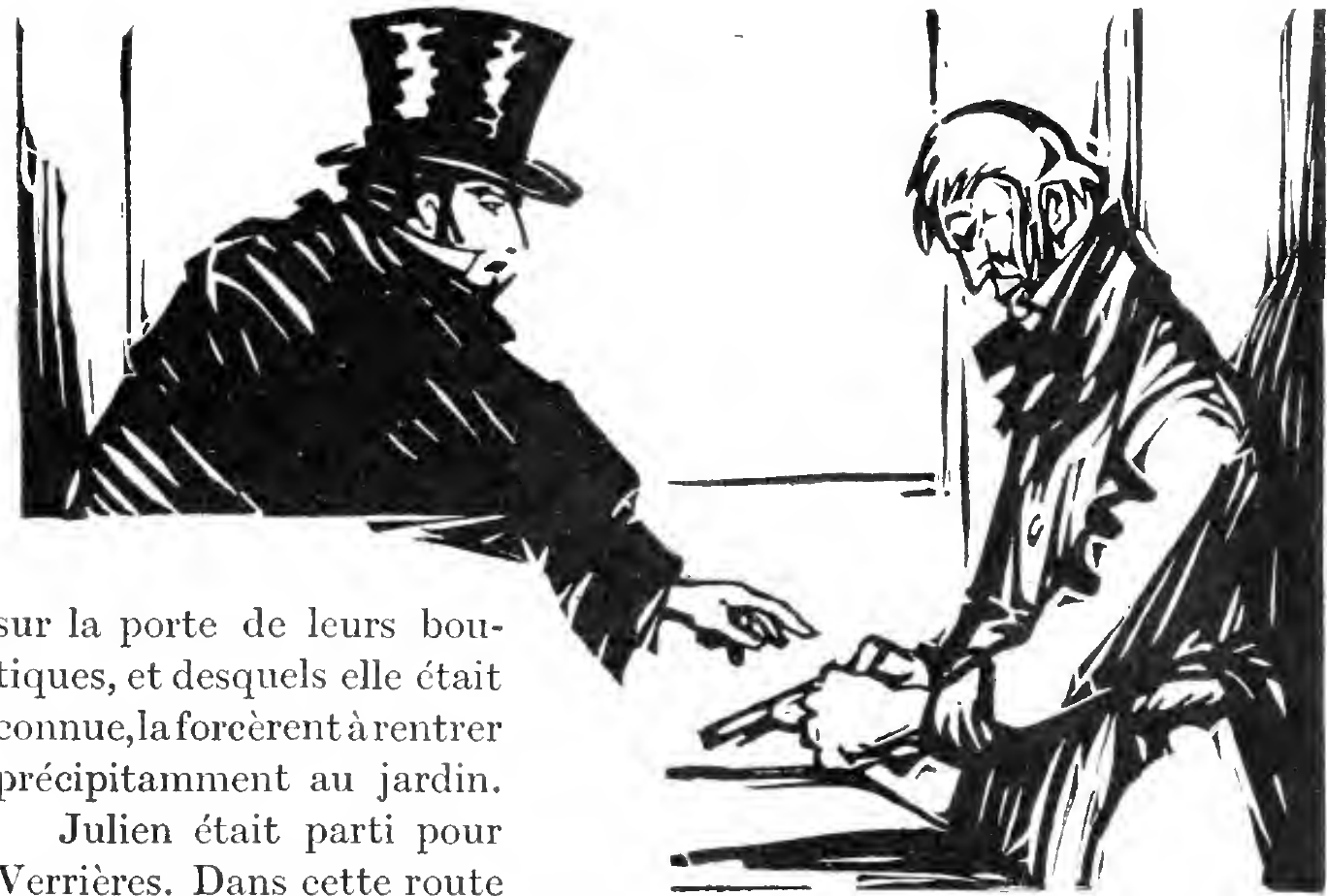
Julien had great difficulty in making him understand that he wanted a pair of pistols. The gunsmith, at his request, loaded the pistols.
The three strokes sounded; it is a signal well known in the villages of France, and which, after the various ringings of the morning, announces the immediate beginning of the mass.
Julien entered the new church of Verrières. All the high windows of the building were veiled with crimson curtains. Julien found himself a few steps behind Madame de Rênal's pew. It seemed to him that she was praying with fervor. The sight of this woman who had loved him so much made Julien's arm tremble in such a way that he could not at first execute his design. I cannot do it, he said to himself; physically, I cannot.
At that moment the young clerk, who was serving the mass, rang for the elevation. Madame de Rênal bowed her head, which for an instant was almost entirely hidden by the folds of her shawl. Julien no longer recognized her so well; he fired a pistol shot at her and missed her; he fired a second shot, she fell.