About this book
Julien Sorel climbs from sawmill to salon, torn between the red of the army and the black of the church. Stendhal's 1830 novel, free to read online.
LXVIII
A MAN OF POWER
But there are so many mysteries in her steps and so much elegance in her figure! Who can she be?
SCHILLER.
The dungeon doors opened very early the next day. Julien was startled awake.
— Ah! good God, he thought, here is my father. What an unpleasant scene!
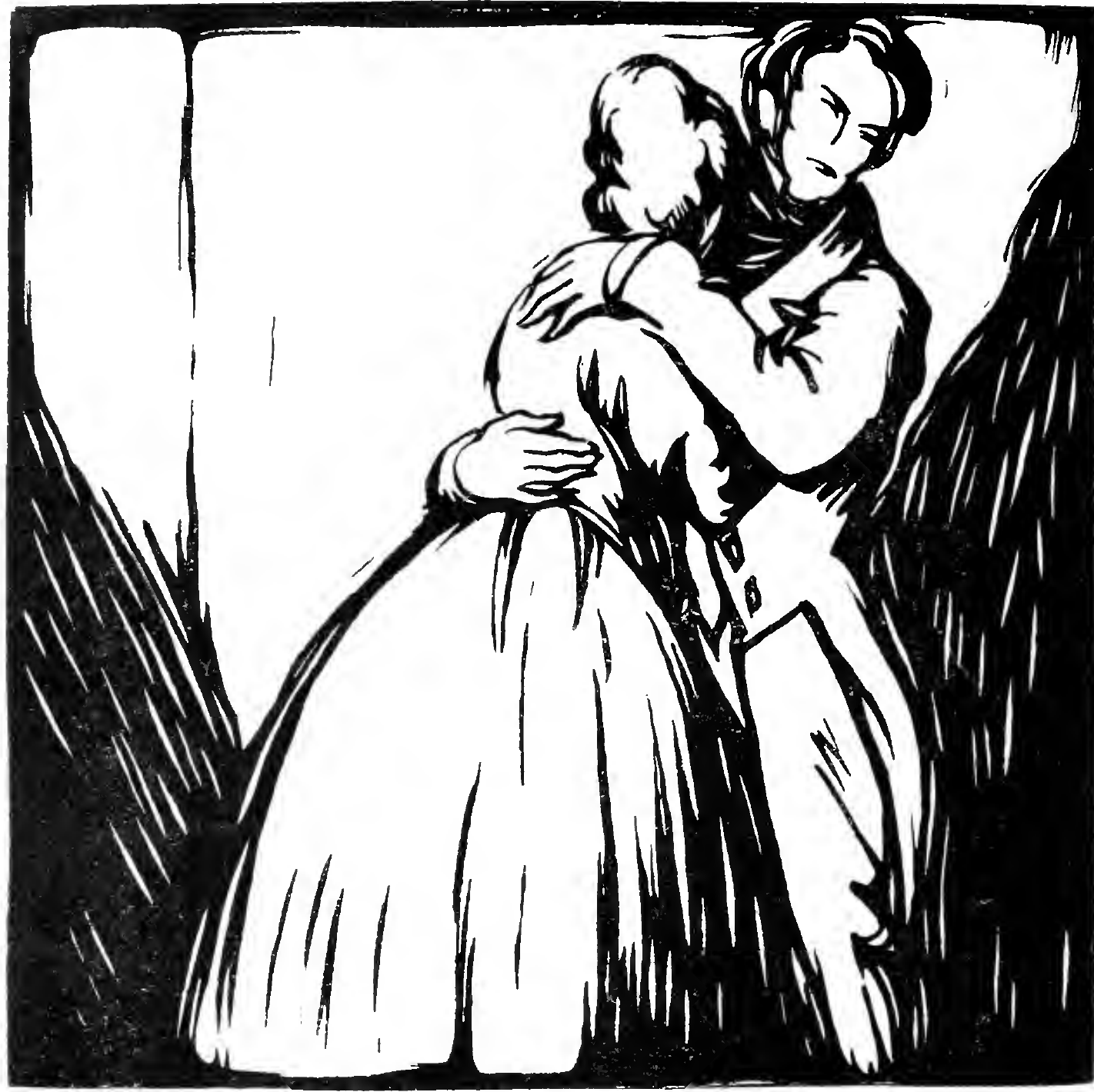
At that same moment, a woman dressed as a peasant woman rushed into his arms; he had difficulty recognizing her. It was Mademoiselle de La Mole.
— Wretch, I only learned from your letter where you were. What you call your crime, and which is nothing but a noble vengeance that shows me all the loftiness of the heart beating in that breast, I only learned of it at Verrières...
Despite his prejudices against Mademoiselle de La Mole, which, moreover, he did not admit to himself very clearly, Julien found her very pretty. How could he fail to see in this way of acting and speaking a noble, disinterested sentiment, far above anything a small and vulgar soul would have dared? He believed he still loved a queen, and after a few moments, it was with a rare nobility of elocution and thought that he said to her:
— The future was taking shape before my eyes very clearly. After my death, I would have remarried you to M. de Croisénois, who would have married a widow. The noble but somewhat romantic soul of this charming widow, astonished and converted to the worship of vulgar prudence by a singular event, tragic and grand for her, would have deigned to understand the very real merit of the young marquis. You would have resigned yourself to being happy with everyone's happiness: esteem, wealth, high rank... But, dear Mathilde, your arrival at Besançon, if it is suspected, will be a mortal blow for M. de La Mole, and that is what I shall never forgive myself for. I have already caused him so much grief! The academician will say that he warmed a serpent in his bosom.
— I confess that I little expected such cold reason, such concern for the future, said Mademoiselle de La Mole, half vexed. My maid, who is almost as prudent as you, had taken a passport for herself, and it was under the name of Madame Michelet that I traveled post.
— And Madame Michelet was able to reach me as easily as that?
— Ah! you are always the superior man, the one I singled out! First, I offered a hundred francs to a clerk of the judge, who claimed that my entry into this dungeon was impossible. But once the money was received, this honest man made me wait, raised objections, and I thought he was thinking of robbing me... She stopped.
— Well? said Julien.
— Do not be angry, my little Julien, she said, embracing him; I was obliged to tell my name to that clerk, who took me for a young working girl from Paris, in love with the handsome Julien... In truth, those were his very words. I swore to him that I was your wife, and I shall have permission to see you every day.
The madness is complete, thought Julien, I could not prevent it. After all, M. de La Mole is such a great lord that opinion will surely find an excuse for the young colonel who marries this charming widow. My death will cover everything; and he abandoned himself with delight to Mathilde's love; it was madness, greatness of soul, all that is most singular. She seriously proposed that he kill himself with her.
After these first transports, and when she had had her fill of the happiness of seeing Julien, a keen curiosity suddenly took possession of her soul. She examined her lover, whom she found far above what she had imagined. Boniface de La Mole seemed to her resurrected, but more heroic.
Mathilde saw the leading lawyers of the country, whom she offended by offering gold too crudely; but they ended by accepting.
She promptly arrived at the idea that, in matters doubtful and of high consequence, everything at Besançon depended on Monsieur l'abbé de Frilair.
Under the obscure name of Madame Michelet, she at first found insurmountable difficulties in reaching the all-powerful congregationist. But the rumor of the beauty of a young milliner, mad with love and come from Paris to Besançon to console the young abbé Julien Sorel, spread through the town.
Mathilde walked alone on foot through the streets of Besançon; she hoped not to be recognized. In any case, she did not think it useless to her cause to produce a great impression on the people. Her madness dreamed of making them revolt in order to save Julien as he walked to his death. Mademoiselle de La Mole believed she was
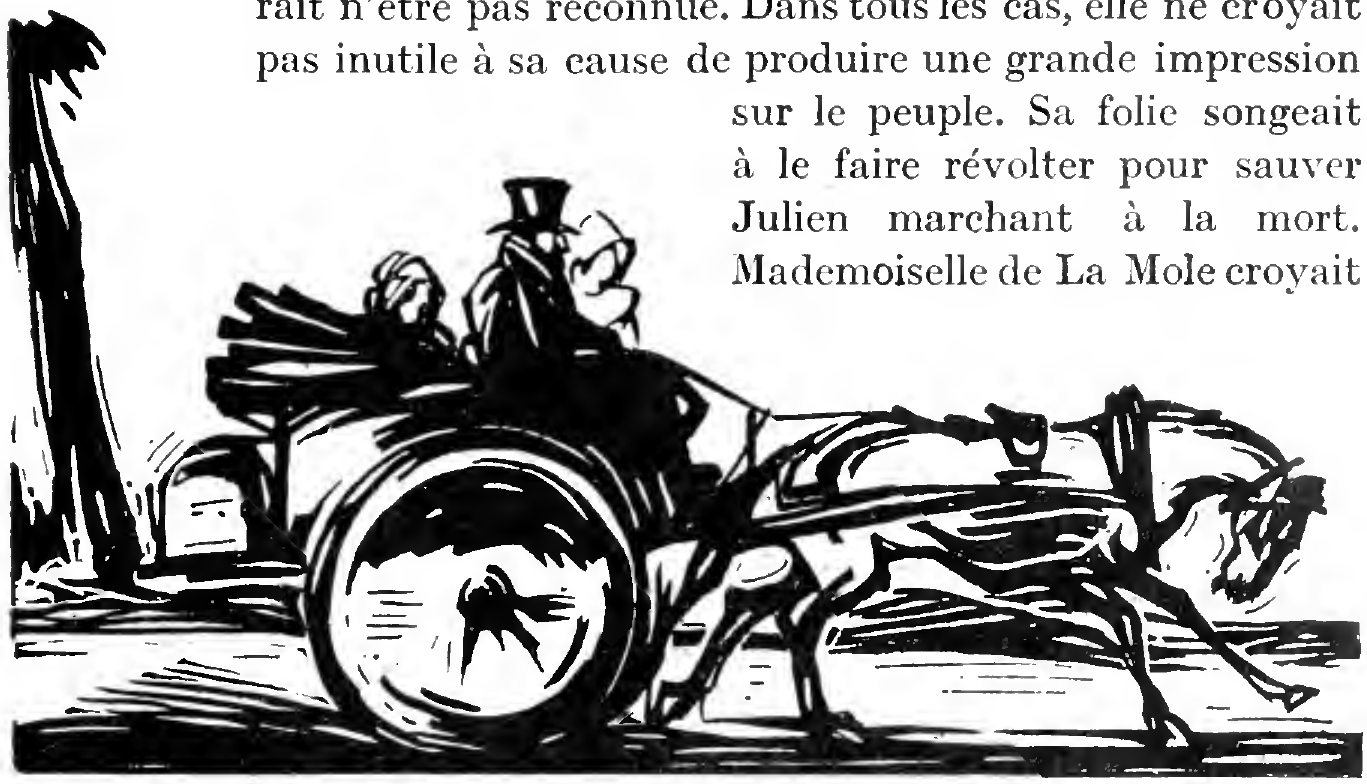
dressed simply and as befits a woman in sorrow; she was dressed in such a way as to attract every eye.
She was the object of everyone's attention in Besançon when, after eight days of solicitations, she obtained an audience with M. de Frilair.
Whatever her courage, the ideas of an influential congregationist and of deep and prudent villainy were so linked in her mind that she trembled as she rang at the door of the bishop's palace. She could scarcely walk when she had to climb the staircase leading to the apartment of the first grand vicar. The solitude of the episcopal palace made her cold. I may sit down on an armchair, and that armchair may seize me by the arms, and I shall have disappeared. To whom will my maid be able to ask for me? The captain of gendarmerie will be careful not to act... I am isolated in this great city!
At her first glance into the apartment, Mademoiselle de La Mole was reassured. First of all, it was a lackey in very elegant livery who had opened the door for her. The drawing room where she was made to wait displayed that refined and delicate luxury, so different from coarse magnificence, and which is found in Paris only in the best houses. As soon as she caught sight of M. de Frilair coming toward her with a fatherly air, all ideas of atrocious crime disappeared. She did not even find on that handsome face the imprint of that energetic and somewhat savage virtue, so antipathetic to Parisian society. The half-smile that animated the priest's features, who disposed of everything at Besançon, announced the man of good company, the learned prelate, the skillful administrator. Mathilde believed herself in Paris.
It took M. de Frilair only a few moments to bring Mathilde to confess that she was the daughter of his powerful adversary, the Marquis de La Mole.
— I am indeed not Madame Michelet, she said, resuming all the height of her bearing, and this confession costs me little, for I come to consult you, Monsieur, on the possibility of procuring the escape of M. de La Vernaye. First, he is guilty only of a thoughtlessness; the woman at whom he fired is well. Secondly, to win over the subordinates, I can hand over fifty thousand francs at once, and pledge myself for double. Finally, my gratitude and that of my family will find nothing impossible for whoever has saved M. de La Vernaye.
M. de Frilair appeared astonished at this name. Mathilde showed him several letters from the Minister of War, addressed to M. Julien Sorel de La Vernaye.
— You see, Monsieur, that my father was taking charge of his fortune. I married him in secret; my father wished him to be a superior officer before declaring this marriage, a little singular for a La Mole.
Mathilde noticed that the expression of kindness and gentle gaiety vanished rapidly as M. de Frilair arrived at important discoveries. A finesse mingled with profound falseness was painted on his face.
The abbé had doubts; he slowly reread the official documents.
What party can I draw from these strange confidences? he said to himself. Here I am suddenly in intimate relation with a friend of the celebrated Maréchale de Fervagues, all-powerful niece of Monseigneur the Bishop of ***, through whom one is a bishop in France.
What I regarded as remote in the future presents itself unexpectedly. This may lead me to the goal of all my vows.
At first Mathilde was frightened by the sudden change in the physiognomy of this so powerful man, with whom she found herself alone in a remote apartment. But what! she said to herself soon after, would not the worst chance have been to make no impression at all on the cold egoism of a priest sated with power and pleasures!
Dazzled by this rapid and unforeseen path opening before his eyes to reach the episcopate, astonished by Mathilde's genius, for a moment M. de Frilair was no longer on his guard. Mademoiselle de La Mole saw him almost at her feet, ambitious and eager to the point of nervous trembling.
Everything is becoming clear, she thought, nothing will be impossible here for the friend of Madame de Fervagues. Mal
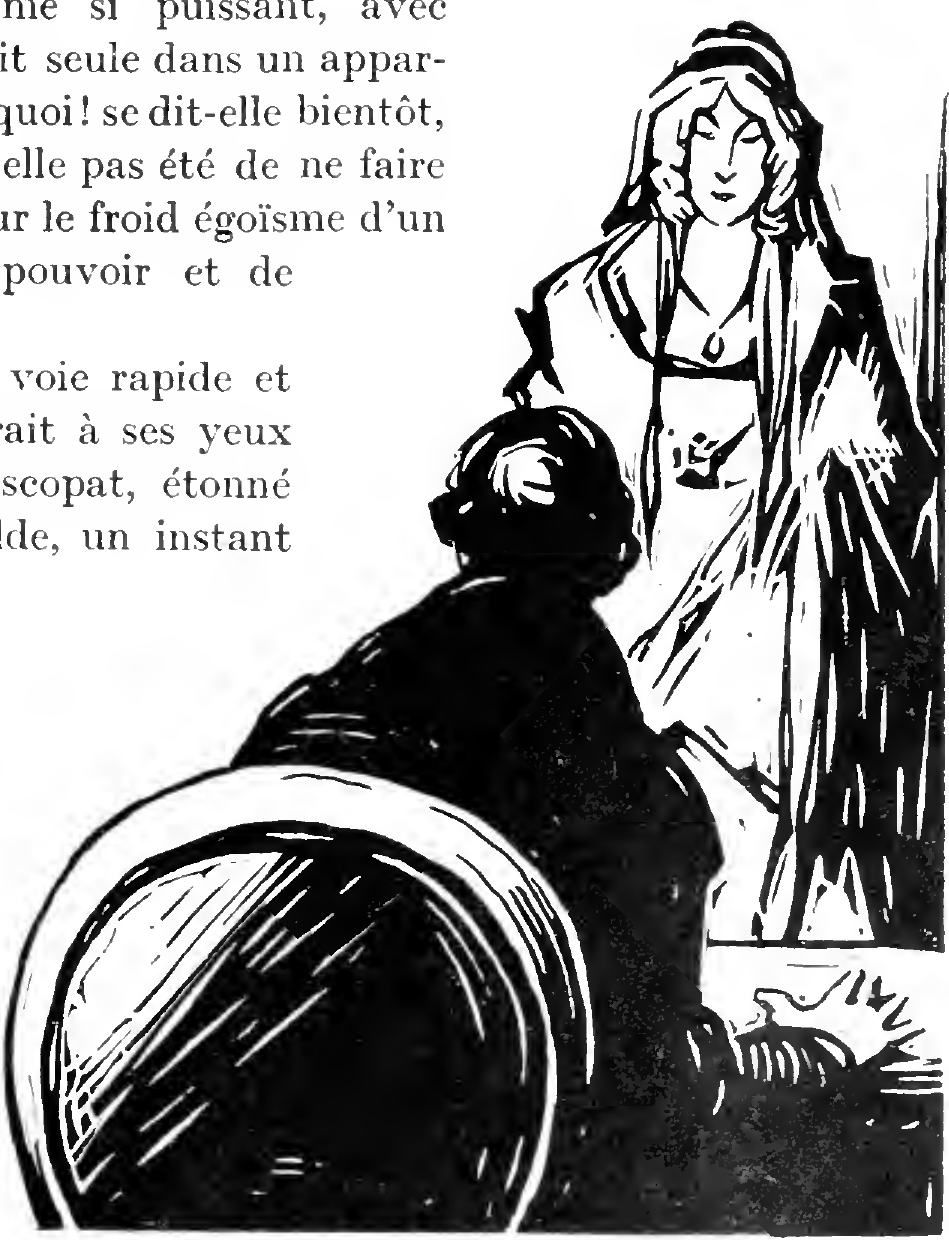
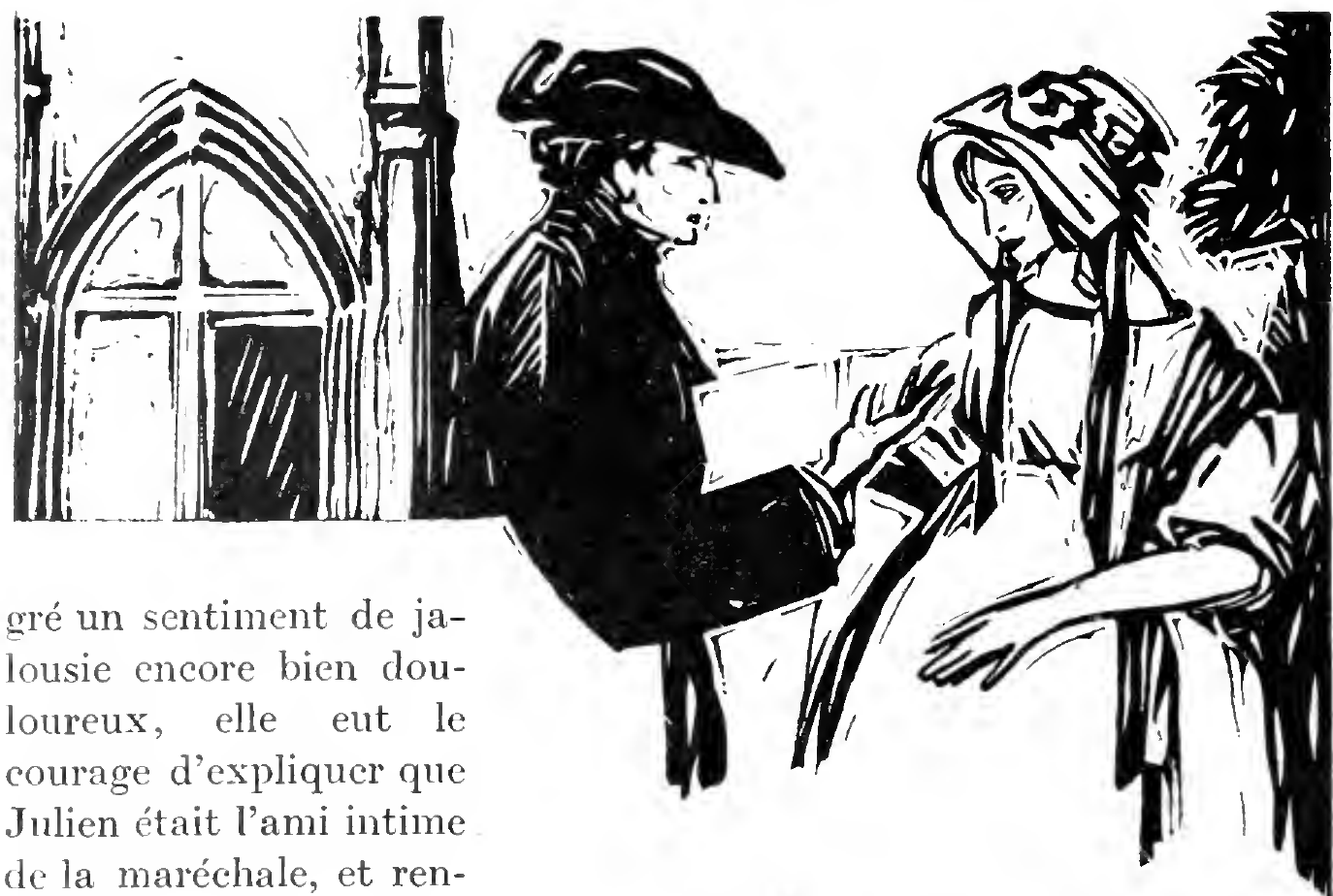
contrat almost every day at her house Monseigneur the Bishop of \\\*.
— If a list of thirty-six jurors were drawn by lot four or five times in succession from among the notable inhabitants of this department, said the grand vicar with the harsh look of ambition and stressing the words, I should consider myself very little uncertain if in each list I did not count eight or ten friends, and the most intelligent of the troop. Almost always I shall have the majority, more than enough to condemn, see, Mademoiselle, with what great ease I can have someone acquitted...
The abbé stopped short, as if astonished at the sound of his own words; he was confessing things that are never said to the profane.
But in turn he struck Mathilde with stupefaction when he told her that what astonished and interested Besançon society most in Julien's strange adventure was that he had once inspired a great passion in Madame de Rênal, and had long shared it. M. de Frilair easily noticed the extreme agitation produced by his account.
“I have my revenge!” he thought. “At last, here is a way to lead this little person who is so determined; I was trembling that I might not succeed. The distinguished air and the difficulty of managing her redoubled in his eyes the charm of the rare beauty that he saw almost suppliant before him.” He recovered all his composure and did not hesitate to turn the dagger in her heart.
“After all, I would not be surprised,” he said to her in a light tone, “if we were to learn that it was out of jealousy that M. Sorel fired two pistol shots at that woman once so beloved. She is far from lacking charms, and recently she was very often seeing a certain Abbé Marquinot, of Dijon, a kind of Jansenist without morals, as they all are.”
M. de Friair voluptuously and at leisure tortured the heart of this pretty girl, whose weak side he had discovered.
“Why,” he said, fixing ardent eyes on Mathilde, “would M. Sorel have chosen the church, if not because, precisely at that moment, his rival was celebrating mass there? Everyone grants infinitely much wit, and still more prudence, to the happy man whom you protect. What could be simpler than to hide in the gardens of M. de Rênal, which he knows so well? There, with the near certainty of being neither seen, nor caught, nor suspected, he could put to death the woman of whom he was jealous.”
This reasoning, so just in appearance, completed Mathilde’s loss of self-control. This haughty soul, but saturated with all that dry prudence which in high society is taken to paint the human heart faithfully, was not made to understand quickly the happiness of mocking all prudence, which can be so vivid for an ardent soul. In the upper classes of Parisian society, where Mathilde had lived, passion can only very rarely strip itself of prudence, and it is from the fifth floor that one throws oneself out the window.
Finally, the abbé de Frilair was sure of his empire. He gave Mathilde to understand (doubtless he was lying) that he could dispose at will of the public prosecutor, charged with supporting the accusation against Julien.
After fate had designated the thirty-six jurors of the session, he would make a direct and personal approach to at least thirty jurors.
If Mathilde had not seemed so pretty to M. de Frilair, he would not have spoken to her so clearly until the fifth or sixth interview.