About this book
Julien Sorel climbs from sawmill to salon, torn between the red of the army and the black of the church. Stendhal's 1830 novel, free to read online.
ENNUI
Non so più cosa son Cosa fucio. M'ozart. (Figaro.)
WITH the vivacity and the grace that were natural to her when she was far from the eyes of men, Madame de Rênal came out through the French window of the salon that opened onto the garden, when she perceived near the entrance door the figure of a young peasant almost still a child, extremely pale and who had just been crying. He was in a very white shirt, and had under his arm a very clean violet ratine jacket.
The complexion of this little peasant was so white, his eyes so gentle, that Madame de Rênal's somewhat romantic mind first had the idea that this might be a young girl in disguise, who had come to ask some favor of the mayor. She pitied this poor creature, stopped at the entrance door, and who evidently did not dare raise his hand to the bell. Madame de Rênal approached, distracted for a moment from the bitter sorrow that the arrival of the tutor gave her. Julien, turned toward the door, did not see her coming. He shuddered when a gentle voice said close to his ear:
"What do you want here, my child?"
Julien turned quickly, and, struck by Madame de Rênal's look so full of grace, he forgot part of his shyness. Soon, astonished by her beauty, he forgot everything, even what he had come to do. Madame de Rênal had repeated her question.
"I have come to be tutor, Madame," he said to her at last, quite ashamed of his tears, which he was wiping as best he could.
Madame de Rênal remained taken aback; they were very close to each other, looking at one another. Julien had never seen a being so well dressed and especially a woman with such a dazzling complexion, speaking to him in so gentle a manner. Madame de Rênal was looking at the large tears that had stopped on the cheeks, so pale at first and now so rosy, of this young peasant. Soon she began to laugh, with all the mad gaiety of a young girl; she was mocking herself and could not picture all her happiness. What, this was the tutor she had imagined as a dirty and badly dressed priest, who would come to scold and whip her children!
"What! Monsieur," she said to him at last, "you know Latin?"
This word "monsieur" astonished Julien so much that he reflected for a moment.
"Yes, Madame," he said timidly. — Madame de Rênal was so happy that she dared say to Julien:
"You will not scold these poor children too much?"
"I, scold them," said Julien, astonished, "and why?"
"Is it not so, Monsieur," she added after a little silence and in a voice whose emotion increased with every instant, "you will be good to them, you promise me?"
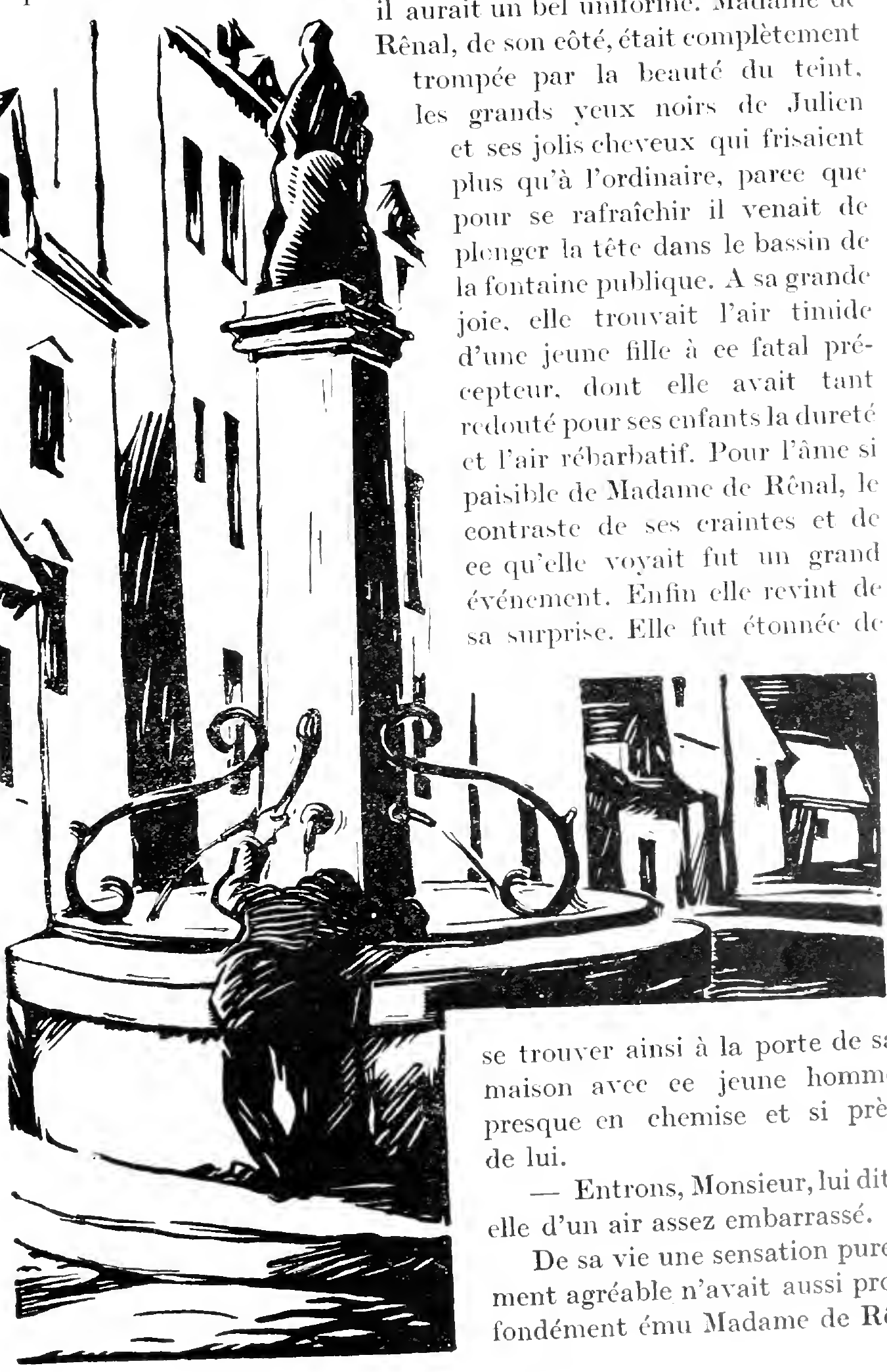
To hear himself called "monsieur" again, quite seriously, and by a lady so well dressed, was beyond all Julien's expectations: in all the castles in Spain of his youth, he had told himself that no lady of good breeding would deign to speak to him until he had a fine uniform. Madame de Rênal, for her part, was completely deceived by the beauty of his complexion, Julien's large black eyes and his pretty hair which curled more than usual, because to refresh himself he had just plunged his head into the basin of the public fountain. To her great joy, she found the timid air of a young girl in this fatal tutor, whose harshness and forbidding air she had so dreaded for her children. For Madame de Rênal's so peaceful soul, the contrast between her fears and what she saw was a great event. At last she recovered from her surprise. She was astonished at
... [sic]; never had so graceful an apparition followed more troubling fears. Thus these pretty children, so cared for by her, would not fall into the hands of a dirty and grumbling priest. Hardly had she entered under the vestibule when she turned back toward Julien, who was following her timidly. His astonished air, at the sight of so beautiful a house, was one more grace in Madame de Rênal's eyes. She could not believe her eyes; it seemed to her above all that the tutor ought to have a black coat.
"But is it true, Monsieur," she said to him, stopping again, and mortally fearing to be mistaken, so much did her belief make her happy, "you know Latin?" — These words wounded Julien's pride and dispelled the charm in which he had been living for a quarter of an hour.
"Yes, Madame," he said to her, trying to assume a cold air; "I know Latin as well as M. le curé, and even sometimes he has the kindness to say better than he."
Madame de Rênal thought Julien looked very wicked; he had stopped two paces from her. She came closer and said to him in a low voice:
"It is true, is it not, that in the first days you will not whip my children, even when they do not know their lessons?"
This tone, so gentle and almost pleading, from such a beautiful lady, suddenly made Julien forget what he owed to his reputation as a Latinist. Madame de Rênal's face was near his own; he smelled the scent of a woman's summer clothes, something so astonishing to a poor peasant. Julien blushed extremely, and said with a sigh and in a faltering voice:
"Fear nothing, Madame, I will obey you in everything."
It was only at this moment, when her anxiety about her children was entirely dispelled, that Madame de Rênal was struck by Julien's extreme beauty. The almost feminine form of his features and his air of embarrassment did not seem ridiculous to a woman who was herself extremely timid. The manly air commonly deemed necessary to a man's beauty would have frightened her.
"How old are you, Monsieur?" she said to Julien.
"Almost nineteen."
"My eldest son is eleven," resumed Madame de Rênal, quite reassured; "he will be almost a comrade for you, you will talk reason to him. Once his father wanted to beat him, the child was ill for a whole week, and yet it was a very little blow. — What a difference from me, thought Julien. Only yesterday, my father beat me. How happy these rich people are!"
:
Madame de Rênal was already grasping the slightest nuances of what was passing in the tutor's soul; she took this movement of sadness for timidity, and wished to encourage him.
"What is your name, Monsieur?" she said to him with an accent and a grace whose whole charm Julien felt without being able to account for it.
“My name is Julien Sorel, Madame; I tremble as I enter a strange house for the first time in my life; I need your protection and that you pardon me many things in the first days. I have never been to college. I was too poor; I have never spoken to any men other than my cousin the surgeon-major, a member of the Legion of Honor, and M. the curé Chélan. He will give you a good testimony of me. My brothers have always beaten me; do not believe them if they tell you ill of me; forgive my faults, Madame, I shall never have any bad intention.”
Julien was reassuring himself during this long speech; he was examining Madame de Rênal. Such is the effect of perfect grace, when it is natural to the character, and above all when the person whom it adorns does not think of feminine beauty, one would have sworn in that instant that she was but twenty years old. He had at once the bold idea of kissing her hand. Soon he was afraid of his idea; a moment afterward he said to himself: It would be cowardice in me not to carry out an action that may be useful to me, and diminish the contempt that this beautiful lady probably has for a poor workman barely torn from the saw. Perhaps Julien was a little encouraged by that word “pretty boy,” which for six months he had heard repeated on Sundays by some young girls. During these inner debates, Madame de Rênal addressed two or three words of instruction to him on the way to begin with the children. The violence Julien was doing himself made him again very pale; he said, with a constrained air:
“Never, Madame, will I beat your children; I swear it before God.” And saying these words, he dared to take Madame de Rênal’s hand and carry it to his lips. She was astonished at this gesture, and on reflection, shocked. As it was very hot, her
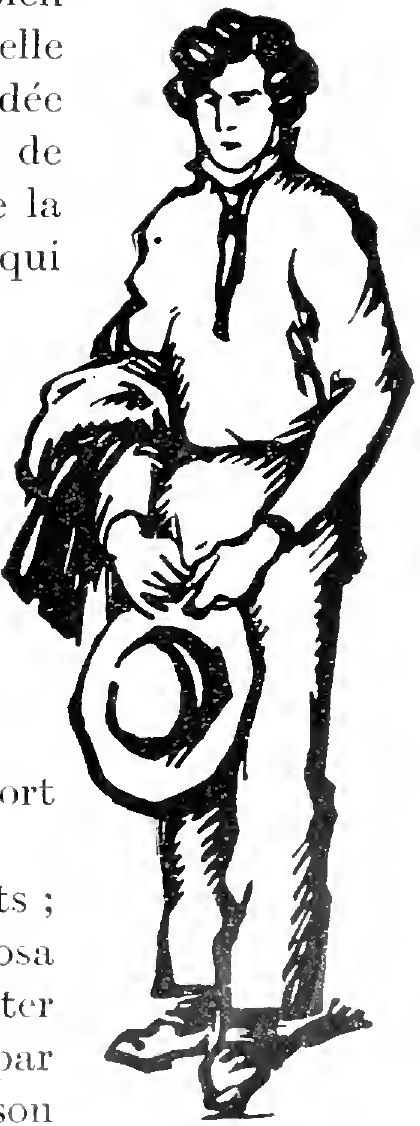
arm was quite bare under her shawl, and Julien’s movement, in carrying the hand to his lips, had entirely uncovered it. After a few moments, she scolded herself; it seemed to her that she had not been indignantly surprised quickly enough.
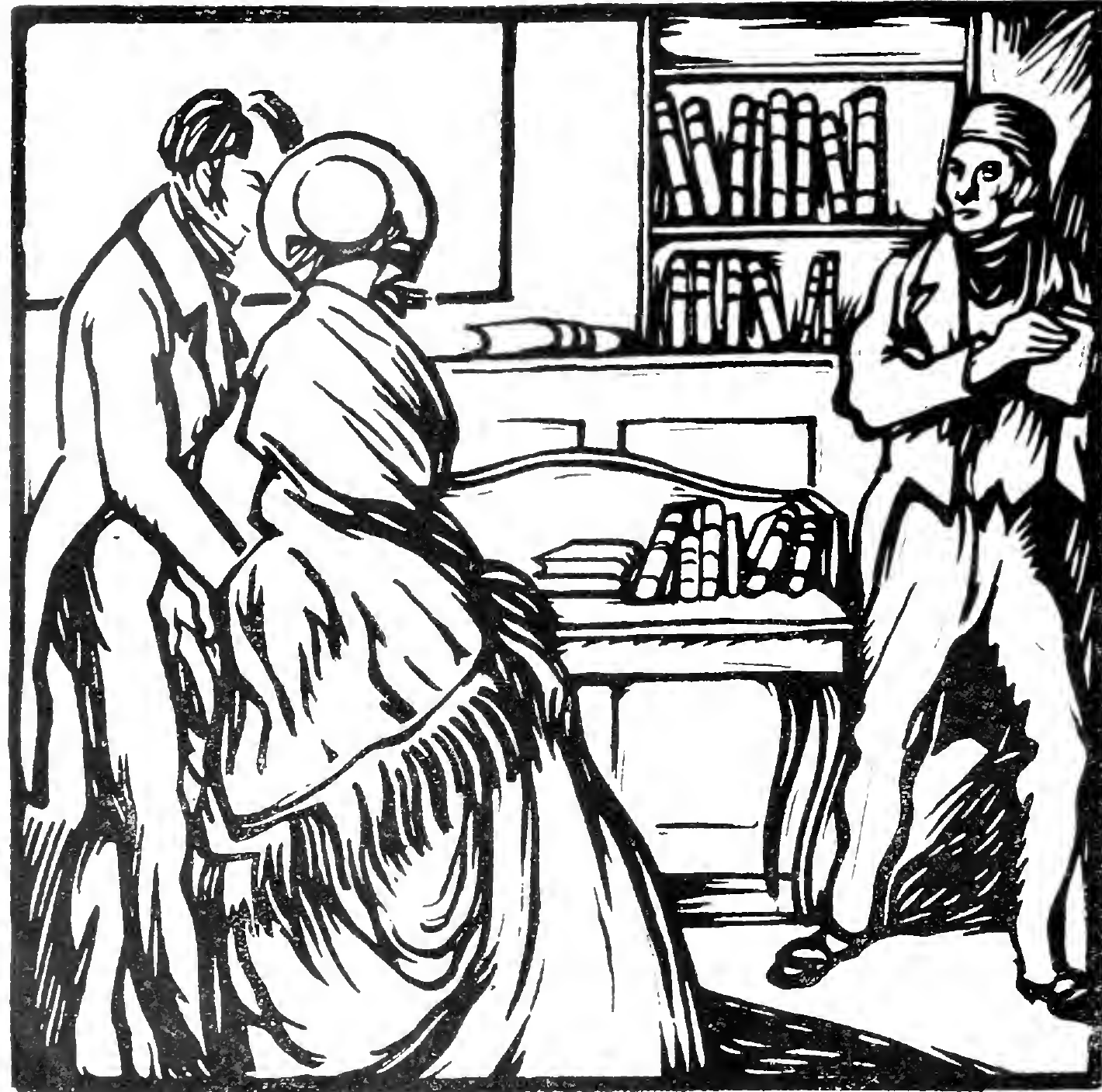
M. de Rênal, who had heard voices, came out of his study; with the same majestic and paternal air that he assumed when he performed marriages at the town hall, he said to Julien:
“It is essential that I speak with you before the children see you.”
He had Julien enter a room and held back his wife, who wanted to leave them alone. The door closed, M. de Rênal sat down with gravity.
“M. the curé has told me that you were a good subject; everyone here will treat you with honor, and if I am pleased, I will help to establish you a little position later on. I want you to see no more parents or friends; their tone cannot suit my children. Here are thirty-six francs for the first month; but I require your word not to give a sou of this money to your father.”
M. de Rênal was piqued against the old man, who, in this affair, had been shrewder than he.
“Now, Monsieur—for according to my orders everyone here will call you Monsieur, and you will feel the advantage of entering a house of people of good breeding; now, Monsieur, it is not proper that the children see you in a jacket. Have the servants seen him?” said M. de Rênal to his wife.
“No, my friend,” she replied with a profoundly pensive air.
“So much the better. Put this on,” he said to the young man, who was surprised, giving him a frock coat of his own. “Let us go now to M. Durand, the cloth merchant.”
More than an hour later, when M. de Rênal returned with the new tutor all dressed in black, he found his wife seated in the same place. She felt reassured by Julien’s presence; in examining him she forgot to be afraid of him. Julien was not thinking of her; despite all his distrust of fate and of men, his soul in that moment was only that of a child; it seemed to him that he had lived for years since the instant when, three hours earlier, he had been trembling in the church. He noticed Madame de Rênal’s icy air; he understood that she was angry that he had dared to kiss her hand. But the feeling of pride that the
The hour that Julien spent in his room seemed an instant to Madame de Rênal. The children, to whom had been announced the new
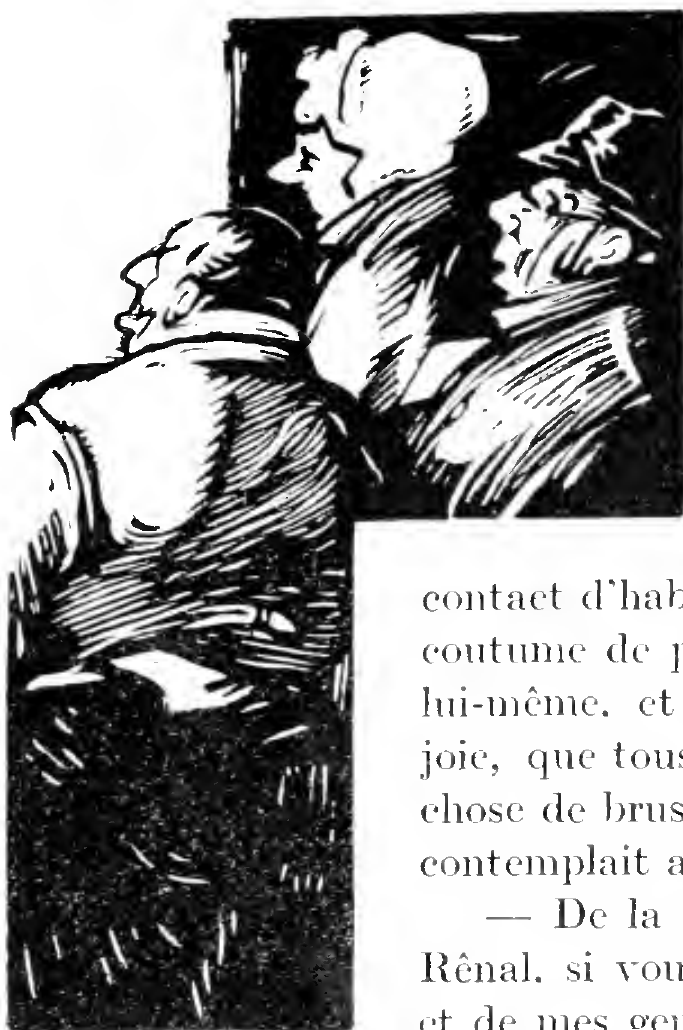
tutor, overwhelmed their mother with questions. Finally Julien appeared. He was another man. It would have been ill spoken to say that he was grave; he was gravity incarnate. He was presented to the children, and spoke to them in an air that astonished M. de Rênal himself.
“I am here, gentlemen,” he said to them at the end of his allocution, “to teach you Latin. You know what it is to recite a lesson. Here is the Holy Bible,” he said, showing them a small in-32 volume, bound in black. “It is particularly the history of Our Lord Jesus Christ, it is the part called the New Testament. I will often have you recite lessons; have me recite mine. Adolphe, the eldest of the children, had taken the book. “Open it at random,” continued Julien, “and tell me the first word of a paragraph. I will recite the sacred book by heart, the rule of our conduct for all of us, until you stop me.”
Adolphe opened the book, read a word, and Julien recited the whole page with the same ease as if he had been speaking French. M. de Rênal looked at his wife with a triumphant air. The children, seeing their parents’ astonishment, opened their eyes wide. A servant came to the drawing-room door. Julien continued speaking Latin. The servant first stood motionless and then disappeared. Soon Madame’s chambermaid and the cook arrived near the door; by then Adolphe had already opened the book in eight places, and Julien was still reciting with the same ease.
“Ah! my God! the pretty little priest,” said the cook aloud, a good girl, very devout.
M. de Rênal’s self-esteem was uneasy; far from thinking of examining the tutor, he was wholly occupied in searching his memory for a few Latin words; finally, he managed to say a line of Horace. Julien knew no Latin but his Bible. He replied, frowning: “The holy ministry to which I destine myself has forbidden me to read so profane a poet.”
M. de Rênal quoted a rather large number of supposed lines of Horace. He explained to his children what Horace was; but the children, struck with admiration, scarcely paid attention to what he was saying. They were looking at Julien.
The servants were still at the door, so Julien felt he ought to prolong the test: "It is necessary," he said to the youngest of the children, "that M. Stanislas-Xavier also indicate to me a passage from the holy book."
Little Stanislas, very proud, read as best he could the first word of a paragraph, and Julien recited the whole page. So that nothing might be lacking in M. de Rênal's triumph, while Julien was reciting, in came M. Valenod, the possessor of fine Norman horses, and M. Charcot de Maugiron, sub-prefect of the arrondissement. This scene earned Julien the title of Monsieur; the servants themselves did not dare refuse it to him.
In the evening, all Verrières flocked to M. de Rênal's to see the marvel. Julien replied to everyone with a somber air that kept them at a distance. His glory spread so rapidly through the town that a few days later M. de Rênal, fearing lest someone take him away, proposed that he sign a two-year engagement.
"No, Monsieur," Julien answered coldly, "if you wished to dismiss me I should be obliged to leave. An engagement that binds me without obliging you to anything is not equal; I refuse it."
Julien knew so well how to go about it that, less than a month after his arrival in the house, M. de Rênal himself respected him. The curé being at odds with MM. de Rênal and Valenod, no one could betray Julien's former passion for Napoleon; he spoke of it only with horror.