About this book
Julien Sorel climbs from sawmill to salon, torn between the red of the army and the black of the church. Stendhal's 1830 novel, free to read online.
THE WORLD, OR WHAT THE RICH MAN LACKS
I am alone on the earth, no one deigns to think of me. All those I see making their fortune have an effrontery and a hardness of heart that I do not feel in myself. They hate me because of my easy beauty. Ah! soon I shall die, either of hunger or of the misfortune of seeing men so hard.
Young.
He hastened to brush his coat and go down; he was late. A junior master scolded him severely; instead of trying to justify himself, Julien crossed his arms on his breast:
"Peccavi, pater optime (I have sinned, I confess my fault, O my father)," he said with a contrite air.
This beginning was a great success. The adroit people among the seminarians saw that they had to do with a man who was not at the elements of the trade. The hour of recreation arrived. Julien found himself the object of general curiosity. But in him they found only reserve and silence. Following the maxims he had made for himself, he regarded his three hundred and twenty-one comrades as enemies; the most dangerous of all in his eyes was the Abbé Pirard.
A few days later, Julien had to choose a confessor; a list was presented to him.
"Eh! good God! who do they take me for?" he said to himself; "do they think I do not understand what speaking means?" And he chose the Abbé Pirard.
Without his suspecting it, this step was decisive. A very young little seminarian, a native of Verrières, who, from the first day, had declared himself his friend, informed him that if he had chosen M. Castanède, the sub-director of the seminary, he would perhaps have acted with more prudence.
"The Abbé Castanède is the enemy of M. Pirard, who is suspected of Jansenism," added the young seminarian, bending toward his ear.
All the first steps of our hero, who believed himself so prudent, were, like the choice of a confessor, acts of thoughtlessness. Led astray by all the presumption of a man of imagination, he took his intentions for facts, and believed himself a consummate hypocrite. His folly went so far as to reproach himself for his successes in this art of weakness.
"Alas! it is my only weapon!" he said to himself. "In another age, it is by speaking actions in the face of the enemy that I should have earned my bread."
Julien, satisfied with his conduct, looked about him; he found everywhere the appearance of the purest virtue.
Eight or ten seminarians lived in odor of sanctity, and had visions like Saint Teresa and Saint Francis, when he received the stigmata on Mount Vernia, in the Apennines. But it was a great secret; their friends concealed it. These poor young people of vision were almost always in the infirmary. A hundred others united a robust faith with an indefatigable application. They worked to the point of making themselves ill, but without learning much. Two or three distinguished themselves by real talent, and, among others, one named Chazel; but Julien felt an aversion for them, and they for him.
The rest of the three hundred and twenty-one seminarians consisted only of coarse beings who were not quite sure of understanding the Latin words they repeated all day long. Almost all were sons of peasants, and they preferred to earn their bread by reciting a few Latin words rather than by hoeing the earth. It was from this observation that, from the first days, Julien promised himself prompt successes. "In every service, intelligent people are needed, for after all there is work to be done," he said to himself. "Under Napoleon, I should have been a sergeant; among these future curés, I shall be a grand vicar."
"All these poor devils," he added, "day laborers from childhood, have lived, until their arrival here, on curdled milk and black bread. In their cottages they ate meat only five or six times a year. Like the Roman soldiers who found war a time of rest, these coarse peasants are enchanted with the delights of the seminary."
Julien never read in their dull eye anything but physical need satisfied after dinner, and physical pleasure awaited before the meal. Such were the people among whom he had to distinguish himself; but what Julien did not know, what they took care not to tell him, is that to be first in the different courses of dogma, of ecclesiastical history, etc., etc., which are followed at the seminary, was in their eyes only a splendid sin. Since Voltaire, since the government of the two Chambers, which is at bottom only mistrust and personal examination, and gives to the mind of peoples this bad habit of mistrusting, the Church of France seems to have understood that books are its true enemies. It is submission of heart that is everything in its eyes. To succeed in studies, even sacred ones, is suspect to it, and rightly. Who will prevent the superior man from passing over to the other side like Sieyès or Grégoire? The trembling Church clings to the pope as to its only chance of salvation. The pope alone can attempt to paralyze personal examination, and, by the pious pomp of the ceremonies of his court, make an impression on the bored and sick minds of the people of the world.
:
:
:
:
:
::
Julien, half penetrating these various truths, which nevertheless all the words spoken in a seminary tend to contradict, fell into a profound melancholy. He worked a great deal, and rapidly succeeded in learning things very useful to a priest, very false in his eyes, and in which he took no interest. He believed he had nothing else to do.
"Am I then forgotten by all the earth?" he thought. He did not know that M. Pirard had received and thrown into the fire some letters stamped at Dijon, and in which, despite the forms of the most suitable style, the most vivid passion broke through. Great remorse seemed to combat this love. "So much the better," thought the Abbé Pirard, "this young man has at least not loved an impious woman."
One day, the Abbé Pirard opened a letter that seemed half effaced by tears; it was an eternal farewell. Finally, they said to Julien, Heaven has granted me the grace to hate, not the author of my fault, he will always be what I shall hold dearest in the world, but my fault in itself. The sacrifice is made, my friend. It is not without tears, as you see. The salvation of the beings to whom I owe myself, and whom you have loved so much, prevails. A just but terrible God will no longer be able to avenge Himself on them for the crimes of their mother. Adieu, Julien, be just toward men.
This end of the letter was almost absolutely illegible. An address was given at Dijon, and yet they hoped that Julien would never reply, or that at least he would use words that a woman returned to virtue could hear without blushing.
Julien's melancholy, aided by the mediocre food that the contractor of dinners at 83 centimes provided to the seminary, was beginning to affect his health, when one morning Fouqué appeared suddenly in his room.
"At last I have been able to enter. I have come five times to Besançon, without reproach, to see you. Always a wooden face. I posted someone at the door of the seminary; why the devil do you never go out?"
"It is a trial I have imposed on myself."
"I find you much changed. At last I see you again. Two fine five-franc crowns have just taught me that I was only a fool not to have offered them on the first trip."
The conversation was endless between the two friends. Julien changed color when Fouqué said to him:
"By the way, do you know? the mother of your pupils has fallen into the highest devotion."
And he spoke with that free and easy air which makes so singular an impression on a passionate soul whose dearest interests one overturns without suspecting it.
"Yes, my friend, into the most exalted devotion. They say she makes pilgrimages. But, to the eternal shame of the Abbé Maslon, who spied so long on that poor M. Chélan, Madame de Rênal would have nothing to do with him. She goes to confess at Dijon or at Besançon."
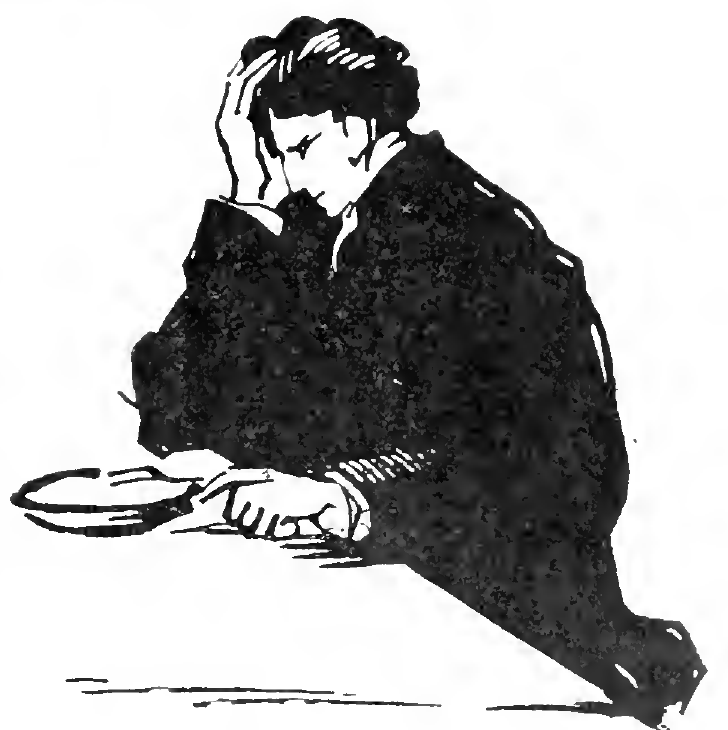
"She comes to Besançon!" said Julien, his brow covered with redness.
"Quite often," Fouqué replied with a questioning air.
"Do you have any Constitutionnels on you?"
"What are you saying?" Fouqué retorted.
"I'm asking if you have any Constitutionnels?" Julien went on in the calmest tone of voice. "They sell for thirty sous a copy here."
"What! Even in the seminary, liberals!" Fouqué exclaimed. "Poor France!" he added, assuming the hypocritical voice and gentle tone of the abbé Maslon.
This visit would have made a profound impression on our hero, had not, the very next day, a word addressed to him by that little seminarian from Verrières who had seemed to him such a child, led him to make an important discovery. Since he had been at the seminary, Julien's conduct had been nothing but a series of false steps. He mocked himself bitterly.
In truth, the important actions of his life were skillfully conducted; but he did not attend to details, and the cunning ones at the seminary looked only at details. Thus he already passed among his comrades for a strong mind. He had been betrayed by a host of small actions.
In their eyes, he was convicted of that enormous vice: he thought, he judged for himself, instead of blindly following authority and example. The abbé Pirard had been of no help to him; he had not addressed a single word to him outside the tribunal of penance, where moreover he listened more than he spoke. It would have been quite otherwise had he chosen the abbé Castanède.
From the moment Julien perceived his folly, he was no longer bored. He wanted to know the full extent of the evil, and to that end he emerged somewhat from the haughty and obstinate silence with which he repelled his comrades. It was then that they took their revenge on him. His advances were met with a contempt that went as far as derision. He recognized that, since his entry into the seminary, there had not been a single hour, especially during recreation, that had not carried consequences for or against him, that had not increased the number of his enemies, or won him the goodwill of some seminarian sincerely virtuous or a little less coarse than the others. The harm to be repaired was immense, the task very difficult. From then on Julien's attention was constantly on its guard; the task was to sketch out an entirely new character.
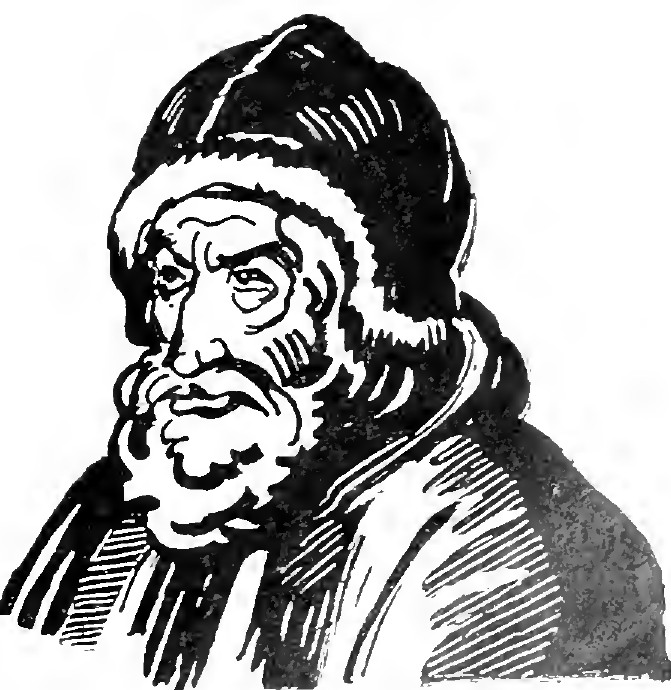
His eye movements, for instance, caused him a great deal of trouble. It is not without reason that in those places people keep their eyes lowered. What presumption I had at Verrières, Julien said to himself; I believed I was living; I was only preparing myself for life, and here I am at last in the world, such as I shall find it until the end of my role, surrounded by real enemies. What an immense difficulty, he added, is this hypocrisy of every minute; it is enough to make the labors of Hercules turn pale. The Hercules of modern times is Sixtus Quintus deceiving for fifteen years running, by his modesty, forty cardinals who had seen him lively and haughty throughout his youth.
So learning is nothing here! he said to himself with vexation; progress in dogma, in sacred history, etc., counts only in appearance. Everything that is said on this subject is designed to make fools like me fall into the trap. Alas! my only merit consisted in my rapid progress, in my way of grasping these absurdities. At bottom, would they estimate them at their true value? Do they judge them as I do? And I had the folly to be proud of it! These first places that I always obtain have served only to give me bitter enemies. Chazel, who has more learning than I, always throws some blunder into his compositions which relegates him to the fiftieth place; if he obtains the first, it is by distraction. Ah! how useful a word, a single word from M. Pirard would have been to me!
From the moment Julien was undeceived, the long exercises of ascetic piety, such as the rosary five times a week, the hymns to the Sacred Heart, etc., etc., which had seemed to him so mortally tedious, became his most interesting moments of action. Reflecting severely upon himself, and seeking above all not to exaggerate his means, Julien did not aspire at the outset, like the seminarians who served as models for the others, to perform at every moment significant actions, that is to say, actions proving a kind of Christian perfection. At the seminary there is a way of eating a soft-boiled egg which proclaims the progress made in the devout life.
The reader, who is perhaps smiling, would he deign to remember all the mistakes that the abbé Delille made, while eating an egg, when invited to lunch at the house of a great lady of the court of Louis XVI?
Julien sought first to arrive at the non culpa: this is the state of the young seminarian whose gait, whose way of moving his arms, his eyes, etc., indicate in truth nothing worldly, but do not yet show the abbé absorbed by the idea of the other life and the pure nothingness of this one.
Constantly Julien found written in charcoal on the walls of the corridors phrases such as these: What are sixty years of trials, weighed against an eternity of delights or an eternity of boiling oil in hell! He no longer despised them; he understood that he must have them constantly before his eyes. What shall I do all my life? he said to himself; I shall sell to the faithful a place in heaven. How will that place be made visible to them? by the difference between my exterior and that of a layman.
After several months of application at every instant, Julien still had the appearance of thinking. His way of moving his eyes and carrying his mouth did not announce the implicit faith ready to believe everything and to maintain everything, even by martyrdom. It was with anger that Julien saw himself outdone in this genre by the most coarse peasants. There were good reasons why they did not have the appearance of thinkers.
What trouble did he not take to arrive at that physiognomy of fervent and blind faith, ready to believe everything and to suffer everything, which is found so frequently in the convents of Italy, and of which, for us laymen, Guercino has left such perfect models in his church paintings (1).
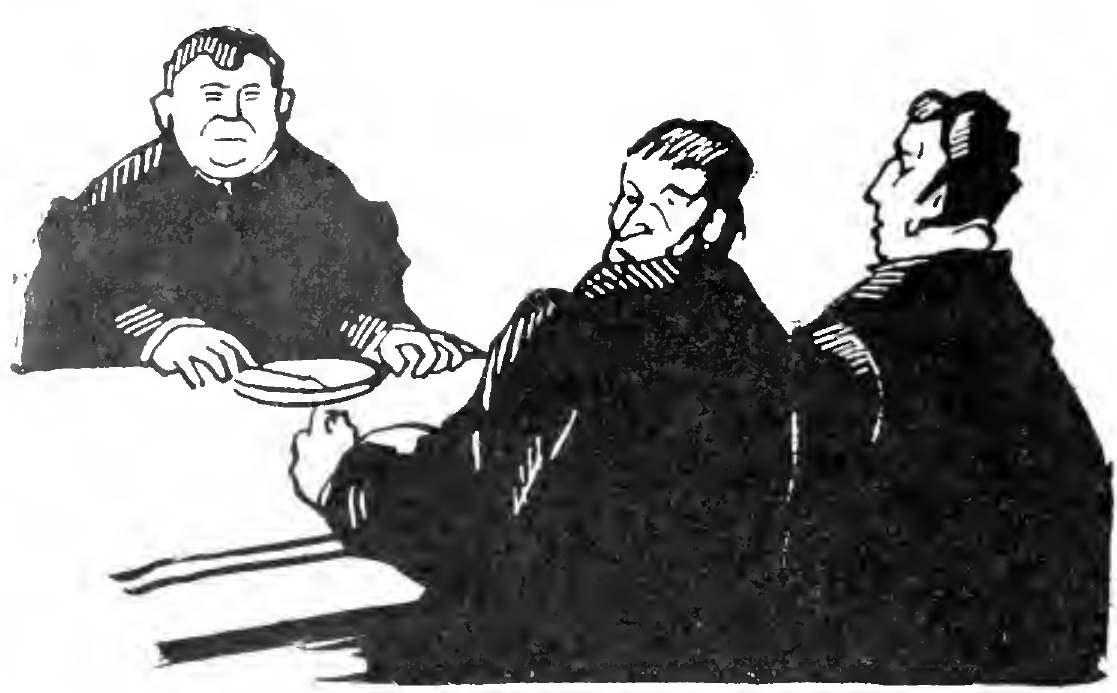
On great feast days, the seminarians were given sausages with sauerkraut. Julien's neighbors at table observed that he was insensible to this happiness; this was one of his first crimes. His comrades saw in it an odious trait of the most stupid hypocrisy; nothing made him more enemies. See this bourgeois, see this disdainful one, they said, who pretends to despise the best fare, sausages with sauerkraut! fie, the wretch! the proud one! the damned one!
Alas! the ignorance of these young peasants, my comrades, is for them an immense advantage, cried Julien in his moments of discouragement. On their arrival at the seminary, the professor has no need to deliver them from that frightful number of worldly ideas which I bring there, and which they read on my face, whatever I do.
Julien studied, with an attention bordering on envy, the coarsest of the little peasants who arrived at the seminary. At the moment when they were stripped of their ratteen jacket to make them put on the black robe, their education was limited to an immense and boundless respect for dry and liquid money, as they say in Franche-Comté.
It is the sacramental and heroic manner of expressing the sublime idea of ready cash.
Happiness, for these seminarians, as for the heroes of Voltaire's novels, consists above all in dining well. Julien discovered in almost all of them an innate respect for the man who wears a coat of fine cloth. This sentiment appreciates distributive justice, such as our tribunals give it to us, at its value and even below its value. What can one gain, they often repeated among themselves, by pleading against a big man?
It is the word of the valleys of the Jura, to express a rich man. Let one judge of their respect for the richest being of all: the government!
Not to smile with respect at the mere name of M. the prefect passes, in the eyes of the peasants of Franche-Comté, for imprudence; now, imprudence in the poor is promptly punished by lack of bread.
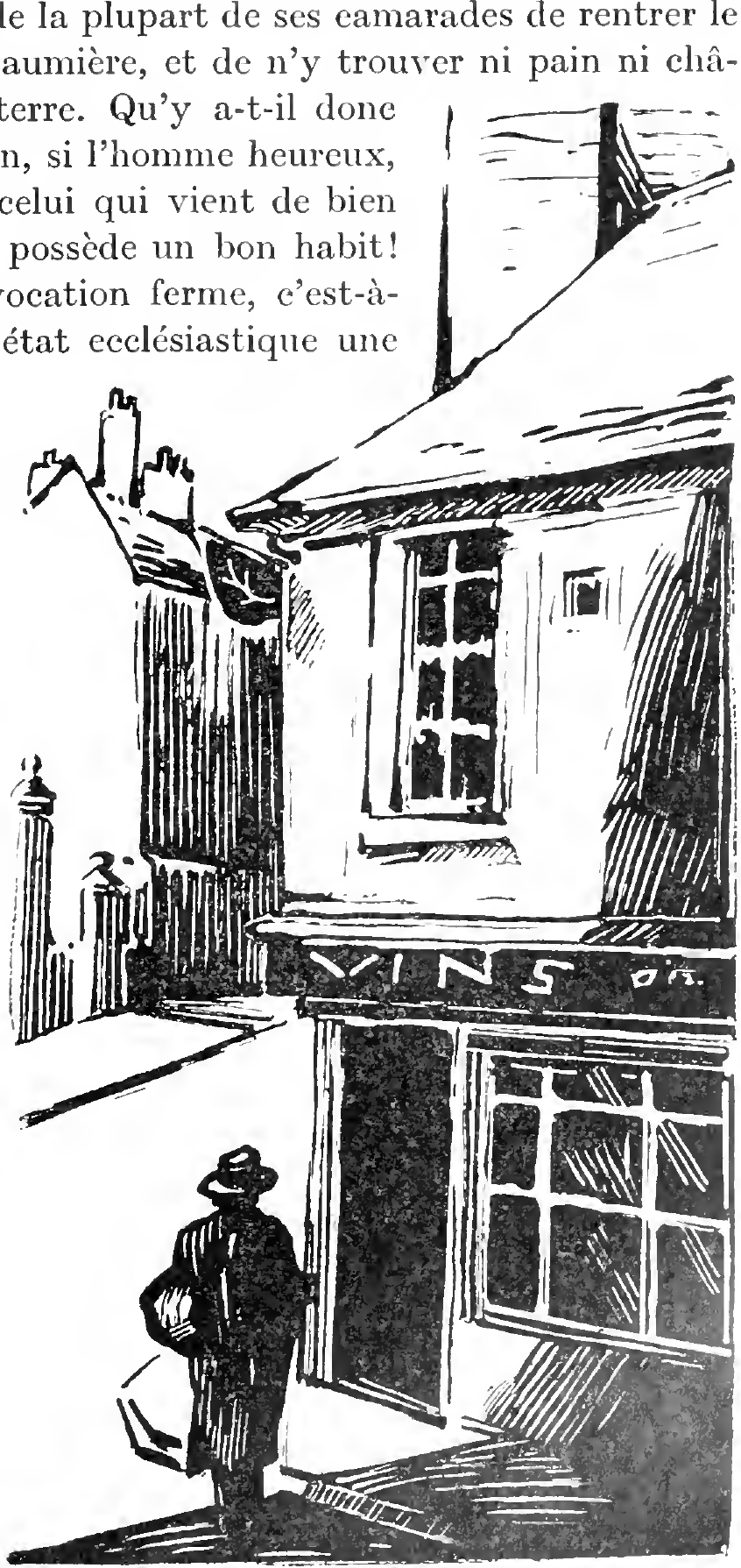
After having been as if suffocated in the early days by the feeling of contempt, Julien ended by experiencing pity: it had often happened to the fathers of most of his comrades to return in the evening in winter to their cottage, and to find there neither bread nor chestnuts nor potatoes. What is there astonishing, then, Julien said to himself, if the happy man, in their eyes, is first of all the one who has just dined well, and then the one who possesses a good coat! My comrades have a firm vocation, that is to say, they see in the ecclesiastical state a long continuation of this happiness: dining well and having a warm coat in winter.
It happened to Julien to hear a young seminarian, gifted with imagination, say to his companion:
— Why should I not become pope like Sixtus Quintus, who kept swine?
— One makes a pope only of Italians, replied the friend; but for sure they will draw lots among us for places of vicars-general, canons, and perhaps bishops. M. P..., bishop of Châlons, is the son of a cooper: that is my father's trade.
One day, in the middle of a lesson on dogma, the abbé Girard had Julien called.
The poor man was delighted to escape from the physical and moral atmosphere in which he was plunged.
Julien found at M. the director's the welcome that had so frightened him on the day of his entry into the seminary.
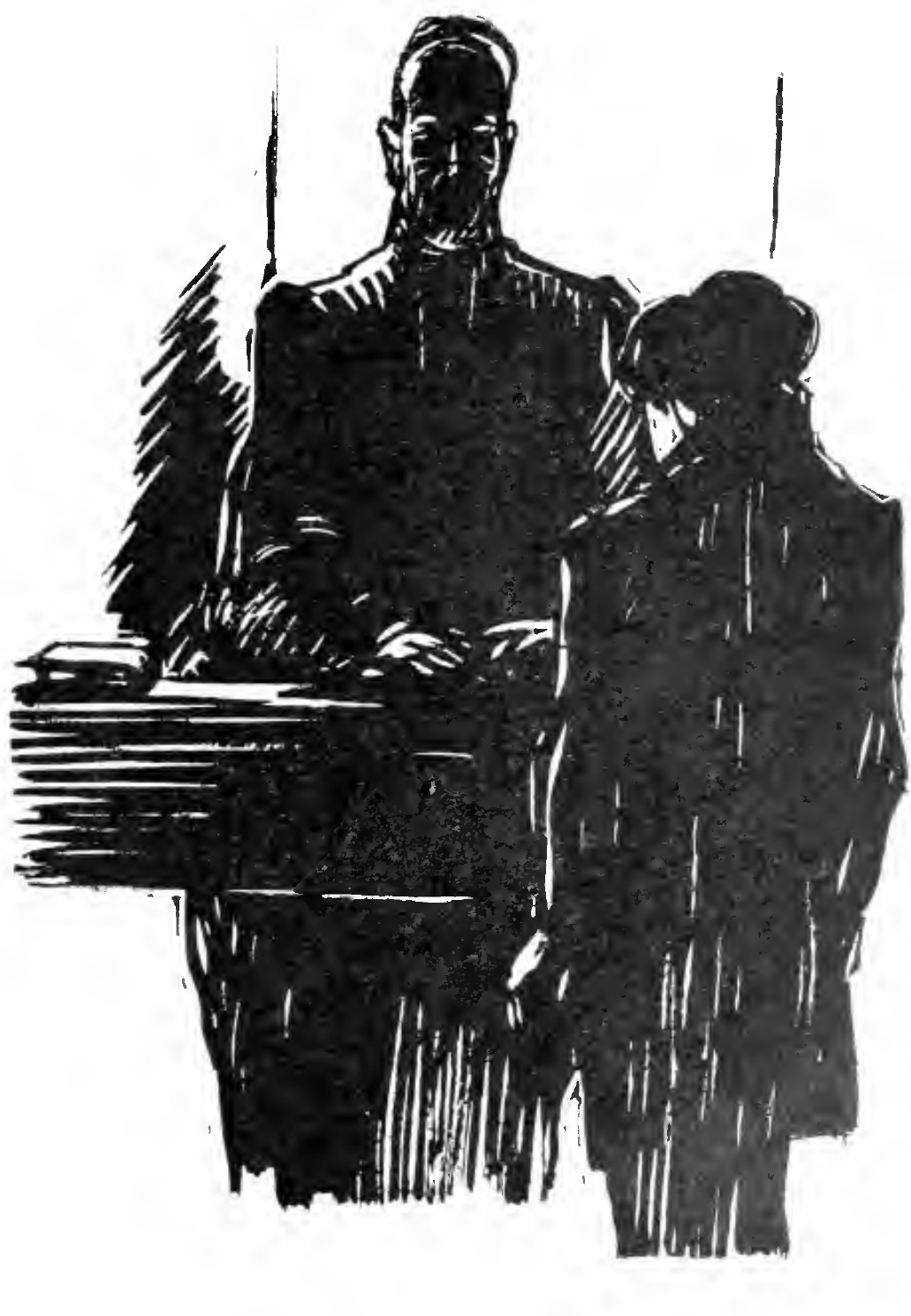
— Explain to me what is written on this playing card, he said to him, looking at him in a way to make him sink into the earth.
Julien read:
"Amanda Binet, at the café de la Girafe, before eight o'clock. Say that one is from Genlis, and the cousin of my mother."
Julien saw the immensity of the danger; the police of the abbé Castanède had stolen this address from him.
“The day I entered here,” he replied, looking at Abbé Pirard’s forehead, for he could not endure his terrible eye, “I was trembling. M. Chélan had told me that it was a place full of tale-bearing and malice of every kind; spying and denunciation among comrades are encouraged there. Heaven wills it so, to show life as it is to young priests, and to inspire in them disgust for the world and its pomps.”
“And it is to me that you make fine phrases!” said Abbé Pirard furiously. “You little rascal!”
“At Verrières,” Julien went on coldly, “my brothers used to beat me when they had reason to be jealous of me . . .”
“To the point! To the point!” cried M. Pirard, almost beside himself.
Without being in the least intimidated, Julien resumed his narration. “The day I arrived at Besançon, about noon, I was hungry, and I went into a café. My heart was filled with repugnance for so profane a place; but I thought that my lunch would cost me less there than at the inn. A lady, who appeared to be the mistress of the shop, took pity on my novice air. ‘Besançon is full of bad characters,’ she said to me. ‘I fear for you, Monsieur. If some misfortune happens to you, have recourse to me, send to my house before eight o’clock. If the porters at the seminary refuse to deliver your message, say that you are my cousin, and a native of Genlis . . .”
“All this chatter will be verified,” cried Abbé Pirard, who, unable to stay in one place, was pronouncing his words as he strode about the room. “Let us go to his cell!”
The abbé followed Julien and locked him in. The latter at once began to search his trunk, at the bottom of which the fatal card was carefully hidden. Nothing was missing from the trunk, but several things had been disturbed; nevertheless, the key never left him. What good fortune, Julien said to himself, that during the time of my blindness I never accepted the permission to go out, which M. Castanède so often offered me with a kindness that I now understand. Perhaps I should have had the weakness to change my clothes and go to see the beautiful Amanda; I should have been lost. When they had despaired of making use of the information in that way, so as not to lose it, they made it into a denunciation.
Two hours later, the director sent for him.
“You did not lie,” he told him, with a less severe look; “but to keep such an address is an imprudence whose gravity you cannot conceive. Unhappy child! in ten years, perhaps, it will bring you harm.”
.