About this book
Julien Sorel climbs from sawmill to salon, torn between the red of the army and the black of the church. Stendhal's 1830 novel, free to read online.
TO FRIGHTEN HER
So this is the fine miracle of your civilization! You have made love an ordinary affair.
BARNAVE.
JULIEN ran to Madame de La Mole's box. His eyes first met Mathilde's tear-filled eyes; she was weeping without the least restraint; there were only subordinate persons there, the friend who had lent the box and men of her acquaintance. Mathilde placed her hand on Julien's; she had as it were forgotten all fear of her mother. Almost stifled by her tears, she said to him only this single word: guarantees!
At least, let me not speak to her, Julien was saying to himself, deeply moved himself, and hiding his eyes as best he could with his hand, on the pretext of the chandelier dazzling the third tier of boxes. If I speak, she can no longer doubt the excess of my emotion, the sound of my voice will betray me, everything may still be lost.
His struggles were far more painful than in the morning; his soul had had time to be stirred. He feared to see Mathilde take offense from vanity. Drunk with love and voluptuousness, he forced himself not to speak.
This is, in my opinion, one of the finest traits of his character; a being capable of such an effort over himself can go far, si fata sinant.
Mademoiselle de La Mole insisted on taking Julien back to the hôtel. Fortunately it was raining heavily. But the Marquise made him sit facing her, spoke to him constantly, and prevented him from being able to say a single word to her daughter. One would have thought the Marquise was tending to Julien's happiness; no longer fearing to lose everything through the excess of his emotion, he abandoned himself to it madly.
Dare I say that on returning to his room, Julien threw himself on his knees and covered with kisses the love letters given by Prince Korasoff.
O great man! what do I not owe you? he cried in his madness.
Little by little some composure returned to him. He compared himself to a general who has just won a great battle. The advantage is certain, immense, he said to himself; but what will happen tomorrow? a single instant can lose everything.
He opened with a passionate movement the Memoirs dictated at Saint Helena by Napoleon, and for two long hours forced himself to read them; his eyes alone were reading, no matter, he forced himself to it. During this singular reading, his head and his heart, raised to the level of all that is greatest, were working without his knowledge. This heart is very different from Madame de Rénal's, he said to himself, but he went no further.
TO FRIGHTEN HER, he suddenly cried, flinging the book far from him. The enemy will obey me only insofar as I frighten him, then he will not dare to despise me.
He was declaiming in his little room, drunk with joy. In truth, this happiness was more of pride than of love.
To frighten her! he repeated proudly, and he was right to be proud. Even in her happiest moments, Madame de Rénal always doubted that my love equaled hers. Here, it is a demon that I am subjugating, therefore I must subjugate.
He well knew that the next day, from eight o'clock in the morning, Mathilde would be in the library; he appeared there only at nine, burning with love, but his head dominated his heart. Perhaps not a single minute passed without his repeating to himself: Keep her always occupied with this great doubt: Does he love me? Her brilliant position, the flatteries of all who speak to her incline her a little too much to reassure herself.
He found her pale, calm, seated on the divan, but apparently incapable of making a single movement. She held out her hand to him:
"Friend, I have offended you, it is true; can you be angry with me?..."
Julien was not expecting so simple a tone. He was on the point of betraying himself.
"You want guarantees, my friend," she added after a silence which she had hoped to see broken; "it is just. Carry me off, let us leave for London... I shall be lost forever, dishonored..." She had the courage to withdraw her hand from Julien's to cover her eyes with it. All the feelings of restraint and feminine virtue had returned to that soul... "Well then! dishonor me," she said at last with a sigh; "it is a guarantee."
"Yesterday, I was happy, because I had the courage to be severe with myself," thought Julien. After a little moment of silence, he had enough command over his heart to say in an icy tone:
"Once on the road to London, once dishonored, to use your expressions, who will answer to me that you will love me?
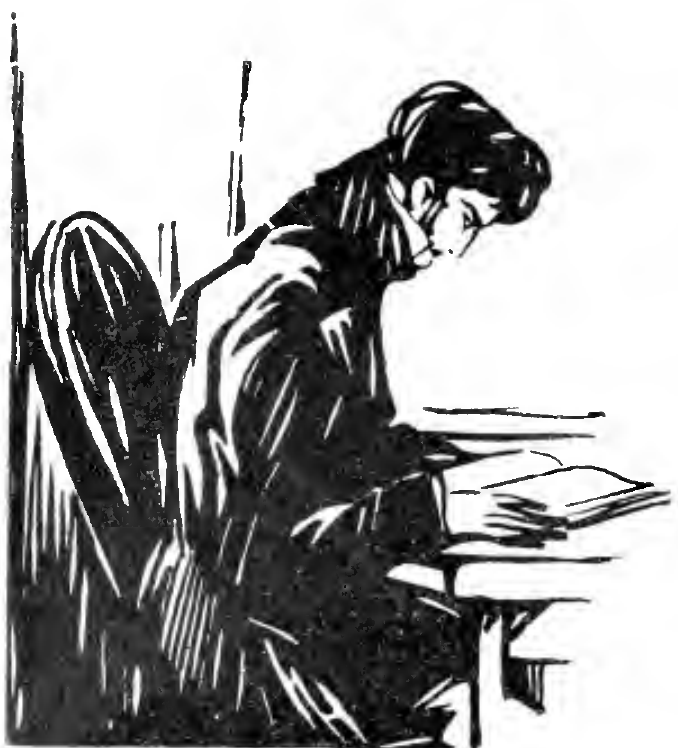
that my presence in the post chaise will not seem importunate to you? I am not a monster; to have you lost in the opinion of the world will be for me only one misfortune the more. It is not your position with the world that is the obstacle, it is unhappily your character. Can you answer to yourself that you will love me eight days?"
(Ah! may she love me eight days, eight days only, Julien was saying to himself under his breath, and I shall die of happiness. What do I care for the future, what do I care for life? and this divine happinesscan begin at this very instant if I wish, it depends only on me!)
Mathilde saw him pensive.
"I am therefore utterly unworthy of you," she said, taking his hand.
Julien kissed her, but at once the iron hand of duty seized his heart. If she sees how I adore her, I lose her. And before leaving her arms he had recovered all the dignity befitting a man.
That day and the following ones, he knew how to hide the excess of his felicity; there were moments when he denied himself even the pleasure of holding her in his arms.
At other moments, the delirium of happiness carried him away over all the counsels of prudence.
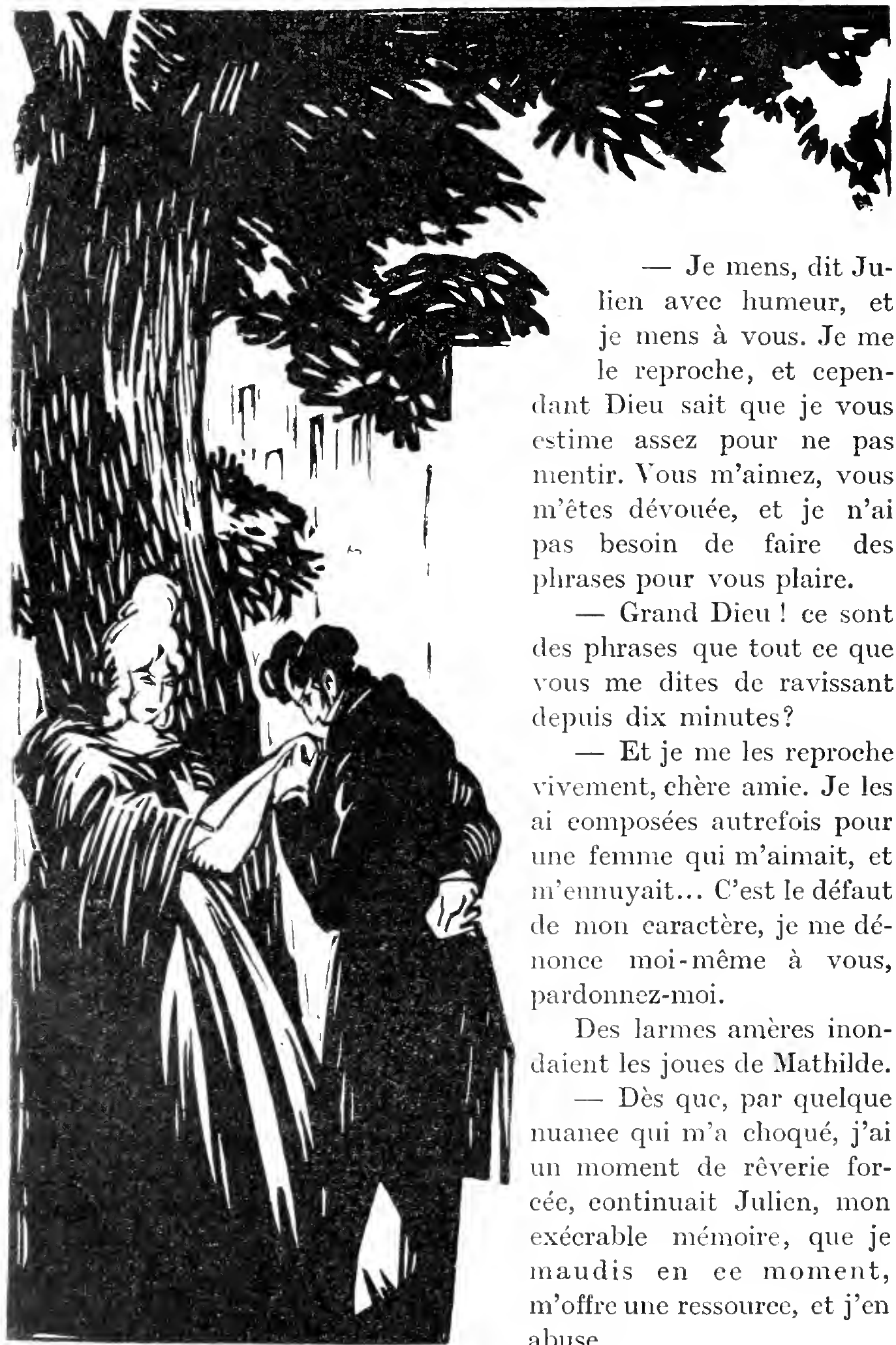
It was beside a bower of honeysuckles arranged to conceal the ladder, in the garden, that he was accustomed to go and place himself to gaze from afar at Mathilde's shutter and weep over her inconstancy. A very large oak stood close by, and the trunk of this tree prevented him from being seen by the indiscreet.
Passing with Mathilde through that very spot which so vividly recalled to him the excess of his misfortune, the contrast between his past despair and his present bliss was too strong for his temperament; tears flooded his eyes, and, carrying his friend's hand to his lips:
"Here I lived thinking of you; here I used to watch that shutter, I waited whole hours for the blessed moment when I should see this hand open it..."
His weakness was complete. With those true colors that no one invents, he depicted for her the excess of his despair at that time. Brief interjections bore witness to his present happiness, which had put an end to that atrocious suffering.
What am I doing, great God! Julien said to himself, suddenly coming to his senses. I am ruining myself.
In the excess of his alarm, he already believed he could see less love in Mademoiselle de La Mole's eyes. It was an illusion; but Julien's face suddenly changed and was covered with a mortal pallor. His eyes dimmed for a moment, and the expression of a haughtiness not untinged with malice soon succeeded that of the truest and most unreserved love.
"What is the matter with you, my friend?" Mathilde said to him with tenderness and anxiety.
"Have I then just unknowingly fallen into some action that has displeased you?" Mathilde said with a charming naivety.
- - -
"One day, I remember, passing near those honeysuckles, you picked a flower, M. de Luz took it from you, and you let him have it. I was two steps away."
"M. de Luz? That is impossible," Mathilde replied, with the haughtiness that was so natural to her: "I do not have those ways."
"I am sure of it," Julien replied quickly.
"Well then! it is true, my friend," Mathilde said, lowering her eyes sadly. She knew positively that for many months she had not allowed such an action from M. de Luz.
Julien looked at her with an inexpressible tenderness: No, he said to himself, she does not love me any the less.
She reproached him that evening, laughing, for his taste for Madame de Fervaques: "A bourgeois loving a parvenue! Hearts of that species are perhaps the only ones my Julien cannot drive mad." She had made a real dandy of you, she said, playing with his hair.
At the time when he believed himself despised by Mathilde, Julien had become one of the best-dressed men in Paris. But he still had one advantage over people of that species: once his toilet was arranged, he no longer thought about it.
One thing piqued Mathilde: Julien continued to copy the Russian letters and send them to the marshal.