About this book
Julien Sorel climbs from sawmill to salon, torn between the red of the army and the black of the church. Stendhal's 1830 novel, free to read online.
LXXIII
An hour later, as he was sleeping deeply, he was awakened by tears that he felt flowing over his hand. Ah! it is Mathilde again, he thought, half awake. She comes, faithful to theory, to attack my resolution through tender feelings. Weary at the prospect of this new scene in the pathetic genre, he did not open his eyes. The lines of Belphegor fleeing his wife came back to his mind.
:
He heard a singular sigh; he opened his eyes: it was Madame de Rênal.
"Ah! I see you again before dying, is it an illusion?" he cried, throwing himself at her feet.
But forgive me, Madame, I am nothing but a murderer in your eyes, he said at once, returning to himself.
"Monsieur, I come to implore you to appeal; I know that you do not wish to... Her sobs stifled her; she could not speak.
"Deign to forgive me."
"If you wish me to forgive you," she said to him, rising and throwing herself into his arms, "appeal at once from your sentence of death."
Julien covered her with kisses.
"Will you come to see me every day during these two months?"
"I swear it to you. Every day, unless my husband forbids me."
"I sign!" cried Julien. "What! you forgive me! is it possible!"
He pressed her in his arms; he was mad. She gave a little cry.
"It is nothing," she said to him, "you hurt me."
"In your shoulder," cried Julien, melting into tears. He drew back a little, and covered her hand with burning kisses. Who would have told me so the last time I saw you in your room at Verrières?
"Who would have told me then that I should write to M. de La Mole that infamous letter?"
"Know that I have always loved you, that I have loved only you."
"Is it possible!" cried Madame de Rênal, delighted in her turn. She leaned upon Julien, who was at her knees, and for a long time they wept in silence.
At no period of his life had Julien found such a moment.
A very long time afterward, when they could speak: "And that young Madame Michelet," said Madame de Rênal, "or
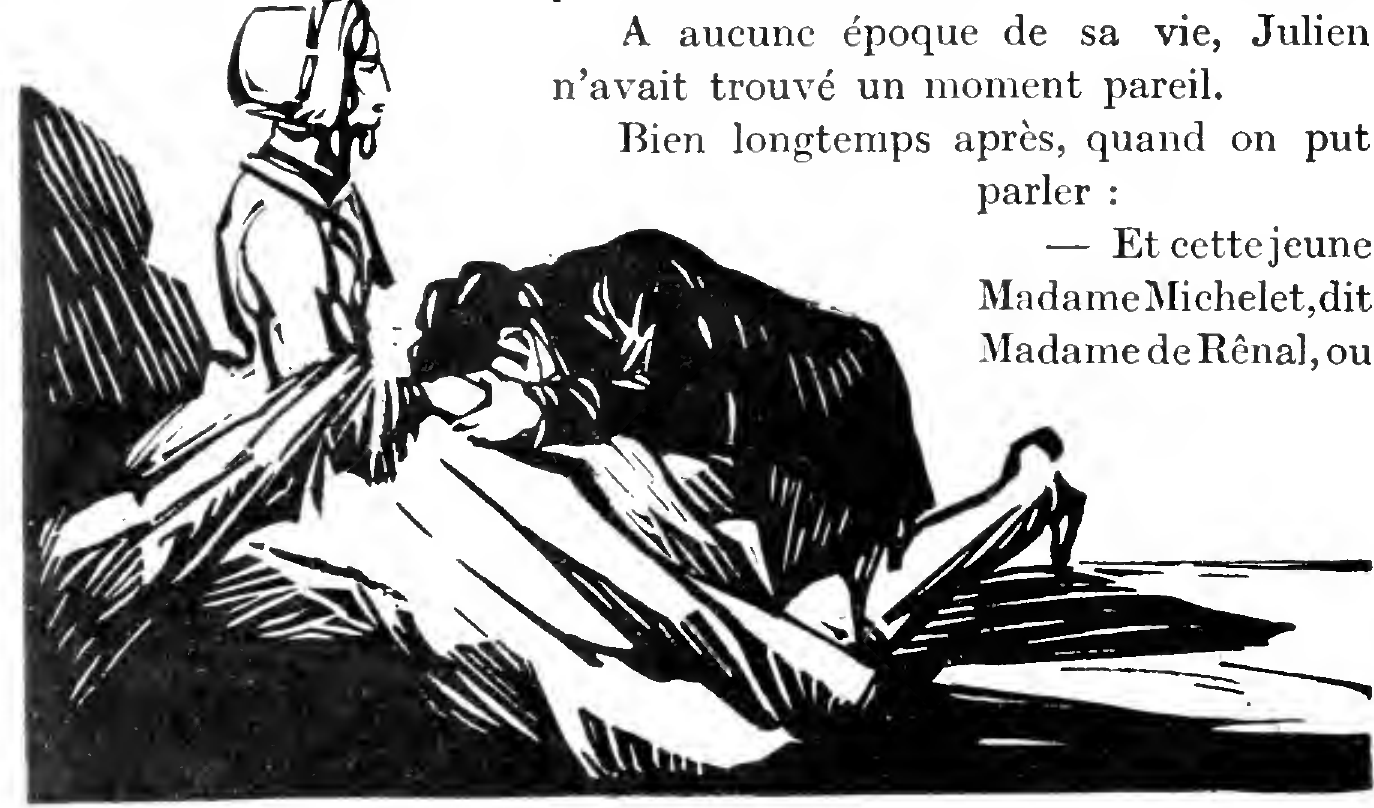
rather that Mademoiselle de La Mole; for in truth I am beginning to believe this strange novel."
"It is true only in appearance," replied Julien. "She is my wife, but she is not my mistress..."
Interrupting each other a hundred times, they barely managed to tell each other what they did not know. The letter written to M. de La Mole had been composed by the young priest who directed Madame de Rênal's conscience, and then copied by her. "What horror religion made me commit!" she said to him; "and even then I softened the most frightful passages of that letter."
Julien's transports and happiness proved to him how completely he forgave her. Never had he been so madly in love.
— Yet I believe myself to be pious, Madame de Rênal said to him later in the conversation. I believe sincerely in God; I believe equally, and this has even been proven to me, that the crime I am committing is dreadful, and as soon as I see you, even after you have fired two pistol shots at me... And here, in spite of herself, Julien covered her with kisses.
— Leave me, she continued, I want to reason with you, for fear of forgetting it... As soon as I see you, all my duties disappear, I am nothing but love for you, or rather, the word love is too weak. I feel for you what I should feel only for God: a mixture of respect, love, obedience... In truth, I do not know what you inspire in me... You would tell me to stab the jailer, and the crime would be committed before I had thought of it. Explain this to me very clearly before I leave you, I want to see clearly into my heart; for in two months we shall leave each other... By the way, shall we leave each other? she said to him smiling.
— I retract my word, cried Julien rising; I do not appeal against the death sentence, if by poison, knife, pistol, charcoal or in any other manner whatsoever, you seek to put an end or obstacle to your life.
Madame de Rênal's countenance suddenly changed; the most vivid tenderness gave way to deep reverie.
— If we were to die right now? she said to him at last.
— Who knows what one finds in the next life? replied Julien, perhaps torments, perhaps nothing at all. Can we not spend two months together in a delightful manner? Two months, that is many days. Never shall I have been so happy?
— Never will you have been so happy?— Never, repeated Julien delighted, and I speak to you as I speak to myself. God preserve me from exaggerating.
— It is commanding me to speak thus, she said with a timid and melancholy smile.
— Well then! you swear, on the love you have for me, not to attempt your life by any direct or indirect means... remember, he added, that you must live for my son, whom Mathilde will abandon to footmen as soon as she is the Marquise de Croisenois.
“I swear it,” she went on coldly, “but I want to carry away your appeal written and signed in your own hand. I will go myself to the attorney-general.”
“Take care, you are compromising yourself.”
“After the step of having come to see you in your prison, I am forever, for Besançon and all Franche-Comté, a heroine of anecdotes,” she said with a profoundly afflicted air. “The bounds of austere modesty are plain... I am a woman lost to honor; it is true that it is for you...”
Her tone was so sad that Julien kissed her with a happiness altogether new to him. It was no longer the intoxication of love, it was extreme gratitude. He had just perceived, for the first time, the full extent of the sacrifice she had made for him.
Some charitable soul doubtless informed M. de Rênal of the long visits his wife was paying to Julien’s prison; for at the end of three days he sent her his carriage, with express orders to return to Verrières at once.
This cruel separation had begun the day badly for Julien. He was warned, two or three hours later, that a certain intriguing priest, who had nevertheless been unable to push himself forward among the Jesuits of Besançon, had established himself since morning outside the prison door, in the street. It was raining hard, and there this man claimed to be playing the martyr. Julien was in a bad mood; this foolishness touched him deeply.
In the morning he had already refused a visit from this priest, but the man had taken it into his head to confess Julien and to make a name for himself among the young women of Besançon, by all the confidences he would claim to have received from him.
He declared aloud that he was going to spend the day and the night at the prison door: “God sends me to touch the heart of this other apostate...” And the common people, always curious for a scene, were beginning to gather.
“Yes, my brothers,” he told them, “I shall stay here the day, the night, and all the days and all the nights that follow. The Holy Spirit has spoken to me, I have a mission from on high; it is I who must save the soul of young Sorel. Join your prayers with mine, etc.”
Julien loathed scandal and everything that could draw attention to him. He thought of seizing the moment to escape from the world incognito; but he had some hope of seeing Madame de Rênal again, and he was madly in love.
The prison door was situated in one of the most frequented streets. The idea of this erotté priest, drawing a crowd and a scandal, tortured his soul. “And, without any doubt, at every moment he repeats my name!” This moment was more painful than death.
He called two or three times, at an hour’s interval, for a turnkey who was devoted to him, to send someone to see whether the priest was still at the prison door.
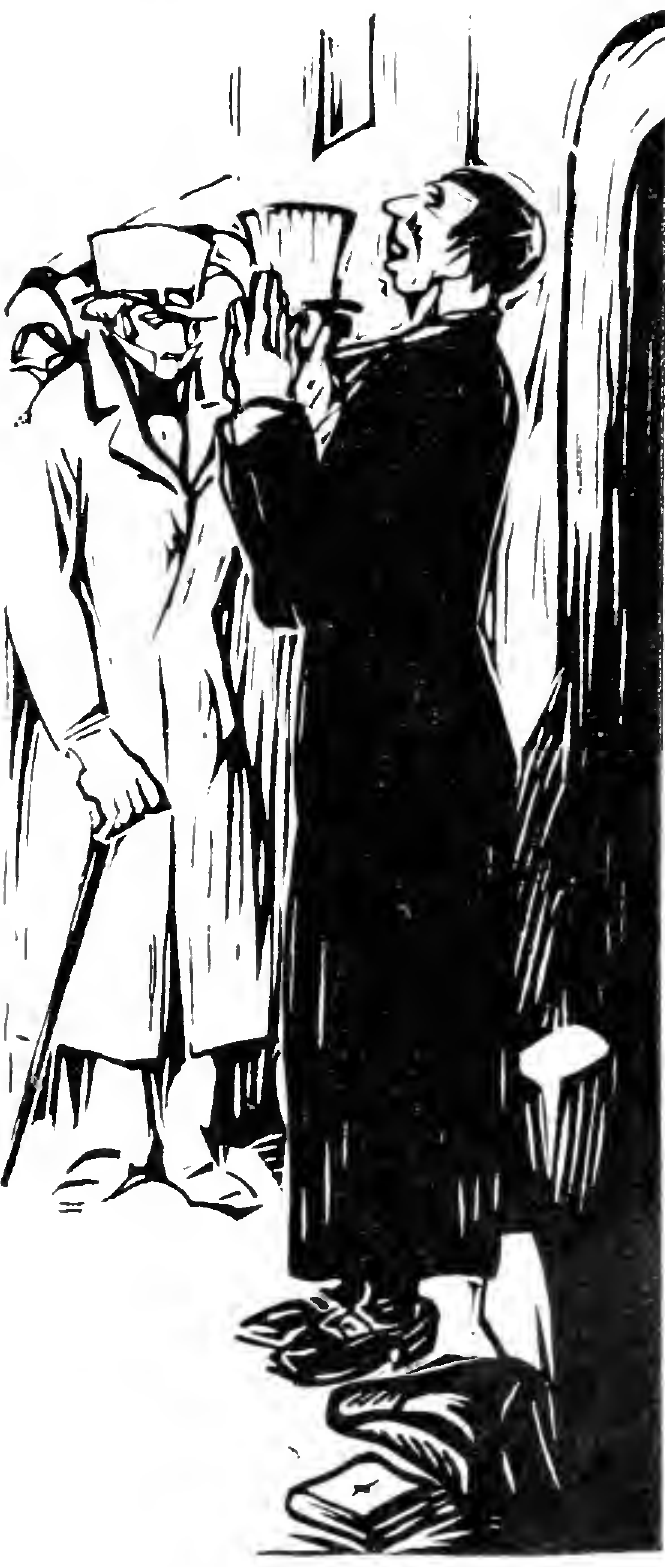
“Sir, he is on his knees in the mud,” the turnkey kept telling him; “he is praying aloud and saying the litanies for your soul... The impétrément!” thought Julien. At that moment, in fact, he heard a dull murmuring; it was the people responding to the litanies. To crown his impatience, he saw the turnkey himself moving his lips as he repeated the Latin words. “People are beginning to say,” added the turnkey, “that your heart must be very hardened to refuse the help of these saint homme.”
O my country! how barbarous you still are! cried Julien, drunk with anger. And he continued his reasoning aloud, without thinking of the turnkey’s presence.
“This man wants an article in the newspaper, and there he is sure to get it.
Ah! cursed provincials! In Paris, I would not be subjected to all these vexations. There they are more learned in charlatanism.”
“Show this saint priest in,” he said at last to the turnkey, and the sweat was flowing in great streams down his forehead. The turnkey made the sign of the cross and went out overjoyed.
This saint priest turned out to be horribly ugly; he was still more erotté. The cold rain that was falling increased the darkness and dampness of the dungeon. The priest wanted to embrace Julien, and began to grow tender as he spoke to him. The basest hypocrisy was too evident; never in his life had Julien been so angry.
A quarter of an hour after the priest entered, Julien found himself altogether a coward. For the first time death appeared horrible to him. He thought of the state of putrefaction in which his body would be two days after the execution, etc., etc.
He was about to betray himself by some sign of weakness, or to throw himself upon the priest and strangle him with his chain, when he had the idea of begging the holy man to go say a good forty-franc mass for him that very day.
Now, it was noon; the priest decamped.