About this book
Julien Sorel climbs from sawmill to salon, torn between the red of the army and the black of the church. Stendhal's 1830 novel, free to read online.
THE TIGER
Alas! why these things and not others!
BEAUMARCHAIS.
An English traveler recounts the intimacy in which he lived with a tiger; he had raised it and would caress it, but always kept a loaded pistol on his table.
Julien abandoned himself to the excess of his happiness only in the moments when Mathilde could not read its expression in his eyes.He acquitted himself with exactness of the duty of saying something harsh to her from time to time.
When Mathilde's gentleness, which he observed with astonishment, and the excess of her devotion were on the point of depriving him of all command over himself, he had the courage to leave her abruptly.
For the first time Mathilde was in love.
Life, which had always dragged along at a tortoise's pace for her, now flew.
Yet pride had to make itself felt in some way; she wanted to expose herself with temerity to all the dangers that her love could bring upon her. It was Julien who was prudent; and it was only when danger was in question that she did not yield to his will; but submissive and almost humble with him, she showed only the more haughtiness toward everything in the house that approached her, parents or servants.
In the evening in the drawing room, amid sixty people, she would call Julien over to speak to him in private and at length.
The little Tanbeau having one day established himself beside them, she asked him to go fetch from the library the volume of Smollett containing the revolution of 1688; and as he hesitated: "Let nothing hurry you," she added with an expression of insulting haughtiness that was a balm to Julien's soul.
"Have you noticed the look of that little monster?" he said to her.
"His uncle has ten or twelve years of service in this drawing room, otherwise I would have him driven out this instant."
Her conduct toward MM. de Croisenois, de Luz, etc., perfectly polite in form, was hardly less provoking at bottom. Mathilde sharply reproached herself for all the confidences formerly made to Julien, and all the more because she did not dare admit to him that she had exaggerated the almost entirely innocent marks of interest of which these gentlemen had been the object.
Despite the finest resolutions, her womanly pride prevented her every day from saying to Julien: "It is because I was speaking to you that I took pleasure in describing the weakness I had of not withdrawing my hand when M. de Croisenois, placing his on a marble table, came to brush lightly against it."
Today, scarcely had one of these gentlemen spoken to her for a few moments than she found she had a question to ask Julien, and this was a pretext to keep him near her.
She found herself pregnant and announced it to Julien with joy.
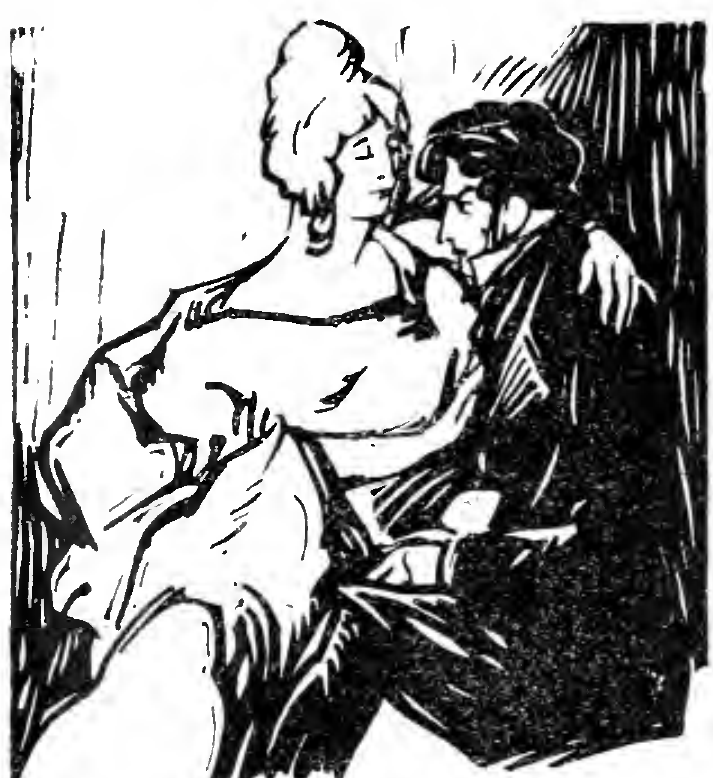
"Now do you doubt me? Is this not a guarantee? I am your wife forever."
This announcement struck Julien with profound astonishment. He was on the point of forgetting the principle of his conduct. How could he be voluntarily cold and offensive toward this poor young girl who was ruining herself for him? Did she look a little unwell, even on the days when wisdom made its terrible voice heard, he no longer found the courage to address to her one of those cruel words so indispensable, according to his experience, to the duration of their love.
"I want to write to my father," Mathilde said to him one day; "he is more than a father to me; he is a friend: as such I would find it unworthy of you and of me to seek to deceive him, even for an instant."
"Good God! what are you going to do?" said Julien, frightened.
"My duty," she replied with eyes shining with joy. She found herself more magnanimous than her lover.
"But he will drive me out with ignominy!"
"That is his right, it must be respected. I will give you my arm and we will go out by the carriage gate, in broad daylight."
Julien, astonished, begged her to postpone it a week.
"I cannot," she replied; "honor speaks, I have seen duty, it must be followed, and at once."
"Well then! I order you to postpone it," Julien finally said. "Your honor is covered, I am your husband. Our situation, both of ours, is going to be changed by this capital step. I too am within my rights. Today is Tuesday; next Tuesday is the day of the Duc de Retz; in the evening, when M. de La Mole returns, the porter will hand him the fatal letter... He thinks only of making you a duchess, I am certain of it; judge of his misfortune!"
"Do you mean: judge of his vengeance?"
"I can have pity for my benefactor, be heartbroken at harming him; but I do not fear and never will fear anyone."
Mathilde submitted. Since she had announced her new condition to Julien, it was the first time he had spoken to her with authority: never had he loved her so much. It was with happiness that the tender part of his soul seized the pretext of Mathilde's condition to dispense with addressing cruel words to her. The confession to M. de La Mole agitated him deeply. Was he going to be separated from Mathilde? And however much pain she might feel at seeing him leave, a month after his departure, would she think of him?
He had an almost equal horror of the just reproaches the Marquis might address to him.
In the evening he confessed to Mathilde this second cause of grief, and then, carried away by his love, he also made confession of the first.
She changed color.
"Really," she said to him, "six months spent far from me would be a misfortune for you!"
"Immense, the only one in the world that I see with terror."
Mathilde was very happy. Julien had followed his role with such application that he had succeeded in making her think that she was the one of the two who had the most love.
The fatal Tuesday arrived. At midnight, on returning, the Marquis found a letter with the address required so that he would open it himself, and only when he was without witnesses.
"MY FATHER,
"All social ties are broken between us; only those of nature remain. After my husband, you are and always will be the being most dear to me. My eyes fill with tears as I think of the grief I am causing you, but so that my shame may not be public, and to leave you time to deliberate and act, I could no longer defer the confession I owe you. If your friendship, which I know to be extreme for me, would grant me a small pension, I shall go and settle wherever you wish—in Switzerland, for example—with my husband. His name is so obscure that no one will recognize your daughter in Madame Sorel, daughter-in-law of a carpenter of Verrières. That is the name that caused me so much pain to write. I dread your anger toward Julien, so just in appearance. I shall not be duchesse, my father; but I knew that when I loved him; for it was I who loved him first, it was I who seduced him. I hold from you a soul too elevated to fix my attention on what is or seems to me vulgar. It was in vain that, with the design of pleasing you, I thought of M. de Croisenois. Why had you placed true merit before my eyes? You told me so yourself on my return from Hyères: this young Sorel is the only being who amuses me; the poor boy is as afflicted as I am, if possible, by the grief this letter causes you. I cannot prevent you from being irritated as a father; but love me as a friend.
"Julien respected me. If he sometimes spoke to me, it was solely because of his profound gratitude toward you; for the natural loftiness of his character leads him never to reply except officially to all that is so far above him. He has a vivid and innate sense of the difference in social positions. It was I, I confess, blushing, to my best friend, and never will such a confession be made to another—it was I who one day in the garden pressed his arm.
"After twenty-four hours, why would you write irritated against him? My fault is irreparable. If you require it, it is through me that assurances of his profound respect and his despair at displeasing you shall pass. You will not see him; but I shall go to join him wherever he wishes. It is his right, it is my duty; he is the father of my child. If your kindness would grant us six thousand francs to live on, I shall receive them with gratitude; otherwise Julien intends to settle
in Besançon, where he will begin the trade of teacher of Latin and literature. From whatever low degree he starts, I am certain that he will rise. With him I do not fear obscurity. If there is a revolution, I am sure of a leading role for him. Could you say as much of any of those who have asked for my hand? They have fine lands? I cannot find in that single circumstance a reason to admire. My Julien would attain a high position even under the present regime, if he had a million and my father's protection..."
Mathilde, who knew that the Marquis was a man of impulse, had written eight pages.
"What is to be done?" Julien asked himself while M. de La Mole was reading this letter. "Where is 1) my duty, 2) my interest? What I owe him is immense: without him I should have been a base scoundrel, and not scoundrel enough not to be hated and persecuted by the others. He has made me a man of the world. My necessary knaveries will be 1) rarer, 2) less ignoble. That is more than if he had given me a million. I owe him that cross and the appearance of diplomatic services which raise me above the common level.
"If he were holding the pen to prescribe my conduct, what would he write?..."
Julien was abruptly interrupted by M. de La Mole's old valet.
"The Marquis asks for you at once, dressed or undressed."
The valet added in a low voice as he walked beside Julien: "He is beside himself, be on your guard."