About this book
Julien Sorel climbs from sawmill to salon, torn between the red of the army and the black of the church. Stendhal's 1830 novel, free to read online.
THE CLERGY, THE WOODS, AND LIBERTY
The first law of every being is to preserve itself, is to live. You sow hemlock and expect to see ripe ears of corn.
MACHIAVELLI.
T HE grave personage continued; one could see that he knew; he expounded with a gentle and moderate eloquence, which pleased Julien infinitely, these great truths:
— 10 England has not a guinea at our service: economy and Hume are in fashion there. Even the Saints will not give us money, and Mr. Brougham will make game of us.
20 Impossible to obtain more than two campaigns from the kings of Europe without English gold; and two campaigns will not suffice against the petty bourgeoisie.
30 Necessity of forming an armed party in France, without which the monarchical principle of Europe will not even hazard those two campaigns.
The fourth point which I dare to propose to you as evident is this:
Impossibility of forming an armed party in France without the clergy. I tell you so boldly, because I am going to prove it to you, gentlemen. Everything must be given to the clergy:
10 Because, attending to its business night and day, and guided by men of high capacity established far from the storms, three hundred leagues from your frontiers...
— Ah! Rome, Rome! cried the master of the house...
— Yes, sir, Rome! resumed the cardinal with pride. Whatever the more or less ingenious pleasantries that were in fashion when you were young, I shall say loudly, in 1830, that the clergy, guided by Rome, speaks alone to the common people.
Fifty thousand priests repeat the same words on the day indicated by the chiefs, and the people, who, after all, furnish the soldiers, will be more touched by the voice of their priests than by all the little verses in the world... (This personality excited murmurs.)
The clergy has a genius superior to yours, resumed the cardinal, raising his voice: all the steps that you have taken toward this capital point, having an armed party in France, have been taken by us. Here facts appeared... Who employed eighty thousand muskets in la Vendée?... etc.
So long as the clergy does not have its woods, it holds nothing. At the first war, the minister of finance writes to his agents that there is no more money except for the curé. At bottom, France does not believe, and she loves war. Whoever gives it to her will be doubly popular, for to make war is to starve the Jesuits, to speak like the vulgar; to make war is to deliver these monsters of pride, the French, from the threat of foreign intervention.
The cardinal was listened to with favor... — It would be necessary, said he, for M. de Nerval to leave the ministry; his name irritates uselessly.
At this word, everyone rose and spoke at once. They are going to send him away again, thought Julien; but the wise president himself had forgotten the presence and the existence of Julien.
All eyes sought a man whom Julien recognized. It was M. de Nerval, the prime minister, whom he had glimpsed at the ball of M. the duke de Retz.
The disorder was at its height, as the newspapers say when speaking of the Chamber. At the end of a good quarter of an hour silence was somewhat restored.
Then M. de Nerval rose, and, taking the tone of an apostle: — I shall not affirm to you, said he in a singular voice, that I do not cling to the ministry.
It is demonstrated to me, gentlemen, that my name doubles the forces of the Jacobins by deciding many moderates against us. I would therefore willingly withdraw: but the ways of the Lord are visible to a small number; but, he added, looking fixedly at the cardinal, I have a mission; heaven has said to me: You shall carry your head on a scaffold, or you shall re-establish the monarchy in France, and reduce the Chambers to what the parliament was under Louis XV, and that, gentlemen, I shall do.He was silent, sat down again, and there was a great silence.
There is a good actor, thought Julien. He was mistaken, always as usual, in supposing too much wit in people. Animated by the debates of so lively an evening, and above all by the sincerity of the discussion, at that moment M. de Nerval believed in his mission. With great courage this man had no sense.
Midnight struck during the silence that followed the fine word, I shall do. Julien found that the sound of the clock had something imposing and funereal about it. He was moved.
The discussion soon resumed with growing energy, and above all an incredible naivety. These people will have me poisoned, thought Julien at certain moments. How can one say such things before a plebeian?
Two o'clock was striking and they were still talking. The master of the house had long been asleep; M. de La Mole was obliged to ring to renew the candles. M. de Nerval, the minister, had gone out at a quarter to two, not without having often studied Julien's face in a mirror that the minister had at his side. His departure had appeared to put everyone at ease.
While the candles were being renewed: — God knows what this
28 man is going to say to the king! said the man in waistcoats in a low voice to his neighbor. He can make us very ridiculous and spoil our future.
One must admit that there is in him a very rare self-sufficiency, and even effrontery, in presenting himself here. He appeared here before arriving at the ministry; but the portfolio changes everything, drowns all a man's interests; he should have felt it.
Hardly had the minister gone out when General de Bonaparte had closed his eyes. At that moment he spoke of his health, of his wounds, consulted his watch, and went away.
— I would wager, said the man in waistcoats, that the general is running after the minister; he is going to excuse himself for having been here, and claim that he is leading us.
When the half-asleep servants had finished renewing the candles:
— Let us deliberate at last, gentlemen, said the president, let us no longer try to persuade one another. Let us think of the tenor of the note which in forty-eight hours will be before the eyes of our friends outside. There has been talk of the ministers. We may say it now that M. de Nerval has left us, what do the ministers matter to us? we shall make them will it.
The cardinal approved with a subtle smile.
— Nothing is easier, it seems, than to summarize our position, said the young bishop of Agde with the concentrated and constrained fire of the most exalted fanaticism. Until then he had kept silence; his eye, which Julien had observed, at first gentle and calm, had become inflamed in the first hour of discussion. Now his soul overflowed like the lava of Vesuvius.
From 1806 to 1814, England had only one fault, said he, it was not to act directly and personally upon Napoleon. As soon as that man had made dukes and chamberlains, as soon as he had re-established the throne, the mission that God had confided to him was finished; he was no longer good for anything but to be immolated. The holy Scriptures teach us in more than one place the manner of finishing with tyrants (here there were several Latin quotations).
Today, gentlemen, it is no longer a man who must be immolated, it is Paris. All France copies Paris. What is the good of arming your five hundred men per department? A hazardous enterprise and one that will never end. What is the good of involving France in a thing that is personal to Paris? Paris alone with its newspapers and its salons has done the harm; let the new Babylon perish.
1.
Between the altar and Paris, it must be finished. This catastrophe is even in the worldly interests of the throne. Why did Paris not dare to breathe under Bonaparte? Ask the cannon of Saint-Roch...
It was not until three in the morning that Julien went out with M. de La Mole.
The Marquis was ashamed and tired. For the first time, in speaking to Julien, there was entreaty in his tone. He asked for his word never to reveal the excesses of zeal—that was his word—of which chance had just made him a witness. Do not speak of it to our friend from abroad unless he insists seriously on knowing about our young fools. What does it matter to them if the State is overthrown? They will be cardinals, and will take refuge in Rome. We, in our châteaux, will be massacred by the peasants.
The secret note that the Marquis drew up from the great twenty-six-page procès-verbal written by Julien was not ready until a quarter to five.
"I am tired to death," said the Marquis, "and it shows plainly in this note, which lacks clarity toward the end; I am more displeased with it than with any thing I have done in my life. Here, my friend," he added, "go and rest for a few hours, and for fear that you may be carried off, I am going to lock you in your room."
The next day the Marquis took Julien to
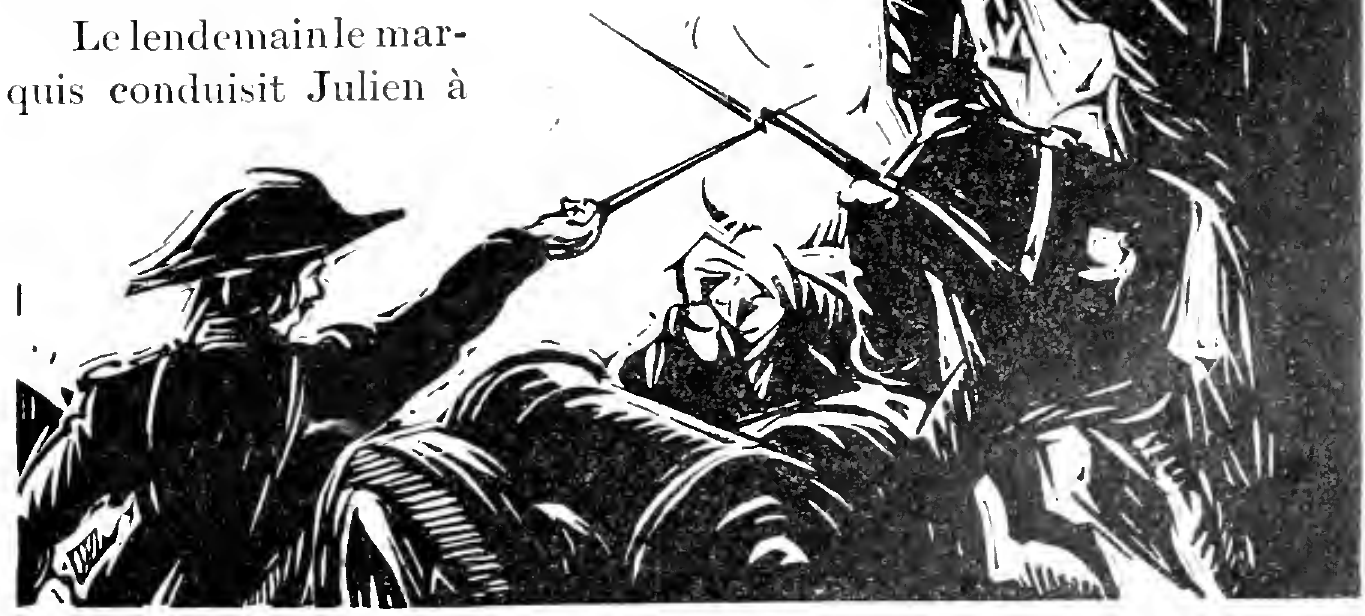
an isolated château fairly far from Paris. There were strange guests there, whom Julien judged to be priests. He was given a passport bearing an assumed name, but which finally indicated the true purpose of the journey that he had always pretended to ignore. He got alone into a calèche.
The Marquis had no anxiety about his memory; Julien had recited the secret note to him several times, but he greatly feared that it might be intercepted.
"Above all, have the air of nothing but a fop traveling to kill time," he said to him affectionately, at the moment when he was leaving the drawing room. There was perhaps more than one false brother in our assembly of last night.
The journey was swift and very sad. Scarcely had Julien been out of the Marquis's sight than he had forgotten both the secret note and the mission, to think only of Mathilde's contempt.
In a village a few leagues beyond Metz, the postmaster came to tell him that there were no horses. It was ten o'clock at night; Julien, greatly vexed, asked for supper. He strolled before the door, and imperceptibly, without any appearance of it, passed into the stable yard. He saw no horses there.The man's manner, however, was singular, he said to himself; his coarse eye was inspecting me.
He was beginning, as may be seen, not to believe exactly everything that was told him. He thought of slipping away after supper, and in order to learn something more about the country, he left his room to go and warm himself at the kitchen fire. What was his joy to find there il signor Geronimo, the famous singer!
Seated in an armchair which he had had brought near the fire, the Neapolitan was groaning aloud and talking more, all by himself, than the twenty German peasants who surrounded him in amazement.
"These people are ruining me," he cried to Julien, "I have promised to sing tomorrow at Mainz. Seven sovereign princes have hurried there to hear me. But let us go and take the air," he added with a meaning look.
When he was a hundred paces down the road, and out of all possibility of being overheard:
"Do you know what is going on?" he said to Julien; "this postmaster is a rascal. While I was pronouncing my name, I gave twenty sous to a little scamp who told me everything. There are twelve horses in a stable at the other end of the village. They want to delay some courier."
"Indeed?" said Julien with an innocent air.
It was not enough to have discovered the fraud, they had to get away: that was what Geronimo and his friend could not manage. "Let us wait for daylight," said the singer at last, "they are suspicious of us. It is perhaps you or I they are after. Tomorrow morning we order a good breakfast; while it is being prepared we go for a walk, we escape, we hire horses and reach the next post."
"And your belongings?" said Julien, who was thinking that perhaps Geronimo himself might have been sent to intercept him. They had to sup and go to bed. Julien was still in his first sleep when he was awakened with a start by the voice of two persons talking in his room, without much ceremony.
He recognized the postmaster, armed with a dark lantern. The light was directed towards the trunk of the calèche which Julien had had brought up to his room. Beside the postmaster was a man who was rummaging quietly in the open trunk. Julien could distinguish only the sleeves of his coat, which were black and very tight.
"It is a cassock," he said to himself, and he gently seized the small pistols which he had placed under his pillow.
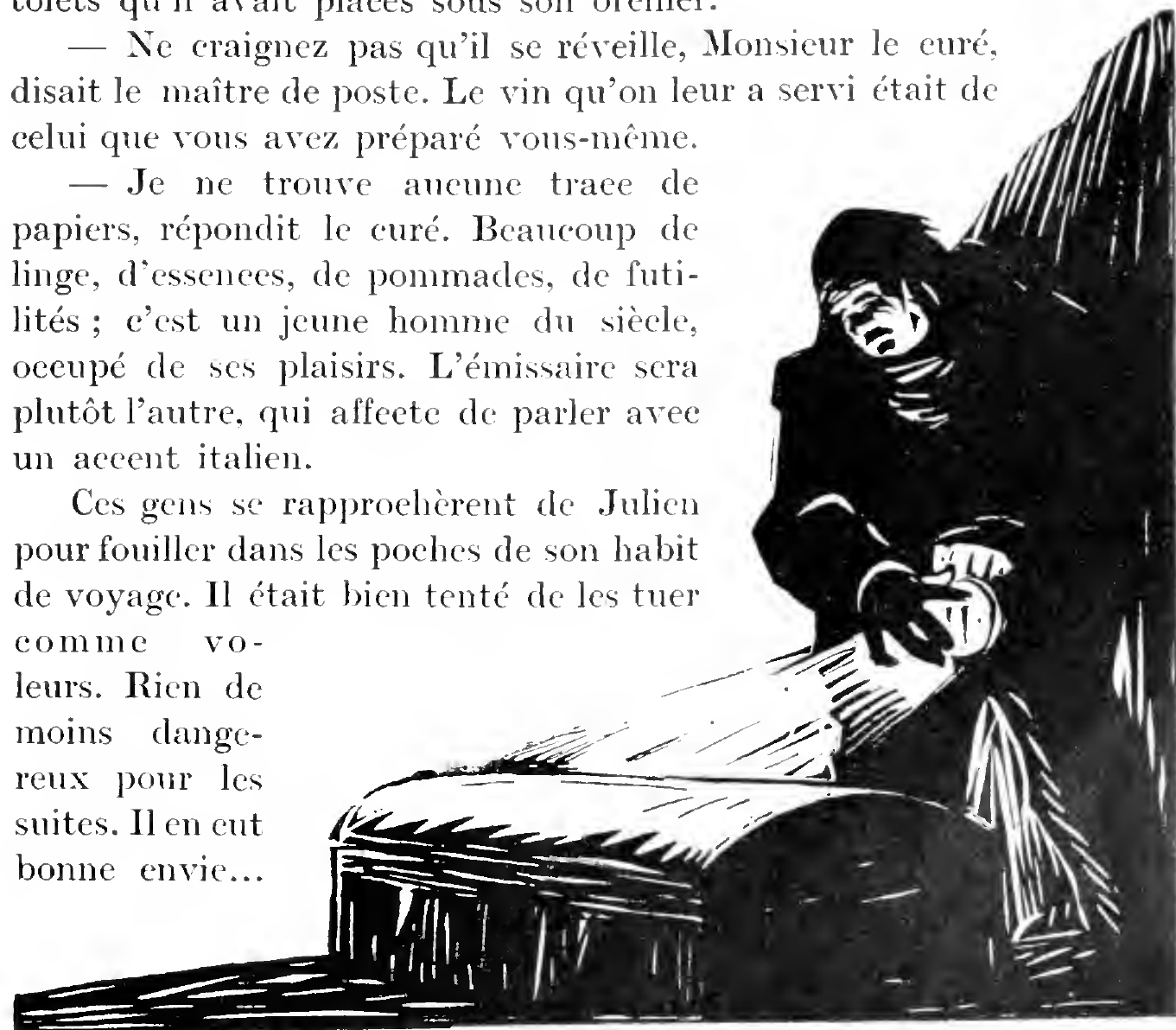
"Have no fear that he will wake, Monsieur le Curé," the postmaster was saying. "The wine that was served to them was of the kind you prepared yourself."
"I find no trace of papers," replied the curé. "A great deal of linen, essences, pomades, trifles; he is a young man of the age, occupied with his pleasures. The emissary will rather be the other one, who affects to speak with an Italian accent."
These people came closer to Julien to search the pockets of his travelling coat. He was strongly tempted to kill them like thieves. Nothing could be less dangerous for the consequences. He had a great mind to it...
"I should be nothing but a fool," he said to himself, "I should compromise my mission." His coat was searched: "This is no diplomat," said the priest; he moved away, and did well.
"If he touches me in my bed, woe to him!" said Julien to himself; "he may very well come to stab me, and that is what I shall not suffer."
The curé turned his head. Julien was opening his eyes halfway; what was his astonishment! it was the abbé Castanède! In fact, although the two persons wished to speak rather low, it had seemed to him, from the first, that he recognized one of the voices. Julien was seized with an immoderate desire to purge the earth of one of its basest scoundrels...
"But my mission!" he said to himself.
The curé and his acolyte went out. A quarter of an hour later, Julien pretended to wake. He called out and roused the whole house.
"I am poisoned," he cried, "I am suffering horribly!" he wanted a pretext to go to Geronimo's rescue. He found him half asphyxiated by the laudanum contained in the wine.
Julien, fearing some joke of this kind, had supped on chocolate brought from Paris. He could not manage to wake Geronimo sufficiently to persuade him to leave.
"I would not give up at this moment the delight of sleeping," said the singer, "not if they gave me the whole kingdom of Naples."
"But the seven sovereign princes!"
"Let them wait."
Julien set out alone and arrived without further incident at the great personage's. He lost a whole morning in vainly soliciting an audience. Fortunately, towards four o'clock, the Duke wished to take the air. Julien saw him come out on foot, and did not hesitate to ask him for alms. When he was within two steps of the great personage, he drew out the Marquis de La Mole's watch and showed it with affectation. "Follow me at a distance," he was told, without a glance.
A quarter of a league away, the Duke turned abruptly into a small Café-houss. It was in a room of this lowest-class inn that Julien had the honour of reciting his four pages to the Duke. When he had finished: "Begin again and go more slowly," he was told.
The Prince took notes. "Walk to the next post. Leave your belongings and your calèche here. Get to Strasbourg as best you can, and on the twenty-second of the month (it was the tenth) meet me at half past twelve in this same Café-houss. Do not leave it until half an hour has passed. Silence!"
Such were the only words Julien heard. They were enough to fill him with the highest admiration. "This," he thought, "is how business is done; what would this great statesman say, if he heard the impassioned chatterers of three days ago?"
Julien took two days to reach Strasbourg; it seemed to him that he had nothing to do there. He made a wide detour. "If that devil of an abbé Castanède has recognized me, he is not the man to lose my trail easily... And what a pleasure for him to mock me, and to make my mission fail!"
The abbé Castanède, head of the congregation's police along the whole northern frontier, had fortunately not recognized him. And the Jesuits of Strasbourg, though very zealous, did not think at all of observing Julien, who, with his cross and his blue frock coat, looked like a young military man very much taken up with himself.