About this book
Julien Sorel climbs from sawmill to salon, torn between the red of the army and the black of the church. Stendhal's 1830 novel, free to read online.
THE FIRST DEPUTY
O, how this spring of love resembleth The uncertain glory of an April day; Which now shows all the beauty of the sun And by and by a cloud takes all away!
TWO GENTLEMEN OF VERONA.
One evening at sunset, sitting beside his friend at the far end of the orchard, far from intruders, he was dreaming deeply. Such sweet moments, he thought, would they last forever? His soul was wholly occupied with the difficulty of taking up a profession; he lamented that great onslaught of misfortune which ends childhood and spoils the first years of youth when one is not rich.
"Ah!" he exclaimed, "what a man Napoleon was, sent by God for the young Frenchmen! Who will replace him? What will become, without him, of the unhappy ones, even richer than I, who have just the few crowns needed to procure a good education, and not enough money to buy a man at twenty and push themselves forward in a career! Whatever one does," he added with a deep sigh, "that fatal memory will forever prevent us from being happy!"
Suddenly he saw Madame de Rênal frown; she assumed a cold and disdainful air; this way of thinking seemed to her fitting for a servant. Brought up in the idea that she was very rich, it seemed to her an agreed thing that Julien was too. She loved him a thousand times more than life, and made no account of money.
Julien was far from guessing these ideas. That frown brought him back to earth. He had enough presence of mind to arrange his sentence and make the noble lady, seated so near him on the green bench, understand that the words he had just repeated he had heard during his journey at his friend the timber merchant's. It was the reasoning of the impious.
"Well! do not mix with such people anymore," said Madame de Rênal, still keeping a little of that icy air which had suddenly succeeded the expression of the most vivid tenderness.
That frown, or rather the remorse of his imprudence, was the first check to the illusion which was carrying Julien away. He said to himself: She is good and gentle, her liking for me is keen, but she has been brought up in the enemy's camp. They must above all things be afraid of that class of men of spirit who, after a good education, have not enough money to enter upon a career. What would become of these nobles, if we were given the chance to fight them on equal terms! I, for instance, mayor of Verrières, well-intentioned, honest as M. de Rênal is at heart, as I would sweep away the vicar, M. Valenod and all their rascalities! how justice would triumph in Verrières! It is not their talents that would stand in my way, they are forever groping.
Julien's happiness was, that day, on the point of becoming lasting. Our hero lacked the courage to be sincere. He needed the courage to give battle, but forthwith; Madame de Rênal had been surprised by Julien's remark, because the men of her set kept repeating that the return of Robespierre was above all things possible by reason of these young men of the lower classes, too well educated. Madame de Rênal's cold air lasted long enough, and seemed to Julien to be marked.
8
It was that the fear of having indirectly said something unpleasant to him succeeded her repugnance to the ill-natured remark. This unhappiness was reflected vividly in her features, so pure, and so naïve when she was happy and far from bores.
Julien dared no longer dream with abandon. More calm and less amorous, he thought it imprudent to go to Madame de Rênal's room. It were better that she should come to him; if a servant saw her running about the house, twenty different pretexts could explain the step.
But this arrangement had also its drawbacks. Julien had received from Fouqué books which he, a student of theology, could never have asked for at a bookseller's. He dared not open them except at night. Often he would have been well pleased not to be interrupted by a visit, the expectation of which, even on the eve of the little scene in the orchard, would have put him out of a condition to read.
He owed it to Madame de Rênal to understand books in an entirely new way. He had dared to ask her questions about a host of little things, ignorance of which abruptly halts the intelligence of a young man born outside society, whatever natural genius one may suppose him to possess.
This education in love, given by an extremely ignorant woman, was a happiness. Julien came directly to see society as it is today. His mind was not obscured by the account of what it was in times past, two thousand years ago, or merely sixty years ago, in the time of Voltaire and Louis XV. To his inexpressible joy, a veil fell from before his eyes; he finally understood the things that were happening at Verrières.
In the foreground appeared very complicated intrigues hatched over the past two years around the prefect of Besançon. They were supported by letters come from Paris, and written by the most illustrious of persons. The point was to make M. de Moirod—the most devout man in the country—the first, and not the second, deputy mayor of Verrières.
He had as his rival a very rich manufacturer, whom it was absolutely necessary to push back into the post of second deputy.
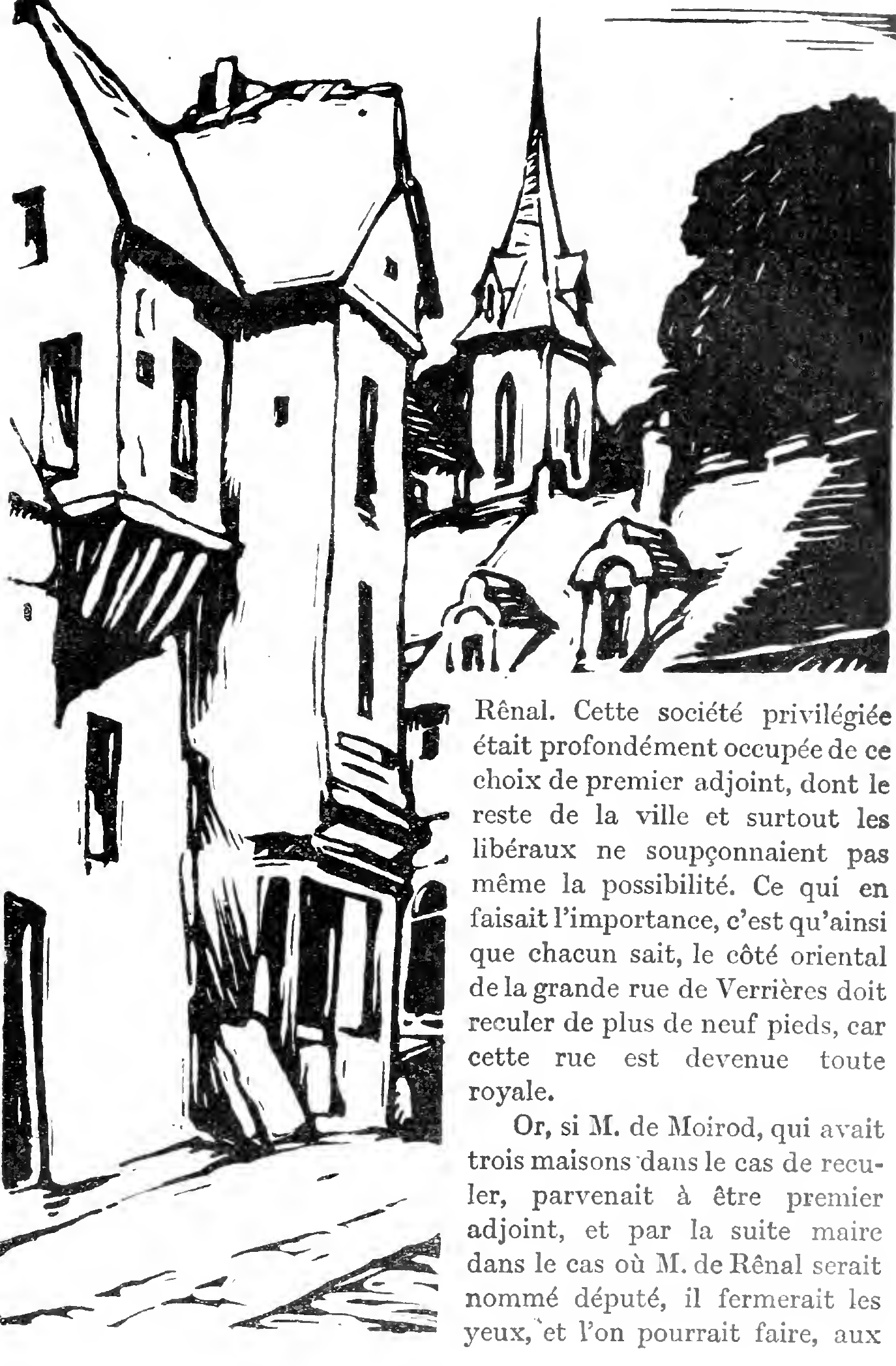
Julien finally understood the half-words he had caught when the high society of the country came to dine at M. de Rênal's—houses that encroach upon the public way, tiny imperceptible repairs, by means of which they would last a hundred years. Despite the high piety and recognized probity of M. de Moirod, one was sure he would be accommodating, for he had many children. Among the houses that were to be set back, nine belonged to the very best people in Verrières.
In Julien's eyes, this intrigue was far more important than the story of the battle of Fontenoy, whose name he was seeing for the first time in one of the books Fouqué had sent him. There were things that had astonished Julien during the five years since he had begun going in the evenings to the curé's. But discretion and humility of mind being the first qualities of a student of theology, it had always been impossible for him to ask questions.
One day, Madame de Rênal was giving an order to her husband's valet, Julien's enemy.
"But, Madame, today is the last Friday of the month," replied the man with a singular air.
"Go," said Madame de Rênal.
"Well!" said Julien, "he is going to that hayloft, a church in former times, and recently restored to worship; but why? There is one of those mysteries I have never been able to penetrate."
"It is a very salutary institution, but very singular," replied Madame de Rênal; "women are not admitted to it; all I know is that everyone there uses the familiar 'tu' with one another. For example, this servant will go find M. Valenod there, and that man, so proud and so foolish, will not be vexed to hear himself addressed as 'tu' by Saint-Jean, and will answer in the same tone. If you insist on knowing what is done there, I will ask M. de Maugiron and M. Valenod for details. We pay twenty francs per servant so that one day they will not cut our throats."
Time flew. The memory of his mistress's charms distracted Julien from his dark ambition. The necessity of not speaking to her of sad and reasonable things, since they were of opposite parties, added, without his suspecting it, to the happiness he owed her, and to the empire she was acquiring over him.
In the moments when the presence of too-intelligent children reduced them to speaking only the language of cold reason, it was with perfect docility that Julien, gazing at her with eyes sparkling with love, listened to her explanations of the world as it goes. Often, in the midst of the account of some clever rascality, concerning a road or a supply contract, Madame de Rênal's mind would suddenly wander to the point of delirium; Julien had need to scold her, she permitted herself with him the same intimate gestures as with her children. It was that there were days when she had the illusion of loving him as her child. Did she not constantly have to answer his naive questions about a thousand simple things that a well-born child does not fail to know at fifteen? A moment later, she admired him as her master. His genius went so far as to frighten her; she believed she perceived more clearly each day the great man of the future in this young abbé. She saw him pope, she saw him prime minister like Richelieu. "Shall I live long enough to see you in your glory?" she said to Julien; "the place is made for a great man; monarchy and religion have need of it."