About this book
Julien Sorel climbs from sawmill to salon, torn between the red of the army and the black of the church. Stendhal's 1830 novel, free to read online.
THINKING MAKES ONE SUFFER
The grotesque nature of everyday events hides from you the true misfortune of the passions.
BARNAVE.
In replacing the ordinary furniture in the room that M. de La Mole had occupied, Julien found a sheet of very strong paper, folded in four. He read at the bottom of the first page:
To His Excellency M. the Marquis de La Mole, peer of France, knight of the orders of the King, etc., etc.
It was a petition in the large handwriting of a cook:
"Monsieur le Marquis,I have had religious principles all my life. I was in Lyon, exposed to the bombs, during the siege, in '93, of execrable memory. I take communion, I go every Sunday to mass at the parish church. I have never failed in the Easter duty, even in '93, of execrable memory. My cook, before the revolution I had servants, my cook keeps Friday as a fast day. I enjoy in Verrières a general consideration, and I dare say a deserved one. I walk under the canopy in processions, beside M. the curé and M. the mayor. On great occasions I carry a large candle bought at my own expense. Of all of which the certificates are in Paris at the Ministry of Finance. I ask Monsieur le Marquis for the lottery office of Verrières, which cannot fail to be vacant soon in one way or another, the holder being very ill, and moreover voting badly in the elections, etc.
"DE CHOLIN."
In the margin of this petition was a note signed De Moirod, which began with this line:
"I have had the honor of speaking yert of the good subject who makes this request, etc."
Thus, even that imbecile Cholin shows me the path to follow, said Julien to himself.
Eight days after the passage of the King of *** through Verrières, what floated to the surface from the innumerable lies, foolish interpretations, ridiculous discussions, etc., etc., which had been successively the talk regarding the King, the Bishop of Agde, the Mar
quis de La Mole, the ten thousand bottles of wine, the poor fallen Moirod, who, in the hope of a cross, did not leave his house until a month after his fall, was the extreme indecency of having included in the guard of honor Julien Sorel, the son of a carpenter. It was necessary to hear, on this subject, the rich manufacturers of printed cottons, who, morning and evening, grew hoarse at the café preaching equality. That haughty woman, Madame de Rênal, was the author of this abomination. The reason? the fine eyes and the fresh cheeks of the little abbé Sorel said more than enough about it.
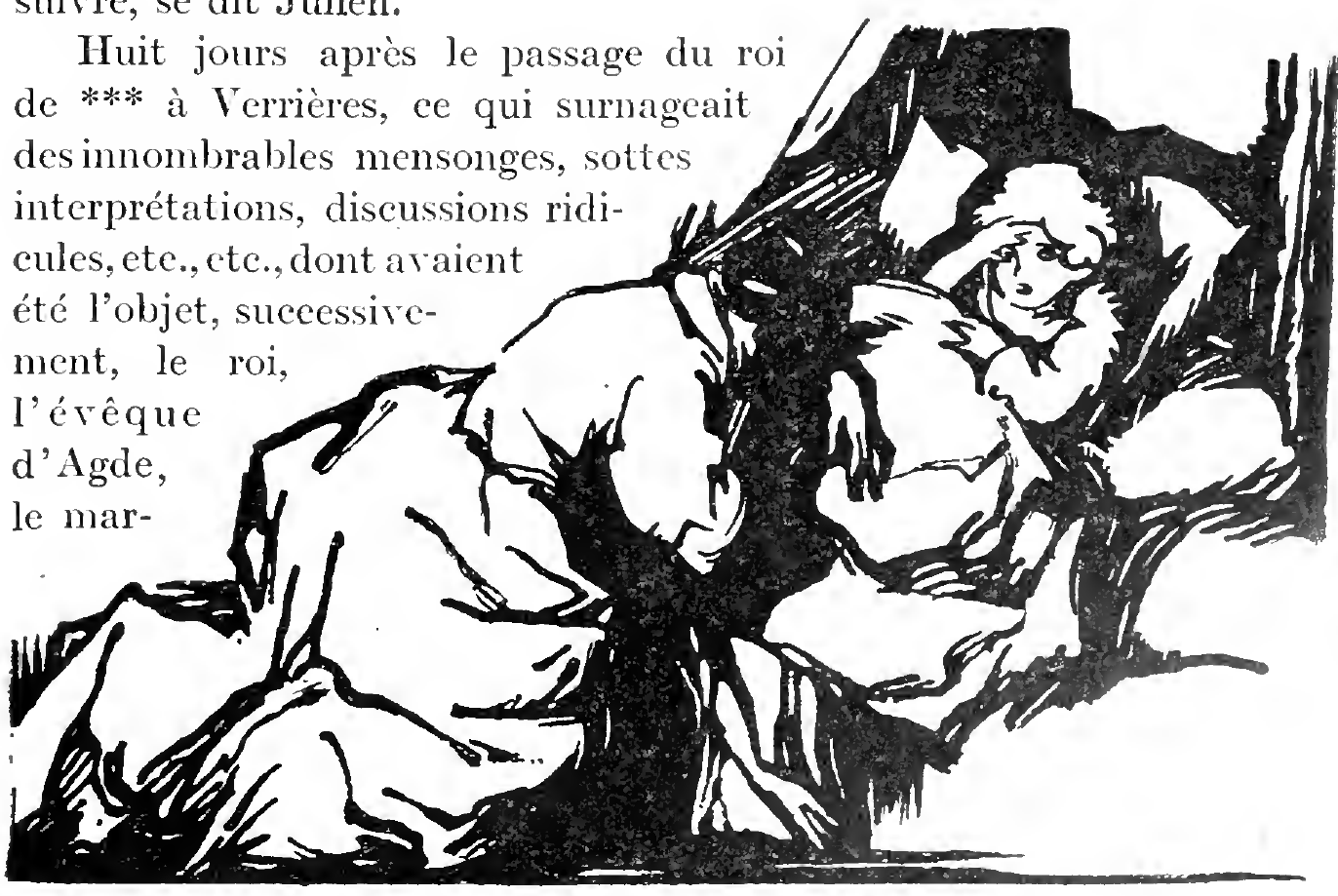
Shortly after the return to Vergy, Stanislas-Xavier, the youngest of the children, came down with a fever; suddenly Madame de Rênal fell into frightful remorse. For the first time she reproached herself for her love in a sustained way; she seemed to understand, as if by a miracle, into what enormous fault she had let herself be drawn. Although of a profoundly religious nature, until that moment she had not thought of the magnitude of her crime in the eyes of God.
Formerly, at the convent of the Sacré-Cœur, she had loved God with passion; she feared Him likewise in this circumstance. The combats that tore her soul were all the more frightful because there was nothing reasonable in her fear. Julien felt that the least reasoning irritated her instead of calming her; she saw in it the language of hell. However, as Julien himself loved little Stanislas very much, he was better received when speaking to her of his illness; it soon took on a serious character. Then continual remorse deprived Madame de Rênal even of the ability to sleep; she did not emerge from a fierce silence: if she had opened her mouth, it would have been to confess her crime to God and to men.
"I implore you," Julien said to her when they were alone, "do not speak to anyone; let me be the sole confidant of your sorrows. If you still love me, do not speak; your words cannot take away our Stanislas's fever." But his consolations produced no effect; he did not know that Madame de Rênal had got it into her head that, to appease the wrath of the jealous God, it was necessary to hate Julien or to see her son die. It was because she felt that she could not hate her lover that she was so unhappy.
"Flee from me," she said to Julien one day; "in the name of God, leave this house: it is your presence here that is killing my son."
"God is punishing me," she added in a low voice, "it is just; I adore His equity; my crime is frightful, and I lived without remorse!" It was the first sign of God's abandonment: I must be punished doubly.
Julien was deeply moved. He could see in this neither hypocrisy nor exaggeration. She believes she is killing her son by loving me, and yet the unfortunate woman loves me more than her son. There, I cannot doubt it, is the remorse that is killing her; there is grandeur in such feelings. But how could I have inspired such a love, I, so poor, so badly educated, so ignorant, sometimes so coarse in my manners?
One night, the child was at his worst. Around two o'clock in the morning, M. de Rênal came to see him. The child, devoured by fever, was very red and could not recognize his father. Suddenly Madame de Rênal threw herself at her husband's feet: Julien saw that she was going to tell everything and ruin herself forever.
Fortunately, this singular movement annoyed M. de Rênal.
"Goodbye! goodbye!" he said as he left.
"No, listen to me," cried his wife, on her knees before him, trying to hold him back. "Learn the whole truth. It is I who am killing my son. I gave him life and I am taking it back from him. Heaven is punishing me; in the eyes of God, I am guilty of murder. I must lose myself and humble myself; perhaps this sacrifice will appease the Lord."
If M. de Rênal had been a man of imagination, he would have known everything.
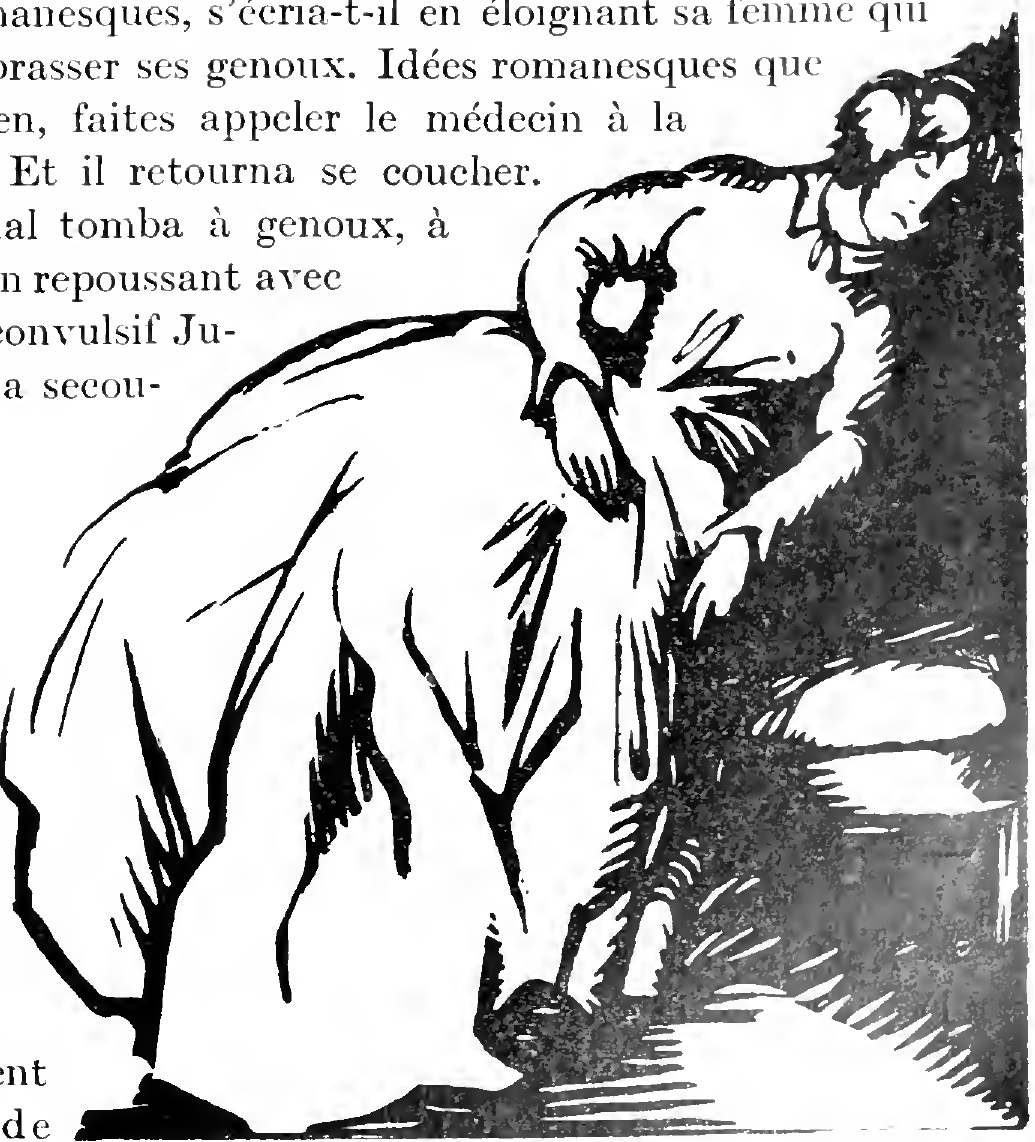
— Romantic ideas! he exclaimed, pushing away his wife, who was trying to embrace his knees. Romantic ideas, all of that! Julien, have the doctor called at daybreak. And he went back to bed.
Madame de Rênal fell to her knees, half fainting, repulsing with a convulsive movement Julien, who wanted to help her.
Julien remained astonished.
So this is adultery! he said to himself.... Could it be possible that those priests, so deceitful... were right? They who commit so many sins would have the privilege of
knowing the true theory of sin? What a peculiarity!...
For the twenty minutes since M. de Rênal had withdrawn, Julien had been seeing the woman he loved, her head resting on the child's little bed, motionless and almost unconscious. There is a woman of superior genius reduced to the utmost misery, because she has known me, he said to himself.
The hours advance rapidly. What can I do for her? I must decide. It is no longer a question of me here. What do I care about men and their flat grimaces? What can I do for her?... leave her? But I leave her alone, prey to the most frightful grief. This automaton of a husband harms her more than he helps her. He will say some harsh word to her, from sheer coarseness; she may go mad, throw herself out of the window.
If I leave her, if I cease to watch over her, she will confess everything to him. And who knows, perhaps, despite the inheritance she is to bring him, he will make a scandal. She may tell everything, great God! to that c... of an abbé Maslon, who takes the illness of a six-year-old child as a pretext to stay in this house, and not without design. In her grief and her fear of God, she forgets all that she knows of the man; she sees only the priest.
— Go away, Madame de Rênal suddenly said to him, opening her eyes.
— I would give my life a thousand times to know what can be most useful to you, replied Julien: never have I loved you so much, my dear angel, or rather, from this moment only, I begin to adore you as you deserve to be. What will become of me far from you, and with the consciousness that you are unhappy because of me! But let there be no question of my sufferings. I shall leave, yes, my love. But, if I leave you, if I cease to watch over you, to find myself constantly between you and your husband, you will tell him everything, you will ruin yourself. Remember that it is with ignominy that he will drive you from his house; all Verrières, all Besançon, will talk of this scandal. You will be given all the blame; never will you recover from this shame...
“That is just what I am asking for,” she cried, rising to her feet. “I shall suffer; so much the better.”
“But by this abominable scandal you will also bring misfortune upon him!”
“But I humble myself, I cast myself into the mire; and thereby perhaps I save my son. This humiliation, in the eyes of all, is perhaps a public penance. As far as my weakness can judge, is it not the greatest sacrifice I can make to God? Perhaps He will deign to accept my humiliation and leave me my son! Point out to me any other more painful sacrifice, and I will hasten to make it.”
“Let me punish myself. I too am guilty. Do you wish me to retire to La Trappe? The austerity of that life may appease your God… Ah! heaven! why cannot I take upon myself Stanislas’s illness?”
“Ah! you love him, you do,” said Madame de Rênal, rising and throwing herself into his arms.
At the same instant she thrust him from her with horror.
“I believe you! I believe you,” she continued, after sinking to her knees again;
“O my only friend! why are you not the father of Stanislas! Then it would not be a horrible sin to love you better than your son.”
“Will you allow me to stay, and that henceforth I love you only as a brother? It is the only reasonable expiation; it may appease the wrath of the Most High.”
“And I,” she cried, rising and taking Julien’s head between her two hands, and holding it before her eyes at a distance, “and I, shall I love you as a brother? Is it in my power to love you as a brother?”
Julien burst into tears.
“I will obey you,” he said, falling at her feet; “I will obey you, whatever you command me; it is all that is left for me to do. My mind is struck with blindness; I see no course to take. If I leave you, you tell everything to your husband; you ruin yourself and him with you. Never, after this ridicule, will he be nominated deputy. If I stay, you believe me the cause of your son’s death, and you die of grief. Will you try the effect of my departure? If you wish, I will punish myself for our fault by leaving you for eight days. I will spend them in the retreat you choose. At the abbey of Bray-le-Haut, for instance; but swear to me that during my absence you will confess nothing to your husband. Remember that I can never come back if you speak.”
She promised; he departed, but was recalled at the end of two days.
“It is impossible for me to keep my oath without you. I shall speak to my husband if you are not constantly there to order me by your looks to be silent. Every hour of this abominable life seems to me to last a whole day.”
At last Heaven took pity on this unhappy mother. Little by little Stanislas was no longer in danger. But the ice was broken; her reason had known the extent of her sin, she could no longer regain her equilibrium. Remorse remained, and it was what it must be in so sincere a heart. Her life was heaven and hell: hell when she did not see Julien, heaven when she was at his feet. “I no longer cherish any illusion,” she said to him, even in the moments when she dared to abandon herself to all her love: “I am damned, irremediably damned. You are young, you yielded to my seductions, Heaven may pardon you; but I, I am damned. I know it by a certain sign. I am afraid; who would not be afraid at the sight of hell? But at bottom I do not repent. I would commit my sin again if it were to be committed. Only let Heaven not punish me in this world and in my children, and I shall have more than I deserve. But you, at least, my Julien,” she cried at other moments, “are you happy? Do you find that I love you enough?”
Julien’s mistrust and wounded pride, which above all needed a love of sacrifices, could not hold out before the sight of a sacrifice so great, so indubitable, and made at every instant. He adored Madame de Rênal. She may be noble, and I the son of a workman, she loves me… I am not in her eyes a valet charged with the functions of a lover. This far-off fear once removed, Julien fell into all the follies of love, into its mortal uncertainties.
“At least,” she cried, seeing his doubts of her love, “let me make you very happy during the few days we have to spend together! Let us hasten; tomorrow perhaps I shall be yours no longer. If Heaven strikes me in my children, it will be in vain that I seek to live only to love you, to avoid seeing that it is my crime that kills them. I shall not be able to survive that blow. Even if I wished it, I could not; I should go mad.
Ah! if I could take upon myself your sin, as you so generously offered to take upon yourself Stanislas’s burning fever!”
This great moral crisis changed the nature of the feeling that united Julien to his mistress. His love was no longer merely admiration for beauty, the pride of possessing her.
Their happiness was henceforth of a far higher nature; the flame that devoured them was more intense. They had transports full of madness. Their happiness would have appeared greater in the eyes of the world. But they no longer found the delicious serenity, the cloudless felicity, the easy happiness of the first epochs of their love, when Madame de Rênal’s only fear was that of not being loved enough by Julien. Their happiness sometimes had the aspect of crime.
In the happiest moments and apparently the most tranquil: “Ah! great God! I see hell,” Madame de Rênal suddenly cried, pressing Julien’s hand with a convulsive movement. “What horrible torments! I have well deserved them.” She clung to him, holding fast to him as the ivy to the wall.
Julien tried in vain to calm this agitated soul. She took his hand, which she covered with kisses. Then, relapsing into a sombre reverie: “Hell,” she said, “hell would be a grace to me; I should still have a few days on earth to pass with him, but hell in this world, the death of my children… Yet, at that price, perhaps my crime would be forgiven me… Ah! great God! do not grant me my pardon at that price. These poor children have not offended You; I, I alone am guilty: I love a man who is not my husband.”
Julien then saw Madame de Rênal arrive at moments apparently calm. She sought to master herself; she wished not to poison the life of the man she loved.
Amid these alternations of love, remorse and pleasure, the days passed for them with the swiftness of lightning. Julien lost the habit of reflection.
Mademoiselle Élisa went to follow a small lawsuit she had at
Verrières. She found M. Valenod greatly incensed against Julien. She hated the tutor, and often spoke to him of him.
“You would ruin me, Monsieur, if I told the truth!…” she said one day to M. Valenod. “Masters are all agreed among themselves in important matters… Certain confessions are never forgiven to poor servants…”
After these customary phrases, which M. Valenod’s impatient curiosity found the art of abridging, he learned the most mortifying things for his self-esteem.
This woman, the most distinguished in the country, whom for six years he had surrounded with so many attentions, and unfortunately openly and in the sight of all; this woman so proud, whose disdain had so many times made him blush, had just taken as her lover a little workman disguised as a tutor. And so that nothing should be lacking in the vexation of the director of the depot, Madame de Rênal adored this lover. And, added the lady's maid with a sigh, M. Julien had not taken any trouble to make this conquest; he had not departed from his usual coldness for Madame.
Élisa had only been certain of things in the country, but she believed that this intrigue dated from much further back. It is doubtless for that reason, she added with vexation, that at the time he refused to marry me. And I, idiot, who was going to consult Madame de Rênal, who was begging her to speak to the tutor!
That very evening M. de Rênal received from the town, along with his newspaper, a long anonymous letter which informed him in the greatest detail of what was happening in his house. Julien saw him turn pale as he read this letter written on bluish paper, and cast malicious glances at him. For the whole evening the mayor did not recover from his agitation; it was in vain that Julien courted him by asking for explanations about the genealogy of the best families of Burgundy.