About this book
Julien Sorel climbs from sawmill to salon, torn between the red of the army and the black of the church. Stendhal's 1830 novel, free to read online.
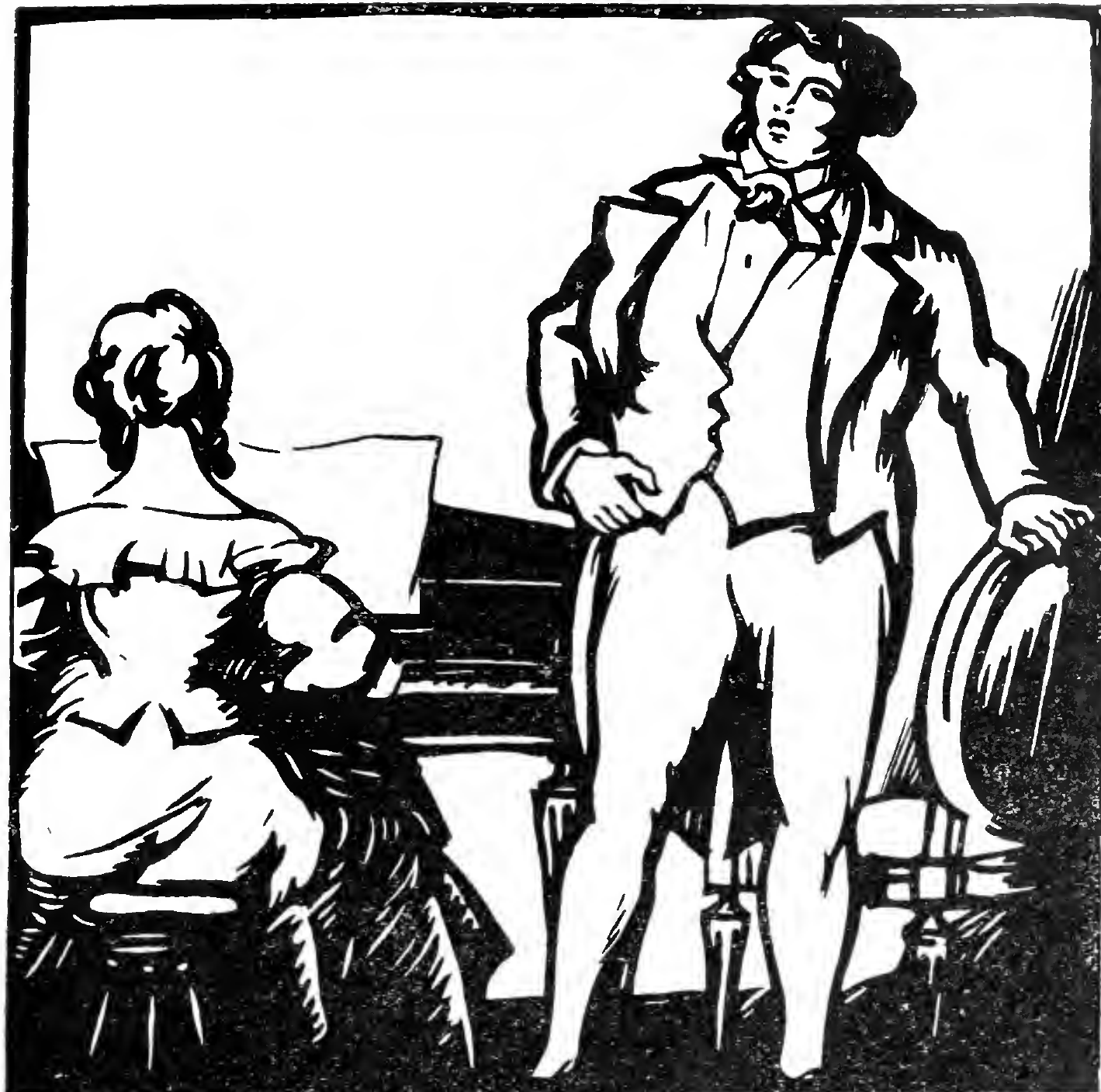
THE MANNER OF ACTING IN 1830
Speech was given to man to hide his thought.
R. P. MALAGRIDA.
SCARCELY arrived at Verrières, Julien reproached himself for his injustice toward Madame de Rênal. I should have despised her as a little woman, if, through weakness, she had bungled her scene with M. de Rênal. She comes out of it like a diplomat, and I sympathize with the vanquished who is my enemy. There is in my conduct a bourgeois pettiness; my vanity is shocked, because M. de Rênal is a man! illustrious and vast corporation to which I have the honour to belong; I am nothing but a fool.
M. Chélan had refused the lodgings that the most esteemed liberals of the country had offered him in emulation, when his dismissal drove him from the presbytery. The two rooms he had rented were encumbered with his books. Julien, wishing to show Verrières what a priest was, went to take from his father a dozen deal planks, which he carried himself on his back all along the Grande-Rue. He borrowed tools from an old comrade, and soon had built a sort of bookcase, in which he arranged M. Chélan's books.
“I believed you to be corrupted by the vanity of the world,” the old man said to him, weeping with joy; “this more than redeems the childishness of that brilliant honorary-guard uniform which made you so many enemies.”
M. de Rênal had ordered Julien to lodge in his house. No one suspected what had happened. On the third day after his arrival, Julien saw climbing all the way up to his room no less a personage than M. the subprefect Maugiron. It was only after two full hours of insipid chatter and grand lamentations about the wickedness of men, about the scant probity of those charged with administering public funds, about the dangers of this poor France, etc., that Julien finally saw the purpose of the visit emerge. They were already on the landing of the staircase, and the poor tutor, half disgraced, was escorting with proper respect the future prefect of some fortunate department, when it pleased the latter to take an interest in Julien’s fortune, to praise his moderation in matters of interest, etc., etc. Finally M. de Maugiron, clasping him in his arms with the most fatherly air, proposed that he leave M. de Rênal and enter the household of a functionary who had children to educate, and who, like King Philip, thanked heaven, not so much for having given them to him as for having caused them to be born in the vicinity of M. Julien. Their tutor would enjoy a salary of eight hundred francs, payable not month by month, which is not noble, said M. de Maugiron, but quarterly, and always in advance.
It was Julien’s turn, who for an hour and a half had been waiting to speak with weariness. His reply was perfect, and above all long as a pastoral letter; it allowed everything to be understood, and yet stated nothing clearly. One would have found in it at once respect for M. de Rênal, veneration for the public of Verrières, and gratitude toward the illustrious subprefect. This subprefect, astonished to find himself more Jesuitical than he, tried in vain to obtain anything precise. Julien, enchanted, seized the occasion to exercise himself, and began his reply again in other terms. Never has an eloquent minister, wishing to wear out the end of a session at which the Chamber seems inclined to wake up, said less in more words. Hardly had M. de Maugiron gone out than Julien began to laugh like a madman. To profit from his Jesuitical verve, he wrote a nine-page letter to M. de Rênal, in which he gave him an account of everything that had been said to him, and humbly asked his advice. That rascal did not even tell me the name of the person who makes the offer! It will be M. Valenod, who sees in my exile to Verrières the effect of his anonymous letter. His dispatch sent, Julien, as content as a hunter who, at six in the morning, on a fine autumn day, emerges into a plain abundant in game, went out to seek advice from M. Chélan. But before arriving at the good curé’s, the sky, which wished to reserve pleasures for him, threw in his path M. Valenod, from whom he did not conceal that his heart was torn; a poor boy like him owed himself entirely to the vocation that heaven had placed in his heart, but vocation was not everything in this lower world. To labor worthily in the vineyard of the Lord, and not to be altogether unworthy of so many learned collaborators, instruction was necessary; he would have to spend two very costly years at the seminary of Besançon; it therefore became indispensable to make savings, which was much easier on a salary of eight hundred francs paid quarterly than with six hundred francs eaten up month by month. On the other hand, heaven, in placing him near the young Rênals and in inspiring him with a special attachment for them, did it not seem to indicate that it was not fitting to abandon this education for another?
Julien attained such a degree of perfection in that kind of eloquence, which has replaced the promptness of action of the Empire, that he ended by boring himself with the sound of his own words.
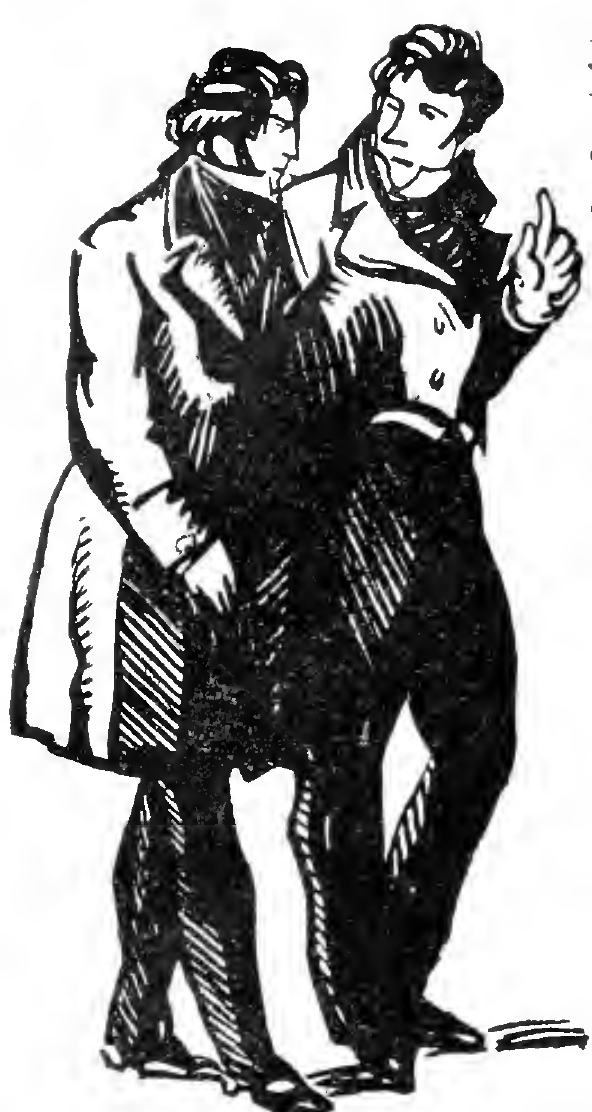
On returning, he found a servant of M. Valenod, in full livery, who was looking for him all over the town, with a note inviting him to dinner for that same day.
Julien had never been to this man's house; only a few days earlier, he had thought of nothing but ways of giving him a volley of cane blows without landing himself in a police-court case. Although the dinner was announced for one o'clock, Julien thought it more respectful to present himself as early as half past twelve in the study of the director of the depot. He found him displaying his importance amid a crowd of cardboard files. His thick black side-whiskers, his enormous quantity of hair, his Greek cap set askew on the top of his head, his immense pipe, his embroidered slippers, the heavy gold chains crossed every which way over his chest, and all this apparatus of a provincial financier who believes himself a man of amorous conquests, made no impression on Julien; he thought all the more about the cane blows he owed him.
He asked the honour of being presented to Madame Valenod; she was at her toilette and could not receive him. By way of compensation, he had the advantage of attending that of M. the director of the depot. They then went in to Madame Valenod, who presented her children to him with tears in her eyes. This lady, one of the most considerable in Verrières, had a large man's face on which she had put rouge for this occasion. She displayed all the pathos
Julien was thinking of Madame [de Rênal]; melancholy did not leave him
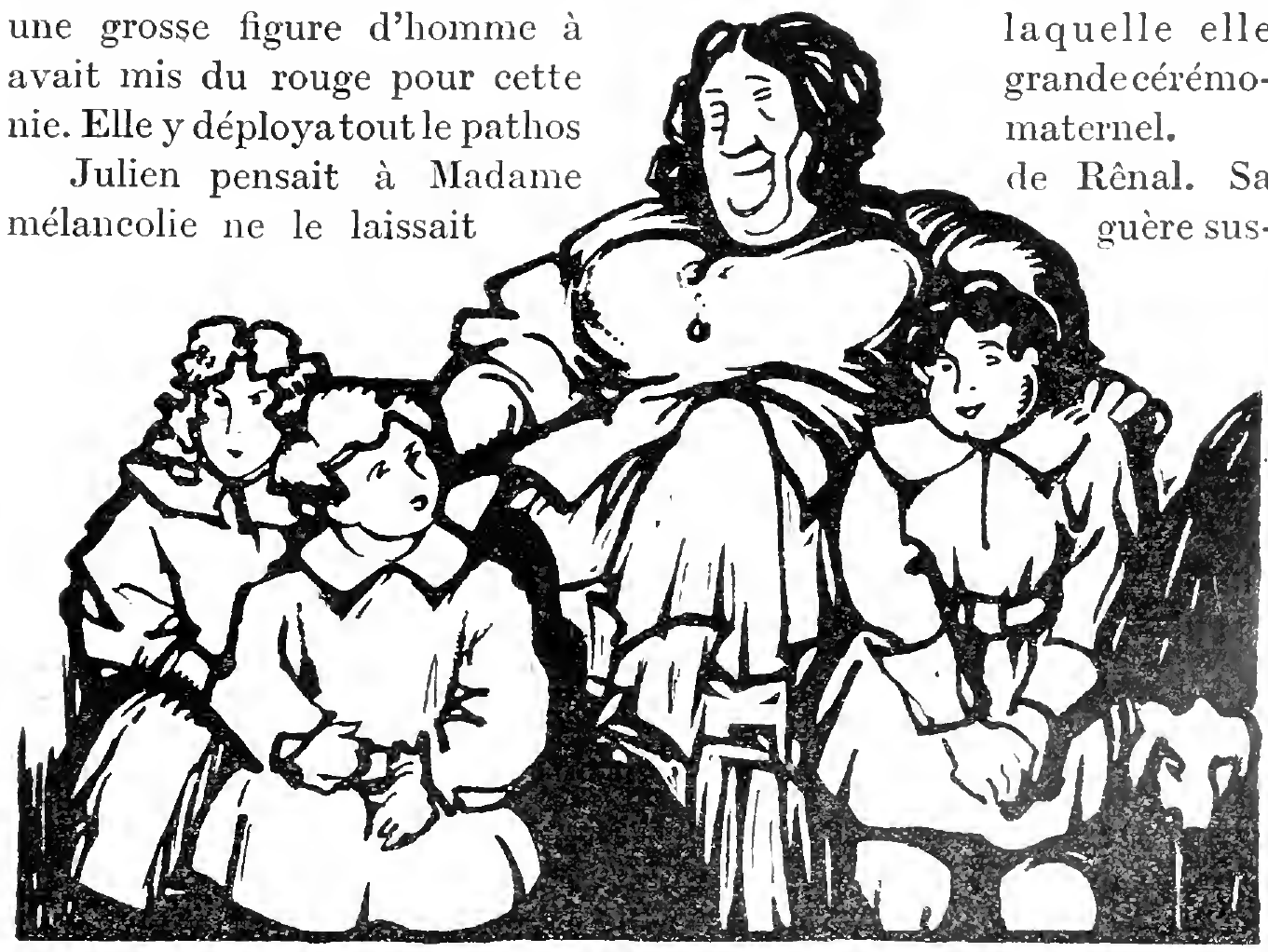
susceptible to anything but that kind of memory which is called up by contrasts, but then it seized hold of him to the point of tenderness. This disposition was increased by the sight of the director of the depot's house. He was made to visit it. Everything there was magnificent and new, and he was told the price of each piece of furniture. But Julien found something ignoble in it, which smacked of stolen money. Down to the servants, everyone there seemed to be composing his countenance against contempt.
The tax collector, the man of indirect taxation, the gendarmerie officer and two or three other public officials arrived with their wives. They were followed by a few rich liberals. Dinner was announced. Julien, already very ill-disposed, came to think that, on the other side of the dining-room wall, there were poor prisoners, on whose portion of meat there had perhaps been skimped in order to buy all this luxury of bad taste with which they wished to dazzle him.
They are perhaps hungry at this very moment, he said to himself; his throat tightened, it was impossible for him to eat and almost to speak. It was far worse a quarter of an hour later; from time to time some strains of a popular song could be heard, and, it must be admitted, a rather ignoble one, sung by one of the recluses. M. Valenod looked at one of his servants in full livery, who disappeared, and soon the singing was heard no more. At that moment, a servant was offering Julien some Rhine wine in a green glass, and Madame Valenod took care to make him observe that this wine cost nine francs a bottle taken on the spot. Julien held his green glass, and said to M. Valenod:
"They are no longer singing that ugly song."
"By Jove! I should think not," replied the director, triumphantly, "I have imposed silence on the beggar."
That word was too much for Julien; he had the manners, but not yet the heart, of his profession. Despite all his hypocrisy so often practised, he felt a big tear rolling down his cheek.
He tried to hide it with the green glass, but it was absolutely impossible for him to do honour to the Rhine wine. To prevent him from singing! he said to himself, O my God! and thou dost suffer it!
Fortunately, no one noticed his ill-bred emotion. The tax collector had struck up a royalist song. During the uproar of the refrain, sung in chorus: So then, Julien's conscience was saying to him, this is the sordid fortune you will attain, and you will enjoy it only on this condition and in such company! You will perhaps have a post worth twenty thousand francs, but you will have to, while you gorge yourself on meats, prevent the poor prisoner from singing; you will give dinners with the money you have stolen from his miserable pittance, and during your dinner he will be even more wretched! — O Napoleon! how sweet it was in your time to rise to fortune through the dangers of battle! but to increase cowardly the suffering of the wretched!
I confess that the weakness Julien shows in this monologue gives me a poor opinion of him. He would be worthy to be the colleague of those conspirators in yellow gloves, who claim to change the whole manner of being of a great country, and do not wish to have to reproach themselves with the slightest scratch.
Julien was violently recalled to his role. It was not to dream and say nothing that he had been invited to dinner in such good company.
A retired printed-calico manufacturer, corresponding member of the academy of Besançon and of that of Uzès, addressed him from one end of the table to the other, to ask him whether what was generally said of his astonishing progress in the study of the New Testament was true.
A profound silence suddenly established itself; a Latin New Testament found itself as though by enchantment in the hands of the learned member of two academies. On Julien's reply, a half-sentence of Latin was read at random. He recited it: his memory proved faithful, and this prodigy was admired with all the noisy energy of the end of a dinner. Julien was looking at the rouged faces of the ladies; several were not bad-looking. He had singled out the wife of the tax collector, the fine singer.
"I am ashamed, in truth, to speak Latin so long before these ladies," he said, looking at her. "If M. Rubignéau"—such was the member of the two academies—"will be so kind as to read a Latin sentence at random, instead of answering by following the Latin text, I shall try to translate it impromptu." This second test put the crowning touch to his glory.
There were there several rich liberals, but happy fathers of children likely to obtain scholarships, and in that capacity suddenly converted since the last mission. Despite this stroke of fine politics, M. de Rênal had never been willing to receive them at his house. These worthy people, who knew Julien only by reputation and from having seen him on horseback on the day of the king of ***'s entry, were his most noisy admirers. When will these fools tire of listening to this biblical style, of which they understand nothing? he was thinking. But on the contrary this style amused them by its strangeness; they laughed at it. But Julien grew weary.

He rose gravely as six o'clock struck and spoke of a chapter of the new theology of Ligorio, which he had to learn in order to recite it the next day to M. Chélan. "For my trade," he added agreeably, "is to make lessons be recited and to recite them myself."
They laughed a great deal; they admired; such is the wit in use at Verrières. Julien was already on his feet, everyone rose despite decorum; such is the empire of genius. Madame Valenod kept him another quarter of an hour; he really had to hear the children recite their catechism; they made the drollest confusions, of which he alone was aware. He was careful not to point them out. What ignorance of the first principles of religion! he was thinking. He bowed at last and believed he could escape; but he had to endure a fable of La Fontaine.
"That author is quite immoral," said Julien to Madame Valenod; "a certain fable about messire Jean Chouart dares to pour ridicule on what is most venerable. It is sharply blamed by the best commentators." Before leaving, Julien received four or five invitations to dinner. "This young man does honour to the department," cried all the guests at once, highly merry. They went so far as to speak of a pension voted from the communal funds, to put him in a position to continue his studies in Paris.
While this imprudent idea was making the dining room ring, Julien had nimbly gained the carriage gate. "Ah! scoundrels! scoundrels!" he cried in a low voice three or four times in succession, giving himself the pleasure of breathing the fresh air.
He felt quite the aristocrat at that moment, he who for so long had been so shocked by the disdainful smile and haughty superiority that he detected at the bottom of all the courtesies addressed to him at M. de Rênal's. He could not help feeling the extreme difference. Let us even forget, he said to himself as he went along, that it is a question of money stolen from the poor prisoners, and even that they are prevented from singing! Did M. de Rênal ever take it into his head to tell his guests the priceof each bottle of wine he sets before them? And this M. Valenod, in the enumeration of his properties, which keeps coming back without ceasing, he cannot speak of his house, his estate, etc., if his wife is present, without saying your house, your estate.
-
This lady, apparently so sensitive to the pleasure of ownership, had just made an abominable scene, during dinner, with a servant who had broken a stemmed glass and spoiled one of her dozens; and this servant had replied with the utmost insolence.
What a collection! said Julien; they would give me half of everything they steal, and I would not want to live with them. One fine day, I would betray myself; I could not restrain the expression of the disdain they inspire in me.
It was necessary, however, according to Madame de Rênal's orders, to attend several dinners of the same kind; Julien was in fashion: his guard-of-honor coat was forgiven him, or rather this imprudence was the true cause of his success. Soon there was no question in Verrières but of seeing who would prevail in the struggle to obtain the learned young man, M. de Rênal or the director of the depot. These gentlemen formed with M. Maslon a triumvirate that for many years had tyrannized the town. The mayor was envied, the liberals had reason to complain of him; but after all he was noble and made for superiority, whereas M. Valenod's father had left him no more than six hundred livres of income. He had had to pass, in his case, from pity for the ugly apple-green coat that everyone had known him to wear in his youth, to envy for his Norman horses, for his gold chains,for his clothes come from Paris, for all his present prosperity.
In the flood
of this new world for Julien, he believed he had discovered an honest man; he was a geometrician, named Gros, and passed for a Jacobin. Julien, having vowed never to say anything but what seemed false to himself, was obliged to confine himself to suspicion with regard to M. Gros. He received from Vergy large packets of themes. He was advised to see his father often, and he conformed to this sad necessity. In a word, he was repairing his reputation fairly well, when one morning he was greatly surprised to feel himself awakened by two hands that were covering his eyes.
It was Madame de Rênal, who had made a trip to the town, and who, climbing the stairs four at a time and leaving her children occupied with a favorite rabbit that was of the party, had reached Julien's room a moment before them. This moment was delicious, but very short: Madame de Rênal had disappeared when the children arrived with the rabbit, which they wanted to show to their friend. Julien gave a warm welcome to all, even to the rabbit. It seemed to him that he was finding his family again; he felt that he loved these children, that he took pleasure in chatting with them. He was astonished at the gentleness of their voices, at the simplicity and nobility of their little ways: he needed to wash his imagination clean of all the vulgar ways of acting, of all the disagreeable thoughts amid which he breathed at Verrières. It was always the fear of failing, always luxury and misery at each other's throats. The people at whose houses he dined, apropos of their roast, made confidences that were humiliating for themselves and nauseating for whoever heard them.
"You nobles, you are right to be proud," he said to Madame de Rênal. And he told her of all the dinners he had endured.
"So you are in fashion!" And she laughed heartily at the thought of the rouge that Madame Valenod felt obliged to put on every time she expected Julien. "I believe she has designs on your heart," she added.
The lunch was delicious. The presence of the children, though apparently embarrassing, in fact increased the common happiness. These poor children did not know how to show their joy at seeing Julien again. The servants had not failed to tell them that he was being offered two hundred francs more to educate the little Valenods.
In the middle of lunch, Stanislas-Xavier, still pale from his great illness, suddenly asked his mother how much his silver place setting was worth, and the goblet from which he drank.
"Why do you ask?"
"I want to sell them to give the price to M. Julien, so that he won't be a dupe in staying with us."
Julien kissed him with tears in his eyes. His mother was crying outright, while Julien, who had taken Stanislas on his knees, explained to him that one must not use the word dupe, which, employed in that sense, was a way of speaking used by lackeys. Seeing the pleasure he was giving Madame de Rênal, he sought to explain, by picturesque examples that amused the children, what it was to be a dupe.
"I understand," said Stanislas, "it's the crow who is foolish enough to let his cheese fall, which the fox takes, and the fox was a flatterer."
Madame de Rênal, mad with joy, covered her children with kisses, which could not be done without leaning a little on Julien.
Suddenly the door opened; it was M. de Rênal. His severe and discontented face made a strange contrast with the gentle joy that his presence drove away. Madame de Rênal turned pale; she felt incapable of denying anything. Julien seized the word, and, speaking very loudly, began to tell M. the mayor the incident of the silver goblet that Stanislas wanted to sell. He was sure that this story would be badly received. First, M. de Rênal frowned from good habit at the mere name of money. The mention of that metal, he said, is always a preface to some draft drawn on my purse.
But here there was more than a money interest; there was an increase of suspicions. The air of happiness that animated his family in his absence was not calculated to arrange matters with a man dominated by such a touchy vanity. As his wife praised to him the manner, full of grace and wit, with which Julien gave new ideas to his pupils:
"Yes! yes! I know it, he makes me odious to my children; it is very easy for him to be a hundred times more amiable to them than I am, who, at bottom, am the master. Everything in this century tends to cast odium on legitimate authority. Poor France!"
Madame de Rênal did not stop to examine the nuances of the reception her husband gave her. She had just glimpsed the possibility of spending twelve hours with Julien. She had a host of purchases to make in the town, and declared that she absolutely wanted to go and dine at the inn; whatever her husband might say or do, she held to her idea. The children were delighted at that single word inn, which modern prudishness pronounces with so much pleasure.
M. de Rênal left his wife in the first novelty shop she entered, to go and pay a few visits. He returned more morose than in the morning; he was convinced that the whole town was occupied with him and Julien. In truth, no one had yet let him suspect the offensive part of the public's talk. Those that had been repeated to M. the mayor had to do solely with whether Julien would remain with him at six hundred francs, or would accept the eight hundred francs offered by M. the director of the deposit.
This director, who met M. de Rênal in society, gave him a cold reception. This conduct was not without skill; there is little thoughtlessness in the provinces, sensations there are so rare that people sound them to the bottom.
M. Valenod was what is called, a hundred leagues from Paris, a faraud; he is a species of man of a brazen and coarse nature. His triumphant existence, since 1815, had reinforced his fine dispositions. He reigned, so to speak, at Verrières, under the orders of M. de Rênal: but much more active, blushing at nothing, meddling in everything, constantly going about, writing, speaking, forgetting humiliations, having no personal pretension, he had ended by balancing the credit of his mayor in the eyes of the ecclesiastical power. M. Valenod had, as it were, said to the grocers of the country: Give me the two stupidest among you; to the men of law: Point out to me the two most ignorant; to the health officers: Designate to me the two greatest charlatans. When he had gathered the most brazen of each trade, he had said to them: Let us reign together.
The ways of these people wounded M. de Rênal.
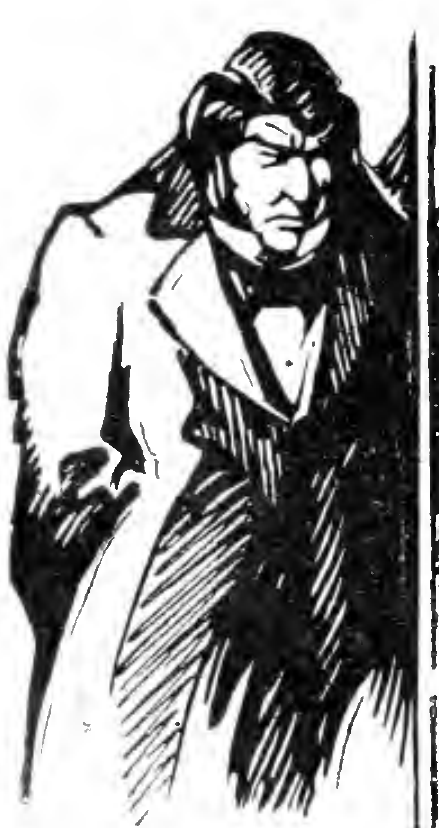
Valenod's coarseness was offended by nothing, not even by the contradictions that the little abbé Maslon did not spare him in public.
But, in the midst of this prosperity, M. Valenod needed to reassure himself by little insolences of detail against the large truths that he felt everyone had the right to address to him. His activity had redoubled since the fears left him by M. Appert's visit. He had made three journeys to Besançon; he wrote several letters with each mail; he sent others by unknown persons who passed by his house at nightfall. He had perhaps been wrong to have the old curé Chélan dismissed; for this vindictive step had made him regarded, by several devout women of good birth, as a profoundly wicked man. Moreover, this service rendered had placed him in absolute dependence on M. the grand vicar de Frilair; he received strange commissions from him. His policy had reached this point, when he yielded to the pleasure of writing an anonymous letter. To add to his embarrassments, his wife declared to him that she wanted to have Julien in her house; her vanity had taken a fancy to it.
In this position, M. Valenod foresaw a decisive scene with his former confederate M. de Rênal. The latter addressed harsh words to him, which was rather a matter of indifference to him; but he could write to Besançon, and even to Paris.
A cousin of some minister could suddenly land at Verrières and take over the poorhouse. M. Valenod thought of drawing closer to the liberals: this is why several of them were invited to the dinner at which Julien was present. He would have been powerfully supported against the mayor. But elections could come along, and it was only too obvious that the poorhouse and a bad vote were incompatible. The account of this political maneuvering, quite well guessed by Madame de Rênal, had been given to Julien while he was offering her his arm to go from one shop to another, and little by little had drawn them to the COURS DE LA FIDÉLITÉ, where they spent several hours, almost as tranquil as at Vergy.
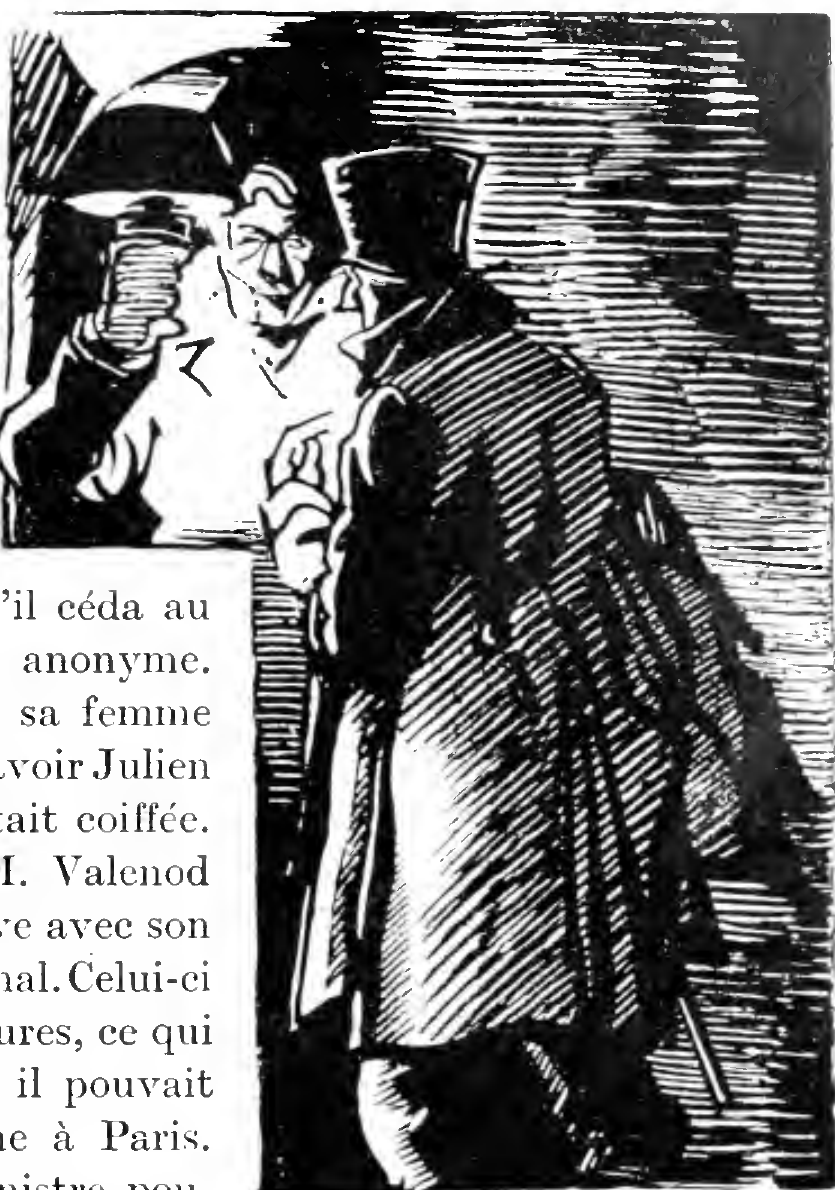
Meanwhile, M. Valenod was trying to ward off a decisive scene with his former patron by himself adopting a bold air toward him. That day, this system succeeded, but increased the mayor's ill humor.
Never has vanity, grappling with all that the petty love of money can have of the harshest and the most sordid, put a man in a more pitiable state than the one in which M. de Rênal found himself uponentering the tavern. Never, on the contrary, had his children been more joyful and more gay. This contrast finished stinging him.
"I am one too many in my family, from what I can see!" he said upon entering, in a tone he tried to make imposing.
For all response, his wife took him aside and expressed to him the necessity of sending Julien away. The hours of happiness she had just found had restored to her the ease and firmness necessary to follow the plan of conduct she had been meditating for a fortnight. What finished completely unsettling the poor mayor of Verrières was that he knew people were publicly joking in the town about his attachment to the species. M. Valenod was generous like a thief, and he himself had conducted himself in a brilliant manner in the five or six last collections for the confraternity of Saint-Joseph, for the congregation of the Virgin, for the congregation of the Holy Sacrament, etc., etc.
Among the country squires of Verrières and the surrounding area, skillfully ranked on the register of the collector brothers according to the amount of their offerings, M. de Rênal's name had more than once been seen occupying the last line. In vain did he say that he himself gained nothing by it. The clergy do not jest on this article.
-