About this book
Julien Sorel climbs from sawmill to salon, torn between the red of the army and the black of the church. Stendhal's 1830 novel, free to read online.
A JOURNEY
One finds elegant people in Paris; there may be people of character in the provinces.
SIEYÈS.
The next day, at five o'clock in the morning, before Madame de Rênal was visible, Julien had obtained a three days' leave of absence from her husband. Contrary to his expectation, Julien found that he desired to see her again; he thought of her hand, so pretty. He went down into the garden; Madame de Rênal kept him waiting a long time. But if Julien had loved her, he would have perceived her behind the half-closed shutters of the first floor, her forehead pressed against the pane. She was watching him. Finally, in spite of her resolutions, she determined to appear in the garden. Her habitual pallor had given place to the most vivid colours. This woman, so naive, was evidently agitated: a feeling of constraint and even of anger altered that expression of profound serenity, as it were above all the vulgar interests of life, which gave such charm to that celestial face.
-
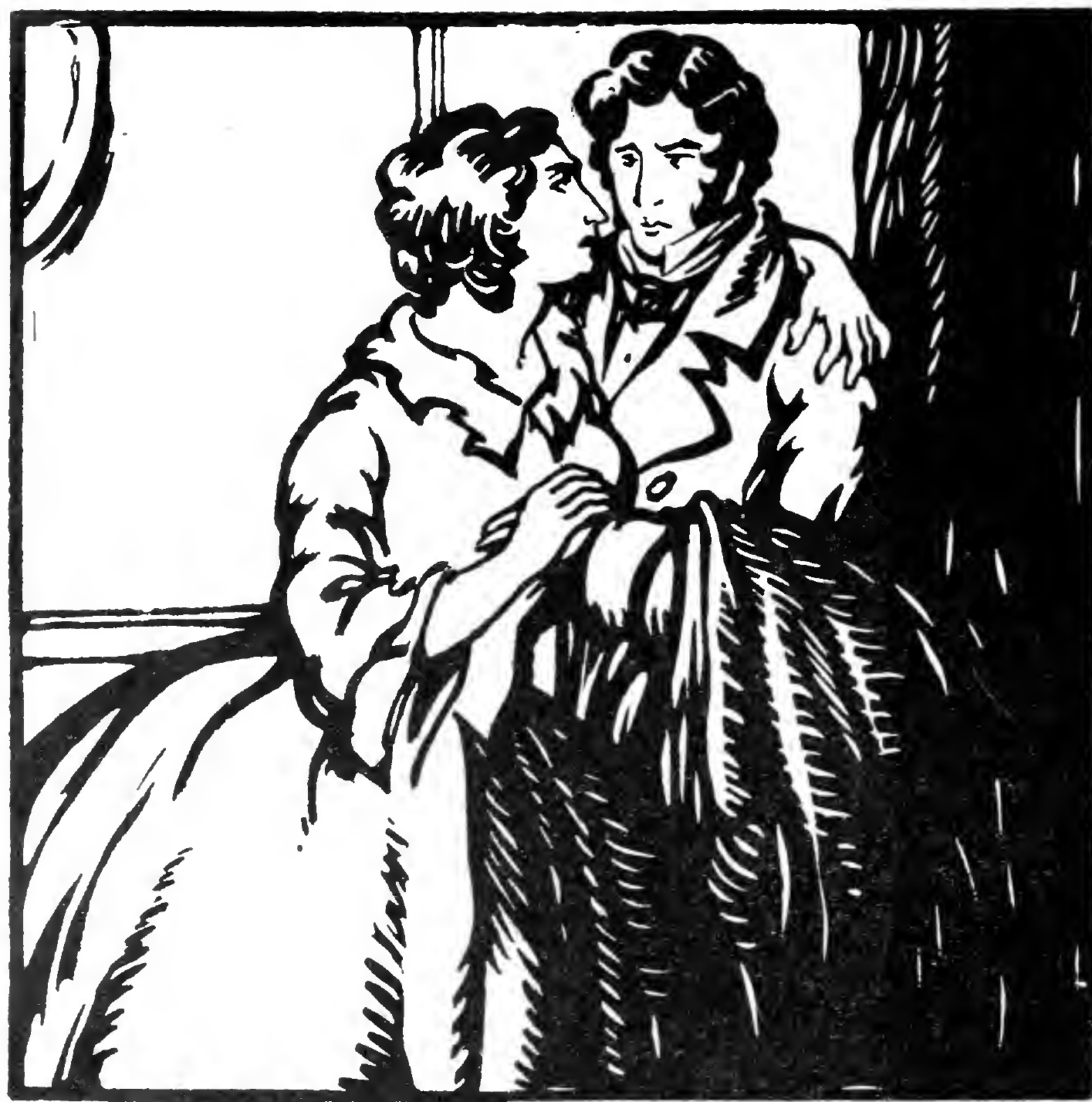
Julien approached her with eagerness; he admired those beautiful arms which a hastily thrown shawl allowed him to perceive. The freshness of the morning air seemed to increase still further the brilliancy of a complexion which the agitation of the night rendered only the more sensitive to every impression. This modest and touching beauty, yet full of thoughts such as are never found in the lower classes, seemed to reveal to Julien a faculty of his soul that he had never felt before. Wholly absorbed in admiration of the charms that his avid gaze surprised, Julien was not thinking in the least of the friendly welcome he had expected to receive. He was all the more astonished at the glacial coldness that they sought to show him, and through which he even thought he could distinguish the intention of putting him in his place.
The smile of pleasure expired on his lips; he remembered the rank he occupied in society, and especially in the eyes of a noble and rich heiress. In a moment there was nothing left on his face but haughtiness and anger against himself. He felt a violent vexation at having been able to delay his departure more than an hour to receive so humiliating a welcome.
It is only a fool, he said to himself, who is angry with others: a stone falls because it is heavy. Shall I always be a child? When shall I have acquired the good habit of giving these people my soul just for their money? If I wish to be esteemed both by them and by myself, I must show them that it is my poverty that traffics with their wealth, but that my heart is a thousand leagues from their insolence, and placed in a sphere too high to be reached by their little marks of disdain or favour.
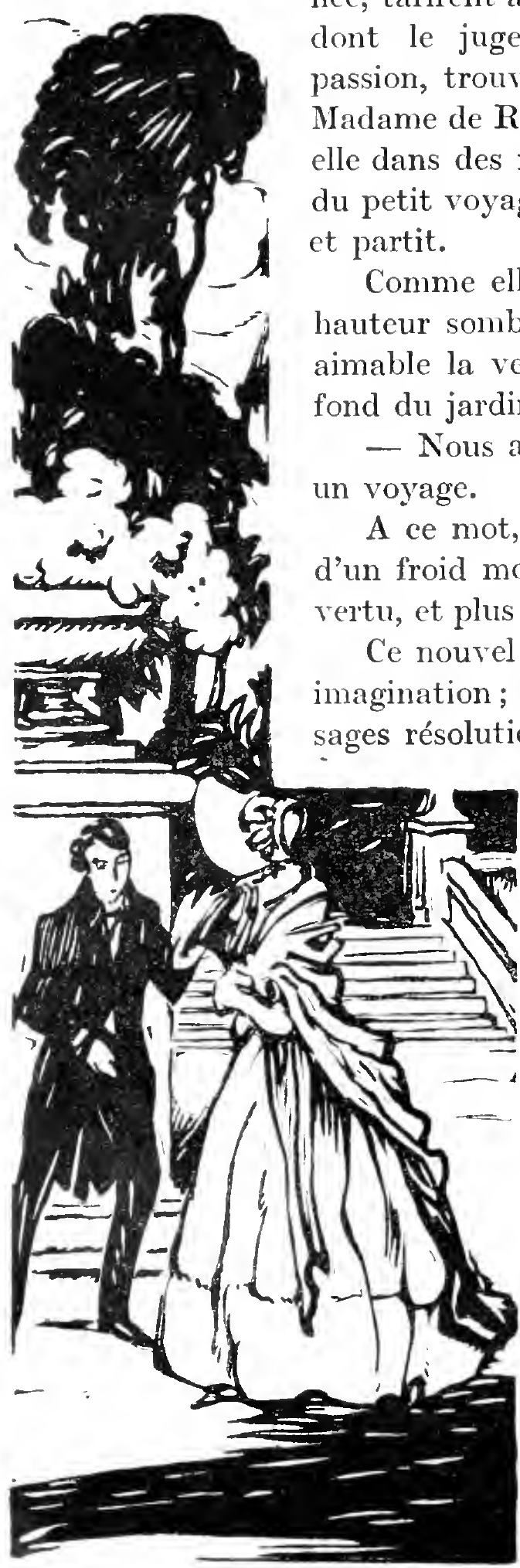
While these feelings crowded in throngs into the soul of the young tutor, his mobile countenance took on the expression of wounded pride and ferocity. Madame de Rênal was quite disturbed by it. The virtuous coldness she had meant to give her welcome gave place to the expression of interest, and of an interest animated by all the surprise of the sudden change she had just witnessed. The empty words that people address to one another in the morning about health, about the beauty of the day, dried up at once in both of them. Julien, whose judgment was disturbed by no passion, soon found a means of marking to Madame de Rênal how little he believed himself to be on terms of friendship with her; he said nothing to her of the little journey he was about to undertake, bowed to her, and departed.
As she watched him go, shattered by the sombre haughtiness she read in that gaze, so amiable the day before, her eldest son, who came running up from the end of the garden, said to her as he embraced her:
"We have a holiday, M. Julien is going away on a journey."
At these words Madame de Rênal felt herself seized by a mortal chill; she was unhappy through her virtue, and more unhappy still through her weakness.
This new event came to occupy her whole imagination; she was carried far beyond the wise resolutions she owed to the terrible night she had just passed. It was no longer a question of resisting this lover so amiable, but of losing him for ever.
She had to be present at breakfast. To crown her grief, M. de Rênal and Madame Derville spoke only of Julien's departure. The mayor of Verrières had noticed something unusual in the firm tone in which he had asked for leave of absence.
"That little peasant has no doubt in his pocket some offers from someone. But that someone, even were it M. Valenod, must be a little discouraged by the sum of 600 francs, to which the annual outlay must now be brought. Yesterday, at Verrières, they will have asked for a delay of three days to reflect; and this morning, so as not to be obliged to give me an answer, the little gentleman sets off for the mountains. To be obliged to reckon with a miserable workman who plays the insolent; that is where we have got to!"
"Since my husband, who does not know how deeply he has wounded Julien, thinks that he will leave us, what am I to believe myself?" said Madame de Rênal. "Ah! everything is decided!"
In order at least to be able to weep in freedom, and not to answer Madame Derville's questions, she complained of a frightful headache and went to bed.
"That is what women are," repeated M. de Rênal, "there is always something out of order in these complicated machines." And he went off, grinning.
While Madame de Rênal was a prey to all that is most cruel in the terrible passion into which chance had drawn her, Julien pursued his way gaily amid the fairest aspects that mountain scenery can present. He had to cross the great chain to the north of Vergy. The path he followed, rising little by little among great beech woods, forms endless zigzags on the slope of the high mountain that outlines to the north the valley of the Doubs. Soon the traveller's gaze, passing over the lower hills that contain the course of the Doubs towards the south, extended as far as the fertile plains of Burgundy and Beaujolais. However insensitive the soul of this young ambitious man might be to this kind of beauty, he could not help stopping from time to time to look at a spectacle so vast and so imposing.
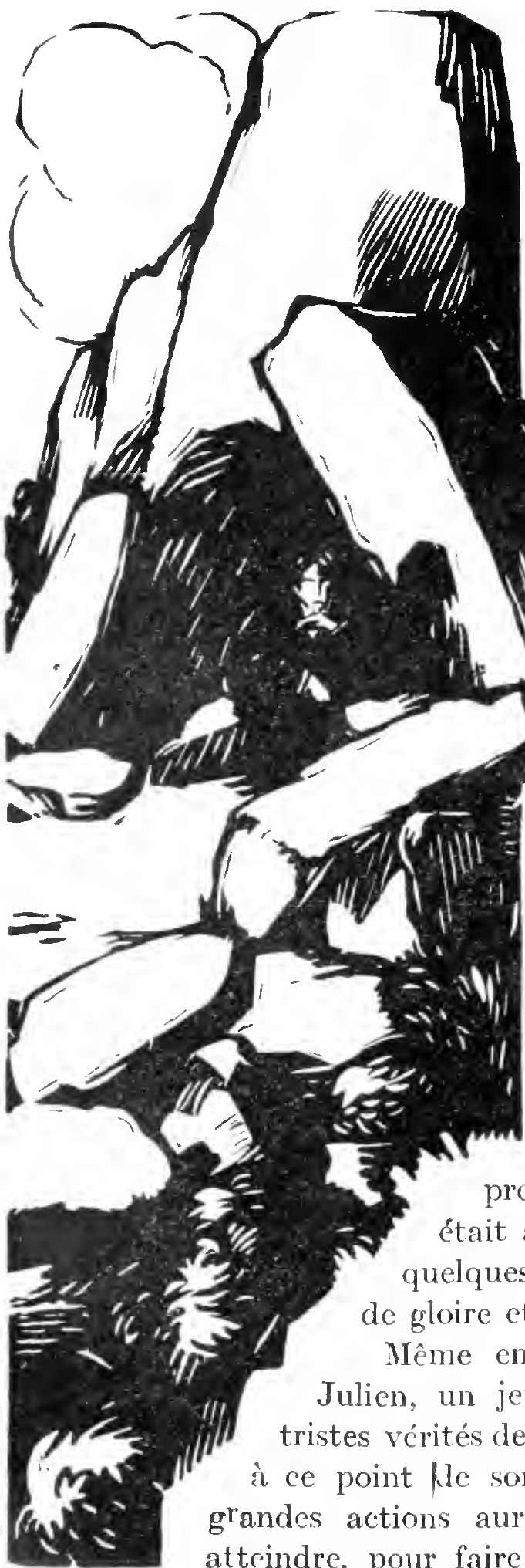
At last he reached the summit of the great mountain, near which he had to pass in order to arrive, by this cross road, at the solitary valley inhabited by Fouqué, the young timber merchant, his friend. Julien was in no haste to see him, or any other human being. Hidden like a bird of prey amid the bare rocks that crown the great mountain, he could perceive from very far off any man who might have approached him. He discovered a little grotto in the middle of the almost vertical slope of one of the rocks. He took to his heels and soon was established in this retreat. Here, he said, with eyes shining with joy, men cannot do me any harm. The idea came to him to give himself up to the pleasure of writing down his thoughts, everywhere else so dangerous for him. A square stone served him as a desk. His pen flew: he saw nothing of what surrounded him. At last he noticed that the sun was setting behind the distant mountains of Beaujolais.
Why should I not pass the night here? he said to himself; I have bread, and I am free! At the sound of that great word his soul was exalted; his hypocrisy made him not free even at Fouqué's. His head resting on both hands, Julien remained in this grotto happier than he had been in his life, agitated by his reveries and by his happiness of freedom.
Without thinking of it he saw all the rays of twilight die out one after another. In the midst of this immense obscurity, his soul wandered in the contemplation of what he imagined he would one day meet in Paris. It was first a woman far more beautiful and of a genius far more elevated than anything he had been able to see in the provinces. He loved with passion, he was loved. If he separated himself from her for a few moments, it was to cover himself with glory and deserve to be still more loved.
Even supposing Julien's imagination, a young man brought up amid the sad truths of Parisian society would have been awakened at this point in the novel by cold irony; great deeds would have disappeared with the hope of attaining them, to make way for the well-known maxim: If one leaves one's mistress, one risks, alas! being deceived two or three times a day. The young peasant saw nothing between himself and the most heroic actions but the lack of opportunity.
.
But a deep night had replaced the day, and he still had two leagues to go to descend to the hamlet inhabited by Fouqué. Before leaving the little grotto, Julien lit a fire and carefully burned everything he had written.
He greatly astonished his friend by knocking at his door at one o'clock in the morning. He found Fouqué occupied in making up his accounts. He was a young man of tall stature, rather ill-made, with large harsh features, an endless nose, and much good nature hidden beneath that repulsive aspect.
"Have you quarreled with your M. de Rênal, then, that you arrive like this unexpectedly?"
Julien told him, but as was necessary, the events of the previous day.
"Stay with me," Fouqué said to him; "I see that you know M. de Rênal, M. Valenod, the sub-prefect Maugiron, the curé Chélan; you have understood the subtleties of the character of those people; here you are in a position to appear at the auctions. You know arithmetic better than I do, you will keep my accounts; I earn a great deal in my trade. The impossibility of doing everything myself and the fear of meeting a rascal in the man I might take as a partner prevent me every day from undertaking excellent business. It is not a month since I made six thousand francs for Michaud of Saint-Amand, whom I had not seen again for six years, and whom I found by chance at the sale of Pontarlier. Why should you not have earned, you, those six thousand francs, or at least three thousand? for, if I had had you with me that day, I would have raised the bid on that lot of wood, and everyone would soon have left it to me. Be my partner."
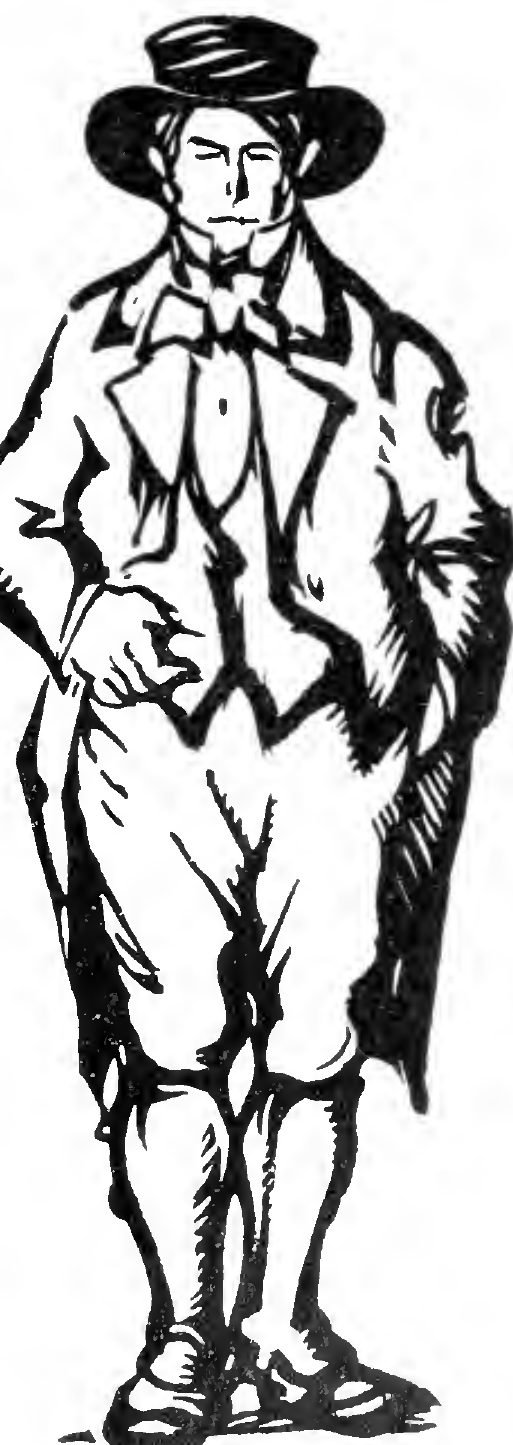
This offer put Julien in good spirits; it disturbed his madness; during the whole supper, which the two friends prepared themselves like heroes of Homer, for Fouqué lived alone, he showed his accounts to Julien, and proved to him how many advantages his timber trade presented. Fouqué had the highest idea of Julien's intelligence and character.
When at last the latter was alone in his little room of pine wood: "It is true," he said to himself, "I can earn a few thousand francs here, then take up again with advantage the trade of soldier or that of priest, according to the fashion which will then reign in France. The little savings I shall have amassed will remove all the difficulties of detail. Solitary on this mountain, I shall have dissipated a little the frightful ignorance in which I am of so many things that occupy all these drawing-room men. But Fouqué renounces marrying; he repeats to me that solitude makes him unhappy. It is evident that if he takes an associate who has no funds to put into his business, it is in the hope of making for himself a companion who will never leave him.
"Shall I deceive my friend?" cried Julien with ill humour. This being, whose hypocrisy and absence of all sympathy were the ordinary means of salvation, could not this time endure the idea of the least lack of delicacy towards a man who loved him.
But suddenly Julien was happy; he had a reason for refusing. "What! I should cowardly lose seven or eight years! I should thus arrive at eight-and-twenty! but, at that age, Bonaparte had done his greatest things! When I shall have obscurely earned some money by running after these timber sales, and earning the favour of some subordinate rascals, who can tell me that I shall still have the sacred fire with which one makes a name for oneself?"
The next morning, Julien replied with great coolness to good Fouqué, who regarded the affair of the partnership as settled, that his vocation for the holy ministry of the altars did not permit him to accept. Fouqué could not get over it.
:
"But do you consider," he kept repeating to him, "that I take you into partnership, or, if you prefer it, that I give you four thousand francs a year? and you want to go back to your M. de Rênal, who despises you as the mud on his shoes! when you will have two hundred louis before you, what prevents you from entering the seminary? I will tell you more, I undertake to procure for you the best living in the country. For," added Fouqué in a lower voice, "I supply firewood to M. le...., M. le...., M..... I deliver them oak essence of the first quality for which they pay me only as for white wood, but never was money better placed."
Nothing could overcome Julien's vocation. Fouqué ended by believing him a little mad. The third day, very early in the morning, Julien left his friend to spend the day among the rocks of the great mountain. He found again his little grotto, but he no longer had peace of soul; his friend's offers had taken it from him. Like Hercules, he found himself not between vice and virtue, but between mediocrity followed by assured well-being and all the heroic dreams of his youth. "I have not, then, a true firmness," he said to himself; and that was the doubt which did him the most harm. "I am not of the wood of which great men are made, since I fear that eight years spent in procuring bread for myself may take from me that sublime energy which makes one do extraordinary things."