About this book
Julien Sorel climbs from sawmill to salon, torn between the red of the army and the black of the church. Stendhal's 1830 novel, free to read online.
THE FINEST POSITIONS IN THE CHURCH
"Services rendered by talent and merit! — beware of a clique."
Télémaque.
THUS the idea of a bishopric was for the first time mingled with the idea of Julien in the mind of a woman who sooner or later was destined to distribute the finest positions in the Church of France. This advantage would hardly have touched Julien; at that moment his thoughts rose to nothing foreign to his present misery; everything redoubled it; for instance, the sight of his room had become unbearable to him. In the evening, when he came back with his candle, every piece of furniture, every little ornament seemedto take on a voice to announce to him bitterly some new detail of his misfortune.
That day: "I have forced labour," he said to himself as he entered, and with a vivacity such as he had not known for a long time: "let us hope the second letter will be as tedious as the first."
It was more so. What he was copying seemed to him so absurd that he came to transcribe it line by line, without thinking of the meaning.
"It is even more emphatic," he said to himself, "than the official documents of the treaty of Munster, which my professor of diplomacy made me copy in London."
Only then did he remember Madame de Fervagues's letters, whose originals he had forgotten to return to the grave Spaniard, don Diego Bustos. He looked for them; they were really almost as bombastic as those of the young Russian nobleman. The vagueness was complete. It meant everything and nothing. "It is the Aeolian harp of style," thought Julien. "Amid the loftiest thoughts on nothingness, on death, on the infinite, etc., I see nothing real but an abominable fear of ridicule."
The monologue we have just abridged was repeated for fifteen days in succession. To fall asleep while transcribing a sort of commentary on the Apocalypse, the next day to go and deliver a letter with a melancholy air, to return the horse to the stable with the hope of catching sight of Mathilde's dress, to work, in the evening to appear at the Opera when Ma
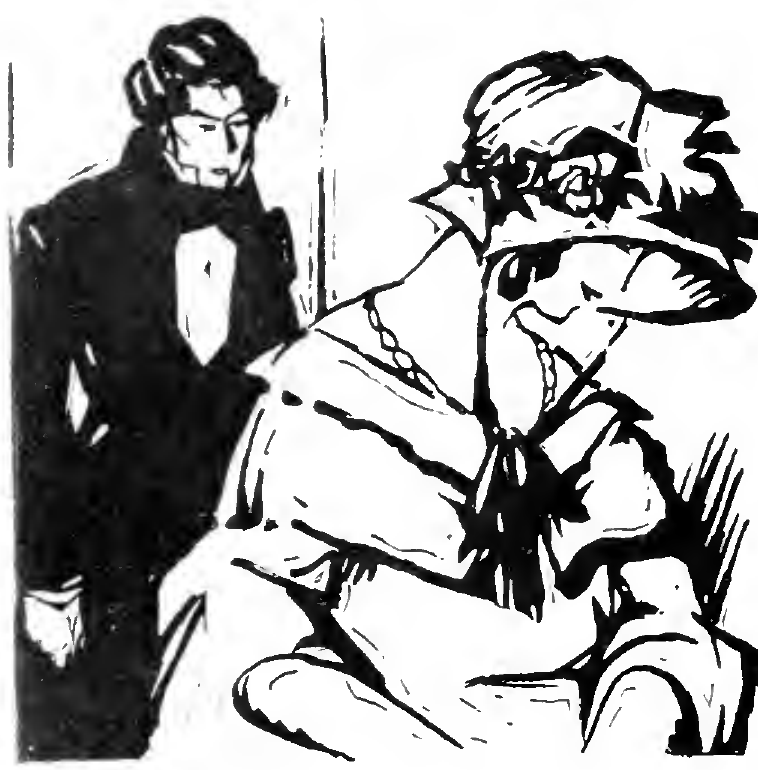
dame de Fervagues did not come to the Hôtel de La Mole — such were the monotonous events of Julien's life. It had more interest when Madame de Fervagues came to the marquise's; then he could glimpse Mathilde's eyes beneath a wing of the marshale's hat, and he was eloquent. His picturesque and sentimental phrases were beginning to take on a turn at once more striking and more elegant.
He felt clearly that what he said was absurd in Mathilde's eyes, but he wished to strike her by the elegance of his diction. "The more false what I say is, the more I must please her," thought Julien; and then, with an abominable boldness, he exaggerated certain aspects of nature. He perceived very quickly that, in order not to appear vulgar in the marshale's eyes, he must above all beware of simple and reasonable ideas. He continued thus, or abridged his amplifications according as he saw success or indifference in the eyes of the two great ladies whom he had to please.
On the whole, his life was less frightful than when his days were spent in inaction.
But, he said to himself one evening, "here I am transcribing the fifteenth of these abominable dissertations; the first fourteen have been faithfully delivered to the marshale's porter. I am about to have the honour of filling all the pigeonholes of her desk. And yet she treats me as if I were not writing at all! What can be the end of all this? Would my constancy bore her as much as it bores me? I must admit that this Russian, Korasoff's friend, and in love with the beautiful Quakeress of Richmond, was in his day a terrible man; one could not be more wearisome."
Like all mediocre beings whom chance brings into the presence of the manoeuvres of a great general, Julien understood nothing of the attack carried out by the young Russian upon the heart of the young Englishwoman. The first forty letters were intended only to obtain pardon for the boldness of writing. He had to make this gentle person, who perhaps was infinitely bored, contract the habit of receiving letters perhaps a little less insipid than her everyday life.
One morning a letter was handed to Julien; he recognized Madame de Fervagues's arms, and broke the seal with an eagerness that would have seemed quite impossible to him a few days earlier: it was merely an invitation to dinner.
.
He ran to Prince Korasoff's instructions. Unfortunately, the young Russian had wished to be light like Dorat, where he should have been simple and intelligible; Julien could not divine the moral position he was to occupy at the marshale's dinner.
The drawing room was of the highest magnificence, gilded like the gallery of Diana at the Tuileries, with oil paintings on the panelling. There were light patches in these paintings. Julien learned later that the subjects had seemed somewhat indecent to the mistress of the house, who had had the paintings touched up. "Moral age!" thought he.
In this drawing room he noticed three of the personages who had assisted at the drafting of the secret note. One of them, Monseigneur the Bishop of \\\, uncle of the marshale, had the disposal of benefices, and, it was said, could refuse his niece nothing. "What an immense step I have made," said Julien to himself, smiling with melancholy, "and how indifferent it is to me! Here I am dining with the famous Bishop of \\\."
The dinner was mediocre and the conversation exasperating. "It is the table of a bad book," thought Julien. "All the greatest subjects of human thought are proudly broached there. Listen for three minutes, and one asks oneself which carries the day, the speaker's bombast or his abominable ignorance."
The reader has doubtless forgotten that little man of letters named Tambeau, nephew of the academician and future professor, who, by his base calumnies, seemed charged with poisoning the drawing room of the Hôtel de La Mole.
It was through this little man that Julien first had the idea that it might well be that Madame de Fervagues, while not answering his letters, looked with indulgence upon the sentiment that dictated them. M. Tambeau's black soul was in decline at the thought of Julien's successes; but as, on the other hand, a man of merit, no more than a fool, cannot be in two places at once, if Sorel becomes the lover of the sublime marshale, said the future professor to himself, she will place him in the Church in some advantageous manner, and I shall be delivered of him at the Hôtel de La Mole.
M. l'abbé Girard also addressed long sermons to Julien on his successes at the Hôtel de Fervagues. There was sectarian jealousy between the austere Jansenist and the Jesuitical, regenerating and monarchical drawing room of the virtuous marshale.