About this book
Julien Sorel climbs from sawmill to salon, torn between the red of the army and the black of the church. Stendhal's 1830 novel, free to read online.
MANNER OF PRONUNCIATION
If fatuity is pardonable, it is in earliest youth, for then it is the exaggeration of an amiable thing. It requires the air of love, gaiety, carelessness. But fatuity with self-importance! fatuity with a grave and self-satisfied air! this excess of folly was reserved for the 19th century. And it is such people who wish to chain the hydra of revolutions!
THE JOHANNISBERG. pamphlet.
For a newcomer who, out of pride, never asked questions, Julien did not fall into too great foolishness. One day, driven into a café on the rue Saint-Honoré by a sudden shower, a tall man in a beaver-cloth frock coat, astonished by his somber gaze, looked at him in turn, exactly as formerly, at Besançon, Mademoiselle Amanda's lover had done.Julien had reproached himself too often for having let that first insult pass to endure this look. He demanded an explanation. The man in the frock coat immediately addressed the filthiest insults to him: everything that was in the café gathered around them; passersby stopped before the door. By a provincial precaution, Julien always carried small pistols; his hand gripped them in his pocket with a convulsive movement. Nevertheless he was prudent, and confined himself to repeating to his man from minute to minute: "Monsieur, your address—I despise you."
The constancy with which he clung to these six words ended by striking the crowd.
"Good Lord! the other one who talks to himself must give him his address." The man in the frock coat, hearing this decision so often repeated, threw five or six cards in Julien's face. None fortunately reached him in the face; he had promised himself to make use of his pistols only in the case where he should be hit. The man went off, not without turning around from time to time to threaten him with his fist and address insults to him.
Julien found himself bathed in sweat. "So it is in the power of the last of men to move me to this point!" he said to himself with rage. "How is this humiliating sensibility to be killed?"
Where to find a witness? He had not a single friend. He had had several acquaintances; but all, regularly, after six weeks of relations, drew away from him. "I am unsociable, and here I am cruelly punished for it," he thought. At last he had the idea of seeking out a former lieutenant of the 96th named Liéven, a poor devil with whom he often practiced arms. Julien was sincere with him.
— I am quite willing to be your witness, said Liéven, but on one condition: if you do not wound your man, you will fight with me, on the spot.
— Agreed, said Julien, enchanted; and they went to seek M. C. de Beauvoisis at the address indicated by his cards, at the far end of the faubourg Saint-Germain.
It was seven o'clock in the morning. It was only in having himself announced at his home that Julien realized that this could well be the young relative of Madame de Rênal, formerly employed at the embassy of Rome or Naples, and who had given a letter of recommendation to the singer Geronimo.
.
Julien had handed to a tall valet one of the cards thrown the day before, and one of his own.
He and his witness were made to wait three long quarters of an hour; at last they were shown into an apartment admirable in its elegance. They found a tall young man, dressed like a doll; his features offered the perfection and the insignificance of Greek beauty. His head, remarkably narrow, bore hair of the most beautiful blond. It was curled with much care, not a hair crossed another. "It is to have himself curled like this," thought the lieutenant of the 96th, "that this cursed fop has kept us waiting." The motley dressing gown, the morning trousers, everything, down to the embroidered slippers, was correct and marvelously well cared for. His physiognomy, noble and empty, announced fitting and rare ideas: the ideal of the diplomat after the manner of Metternich. Napoleon too did not want thinking officers among those who approached him.
Julien, to whom his lieutenant of the 96th had explained that to be kept waiting so long, after having grossly thrown his card in his face, was one more offense, entered brusquely into M. de Beauvoisis's home. He intended to be insolent, but he would have very much liked at the same time to be in good form.
Julien was so astonished by the gentleness of M. de Beauvoisis's manners, by his air at once composed, important, and self-satisfied, by the admirable elegance of what surrounded him, that he lost in the twinkling of an eye all idea of being insolent. This was not his man of the day before. His astonishment was so great at encountering so distinguished a being instead of the coarse personage he was seeking, that he could not find a single word. He presented one of the cards that had been thrown at him.
— That is my name, said the young diplomat, to whom Julien's black coat, from seven o'clock in the morning, inspired rather little consideration; but I do not understand, upon my honor...The manner of pronouncing these last words restored to Julien a part of his temper. — I come to fight with you, Monsieur, and he explained the whole affair in one breath.
M. Charles de Beauvoisis, after having ... this waistcoat is in good taste, these boots are fine; but, on the other hand, this black coat from early in the morning!... "It will be to better escape the bullet," said the chevalier de Beauvoisis to himself.
As soon as he had given himself this explanation, he returned to a perfect politeness, and almost of equal to equal toward Julien. The colloquy was rather long, the affair was delicate; but at last Julien could not refuse to accept the evidence. The young man of perfect tone whom he had before him offered no resemblance to the coarse personage who, the day before, had insulted him.
Julien felt an invincible repugnance at going away; he made the explanation last. He observed the self-sufficiency of the chevalier de Beauvoisis—for thus he had named himself in speaking of himself—shocked that Julien called him quite simply monsieur.
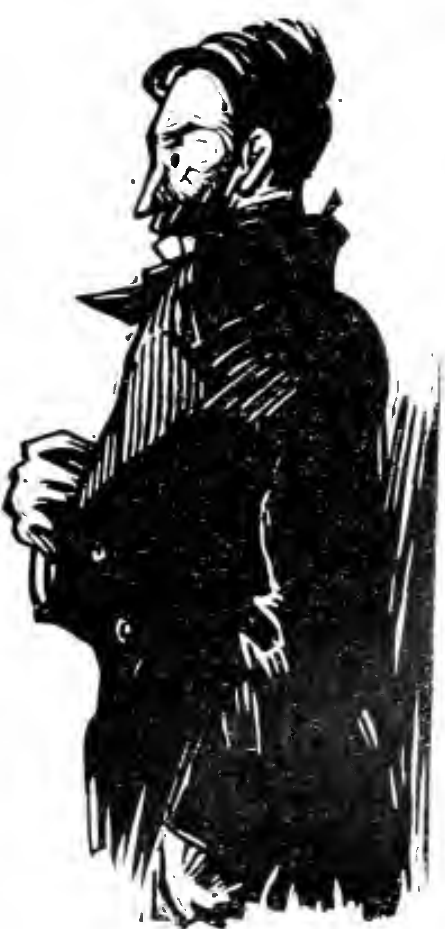
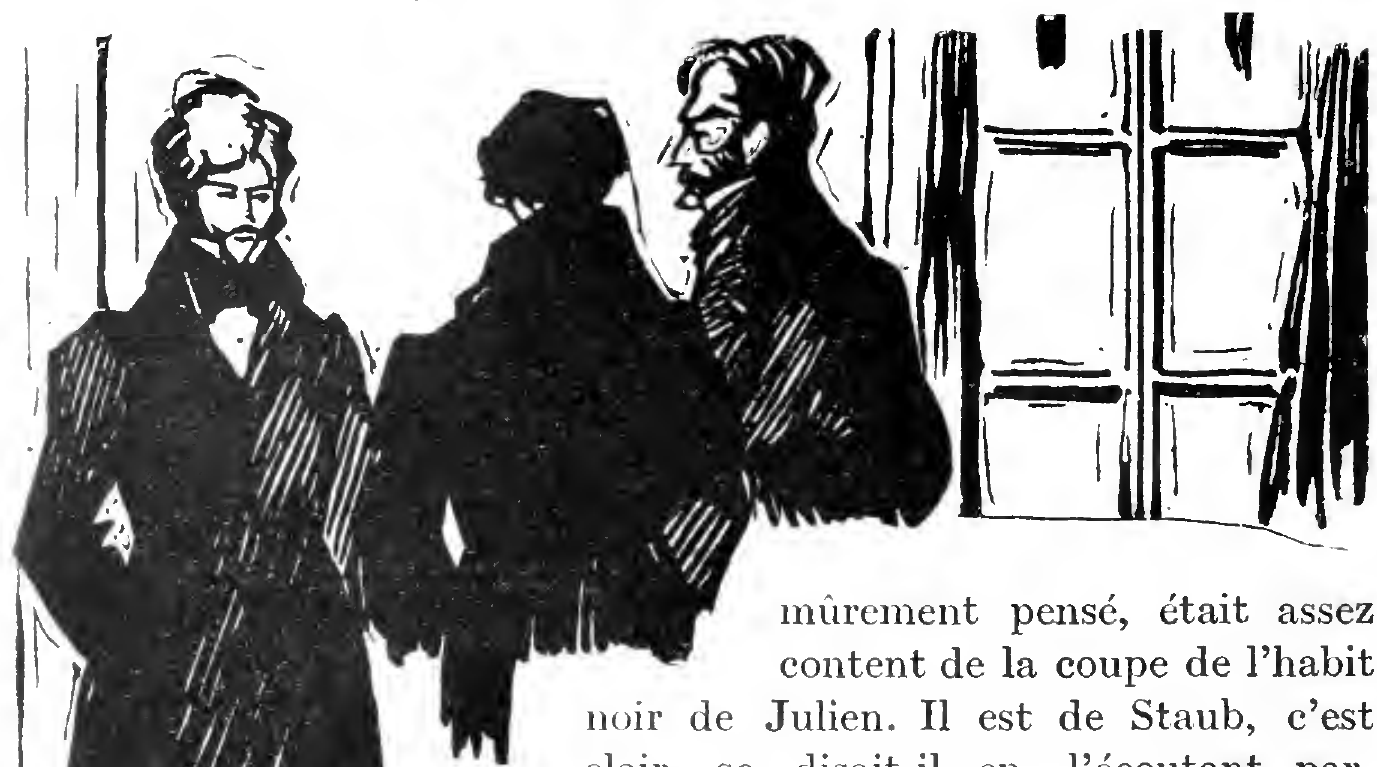
He admired his gravity, mingled with a certain modest fatuity, but one that did not abandon him for a single instant. He was astonished by his singular manner of moving his tongue in pronouncing words... But after all, in all that, there was not the slightest reason to pick a quarrel with him.
The young diplomat offered to fight with much grace, but the ex-lieutenant of the 96th, seated for an hour, legs apart, hands on his thighs, and elbows outward, decided that his friend M. Sorel was not made to pick a quarrel with a man for no reason, because this man's visiting cards had been stolen from him.
Julien went out in a very bad humor. The chevalier de Beauvoisis's carriage was waiting for him in the courtyard, before the perron; by chance. Julien raised his eyes and recognized his man of the day before in the coachman.
To see him, to pull him by his great jacket, to make him fall from his seat, and to overwhelm him with strokes of the riding whip was only the affair of an instant. Two lackeys tried to defend their comrade; Julien received blows with the fist: at the same instant he armed one of his small pistols and fired it at them; they took flight. All that was the affair of a minute.
The chevalier de Beauvoisis was coming down the staircase with the most amusing gravity, repeating with his great-lord pronunciation: "What is this? what is this!" He was evidently very curious, but diplomatic importance did not permit him to show more interest. When he learned what it was about, haughtiness still disputed in his features with the slightly bantering coolness that must never leave a diplomat's face.The lieutenant of the 96th understood that M. de Beauvoisis had a desire to fight; he wished, diplomatically too, to preserve for his friend the advantages of the initiative. "This time," he cried, "there is matter for a duel!" — I am inclined to believe it, replied the diplomat.
— I dismiss this scoundrel, he said to his lackeys; let another mount. The carriage door was opened: the chevalier absolutely wished to do the honors of it to Julien and his witness. They went to fetch a friend of M. de Beauvoisis, who indicated a quiet place. The conversation on the way was truly quite fine. The only singular thing was the diplomat in a dressing gown.
These gentlemen, although very noble, thought Julien, are not at all boring like the people who come to dine at M. de La Mole's; and I see why, he added a moment later, they allow themselves to be indecent. They were talking about the dancers whom the public had singled out in a ballet given the day before. These gentlemen were alluding to piquant anecdotes that Julien and his second, the lieutenant of the 96th, were completely ignorant of. Julien did not have the foolishness to claim to know them; he good-naturedly admitted his ignorance. This frankness pleased the chevalier's friend; he told him these anecdotes in the greatest detail, and very well.
One thing infinitely astonished Julien. A wayside shrine that was being built in the middle of the street, for the procession of Corpus Christi, stopped the carriage for a moment. These gentlemen permitted themselves several jokes; the curate, according to them, was the son of an archbishop. Never at

the marquis de La Mole's, who wanted to be a duke, would anyone have dared to utter such a word.
The duel was over in an instant: Julien had a bullet in his arm; it was bound with handkerchiefs; they were moistened with brandy, and the chevalier de Beauvoisis very politely begged Julien to allow him to take him home in the same carriage that had brought him. When Julien indicated the Hôtel de La Mole, there was an exchange of glances between the young diplomat and his friend. Julien's hackney cab was there, but he found the conversation of these gentlemen infinitely more amusing than that of the good lieutenant of the 96th.
My God! is a duel only that? thought Julien. How happy I am to have found this coachman again! What would be my misfortune if I had had to endure that insult again in a café! The amusing conversation had scarcely been interrupted. Julien understood then that diplomatic affectation is good for something.
Boredom, then, is not inherent, he said to himself, in a conversation among people of high birth! These men joke about the Corpus Christi procession, they dare to recount, and with picturesque details, highly scabrous anecdotes. All they lack is reasoning about political matters, and that lack is more than compensated for by the grace of their tone and the perfect aptness of their expressions. Julien felt a strong inclination toward them. How happy I would be to see them often!
No sooner had they parted than the Chevalier de Beauvoisis went to make inquiries: the results were not brilliant.
He was very curious to know who his man was; could he decently pay him a visit? The little information he was able to obtain was not of an encouraging nature.
"All this is frightful!" he said to his second. "It is impossible that I should admit having fought with a mere secretary of M. de La Mole, and moreover because my coachman stole my visiting cards."
"It is certain that there would be in all that a possibility of ridicule."
That same evening, the Chevalier de Beauvoisis and his friend told everyone that this M. Sorel, otherwise a perfect young man, was the natural son of an intimate friend of the Marquis de La Mole. This fact passed without difficulty. Once it was established, the young diplomat and his friend deigned to pay a few visits to Julien, during the fortnight he spent in his room. Julien confessed to them that he had been to the Opera only once in his life.
"That is appalling," they told him. "One goes nowhere else; your first outing must be for the Comte Ory."
At the Opera, the Chevalier de Beauvoisis introduced him to the famous singer Geronimo, who was then enjoying an immense success.
Julien almost paid court to the Chevalier; this mixture of self-respect, mysterious importance and young-man fatuity enchanted him. For example, the Chevalier stammered a little because he had the honour of often seeing a great nobleman who had that defect. Never had Julien found united in a single being the ridiculous that amuses and the perfection of manners that a poor provincial must seek to imitate.
He was seen at the Opera with the Chevalier de Beauvoisis; this connection caused his name to be pronounced.
"Well then!" M. de La Mole said to him one day, "so you are the natural son of a rich gentleman of Franche-Comté, an intimate friend of mine?"
The Marquis cut short Julien, who wanted to protest that he had in no way contributed to lending credit to this rumour.
"M. de Beauvoisis did not wish to have fought against the son of a carpenter."
"I know, I know," said M. de La Mole; "it is for me now to give consistency to this story, which suits me. But I have a favour to ask of you, and it will cost you only a small half-hour of your time: every Opera day, at half past eleven, go and attend in the vestibule at the exit of the fashionable world. I still see in you sometimes provincial ways; you must get rid of them; besides, it is not a bad thing to know, at least by sight, great personages to whom I may one day give you some mission. Call at the box office to have yourself recognized; you have been given the entrées."