About this book
Julien Sorel climbs from sawmill to salon, torn between the red of the army and the black of the church. Stendhal's 1830 novel, free to read online.
A MAN OF SPIRIT
The prefect, riding along on his horse, said to himself: Why should I not be a minister, president of the council, a duke? This is how I shall make war... By this means I would throw the innovators into irons... The Globe.
NO argument avails to destroy the empire of ten years of agreeable reveries. The Marquis did not think it reasonable to be angry, but could not bring himself to forgive. If this Julien could die by accident, he said to himself sometimes... Thus it was that this saddened imagination found some relief in pursuing the most absurd chimeras. They paralysed the influence of Abbé Pirard's wise reasonings. A month passed thus without the negotiation making any progress.
In this family affair, as in those of politics, the Marquis had brilliant glimpses which he enthused over for three days. Then a plan of conduct no longer pleased him, because it was supported by good reasonings; but reasonings found favour in his eyes only insofar as they supported his favourite plan. For three days he laboured, with all the ardour and enthusiasm of a poet, to bring things to a certain position; the next day he no longer thought of it.
At first Julien was disconcerted by the Marquis's slowness; but after some weeks he began to divine that M. de La Mole had, in this affair, no settled plan.
Madame de La Mole and the whole household believed that Julien was travelling in the provinces for the administration of the estates; he was hidden at Abbé Pirard's presbytery, and saw Mathilde almost every day; she, every morning, went to spend an hour with her father, but sometimes whole weeks passed without their speaking of the affair that occupied all their thoughts.
"I do not wish to know where this man is," the Marquis said to her one day; "send him this letter." Mathilde read:
"The estates in Languedoc yield 20,600 francs. I give 10,600 francs to my daughter, and 10,000 francs to M. Julien Sorel. I give the estates themselves, of course. Tell the notary to draw up two separate deeds of gift, and to bring them to me tomorrow; after which, no more relations between us. Ah! Monsieur, should I have expected all this? "The Marquis de La Mole."
"I thank you very much," said Mathilde gaily. "We are going to settle at the Château d'Aiguillon, between Agen and Marmande. They say it is a country as beautiful as Italy."
This donation extremely surprised Julien. He was no longer the severe and cold man we have known. The destiny of his son absorbed all his thoughts in advance. This unforeseen fortune, and considerable enough for a man so poor, made him ambitious. He saw for himself as for his wife 36,000 livres of income. As for Mathilde, all her feelings were absorbed in her adoration for her husband, for that is how her pride always called Julien. Her great, her sole ambition was to have her marriage recognised. She spent her life exaggerating the lofty prudence she had shown in linking her fate to that of a superior man. Personal merit was in fashion in her head.
The almost continuous absence, the multiplicity of affairs, the little time there was for talking of love came to complete the good effect of the wise policy formerly invented by Julien.
Mathilde ended by growing impatient at seeing so little the man she had succeeded in really loving.
In a moment of ill humour she wrote to her father, and began her letter like Othello:
"That I have preferred Julien to the pleasures that society offered to the daughter of M. le Marquis de La Mole, my choice proves it sufficiently. These pleasures of consideration and petty
vanity are nothing to me. It is soon six weeks that I have lived separated from my husband. That is enough to testify my respect to you. Before next Thursday I shall leave my father's house. Your bounties have enriched us. No one knows my secret but the respectable Abbé Pirard. I shall go to him; he will marry us, and an hour after the ceremony we shall be on the road to Languedoc, and shall never reappear in Paris except by your orders. But what pierces my heart is that all this will make a piquant anecdote against me, against you. Can the epigrams of a foolish public not oblige our excellent Norbert to seek a quarrel with Julien? In this circumstance, I know him, I should have no
power over him. We should find in his soul the revolted plebeian. I conjure you on my knees, O my father! come to assist at my marriage, in M. Pirard's church, next Thursday. The sting of the malicious anecdote will be softened, and the life of your only son, that of my husband, will be assured, etc., etc."
The Marquis's soul was thrown by this letter into a strange embarrassment. So at last a decision must be taken. All the little habits, all the vulgar friends had lost their influence.
In this strange circumstance, the great features of character, imprinted by the events of youth, resumed all their empire. The misfortunes of the Emigration had made him a man of imagination. After having enjoyed for two years an immense fortune and all the distinctions of the court, 1790 had thrown him into the frightful miseries of emigration. This harsh school had changed a soul of twenty-two. At bottom, he was encamped in the midst of his present riches rather than dominated by them. But this same imagination which had preserved his soul from the gangrene of gold had thrown him a prey to a mad passion to see his daughter decorated with a fine title.
During the six weeks that had just elapsed, now urged by a caprice, the Marquis had wished to enrich Julien; poverty seemed to him ignoble, dishonouring to him M. de La Mole, impossible in his daughter's husband; he threw money at it. The next day, his imagination taking another course, it seemed to him that Julien would hear the mute language of this generosity in money, change his name, exile himself to America, write to Mathilde that he was dead to her. M. de La Mole supposed this letter written, he followed its effect on his daughter's character...
The day he was drawn from these youthful dreams by Mathilde's actual letter, after having long thought of killing Julien or of making him disappear, he was dreaming of building him a brilliant fortune. He was making him take the name of one of his estates; and why should he not transmit his peerage to him? M. the duc de Chaulnes, his father-in-law, had spoken to him several times, since his only son had been killed in Spain, of his desire to transmit his title to Norbert...
One cannot deny Julien a singular aptitude for business, boldness, perhaps even brilliance, the marquis was saying to himself... But at the bottom of this character I find something frightening. It is the impression he produces on everyone, so there is something real there (the more difficult this real point was to grasp, the more it frightened the old marquis's imaginative soul).
My daughter told me so very cleverly the other day (in a suppressed letter):
"Julien has attached himself to no salon, to no coterie." He has preserved for himself no support against me, not the smallest resource if I abandon him... But is that ignorance of the present state of society?... Two or three times I have told him: There is no real and profitable candidacy but that of the salons...
:
No, he does not have the clever and cautious genius of a prosecutor who loses neither a minute nor an opportunity... He is not a character in the style of Louis XI. On the other hand, I see in him the most antigenerous maxims... I lose my way in it... Would he be repeating these maxims to himself, to serve as a dike against his passions?
Besides, one thing stays afloat: he is impatient of contempt, I have him there.
He does not have the religion of high birth, it is true, he does not respect us by instinct... That is a fault; but after all, the soul of a seminarian should be impatient only at the lack of enjoyment and money. He, very different, cannot endure contempt at any price.
Pressed by his daughter's letter, M. de La Mole saw the necessity of making a decision: "After all, here is the great question: has Julien's audacity gone so far as to undertake to court my daughter, because he knows that I love her above all else, and that I have a hundred thousand crowns a year in income?
Mathilde protests the contrary... No, my Julien, there is one point on which I will not let myself be deceived.
Has there been true love, unforeseen? Or else a vulgar desire to rise to a fine position? Mathilde is clear-sighted; she felt at once that this suspicion could ruin him in my eyes; hence this confession: it was she who first took it into her head to love him...
A girl of such haughty character would have forgotten herself to the point of making material advances!... To press his arm in the garden, one evening, what horror! as if she had not had a hundred less indecent means of letting him know that she distinguished him.
He who accuses himself accuses himself; I distrust Mathilde... That day, the Marquis's reasonings were more conclusive than usual. However, habit carried the day; he resolved to
gain time and to write to his daughter; for they wrote to each other from one side of the mansion to the other. M. de La Mole did not dare to argue with Mathilde and stand up to her. He was afraid of ending it all with a sudden concession.
LETTER
"Beware of committing new follies; here is a commission as lieutenant of hussars for M. le chevalier Julien Sorel de La Vernaye. You see what I am doing for him. Do not thwart me, do not question me. Let him leave within twenty-four hours, to be received at Strasbourg, where his regiment is. Here is a draft on my banker; let me be obeyed."
Mathilde's love and joy knew no bounds; she wished to profit from the victory, and replied at once:
"M. de La Vernaye would be at your feet, overwhelmed with gratitude, if he knew all that you deign to do for him. But, in the midst of this generosity, my father has forgotten me; the honor of your daughter is in danger. An indiscretion can leave an eternal stain, which twenty thousand crowns a year would not repair. I will send the commission to M. de La Vernaye only if you give me your word that, in the course of next month, my marriage will be celebrated publicly, at Villequier. Soon after that time, which I beg you not to exceed, your daughter will be unable to appear in public except under the name of Madame de La Vernaye. How I thank you, dear papa, for having saved me from that name of Sorel, etc., etc."
The reply was unforeseen.
"Obey, or I retract everything. Tremble, young imprudent one. I do not yet know what your Julien is, and you yourself know it less than I do. Let him leave for Strasbourg, and take care to walk straight. I will make my wishes known within a fortnight."
This reply, so firm, astonished Mathilde. "I do not know Julien"; this word plunged her into a reverie, which soon ended in the most enchanting suppositions; but she believed them to be the truth. "My Julien's mind has not donned the petty, shabby uniform of the salons, and my father does not believe in his superiority, precisely because of what proves it... However, if I do not obey this whim of character, I see the possibility of a public scene: an outburst lowers my position in the world, and may make me less lovable in Julien's eyes. After the outburst... poverty for ten years; and the folly of choosing a husband for his merit can be saved from ridicule only by the most brilliant opulence. If I live far from my father, at his age, he may forget me... Norbert will marry an amiable, clever woman: old Louis XIV was seduced by the Duchesse de Bourgogne...
;
She decided to obey, but took care not to communicate her father's letter to Julien; that fierce character might have been driven to some folly.
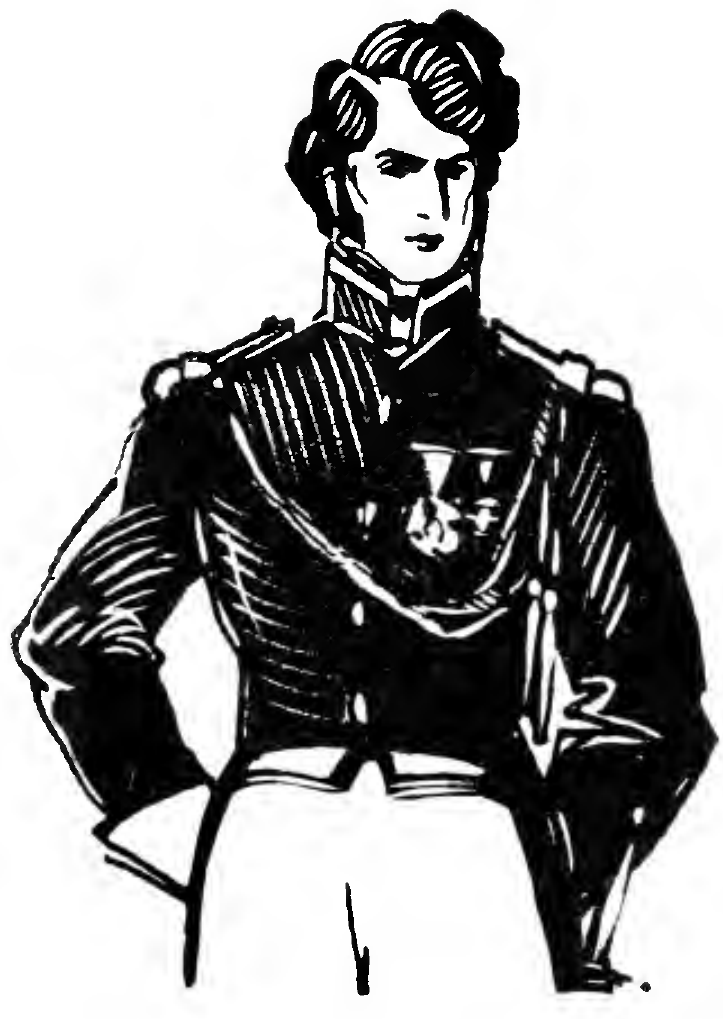
In the evening, when she told Julien that he was a lieutenant of hussars, his joy was boundless. It may be imagined by the ambition of his whole life, and by the passion he now had for his son. The change of name struck him with astonishment.
After all, he thought, my novel is finished, and the whole merit is mine alone. I have known how to make myself loved by this monster of pride, he added, looking at Mathilde; her father cannot live without her, and she cannot live without me.