
A FAMILY AFFAIR.
Athos had found the word: affair and family. A family affair was not subject to the cardinal's investigation; a family affair concerned nobody. One could attend to a family affair before everybody.
Aramis had found the idea: the lackeys.
Porthos had found the means: the diamond.
D'Artagnan alone had found nothing, he ordinarily the most inventive of the four; but it must also be said that the mere name of milady paralyzed him. Ah! we are mistaken, he had found a purchaser for the diamond.
Lunch at M. de Tréville's was charmingly merry. D'Artagnan already had his uniform. As he was about the same height as Aramis, and as Aramis, liberally paid, as will be remembered, by the bookseller who had bought his poem, had had everything made in duplicate, he had given his friend a complete outfit.
D'Artagnan would have been at the height of his wishes had he not seen milady looming like a dark cloud on the horizon.
After lunch, it was agreed that they would meet that evening at Athos's lodgings, and that there the affair would be settled.
D'Artagnan spent the day showing off his musketeer's uniform in every street of the camp.
In the evening, at the appointed hour, the four friends met; there remained only three things to decide:
What they would write to milady's brother;
What they would write to the clever person at Tours;
And which lackeys would carry the letters.
Each offered his own: Athos praised the discretion of Grimaud, who spoke only when his master unstitched his mouth; Porthos praised the f. strength of Mousqueton, who was of a size to thrash four men of ordinary constitution; Aramis, confident in Bazin's cleverness, sang the pompous praises of his candidate; finally d'Artagnan had complete faith in Planchet's bravery, and recalled the way he had conducted himself in the thorny affair of Boulogne.
These four virtues long disputed the prize and gave rise to magisterial speeches, which we shall not report for fear they might make tedious reading.
"Unfortunately," said Athos, "the one we send would need to possess all four qualities united in himself alone."
"But where are we to find such a lackey?"
"Nowhere to be found," said Athos, "I know it well; so take Grimaud."
"Take Mousqueton."
"Take Bazin."
— Take Planchet. Planchet is frank and clever: that is already two qualities out of four.
— Gentlemen, said Aramis, the main thing is not to know which of our four lackeys is the most discreet, the strongest, the cleverest, or the bravest; the main thing is to know which one loves money most.
— What Aramis says is full of sense, replied Athos; one must speculate on people's defects and not on their virtues. Monsieur l'abbé, you are a great moralist.
— No doubt, replied Aramis; for we need to be well served, not only to succeed, but also not to fail, since in case of failure it is our heads that are at stake, not the lackey's.
— Lower your voice, Aramis, said Athos.
— Quite right; not the lackey's, resumed Aramis, but the master's, and even the masters'. Are our lackeys devoted enough to us to risk their lives for us? No.
— Faith! said d'Artagnan, I would almost vouch for Planchet myself.
— Well then! my dear friend, add to his natural devotion a good sum that gives him some ease, and then, instead of vouching for him once, vouch for him twice.
— Eh! good God, you will be deceived all the same, said Athos, who was an optimist where things were concerned, and a pessimist where men were concerned; they will promise anything to get money, and on the way fear will keep them from acting. Once caught, they will be squeezed; squeezed, they will confess. The devil! we are not children! To go to England (Athos lowered his voice) we must cross the whole of France, sown with spies and creatures of the cardinal; we need a pass to embark; we need to know English to ask our way in London. There, I see the thing as very difficult.
— Not at all, said d'Artagnan, who was very set on the thing being accomplished; on the contrary, I see it as easy. It goes without saying, by Jove! that if we write to Lord de Winter things that are shouted from the housetops, the cardinal's schemes...
— Lower your voice, said Athos.— Intrigues and state secrets, continued d'Artagnan, complying with the recommendation, it goes without saying that we will all be flayed alive; but, for God's sake! do not forget, as you yourself said, Athos, that we are writing to Lord de Winter about a family matter, that we are writing to him for the sole purpose that, as soon as he arrives in London, he put milady in a position where she cannot harm us. I will therefore write him a letter more or less in these terms.
;
— Let us see, said Aramis, putting on in advance a critical face.
— "Monsieur and dear friend..."
— Ah! yes, dear friend to an Englishman! interrupted Athos. Well begun! Bravo, d'Artagnan! with that word alone you will be quartered instead of being broken on the wheel alive.
— Well, so be it! I will say then, monsieur, simply.
— You may even say milord, resumed Athos, who was very attached to propriety.
— "Milord, do you remember the little goat enclosure in the Luxembourg?"
— Good! the Luxembourg now! people will think it is an allusion to the queen mother! that is ingenious! said Athos.
— Well then! we will put quite simply: Milord, do you remember a certain little enclosure where your life was saved?
— My dear d'Artagnan, said Athos, you will never be anything but a very bad writer. "Where your life was saved! fie then! that is not worthy; one does not remind a gallant man of such services. A benefit reproached is an offense done.
— Ah! my dear, said d'Artagnan, you are unbearable, and if I must write under your censure, faith, I give it up.
— And you do well. Handle the musket and the sword, my dear, you acquit yourself gallantly in those two exercises; but pass the pen to Monsieur l'abbé, that is his concern.
— Yes, indeed, said Porthos, pass the pen to Aramis, who writes theses in Latin, he does.
— Well, so be it, said d'Artagnan, draft us this note, Aramis; but by our holy father the pope! keep it tight, for I will pick it apart in my turn, I warn you.
— I ask nothing better, said Aramis with that naive confidence that every poet has in himself; but let someone put me in the picture. I have indeed heard here and there that this sister-in-law was a hussy, I have even acquired proof of it by listening to her conversation with the cardinal.
— Go on then, damn it! said Athos.
— But, continued Aramis, the detail escapes me.
— And me too, said Porthos.
D'Artagnan and Athos looked at each other for some time in silence. At last Athos, after collecting himself and becoming even paler than usual, made a sign of assent. D'Artagnan understood that he could speak.
— Well then! here is what there is to write, resumed d'Artagnan: "Milord, your sister-in-law is a villain, who tried to have you killed so as to inherit from you; but she could not marry your brother, being already married in France and having been..." D'Artagnan stopped, as if searching for the word, looking at Athos.
— "Driven out by her husband," said Athos.
— "Because she had been marked," continued d'Artagnan.
— Bah! cried Porthos, impossible! she tried to have her brother-in-law killed?
— Yes.
— She was married? asked Aramis.
— Yes.
— And her husband noticed that she had a fleur-de-lis on her shoulder? cried Porthos.
— Yes.
These three yeses had been said by Athos, each with a more somber intonation.
— And who saw this fleur-de-lis? asked Aramis.
— D'Artagnan and I, or rather, to observe chronological order, I and d'Artagnan, replied Athos.
— And the husband of this frightful creature is still alive? said Aramis.
— He is still alive.
— Are you sure of it?
— I am sure of it.
There was a moment of cold silence, during which each felt impressed according to his nature.
— This time, resumed Athos, breaking the silence first, d'Artagnan has given us an excellent plan, and that is what must be written first.
— The devil! you are right, Athos, resumed Aramis, and the drafting is exhausting. Monsieur the chancellor himself would be embarrassed to draft an epistle of this force, and yet Monsieur the chancellor drafts a procès-verbal very agreeably. No matter! be quiet. I am writing.
Aramis took the pen, reflected for a few moments, began to write eight or ten lines in a charming small feminine hand, then, in a soft and slow voice, as if every word had been scrupulously weighed, he read the following:
"My Lord,
"The person who writes these few lines to you has had the honor of crossing swords with you, in a small enclosure in the Rue d'Enfer. As you have since been pleased to call yourself several times the friend of this person, she owes it to you to acknowledge that friendship by good advice. Twice you have nearly been the victim of a close relative whom you believe to be your heiress, because you are unaware that before contracting marriage in England, she was already married in France; but the third time, which is this one, you might succumb to it. Your relative has left La Rochelle for England. Watch her rear, for she has great and terrible designs. If you absolutely insist on knowing what she is capable of, read her past on her left shoulder."
— Well! that is perfectly done, said Athos, and you have a pen worthy of a veritable secretary of state, my dear Aramis. De Winter will keep good watch now, provided the advice reaches him, and even if it fell into the hands of His Eminence himself, we could not be compromised; but since the valet who is to leave might make us believe he went to London and stop at Châtellerault, let us give him only half the sum with the letter, promising him the other half in exchange for the reply. Have you the diamond? continued Athos.
— I have better than that, I have the sum, said d'Artagnan.
And he threw the bag on the table. At the sound of the gold, Aramis raised his eyes, Porthos trembled; as for Athos, he remained impassive.
— How much is in this little bag? he said.
— Seven thousand livres in louis of twelve francs.
— Seven thousand livres! cried Porthos; that wretched little diamond was worth seven thousand livres!
— It appears so, said Athos, since there they are; I do not presume that our friend d'Artagnan put any of his own into it.
— But, gentlemen, in all this, resumed d'Artagnan, we are not thinking of the queen; let us attend a little to the health of her dear Buckingham; it is the least we owe him.
— That is right, observed Athos, but this concerns Aramis.
— Well! replied the latter, blushing, what do you want me to do?
— "But," replied Athos, "it is all very simple: write a second letter for that clever person who lives in Tours."
Aramis took up the pen again, began to reflect once more, and wrote the following lines, which he at once submitted to the approval of his friends:
"My dear cousin."
— "Ah! ah!" said Athos, "that clever person is your relative?"
— "A cousin-german," said Aramis.
— "Very well, then, cousin."
Aramis continued:
"My dear cousin, His Eminence the Cardinal, whom God preserve for the happiness of France and the confusion of the enemies of the kingdom! is on the point of finishing with the heroic rebels of La Rochelle; it is probable that the help of the English fleet will not even arrive in sight of the place; I will venture almost to say that I am certain that M. de Buckingham will be prevented from setting out by some great event. His Eminence is the most illustrious politician of times past, of times present, and probably of times to come. He would extinguish the sun if the sun were in his way. Give these happy tidings to your sack, my dear cousin. I dreamed that this accursed Englishman was dead. I cannot remember whether it was by the sword or by the fish; but I am sure he was dead, and you know my dreams never deceive me. Be assured, then, of seeing me return soon."
— "Admirable!" cried Athos; "you are the king of poets, my dear Aramis; you speak pearls like the Apocalypse and you are as true as the Gospel. There is nothing left now but to put the address on this letter."
— "That is very easy," said Aramis.
He folded the letter coquettishly, took it up again, and wrote:
"To Mademoiselle Marie Michu, seamstress, at Tours."
The three friends looked at one another and laughed: they were caught.
— "Now," said Aramis, "you understand, gentlemen, that only Bazin can carry this letter to Tours. My cousin knows no one but Bazin and has confidencein no one but him. Any other would make the affair fail. Besides, Bazin is ambitious and learned. Bazin has read history, gentlemen; he knows that Sixtus V became pope after having kept swine; and as he counts on entering the Church at the same time as I do, he does not despair in his turn of becoming pope or at least cardinal. You understand that a man with such aims will not let himself be taken, or, if he is taken, will suffer martyrdom rather than speak."
— "Very well," said d'Artagnan, "I willingly give you Bazin; but give me Planchet. Milady had him thrown out of doors one day with a hearty shower of blows from a stick. Now, Planchet has a good memory, and I answer for it, if he can imagine a vengeance possible, he would rather be broken on the wheel than give it up. If the affairs of Tours are your affairs, Aramis, those of London are mine. I beg, therefore, that Planchet be chosen, who besides has already been to London with us and knows how to say very correctly: 'London, sir, if you please,' and 'my master, Lord d'Artagnan.' With that, rest easy, he will make his way going and coming."
— "In that case," said Athos, "Planchet must receive seven hundred livres for going and seven hundred livres for returning, and Bazin three hundred livres for going and three hundred livres for returning; that will reduce the sum to five thousand livres. We will each take a thousand livres to employ as we think fit, and we will leave a fund of a thousand livres which the abbé will keep for extraordinary cases or common needs. Does that suit you?"
— "My dear Athos," said Aramis, "you speak like Nestor, who was, as everyone knows, the wisest of the Greeks."
— "Well, then, it is settled," resumed Athos. "Planchet and Bazin shall set out. On the whole, I am not sorry to keep Grimaud; he is accustomed to my ways, and I am attached to him; yesterday's day has already shaken him; this journey would be the ruin of him."
Planchet was sent for, and his instructions were given to him; d'Artagnan had prepared him for it, having first announced glory to him, then money, then danger.
— "I will carry the letter in the lining of my coat," said Planchet, "and I will swallow it if they take me."
— "But then you will not be able to carry out the commission," said d'Artagnan.
— "You will give me a copy tonight which I will know by heart tomorrow."
D'Artagnan looked at his friends as if to say:
— "Well! what did I promise you?"
— "Now," he continued, addressing Planchet, "you have eight days to reach Lord de Winter; you have eight more days to return here: sixteen days in all. If on the sixteenth day from your departure, at eight o'clock in the evening, you have not arrived, no money, even if it were five minutes past eight."
— "Then, sir," said Planchet, "buy me a watch."
— "Take this one," said Athos, giving him his own, with his careless generosity, "and be a brave lad; remember that if you speak, if you chatter, if you loiter, you will have your master's throat cut, who has such great confidence in your fidelity that he has answered for you to us. But remember also that if anything happens to d'Artagnan through your fault, I will find you wherever you are, and it will be to open your belly."
— "Oh! sir!" said Planchet, humiliated by this suspicion and especially frightened by the musketeer's calm air.
— "And I," said Porthos, rolling his big eyes, "remember that I will flay you alive."
— "Ah! sir!"
— "And I," continued Aramis, in his soft and melodious voice, "remember that I will roast you over a slow fire like a savage."
— "Ah! sir!"
And Planchet began to weep; we would not dare say whether it was from terror because of the threats made to him, or from emotion at seeing four friends so closely united in their intentions.
D'Artagnan took his hand.
— "Do you see, Planchet," he said to him, "these gentlemen say all that out of tenderness for me, but at bottom they love you."
— "Ah! sir," said Planchet, "either I shall succeed, or they will cut me in four; and even if I were cut in four, be convinced that there will not be a single piece that will speak."
It was decided that Planchet would set out the next morning at eight o'clock, so that, as he had said, he might during the night learn the letter by heart. He gained just twelve hours by this arrangement; he was to be back on the sixteenth day, at eight o'clock in the evening.
In the morning, at the moment when he was about to mount his horse, d'Artagnan, who felt at the bottom of his heart a weakness for the Duke of Buckingham, took Planchet aside:
— "Listen," he said to him, "when you have delivered the letter to Lord de Winter and he has read it, you will also say to him: 'Watch over His Grace Lord Buckingham, for they want to assassinate him.' But this, Planchet, you see, is so serious and so important that I did not even want to admit to my friends that I was entrusting this secret to you, and for a captain's commission I would not want to write it to you."
— "Rest easy, sir," said Planchet, "you will see whether I can be counted on."
And mounted on an excellent horse, which he was to leave twenty leagues from there to take the post, Planchet set off at a gallop, his heart a little tightened by the sad promise the musketeers had made him, but otherwise in the best dispositions.
Bazin left the next morning for Tours, and had eight days to carry out his commission.
The four friends, during the whole of these two absences, had, as may well be supposed, kept a sharper lookout than ever, with their noses to the wind and their ears on the alert. Their days were spent trying to catch what was being said, watching the cardinal's movements, and sniffing out the couriers who arrived. More than once an irresistible trembling seized them when they were called for some unexpected service. They had, moreover, to look out for their own safety: Milady was a ghost who, once she had appeared to people, did not let them sleep peacefully.
On the morning of the eighth day, Bazin, fresh as always and smiling according to his habit, entered the tavern of the Parpaillot just as the four friends were having breakfast, saying, according to the agreed convention:
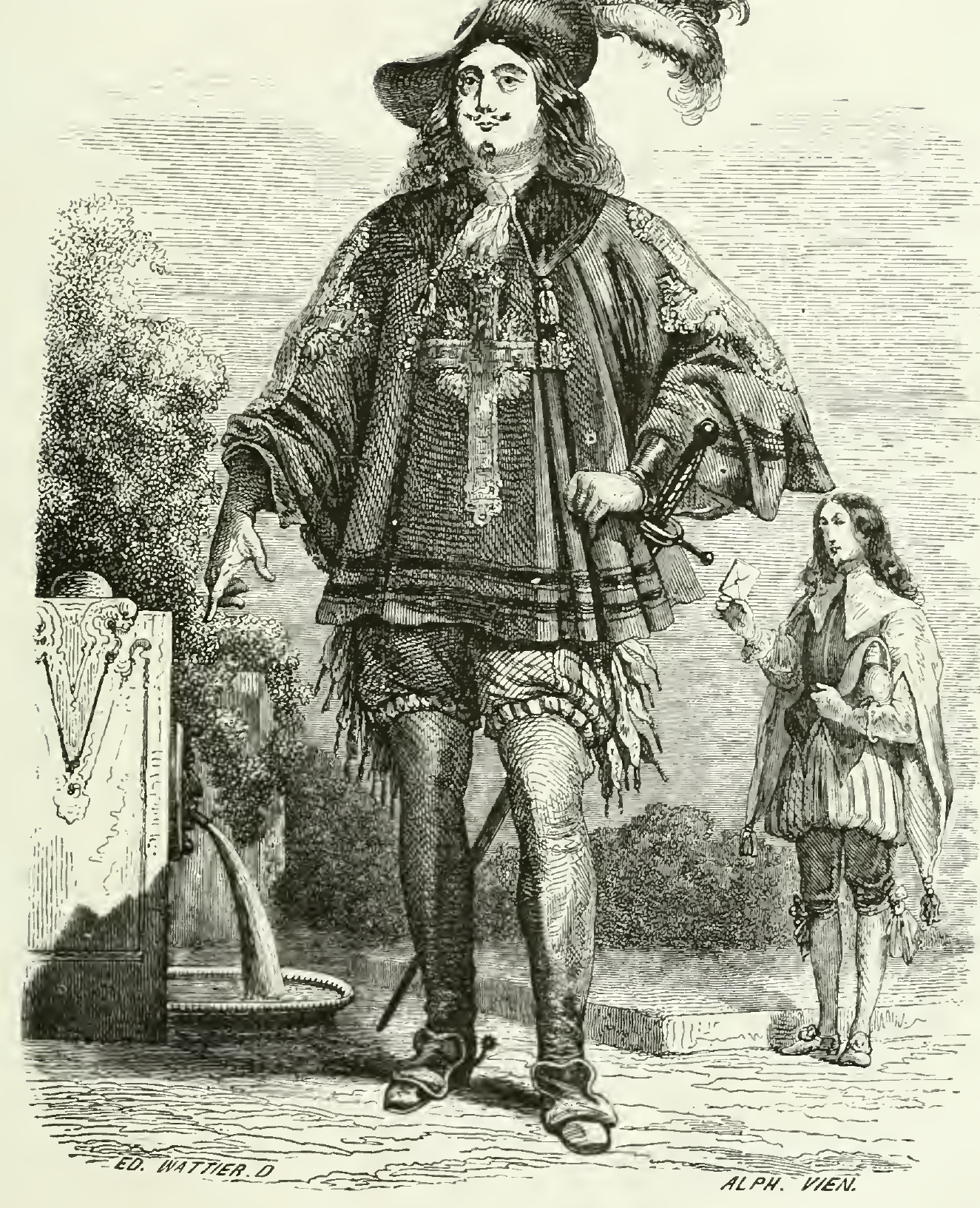

"Monsieur Aramis, here is the reply from your cousin."
The four friends exchanged a joyful glance; half the work was done; true, it was the shortest and easiest half.
Aramis took the letter, blushing in spite of himself; it was in a coarse hand and without spelling.
"Good heavens!" he cried, laughing, "I despair of it decidedly; that poor Michon will never write like M. de Voiture."
"What is that you are saying: that poor Mignon?" asked the Swiss, who was chatting with the four friends when the letter arrived.
"Oh! my God! less than nothing," said Aramis, "a charming little seamstress whom I loved very much, and from whom I asked a few lines in her own hand as a keepsake."
"By God!" said the Swiss, "if she is as tall as her writing is big, you are in good hands, my comrade!"
Aramis read the letter and passed it to Athos.
— Look at what she writes to me, Athos, he said.
Athos cast a glance at the epistle, and to dispel all the suspicions that might have arisen, read aloud:
"My cousin, my sister and I can read dreams very well, and we are dreadfully afraid of them; but of yours it may be said, I hope, 'every dream is a lie.' Farewell, keep well, and let us hear from you from time to time.
"Marie Michon."
"And of what dream does she speak?" asked the dragon, who had come nearer during the reading.
"Fout, of what dream?" said the Swiss.
"Eh! by Jove!" said Aramis, "it is very simple—of a dream I had and told her about."
"Ah! fout, partieu! it is very silly to tell one's dream; but I never dream at all."
"You are very fortunate," said Athos, rising, "and I would gladly be able to say as much as you!"
"Chamais," replied the Swiss, delighted that a man like Athos should envy him something. "Chamais, chamais."
D'Artagnan, seeing that Athos was rising, did the same, took his arm and went out.
Porthos and Aramis remained to face the jests of the dragon and the Swiss.
As for Bazin, he went to bed on a truss of straw, and as he had more imagination than the Swiss, he dreamed that M. Aramis, having become pope, put a cardinal's hat on his head.
But, as we have said, Bazin, by his happy return, had removed only a part of the anxiety that goaded the four friends. The days of waiting are long, and d'Artagnan above all would have wagered that the days had forty-eight hours. He forgot the inevitable slowness of navigation, he exaggerated milady's power; he attributed to this woman, who appeared to him like a demon, supernatural auxiliaries like herself; at the slightest noise he imagined that someone was coming to arrest him and that Planchet was being brought back to confront him and his friends. What is more, his confidence, formerly so great in the worthy Picard, diminished from day to day. This uneasiness was so strong that it won over Porthos and Aramis; only Athos remained impassive, as if no danger stirred around him and he breathed his usual atmosphere.
On the sixteenth day especially, these signs of agitation were so visible in d'Artagnan and his two friends that they could not stay in place and wandered like shadows along the road by which Planchet was to return.
"Truly," Athos said to them, "you are not men, you are children, for a woman to make you so uneasy! Eh! what is it all about, after all? Being imprisoned? Well then, we shall be taken out of prison, as Mme Bonacieux was taken out. Being beheaded? But every day, in the trenches, we go joyfully to expose ourselves to worse than that, for a cannonball can break our leg, and I am convinced that a surgeon makes us suffer more in cutting off our thigh than an executioner in cutting off our head. So remain calm; in two hours, in four, in six hours at the latest, Planchet will be here; he promised to be, and I have very great faith in Planchet's promises; he seems to me a very brave fellow."
"But if he does not arrive?" said d'Artagnan.
"Well! if he does not arrive, it is because he has been delayed, that is all. He may have fallen from his horse, he may have tumbled over the bridge, he may have run so fast that he caught a chest cold. Eh! gentlemen, let us make allowance for events. Life is a great rosary of little miseries which the philosopher tells off laughing. Be philosophers like me, gentlemen, sit down at the table and let us drink; nothing makes the future look rosy like looking at it through a glass of Chambertin.
"That is all very well," replied d'Artagnan, "but I am tired of having to fear, while drinking cool wine, that the wine may come from milady's cellar."
"You are very difficult!" said Athos. "Such a beautiful woman!"
"A woman of mark!" said Porthos with his loud laugh.
Athos shuddered, passed his hand over his brow to wipe away the sweat, and rose in turn with a nervous movement he could not repress.
The day passed, however, and evening came more slowly; but at last it came; the taverns filled with customers. Athos, who had pocketed his share of the diamond, no longer left the Parpaillot: he had found in M. de Busigny, who had besides given them a magnificent dinner, a partner worthy of him. They were therefore playing together as usual, when seven o'clock struck; the patrols could be heard passing to double the posts. At half past seven the retreat sounded in its turn.
"We are lost," said d'Artagnan in Athos's ear.
"You mean that we have lost," said Athos calmly, drawing ten louis from his pocket and throwing them on the table. "Well! gentlemen," he continued, "the retreat is beating, let us go to bed."
And Athos left the Parpaillot followed by d'Artagnan. Aramis came behind, giving his arm to Porthos. Aramis mumbled verses, and Porthos from time to time pulled a few hairs from his mustache as a sign of despair.
But suddenly, in the darkness, a shadow took shape whose form was familiar to d'Artagnan, and a well-known voice said to him:
"Monsieur, I bring you your cloak, for it is cool this evening."
"Planchet!" cried d'Artagnan, drunk with joy.
"Planchet!" cried Porthos and Aramis.
"Well! yes, Planchet," said Athos, "what is astonishing about that? He had promised to be back by eight o'clock, and there are eight o'clock striking. Bravo! Planchet, you are a man of your word, and if ever you leave your master, I keep a place for you in my service."
"Oh! no, never," said Planchet, "never will I leave M. d'Artagnan."
And at the same time d'Artagnan felt Planchet slip a little note into his hand.
D'Artagnan had a great desire to embrace Planchet; but he feared that this mark of effusion given to his lackey in the middle of the street might appear extraordinary to some passer-by, and he restrained himself.
"I have the note," he said to Athos and his friends.
"That is well," said Athos, "let us go in and we will read it."
The note burned d'Artagnan's hand; he wanted to quicken his pace, but Athos took his arm and passed it under his own, and the young man was forced to regulate his pace by that of his friend.
At last they entered the tent, a lamp was lit, and while Planchet stood at the door so that the four friends would not be surprised, d'Artagnan, with a trembling hand, broke the seal and opened the long-awaited letter.
It contained half a line in a wholly British hand and of a wholly Spartan conciseness.
"Think you be easy." Which meant: Thank you; be at ease.
Athos took the letter from d'Artagnan's hands, brought it close to the lamp, set fire to it, and did not let go of it until it was reduced to ashes.
Then, calling Planchet:
— Now, my boy, he said to him, you may claim the seven hundred livres, but you were not risking much with a note like that.
— It's not for want of having invented many ways of hiding it, said Planchet.
— Well! said d'Artagnan, tell us about that.
— Goodness, it's very long, sir.
— You are right, Planchet; besides, retreat is being sounded and we would be noticed if we kept a light longer than the others.
— So be it, said d'Artagnan, let us go to bed; sleep well, Planchet.
— Upon my word, sir, it will be the first time in sixteen days.
— And for me too! said d'Artagnan.
— And for me too! repeated Porthos.
— And for me too! repeated Aramis.
— Well! do you want me to confess the truth to you? And for me too! said Athos.