
THE COUNTESS DE WINTER.
On the way the duke made d'Artagnan inform him, not of all that had happened, but of what d'Artagnan knew. By joining to what he heard from the young man's lips his own recollections, he was able to form a sufficiently exact idea of a position whose gravity, moreover, the queen's letter, short and explicit as it was, gave him the measure of. But what astonished him most was that the cardinal, interested as he was in preventing this young man from setting foot in England, had not succeeded in stopping him on the road. It was then, upon the expression of this astonishment, that d'Artagnan told him of the precautions taken, and how, thanks to the devotion of his three friends, whom he had scattered all bleeding along the road, he had come off with nothing worse than the sword thrust that had pierced the queen's note, and which he had returned to M. de Wardes in such terrible coin. While listening to this recital, made with the greatest simplicity, the duke from time to time looked at the young man with an astonished air, as if he could not understand how so much prudence, courage, and devotion could be allied with a face that did not yet betoken twenty years.
The horses went like the wind, and in a few minutes they were at the gates of London. D'Artagnan had thought that on arriving in the city the duke would slacken the pace of his horse, but it was not so; he continued his course at full speed, little caring whether he overturned those who were in his path. In fact, in crossing the city, two or three accidents of this kind occurred; but Buckingham did not even turn his head to look at what had become of those he had knocked down. D'Artagnan followed him amid cries that strongly resembled curses.
On entering the courtyard of the hotel, Buckingham sprang from his horse, and without troubling himself about what would become of it, threw the bridle over its neck and rushed toward the perron. D'Artagnan did the same, with a little more uneasiness, however, for those noble animals whose merit he had been able to appreciate; but he had the consolation of seeing that three or four servants had already rushed from the kitchens and stables, and were immediately seizing their mounts.
The duke walked so rapidly that d'Artagnan had difficulty in following him. He passed successively through several salons of an elegance of which the greatest lords of France had not even an idea, and he reached at last a bedchamber that was at once a miracle of taste and of wealth. In the alcove of this chamber was a door, concealed in the tapestry, which the duke opened with a little gold key that he wore suspended from his neck by a chain of the same metal. Out of discretion, d'Artagnan had remained behind; but at the moment when Buckingham crossed the threshold of this door, he turned around, and seeing the young man's hesitation:
"Come," he said to him, "and if you have the good fortune to be admitted into the presence of Her Majesty, tell her what you have seen."
Encouraged by this invitation, d'Artagnan followed the duke, who closed the door behind him.
Both then found themselves in a little chapel all hung with Persian silk, embroidered with gold and brightly lighted by a great number of candles. Above a sort of altar and beneath a canopy of blue velvet surmounted by white and red plumes was a life-size portrait representing Anne of Austria, a portrait so perfectly lifelike that d'Artagnan uttered a cry of surprise on perceiving it: one would have thought the queen was about to speak.
On the altar, and beneath the portrait, was the casket that contained the diamond studs.
The duke approached the altar, knelt as a priest might have done before Christ, then opened the casket.
"Here," he said, drawing from the casket a large knot of blue ribbon all sparkling with diamonds, "here are those precious studs with which I had sworn to be buried. The queen had given them to me, the queen takes them back: her will, like that of God, be done in all things."
Then he began to kiss one after another those studs from which he was about to part. Suddenly he uttered a terrible cry.
"What is it?" asked d'Artagnan with uneasiness; "and what has happened to you, milord?"
"It is that all is lost," cried Buckingham, turning pale as a dead man; "two of these studs are missing, there are only ten left."
"Has milord lost them, or does he believe they have been stolen from him?"
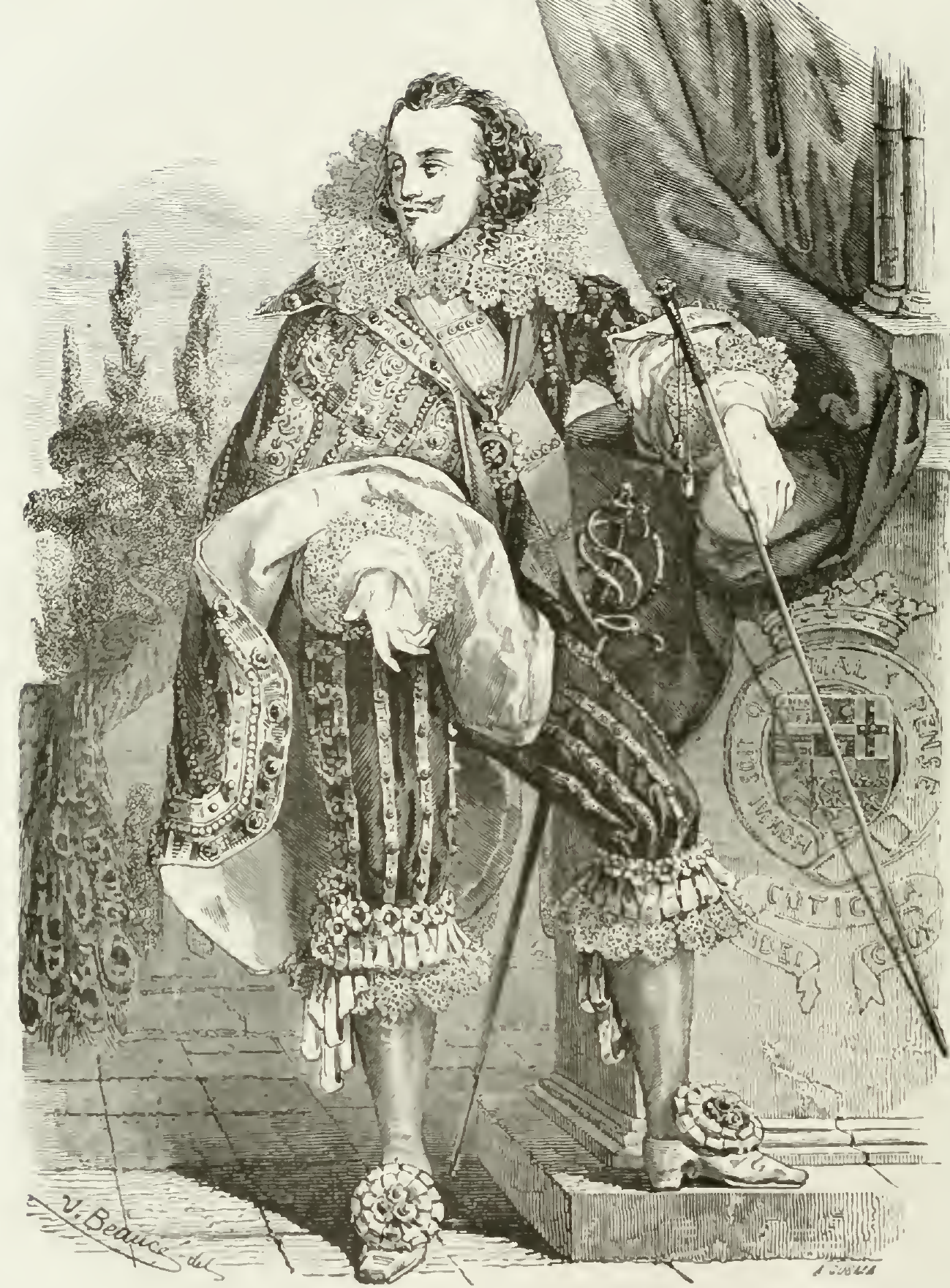
"They have been stolen from me," resumed the duke, "and it is the cardinal who has done the deed. Look, see: the ribbons that held them have been cut with scissors."
"If milord could suspect who committed the theft... Perhaps the person still has them in his hands."
"Wait, wait," cried the duke. "The only time I wore these studs was at the king's ball, eight days ago, at Windsor. The Countess de Winter, with whom I was on bad terms, drew near me at that ball. That reconciliation was a jealous woman's vengeance. Since that day I have not seen her again. That woman is an agent of the cardinal."
"But has he agents, then, all over the world?" cried d'Artagnan.
"Oh! yes, yes," said Buckingham, grinding his teeth with rage; "yes, he is a terrible wrestler. But however, when is the ball at Paris to take place?"
"Next Monday."
"Next Monday! Five days still, that is more time than we need. Patrice!" cried the duke, opening the door of the chapel; "Patrice!"
His confidential valet appeared.
"My jeweler and my secretary!"
The valet went out with a promptness and a silence that proved the habit he had contracted of obeying blindly and without reply.
But although it was the jeweler who had been called first, it was the secretary who appeared first. That was quite simple; he lived in the hotel. He found Buckingham seated before a table in his bedchamber, writing some orders with his own hand.
"Mr. Jackson," he said to him, "you will go this instant to the lord chancellor and tell him that I charge him with the execution of these orders. I desire that they be promulgated at once."
"But, my lord, if the lord chancellor questions me as to the motives that may have led Your Grace to so extraordinary a measure, what shall I answer?"
"That such was my good pleasure, and that I have to give an account of my will to no one."
"Will that be the answer he must transmit to His Majesty," resumed the secretary with a smile, "if by chance the king should be curious to know why no vessel can leave the ports of Great Britain?"
"You are right, sir," replied Buckingham; "he would say in that case to the king that I have decided upon war, and that this measure is my first act of hostility against France."
The secretary bowed and went out.
"We are now easy on that side," said Buckingham, turning to d'Artagnan. "If the studs have not already left for France, they will not arrive there until after you."
"How is that?"
"I have just laid an embargo on all the vessels at present in His Majesty's ports, and, without special permission, not one of them will dare to weigh anchor.
D'Artagnan looked with stupefaction at this man, who placed the unlimited power with which he was invested by the confidence of a king at the service of his love. Buckingham saw from the expression on the young man's face what was passing in his mind, and he smiled.
"Yes," said he, "yes, it is because Anne of Austria is my true queen; at a word from her I would betray my country, I would betray my king, I would betray my God. She asked me not to send the Protestants of La Rochelle the help I had promised them, and I did so. I broke my word, but no matter, I obeyed her desire; was I not greatly repaid for my obedience, tell me, for it is to that obedience that I owe her portrait."
D'Artagnan marveled at the fragile and unknown threads on which the destinies of a people and the lives of men are sometimes suspended.
He was in the depths of these reflections when the goldsmith entered: he was an Irishman of the greatest skill in his art, and who himself admitted that he earned a hundred thousand livres a year with the Duke of Buckingham.
"M. O'Reilly," said the duke, leading him into the chapel, "look at these diamond studs and tell me what they are worth apiece."
The goldsmith cast a single glance at the elegant manner in which they were set, calculated the value of the diamonds one with another, and without any hesitation:
"Fifteen hundred pistoles apiece, milord," he replied.
"How many days would it take to make two studs like these? You see that two are missing."
"Eight days, milord."
"I will pay you three thousand pistoles apiece; I must have them by the day after tomorrow."
"Milord shall have them."
"You are a precious man, M. O'Reilly, but that is not all; these studs cannot be entrusted to anyone, they must be made in this palace."
— Impossible, milord, there is only I who can execute them so that the difference between the new and the old will not be seen.
— Also, my dear M. O'Reilly, you are my prisoner, and you would like to leave my palace at this hour, but you could not; so make up your mind to it. Name for me those of your workmen whom you need, and designate the tools they must bring.
— The goldsmith knew the duke; he knew that any objection was useless, so he made up his mind at once.
“Will I be permitted to notify my wife?” he asked.
— Oh! you will even be permitted to see her, my dear M. O'Reilly; your captivity will be gentle, rest assured, and since all inconvenience demands compensation, here, apart from the price of the two clasps, is a voucher for a thousand pistoles to make you forget the trouble I am causing you.
D'Artagnan could not get over the surprise caused him by this minister, who moved men and millions with both hands.
As for the goldsmith, he wrote to his wife, sending her the voucher for a thousand pistoles and instructing her to return to him in exchange, with his most skillful apprentice, an assortment of diamonds whose weight and quality he gave her, and a list of the tools he needed.
Buckingham led the goldsmith into the room intended for him, which, at the end of half an hour, had been transformed into a workshop. Then he placed a sentinel at each door, with orders not to let anyone enter except his valet Patrice. It is unnecessary to add that the goldsmith O'Reilly and his assistant were absolutely forbidden to go out under any pretext.
This point settled, the duke returned to D'Artagnan.
— Now, my young friend, he said to him, England belongs to the two of us; what did you want, what do you desire?
— A bed, replied D'Artagnan; it is, for the moment, I admit, the thing I need most.
Buckingham gave D'Artagnan a room adjoining his own. He wanted to keep the young man under his hand, not that he distrusted him, but to have someone with whom to speak constantly of the queen.
An hour later, the ordinance was promulgated in London forbidding any vessel loaded for France to leave the ports, not even the mail packet. In the eyes of all, it was a declaration of war between the two kingdoms.
Two days later at eleven o'clock, the two diamond clasps were finished, but so exactly imitated, so perfectly identical, that Buckingham could not distinguish the new ones from the old, and the most experienced in such matters would have been deceived by them as he was.
He immediately sent for D'Artagnan.
— Here, he said to him, are the diamond clasps you came to seek, and be my witness that all that human power could do, I have done.
— Rest assured, milord: I will say what I have seen; but Your Grace is giving me the clasps without the box.
— The box would embarrass you. Besides, the box is all the more precious to me because it remains mine alone. You will say that I am keeping it.
— I will carry out your commission word for word, milord.
— And now, resumed Buckingham, looking fixedly at the young man, how shall I ever discharge my debt to you?
D'Artagnan blushed to the whites of his eyes. He saw that the duke was seeking a means of making him accept something, and the idea that the blood of his companions and his own was to be paid for with English gold was strangely repugnant to him.
— Let us understand each other, milord, replied D'Artagnan, and let us weigh the facts in advance, so that there may be no mistake. I am in the service of the king and queen of France, and belong to the company of the guards of M. des Essarts, who, like his brother-in-law M. de Tréville, is particularly attached to Their Majesties. I have therefore done everything for the queen and nothing for Your Grace. Moreover, perhaps I would not have done any of all this, had it not been a question of pleasing someone who is my lady, as the queen is yours.
— Yes, said the duke, smiling, and I believe I even know that other person; it is—
— Milord, I have not named her, interrupted the young man quickly.
— True, said the duke; it is therefore to that person that I must be grateful for your devotion.
— You have said it, milord, for precisely at this hour when war is in question, I confess to you that I see in Your Grace only an Englishman, and consequently an enemy whom I would be even more delighted to meet on the field of battle than in the park of Windsor or the corridors of the Louvre; which, moreover, will not prevent me from carrying out my mission point by point and from getting myself killed, if need be, to accomplish it; but, I repeat to Your

Grace, without her having personally, on that account, more to thank me for what I do for myself in this second interview than for what I have already done for her in the first.
— We say, we: “Proud as a Scot,” murmured Buckingham.
— And we say, we: “Proud as a Gascon,” replied D'Artagnan. The Gascons are the Scots of France.
D'Artagnan bowed to the duke and prepared to leave.
— Well! you are leaving like that? By what route? How?
— That is true.
— God damn me, the French doubt nothing!
— I had forgotten that England was an island, and that you were its king.
— Go to the port, ask for the brig the Sund, hand this letter to the captain; he will take you to a small port where certainly no one expects you, and where ordinarily only fishing vessels put in.
— That port is called?
— Saint-Valery; but wait, then; once there, you will enter a wretched inn without name and without sign, a regular sailors' den, there is no mistaking it, there is only one.
— After that?
— You will ask for the host and say to him: For'ward.
— Which means?
— Forward: that is the password. He will give you a fully saddled horse and indicate the road you must follow; you will thus find four relays on your route. If you wish, at each of them, to give your address in Paris, the four horses will follow you there; you already know two of them, and you appeared to me to appreciate them as an amateur: they are those we were riding; trust me, the others will not be inferior to them. These four horses are equipped for the campaign. Proud as you are, you will not refuse to accept one and to make your companions accept the other three; it is to make war on us, moreover. The end justifies the means, as you French say, do you not?
— Yes, milord, I accept, said D'Artagnan, and, if it please God, we will make good use of your presents.
— Now, your hand, young man; perhaps we shall soon meet on the field of battle; but, meanwhile, we will part good friends, I hope.
— Yes, milord, but with the hope of soon becoming enemies.
— Set your mind at ease, I promise you.
— I rely upon your word, milord.
D'Artagnan bowed to the duke and walked briskly toward the port.
Opposite the Tower of London he found the vessel designated, handed his letter to the captain, who had it endorsed by the governor of the port, and set sail at once.
Fifty vessels were preparing to depart and waiting.
As he passed alongside one of them, D'Artagnan thought he recognized the woman of Meung, the same whom the unknown gentleman had called milady, and whom he, D'Artagnan, had found so beautiful; but thanks to the current of the river and the fair wind that was blowing, his ship went so swiftly that after a moment they were out of sight.
The next day, about nine o'clock in the morning, they landed at Saint-Valery.
D'Artagnan made his way at once to the inn indicated, and recognized it by the shouts issuing from it: they were talking of the war between England and France as of a thing imminent and indubitable, and the merry sailors were making good cheer.
D'Artagnan cleft the crowd, advanced toward the host, and pronounced the word for'ward. Instantly the host motioned him to follow, went out with him through a door that opened into the courtyard, led him to the stable, where a fully saddled horse awaited him, and asked whether he needed anything else.
— I need to know the road I must follow, said D'Artagnan.
— Go from here to Blangy, and from Blangy to Neufchâtel. At Neufchâtel, enter the inn of the Herse-d'Or, give the password to the innkeeper, and you will find, as here, a horse fully saddled.
— Do I owe anything? asked D'Artagnan.
— Everything is paid, said the host, and liberally. Go, then, and may God guide you! — Amen! replied the young man as he set off at a gallop.
Four hours later, he was at Neufchâtel.
He followed strictly the instructions he had received; at Neufchâtel as at Saint-Valery, he found a horse all saddled and waiting for him; he wished to transfer the pistols from the saddle he had just left to the saddle he was about to take: the holsters were furnished with similar pistols.
"Your address in Paris?"
"Hôtel des Gardes, company of the Essarts."
"Good," replied the latter.
"Which road must I take?" asked d'Artagnan in his turn.
"That of Rouen; but you will leave the town to your right. At the little village of Écouis, you will stop; there is only one inn, the Écu-de-France. Do not judge it by its appearance; it will have in its stables a horse that will be worth this one."
"Same password?"
"Exactly."
"Adieu, master."
"Good journey, my gentleman. Do you need anything?"
D'Artagnan signaled with his head that he did not, and set off at full speed. At Écouis the same scene was repeated: he found a host equally obliging, a fresh and rested horse; he left his address as he had done before, and set off at the same speed for Pontoise. At Pontoise, he changed mounts one last time, and at nine o'clock he entered at a full gallop the courtyard of M. de Tréville's hôtel.
He had covered nearly sixty leagues in twelve hours.
M. de Tréville received him as if he had seen him that very morning; only, pressing his hand a little more warmly than usual, he announced to him that M. des Essarts's company was on guard at the Louvre and that he could go to his post.