THE KING’S MUSKETEERS AND M. THE CARDINAL’S GUARDS.
D’Artagnan knew no one in Paris. He therefore went to the appointment with Athos without bringing a second, resolved to be satisfied with those his adversary would have chosen. Besides, his intention was firm to make the brave musketeer all suitable apologies, but without weakness, fearing that there would result from this duel what always results from something unfortunate in an affair of this kind, when a young and vigorous man fights against a wounded and weakened adversary: if vanquished, he doubles the triumph of his antagonist; if victor, he is accused of foul play and easy boldness.
Moreover, either we have badly set forth the character of our seeker of adventures, or our reader must already have noticed that d’Artagnan was not an ordinary man. Thus, while repeating to himself that his death was inevitable, he did not resign himself to dying gently like some other man less courageous and less moderate than he would have done in his place. He reflected on the different characters of those with whom he was going to fight, and began to see more clearly into his situation. He hoped, thanks to the loyal apologies he reserved for him, to make a friend of Athos, whose grand-seigneur air and austere mien pleased him greatly. He flattered himself that he would frighten Porthos with the adventure of the baldric, which he could, if he were not killed on the spot, tell to everyone, a tale which, skillfully pushed to its effect, ought to cover Porthos with ridicule; finally, as for the sly Aramis, he was not very greatly afraid of him, and supposing that he reached him, he took it upon himself to dispatch him handsomely, or at least, by striking him in the face, as Caesar had recommended be done to Pompey’s soldiers, to damage forever that beauty of which he was so proud.
Next there was in d’Artagnan that unshakable fund of resolution which his father’s advice had deposited in his heart, advice whose substance was—to suffer nothing from anyone except the king, the cardinal, and M. de Tréville. He therefore rather flew than walked toward the convent of the Discalced Carmelites, or rather the “deschaux,” as people said at that time, a sort of building without windows, bordered by arid meadows, a dependency of the Pré-aux-Clercs, and which ordinarily served for encounters between people who had no time to lose.
When d'Artagnan came in sight of the little open space that stretched at the foot of the monastery, Athos had been waiting only five minutes, and noon was striking. He was therefore as punctual as the Samaritan woman, and the most rigorous casuist in the matter of duels had nothing to say.
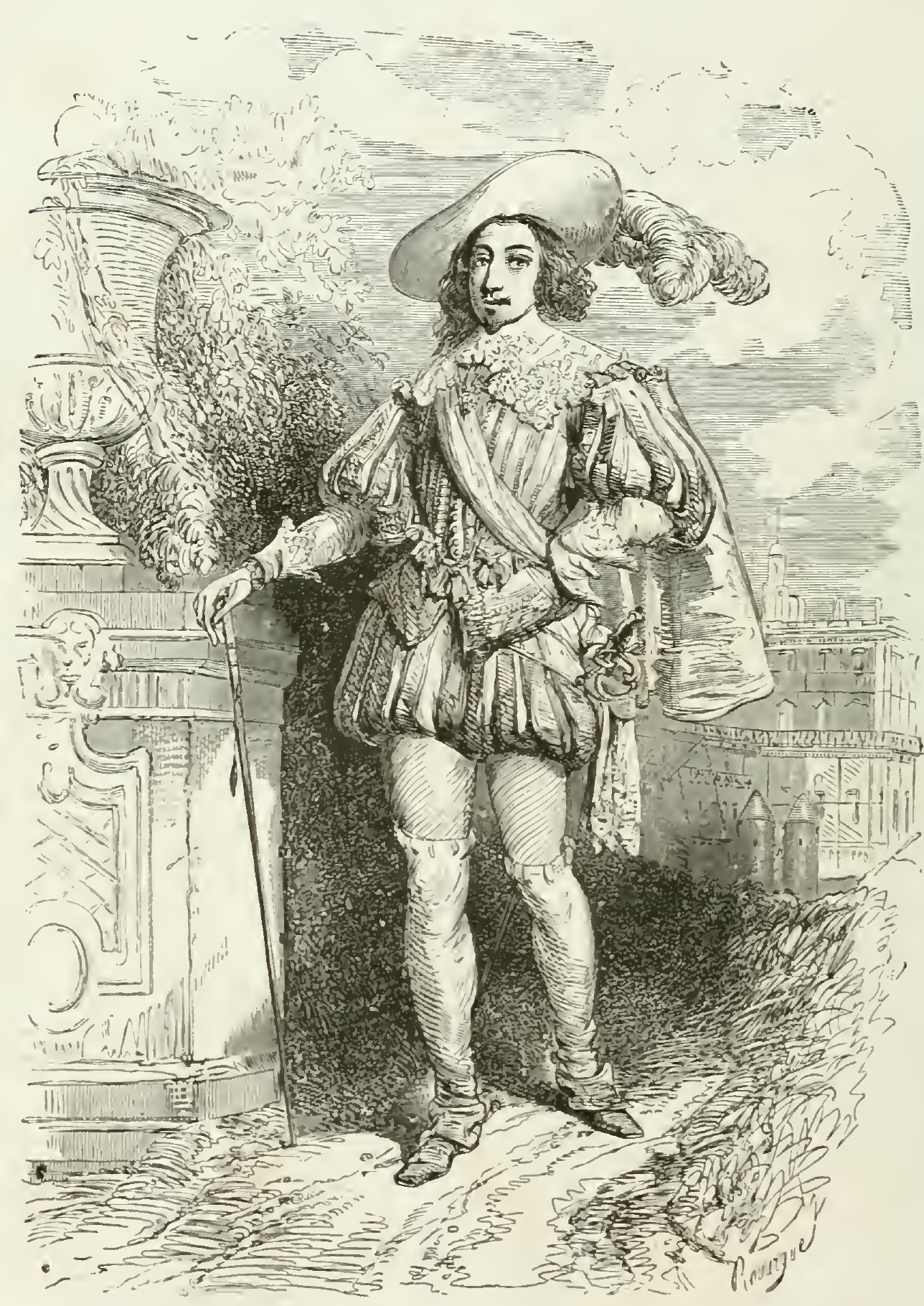
Athos, who was still suffering cruelly from his wound, although it had been freshly dressed by M. de Tréville's surgeon, had sat down on a stone and was awaiting his adversary with that calm countenance and that dignified air that never left him. At the sight of d'Artagnan, he rose and politely took a few steps toward him. The latter, for his part, approached his adversary only with his hat in his hand and his plume trailing on the ground.
"Monsieur," said Athos, "I have sent word to two of my friends, who will serve as my seconds, but these two friends have not yet arrived. I am surprised at their delay; it is not their habit."
"I have no second, myself, monsieur," said d'Artagnan, "for, having arrived in Paris only yesterday, I as yet know no one there but M. de Tréville, to whom I was recommended by my father, who has the honor of being somewhat of his friend."
Athos reflected for a moment.
"You know only M. de Tréville?" he asked.
"Yes, monsieur, I know only him."
"Ah, but then," continued Athos, speaking half to himself and half to d'Artagnan, "ah, but then, if I kill you, I shall look like a child-eater, I will!"
"Not too much so, monsieur," replied d'Artagnan with a bow that was not lacking in dignity; "not too much so, since you do me the honor of drawing your sword against me with a wound that must be very troublesome to you."
"Very troublesome, on my word, and you have done me a devil of a hurt, I must say; but I shall use my left hand, it is my habit in such circumstances. Do not believe that I am doing you a favor; I fence properly with both hands; there will even be a disadvantage for you: a left-hander is very awkward for people who are not forewarned. I regret, therefore, not having informed you of this circumstance sooner."
"You are truly, monsieur," said d'Artagnan, bowing again, "of a courtesy for which I am more grateful than I can say."
"You embarrass me," replied Athos with his gentlemanly air; "let us talk of something else, I beg you, unless that is disagreeable to you. Ah! zounds! how you have hurt me! my shoulder is burning."
"If you would allow..." said d'Artagnan timidly.
"What, monsieur?"
"I have a miraculous balm for wounds, a balsam that comes from my mother, and which I have tested on myself."
"Well!—Well, I am sure that in less than three days this balm would cure you, and after three days, when you were healed, well! monsieur, it would still be a great honor to be your man."
D'Artagnan said these words with a simplicity that did honor to his courtesy, without in any way detracting from his courage.
"By Jove, monsieur," said Athos, "here is a proposal that pleases me, not that I accept it, but it smacks of the gentleman a league away. It was thus that those valiant men of Charlemagne's time spoke and acted, after whom every knight must seek to model himself. Unfortunately we are no longer in the time of the great emperor. We are in the time of M. le Cardinal, and within three days it would be known, I say, that we were to fight, and our combat would be opposed. Ah, but then, those idlers will not come, then."
"If you are in a hurry, monsieur," said d'Artagnan to Athos, with the same simplicity with which a moment before he had proposed to postpone the duel for three days, "if you are in a hurry and it pleases you to dispatch me at once, do not stand on ceremony, I beg you."
"There is another word that pleases me," said Athos, giving d'Artagnan a gracious nod; "it is not that of a man without brains, and it is surely that of a man of heart. Monsieur, I like people of your stamp, and I see that if we do not kill each other, one or the other, I shall later have real pleasure in your conversation. Let us wait for these gentlemen, I beg you; I have all the time in the world, and it will be more correct. Ah! here is one, I believe."
Indeed, at the end of the rue de Vaugirard, the gigantic Porthos was beginning to appear.
"What!" exclaimed d'Artagnan, "your first witness is M. Porthos?"
"Yes, does that vex you?"
"No, not at all."
"And here is the second."
D'Artagnan turned in the direction indicated by Athos and recognized Aramis.
"What!" he exclaimed, in a tone even more astonished than the first time, "your second witness is M. Aramis?"
"Of course; do you not know that we are never seen one without the other, and that in the musketeers and in the guards, at court and in town, we are called Athos, Porthos, and Aramis, or the three inseparables? After that, as you come from Dax or from Pau..."
"From Tarbes," said d'Artagnan.
"You may be permitted not to know this detail," said Athos.
"Faith," said d'Artagnan, "you are well named, gentlemen, and my adventure, if it makes any noise, will at least prove that your union is not founded on contrasts."
Meanwhile Porthos had approached, had greeted Athos with a wave of his hand; then, turning toward d'Artagnan, he had remained quite astonished.
Let us say in passing that he had changed his baldric and taken off his cloak.
"Ah! ah!" he said, "what is this?"
"It is with monsieur that I am fighting," said Athos, pointing to d'Artagnan with his hand and greeting them both with the same gesture.
"It is with him that I am fighting too," said Porthos.
"But only at one o'clock," replied d'Artagnan.
"And I too, it is with monsieur that I am fighting," said Aramis, arriving in his turn on the field.
"But only at two o'clock," said d'Artagnan with the same calm.
"But about what are you fighting, Athos?" asked Aramis.
"Faith, I do not know exactly; he hurt my shoulder; and you, Porthos?"
"Faith, I am fighting because I am fighting," replied Porthos, blushing. Athos, who missed nothing, saw a subtle smile pass over the Gascon's lips.
"We had a discussion about dress," said the young man.
"And you, Aramis?" asked Athos.
"I, I am fighting for a cause of theology," replied Aramis, while signaling to d'Artagnan that he begged him to keep the cause of his duel secret.
Athos saw a second smile pass over d'Artagnan's lips.
— Really? said Athos.
— Yes, a point of Saint Augustine on which we do not agree, said the Gascon.
— Decidedly, he is a man of wit, murmured Athos.
— And now that you are assembled, gentlemen, said d'Artagnan, allow me to make my apologies to you.
At this word apologies, a cloud passed over Athos's brow, a haughty smile slid across Porthos's lips, and a negative sign was Aramis's response.
— You do not understand me, gentlemen, said d'Artagnan, raising his head, over which a ray of sunlight was at that moment playing, gilding its fine and bold lines; I ask your pardon in the event that I cannot pay my debt to all three of you; for Monsieur Athos has the right to kill me first, which greatly diminishes the value of your claim, Monsieur Porthos, and which renders yours approximately nil, Monsieur Aramis. Now, gentlemen, I repeat it to you, excuse me, but for that only, and on guard!
At these words, and with the most cavalier gesture imaginable, d'Artagnan drew his sword.
The blood had risen to d'Artagnan's head, and in that moment he would have drawn his sword against all the musketeers in the kingdom as he had just done against Athos, Porthos, and Aramis.
It was a quarter past noon. The sun was at its zenith, and the spot chosen to be the theater of the duel was exposed to all its ardor.
— It is very hot, said Athos, drawing his sword in his turn, and yet I could not remove my doublet; for, just now, I felt that my wound was bleeding, and I would fear to inconvenience monsieur by showing him blood that he had not drawn himself.
"It is true, monsieur," said d'Artagnan, "and whether drawn by another or drawn by me, I assure you I shall always see with great regret the blood of so brave a gentleman; I shall therefore fight in my doublet as you do."
"Come, come," said Porthos, "enough compliments like that, and remember that we are waiting our turn."
"Speak for yourself alone, Porthos, when you have such impertinences to utter," interrupted Aramis."As for me, I find the things these gentlemen are saying to one another very well said and altogether worthy of two gentlemen."
"When you please, monsieur," said Athos, putting himself on guard.
"I was awaiting your orders," said d'Artagnan, crossing his blade with his.
But the two rapiers had scarcely rung out as they touched, when a squad of His Eminence's guards, commanded by M. de Jussac, appeared at the corner of the convent.
"The cardinal's guards!" cried Porthos and Aramis at the same time. "Swords in their scabbards, gentlemen, swords in their scabbards!"
But it was too late. The two combatants had been seen in a posture that left no doubt as to their intentions.
"Halloa!" cried Jussac, advancing toward them and motioning to his men to do likewise, "halloa! musketeers, so we are fighting here, are we? And the edicts, what do we make of them?"
"You are very generous, gentlemen of the guards," said Athos, full of rancor, for Jussac had been one of the aggressors of two evenings before. "If we saw you fighting, I answer for it, for my part, that we should take good care not to hinder you; let us alone, then, and you will have the pleasure without taking any trouble."
"Gentlemen," said Jussac, "it is with great regret that I declare to you that the thing is impossible. Our duty before all. Sheathe your swords, therefore, if you please, and follow us."
"Monsieur," said Aramis, parodying Jussac, "it would be with great pleasure that we should obey your gracious invitation if it depended upon us, but, unfortunately, the thing is impossible: M. de Tréville has forbidden it. Pass on your way, then; that is the best thing you can do."
This raillery exasperated Jussac.
"We shall charge you, then," said he, "if you disobey."
"They are five," said Athos, half aloud, "and we are only three; we shall be beaten again, and we shall have to die here, for, I declare, I will not reappear before the captain defeated."
Athos, Porthos, and Aramis drew close to one another instantly, while Jussac aligned his soldiers.
That single moment was enough for d'Artagnan to make up his mind: this was one of those events that decide the life of a man; it was a choice to be made between the king and the cardinal, and once that choice was made, he must persevere in it. To fight, that is to say, to disobey the law, that is to say, to risk his head, that is to say, to make himself at a single blow the enemy of a minister more powerful than the king himself—that is what the young man glimpsed, and, let us say it to his praise, he did not hesitate a single second. Turning, therefore, toward Athos and his friends:
"Gentlemen," said he, "I shall take back, if you please, something from your words. You said that you were only three, but it seems to me that we are four."
"But you are not one of us," said Porthos.
"That is true," replied d'Artagnan, "I have not the uniform, but I have the soul. My heart is a musketeer's, I feel it well, monsieur, and that carries me away."
"Stand aside, young man," cried Jussac, who doubtless from his gestures andthe expression of his face had guessed d'Artagnan's design. "You may withdraw, we consent to it. Save your skin; go quickly."
D'Artagnan did not move.
"Decidedly, you are a fine lad," said Athos, pressing the young man's hand.
"Come, come, let us come to a decision," resumed Jussac.
"Come now," said Porthos and Aramis, "let us do something."
"Monsieur is full of generosity," said Athos.
But all three were thinking of d'Artagnan's youth and dreaded his inexperience.
"We should be only three, one of them wounded, plus a child," resumed Athos, "and it will not be said any the less that we were four men."
"Yes, but to retreat!" said Porthos.
"It is difficult," resumed Athos.
"It is impossible," said Aramis.
D'Artagnan understood their irresolution.
"Gentlemen, try me always," said he, "and I swear to you on my honor that I will not leave here if we are vanquished."
"What is your name, my brave fellow?" said Athos.
"D'Artagnan, monsieur."
"Well then! Athos, Porthos, Aramis, and d'Artagnan, forward!" cried Athos.
"Well then! come, gentlemen, do you decide to decide?" cried Jussac for the third time.
"It is done, monsieur," said Athos.
"And what course do you take?" demanded Jussac.
"We are about to have the honor of charging you," replied Aramis, lifting his hat with one hand and drawing his sword with the other.
"Ah! you resist," cried Jussac.
"By heaven! does that astonish you?" said Porthos.
And the nine combatants rushed upon one another with a fury that did not exclude a certain method.
Athos took a certain Cahusac, a favorite of the cardinal; Porthos had one named Biscarat, and Aramis found himself facing two adversaries.
As for d'Artagnan, he found himself launched against Jussac himself.
The heart of the young Gascon beat as if to burst his breast, not with fear, thank God, he had not the slightest shadow of it, but with emulation; he fought like a tiger in a fury, turning ten times around his adversary, changing his guard and his ground twenty times. Jussac was, as they said then, fond of the blade and had practiced it greatly; nevertheless he had the greatest difficulty in the world defending himself against an adversary who, agile and bounding, departed at every moment from the received rules, attacking from all sides at once, and all the while parrying like a man who has the greatest respect for his own skin.
Finally, this struggle ended by making Jussac lose patience. Furious at being held in check by someone he regarded as a child, he grew heated and began to make mistakes. D'Artagnan, who, lacking practice, had a profound theoretical knowledge, redoubled his agility. Jussac, wishing to put an end to it, delivered a terrible blow to his adversary by lunging deeply; but the latter parried it, and while Jussac was recovering himself, gliding like a serpent under his blade, he ran his sword through his body. Jussac fell like a mass.
D'Artagnan then cast a rapid and anxious glance over the battlefield. Aramis had already killed one of his adversaries, but the other was pressing him hard.
However, Aramis was in a good position and could still defend himself. Biscarat and Porthos had just exchanged thrusts. Porthos had received a sword thrust through the arm, and Biscarat through the thigh. But as neither of the two wounds was serious, they only fought with all the more fury.
Athos, wounded again by Cahusac, was growing visibly pale, but he did not retreat a single step; he had only changed his sword to the other hand and was fighting left-handed.
D'Artagnan, following the laws of dueling of that era, could help someone; while he was searching with his eyes for which of his companions needed his aid, he caught a glance from Athos. That glance was of a sublime eloquence. Athos would have died rather than call for help; but he could look, and with a look request support. D'Artagnan guessed it, made a terrible bound, and fell upon Cahusac's flank, crying:
"To me, guardsman, or I kill you."
Cahusac turned around; it was time. Athos, sustained by his extreme courage alone, fell upon one knee.
"Zounds!" he cried to D'Artagnan, "do not kill him, I beg you; I have an old score to settle with him, when I am healed and in good health. Only disarm him, bind his sword. That's it. Good! very good!"
This exclamation was wrung from Athos by Cahusac's sword, which sprang twenty paces from him. D'Artagnan and Cahusac rushed forward together, one to seize it, the other to take possession of it; but D'Artagnan, more nimble, arrived first and set his foot upon it.
Cahusac ran to the guardsman whom Aramis had killed, seized his rapier, and wanted to return to D'Artagnan; but on his way he met Athos, who, during the momentary pause that D'Artagnan had procured for him, had recovered his breath, and who, fearing that D'Artagnan would kill his enemy, wanted to begin the combat again.
D'Artagnan understood that it would be offending Athos not to let him do so. Indeed, a few seconds later, Cahusac fell with his throat pierced by a sword thrust.
At the same instant, Aramis pressed the point of his sword against the breast of his overthrown adversary and forced him to beg for mercy.
There remained Porthos and Biscarat. Porthos, while fighting, made no boasting at all, asking Biscarat what time it could possibly be, and paying him compliments on the company his brother had just obtained in the regiment of Navarre; but, while jesting, he was gaining nothing. Biscarat was one of those men of iron who fall only dead.
However, it was necessary to finish. The watch could arrive and take all the combatants, wounded or not, royalists or cardinalists. Athos, Aramis, and D'Artagnan surrounded Biscarat and summoned him to surrender. Although alone against all, and with a sword thrust through his thigh, Biscarat wanted to hold out; but Jussac, who had raised himself on his elbow, cried out to him to surrender. Biscarat was a Gascon like D'Artagnan; he turned a deaf ear and contented himself with laughing, and between two parries, finding time to designate with the tip of his sword a spot on the ground:
"Here," he said, parodying a verse of the Bible, "here Biscarat shall die, alone of those who are with him."
"But they are four, four against you; finish it, I order you."
"Ah! if you order it, that's another matter," said Biscarat; "since you are my brigadier, I must obey."
And making a bound backward, he broke his sword across his knee so as not to surrender it, threw the pieces over the wall of the convent, and crossed his arms, whistling a cardinalist tune.
Bravery is always respected, even in an enemy. The musketeers saluted Biscarat with their swords and returned them to their scabbards. D'Artagnan did the same, then, aided by Biscarat, the only one who had remained standing, he carried under the porch of the convent Jussac, Cahusac, and the one of Aramis's adversaries who was only wounded. The fourth, as we have said, was dead. Then they rang the bell, and carrying away four swords out of five, they made their way, drunk with joy, toward M. de Tréville's hôtel.
They were seen arm in arm, taking up the whole width of the street, and accosting every musketeer they met, so that in the end it was a triumphal march. D'Artagnan's heart swam in rapture; he walked between Athos and Porthos, embracing them tenderly.
"If I am not yet a musketeer," he said to his new friends as he crossed the threshold of M. de Tréville's hôtel, "at least I am received as an apprentice, am I not?"