THE BONACIEUX HOUSEHOLD.
IT was the second time that the cardinal had returned to this point of the diamond studs with the king. Louis XIII was therefore struck by this insistence, and thought that this recommendation concealed a mystery.
More than once the king had been humiliated that the cardinal, whose police, without having yet attained the perfection of the modern police, was excellent, should be better informed than himself of what was passing in his own household. He hoped, therefore, in a conversation with Anne of Austria, to draw some light from that conversation, and then to return to His Eminence with some secret which the cardinal either knew or did not know, which in either case raised him infinitely in the eyes of his minister.
He therefore went to the queen, and, according to his custom, addressed her with fresh threats against those who surrounded her. Anne of Austria bowed her head, let the torrent flow without answering, and hoping that he would end by stopping; but this was not what Louis XIII wanted; Louis XIII wanted a discussion from which some light might spring, convinced as he was that the cardinal had some hidden thought and was hatching one of those terrible surprises of which His Eminence knew the secret. He attained this end by his persistency in accusing.
"But," cried Anne of Austria, weary of these vague attacks, "but, Sire, you do not tell me all that you have in your heart. What then have I done? Come, what crime have I committed? It is impossible that Your Majesty should make all this noise for a letter written to my brother."
The king, attacked in his turn in so direct a manner, did not know what to answer; he thought that this was the moment to place the recommendation which he was not to make until the eve of the fete.
"Madame," said he with majesty, "there will shortly be a ball at the Hotel de Ville; I desire that, to do honor to our brave aldermen, you appearthere in ceremonial dress, and above all adorned with the diamond studs that I gave you for your fete. That is my answer."
The answer was terrible. Anne of Austria believed that Louis XIII knew all, and that the cardinal had obtained from him this long dissimulation of seven or eight days, which was, moreover, in his character. She became excessively pale, rested on a console table her hand of admirable beauty, which then seemed a hand of wax, and looking at the king with terrified eyes, she did not answer a single syllable.
"You hear, madame," said the king, who enjoyed this embarrassment in all its extent, but without divining its cause, "you hear?"
"Yes, Sire, I hear," stammered the queen.
"You will appear at this ball?"
"Yes."
"With your studs?"
"Yes."
The queen's pallor increased still more, if possible; the king perceived it and enjoyed it with that cold cruelty which was one of the bad sides of his character.
"Then it is agreed," said the king, "and that is all I had to say to you."
"But on what day will this ball take place?" asked Anne of Austria.
Louis XIII felt instinctively that he ought not to answer this question, the queen having asked it in an almost dying voice.
"But very shortly, madame," said he; "I do not precisely remember the date of the day; I will ask the cardinal."
"Then it is the cardinal who has announced this fete to you?" cried the queen.
"Yes, madame," replied the king, astonished; "but why?"
"It is he who told you to invite me to appear there with these studs?"
"That is to say, madame—"
"It is he, Sire, it is he!"
"Well! what matters it whether it be he or I? Is there a crime in this invitation?"
"No, Sire."
"Then you will appear?"
"Yes, Sire."
"That is well," said the king as he withdrew, "that is well, I count upon it."
The queen made a courtesy, less from etiquette than because her knees gave way under her.
The king departed enchanted.
"I am lost," murmured the queen, "lost, for the cardinal knows all, and it is he who urges on the king, who as yet knows nothing, but who will soon know all. I am lost! My God! my God! my God!"
She knelt on a cushion and prayed, her head buried in her trembling arms.
Indeed, the position was terrible. Buckingham had returned to London, Madame de Chevreuse was in Tours. Watched more closely than ever, the queen sensed dimly that one of her women was betraying her without being able to say which one. Laporte could not leave the Louvre; she did not have a single soul in the world to trust.
So, in the presence of the misfortune that threatened her and the abandonment that was hers, she burst into sobs.
"Can I then be of no use at all to Your Majesty?" said suddenly a voice full of gentleness and pity.
The queen turned sharply, for there was no mistaking the expression of that voice: it was a friend who spoke thus.
Indeed, at one of the doors opening into the queen's apartment appeared the pretty Madame Bonacieux; she had been busy putting away the dresses and linen in a closet when the king entered; she had not been able to get out and had heard everything.
The queen uttered a piercing cry on finding herself surprised, for in her agitation she did not at first recognize the young woman whom Laporte had given her.
"Oh! fear nothing, madame," said the young woman, clasping her hands and herself weeping over the queen's anguish; "I am Your Majesty's body and soul, and however far I may be from her, however inferior my position, I believe I have found a way to deliver Your Majesty from her trouble."
"You! O heaven! you!" cried the queen; "but come, look me in the face. I am betrayed on every side; can I trust you?"
"Oh! madame!" cried the young woman, falling to her knees: "oh! upon my soul, I am ready to die for Your Majesty!"
That cry had come from the deepest depths of the heart, and, like the first, there was no mistaking it.
"Yes," continued Madame Bonacieux, "yes, there are traitors here; but, by the holy name of the Virgin, I swear to you that no one is more devoted than I to Your Majesty. Those studs that the king is asking for again, you gave them to the Duke of Buckingham, did you not? Those studs were enclosed in a small rosewood box that he held under his arm. Am I mistaken? Is that not it?"
— Oh! my God! my God! murmured the queen, whose teeth chattered with fright.
— Well! these studs, continued Mme. Bonacieux, must be recovered?
— Yes, undoubtedly, they must, cried the queen; but how is it to be done, how can we succeed?
— Someone must be sent to the duke.
— But who?... who?... Whom can I trust?
— Have confidence in me, madame; do me that honor, my queen, and I will find the messenger myself.
— But it will be necessary to write!
— Oh, yes. That is indispensable. Two words from the hand of your Majesty, and your private seal.
— But these two words would be my condemnation: the divorce, the exile!
— Yes, if they fall into infamous hands! But I answer for it that these two words shall be delivered to their address.
— Oh! my God! I must then place my life, my honor, my reputation in your hands!
— Yes, yes, madame, you must, and I will save all that, I will!
— But how? tell me at least!
— My husband has been set at liberty two or three days ago; I have not yet had time to see him again. He is a brave and honest man, who has neither hatred nor love for anyone. He will do all that I wish: he will set out on an order from me, without knowing what he carries, and he will deliver the letter of your Majesty, without even knowing that it is from your Majesty, at the address it indicates.
The queen took the two hands of the young woman with a passionate impulse, looked at her as if to read to the bottom of her heart, and seeing only sincerity in her beautiful eyes, she embraced her tenderly.
— Do this, cried she, and you will have saved my life, you will have saved my honor!
— Oh! do not exaggerate the service which I have the happiness to render you; I have nothing to save for your Majesty, who is only the victim of perfidious plots.
— That is true, that is true, my child, said the queen, and you are right.
— Give me then this letter, madame, time presses.
The queen ran to a little table on which were ink, paper, and pens: she wrote two lines, sealed the letter with her own seal, and handed it to Mme. Bonacieux.
— And now, said the queen, we are forgetting one very necessary thing.
— What?
— Money.
Mme. Bonacieux smiled.
— Yes, that is true, said she, and I will confess to your Majesty that my husband—
— Your husband has none, that is what you mean to say.
— He has some, but he is very avaricious, that is his failing. However, let not your Majesty be uneasy, we shall find means.
— It is that I have none either, said the queen. — Those who read the memoirs of Mme. de Motteville will not be astonished at this reply. — But wait.
Anne of Austria ran to her jewel-case.
— Here, said she, here is a ring of great price, as I am assured; it comes from my brother the King of Spain; it is mine, and I can dispose of it. Take this ring and turn it into money, and let your husband set out.
— In an hour you shall be obeyed.
— You see the address, added the queen, speaking so low that one could scarcely hear what she said: To my Lord Duke of Buckingham, at London.
— The letter shall be delivered to himself.
— Generous child, cried Anne of Austria.
Mme. Bonacieux kissed the hands of the queen, concealed the paper in her bosom, and disappeared with the lightness of a bird.
Ten minutes after, she was at home, as she had told the queen; she had not seen her husband since his liberation; she was therefore ignorant of the change that had taken place in him with regard to the cardinal, a change which the money and flattery of His Eminence had wrought, and which had since been corroborated by two or three visits from the Comte de Rochefort, who had become the best friend of Bonacieux, and to whom he had made believe, without much difficulty, that no guilty sentiment had led to the abduction of his wife, but that it was only a political precaution.
She found M. Bonacieux alone: the poor dear man was with great difficulty restoring some order in his house, of which he had found the furniture almost broken and the cupboards almost empty, justice not being one of the three things which King Solomon indicates as leaving no trace of their passage. As for the servant, she had fled at the arrest of her master. The terror had gained upon the poor girl to such a degree that she had not ceased to walk from Paris to Burgundy, her native country.
The worthy mercer had, immediately upon his return to his house, informed his wife of his happy return, and his wife had replied to congratulate him and to tell him that the first moment she could steal from her duties would be devoted entirely to paying him a visit.
This first moment had been delayed five days, which, under any other circumstances, would have appeared a little very long to Master Bonacieux; but he had, in the visit he had paid to the cardinal and in the visits Rochefort had paid him, ample subject for reflection; and, as is well known, nothing makes time pass like reflection.
All the more because the reflections of Bonacieux were all rose-colored. Rochefort called him his friend, his dear Bonacieux, and never ceased telling him that the cardinal made the greatest account of him. The mercer already saw himself on the road to honors and fortune.
For her part, Mme. Bonacieux had reflected, but, it must be said, upon anything but ambition; in spite of herself her thoughts had had for a constant motive this handsome young man, so brave and who appeared so much in love. Married at eighteen to M. Bonacieux, having always lived in the midst of her husband's friends, little susceptible of inspiring any sentiment in a young woman whose heart was higher than her position, Mme. Bonacieux had remained insensible to vulgar seductions; but, at this epoch especially, the title of gentleman had a great influence upon the bourgeoisie, and d'Artagnan was a gentleman; besides, he wore the uniform of the guards, which, after the uniform of the musketeers, was the most appreciated by the ladies. He was, we repeat, handsome, young, adventurous; he spoke of love like a man who loves and who thirsts to be loved; there was more than enough there to turn a head of twenty-three, and Mme. Bonacieux had arrived at just that happy age of life.
The two spouses, although they had not seen each other for more than eight days, and although during that week grave events had passed between them, therefore approached each other with a certain preoccupation; nevertheless, M. Bonacieux manifested a real joy and advanced toward his wife with open arms.
Mme. Bonacieux presented her forehead to him.
— Let us talk a little, said she.
— How, said Bonacieux, astonished.
— Yes, undoubtedly, I have a thing of the greatest importance to tell you.
— By the way, I too have some rather serious questions to put to you. Explain your abduction to me a little, I beg you.
— That is not the point at present, said Madame Bonacieux.
— And what is the point, then? My captivity?
— I learned of it the very same day; but as you were guilty of no crime, as you were the accomplice of no intrigue, as in short you knew nothing that could compromise you or anyone else, I attached to that event only the importance it deserved.
— You speak of it very much at your ease, madame, replied Bonacieux, wounded by the little interest his wife showed him; do you know that I was plunged for a day and a night in a dungeon of the Bastille?
— A day and a night are soon past: let us leave your captivity, then, and return to what brings me to you.
— What? what brings you to me, is it not the desire to see again a husband from whom you have been separated for eight days? asked the mercer, stung to the quick.
— That is the first thing, and something else afterward.
— Speak!
— A matter of the highest interest, and upon which our future fortune perhaps depends.
— Our fortune has greatly changed face since I last saw you, Madame Bonacieux, and I would not be surprised if within a few months it should make many people envious.
— Yes, especially if you will follow the instructions I am about to give you.
— To me!
— Yes, to you. There is a good and holy action to be done, monsieur, and a great deal of money to be gained at the same time.
Madame Bonacieux knew that in speaking of money to her husband she was taking him by his weak side.
But a man, even a mercer, when he has conversed for ten minutes with a cardinal of Richelieu, is no longer the same man.
— A great deal of money to be gained? said Bonacieux, pursing his lips.
— Yes, a great deal.
— How much, approximately?
— A thousand pistoles, perhaps.
— What you have to ask of me is therefore very serious?
— Yes.
— What must be done?
— You will leave at once; I will give you a paper which you will not part with under any pretext, and which you will deliver into his own hands.
— And where am I to go?
— To London.
— I! To London! Come now, you are jesting; I have no business in London.
— But others need you to go there.
— Who are these others? I warn you that I no longer do anything blindly, and I want to know not only what I am exposing myself to, but also for whom I am exposing myself.
— A illustrious person sends you, an illustrious person awaits you; the reward will exceed your desires, that is all I can promise you.— Intrigues again, always intrigues; thank you, I distrust them now, and M. the cardinal has enlightened me on that score.
— The cardinal! cried Mme Bonacieux; have you seen the cardinal?
— He sent for me, replied the mercer proudly.
— And you went to his invitation, imprudent man that you are?
— I must say that I had no choice whether to go or not to go, for I was between two guards. It is also true to say that, as I did not know His Eminence at the time, if I could have avoided that visit, I would have been very delighted.
— So he mistreated you? So he made threats against you?
— He held out his hand to me and called me his friend—his friend! do you hear, madame? I am the friend of the great cardinal!
— Of the great cardinal!
— Would you by chance dispute him that title, madame?
— I dispute nothing with him; but I tell you that the favor of a minister is ephemeral, and that one must be mad to attach oneself to a minister: there are powers above his that do not rest on the caprice of a man or the outcome of an event; it is to those powers that one must rally.
— I am sorry, madame, but I know no other power than that of the great man whom I have the honor to serve.
— You serve the cardinal?
— Yes, madame, and as his servant, I will not permit you to engage in plots against the safety of the State and to serve, you, the intrigues of a woman who is not French and who has a Spanish heart. Fortunately, the great cardinal is there; his vigilant eye watches over and penetrates to the bottom of the heart.
Bonacieux was repeating word for word a phrase he had heard the Comte de Rochefort say; but the poor woman, who had counted on her husband, and who, in that hope, had answered for him to the queen, nonetheless shuddered at the danger into which she had almost thrown herself and at the powerlessness in which she found herself. However, knowing her husband's weakness and especially his greed, she did not despair of bringing him around to her ends.
— Ah! you are a cardinalist, monsieur! she cried; ah! you serve the party of those who mistreat your wife and insult your queen!
— Private interests are nothing before the interests of all. I am for those who save the State, said Bonacieux with emphasis.
It was another phrase of the Comte de Rochefort that he had retained and that he found an occasion to place.
— And do you know what this State is that you speak of? said Mme Bonacieux, shrugging her shoulders. Be content to be a bourgeois without any finesse, and turn to the side that offers you the most advantage.
— Eh! eh! said Bonacieux, striking a bag with a rounded belly that gave forth a silvery sound; what do you say to this, Madame the preacher?
— Where does this money come from?
— You do not guess?
— From the cardinal?

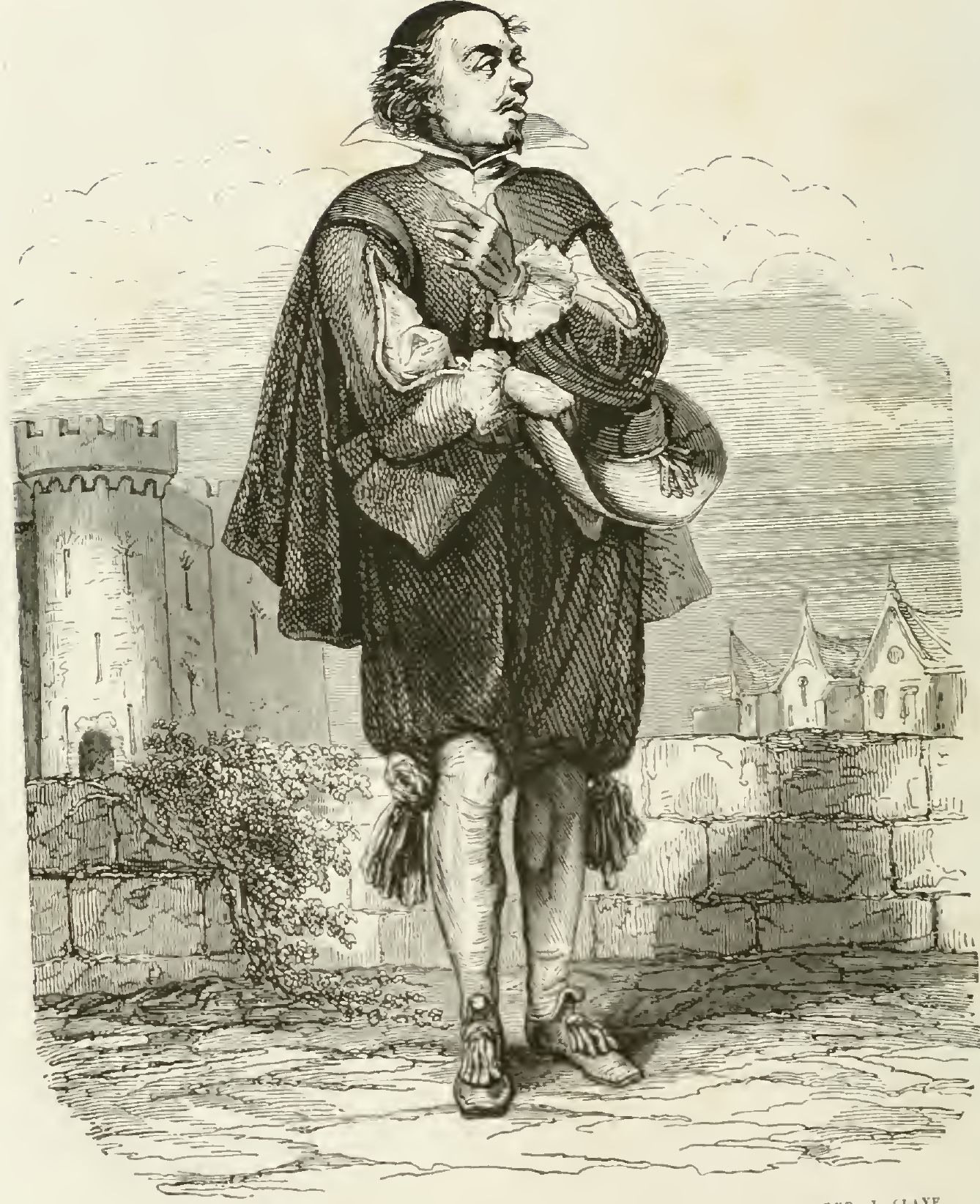
— From him and from my friend the Comte de Rochefort.
— The Comte de Rochefort! but that is the one who abducted me!
— That may be, madame.
— And you receive money from that man?
— Did you not tell me that this abduction was entirely political?
— Yes; but this abduction had for its purpose to make me betray my mistress, to tear from me by torture confessions that could compromise the honor and perhaps the life of my august mistress.
— Madame, resumed Bonacieux, your mistress is a perfidious Spanish woman, and what the great cardinal does is well done.
— Monsieur, said the young woman, I knew you to be cowardly, avaricious and imbecilic; but I did not know you to be infamous!
— Madame, said Bonacieux, who had never seen his wife angry, and who recoiled before conjugal wrath; madame, what are you saying!
— I say that you are a wretch! continued Mme Bonacieux, who saw that she was regaining some influence over her husband. Ah! you engage in politics, you! and cardinalist politics, at that! Ah! you sell yourself body and soul to the devil for money!
— No, but to the cardinal.
— It is the same thing, cried the young woman; whoever says Richelieu says Satan!
— Be quiet, madame, be quiet, someone might hear you.
— Yes, you are right, and I would be ashamed for you of your cowardice!
— But what then do you require of me, come now.
— I have told you: that you leave this very instant, monsieur; that you loyally carry out the commission that I deign to entrust to you, and on this condition I forget everything, I forgive everything; and moreover—she held out her hand to him—I give you back my friendship.
Bonacieux was a coward and a miser, but he loved his wife; he was moved. A man of fifty does not hold a grudge long against a woman of twenty-three. Mme Bonacieux saw that he was hesitating:
— Come, are you decided? she said to him.
— But, my dear friend, think a little about what you are requiring of me; London is far from Paris, very far, and perhaps the commission you are entrusting to me is not without danger?
— What does it matter! if you avoid them.
— There, Madame Bonacieux, said the mercer, there, decidedly, I refuse: intrigues frighten me. I have seen the Bastille, I have. Brrrron! it is frightful! the Bastille! The mere thought of it gives me gooseflesh. I have been threatened with torture. Do you know what torture is? Wooden wedges that are driven between your legs until the bones burst! No, decidedly, I will not go. And zounds! why do you not go yourself? for in truth I believe I have been mistaken about you until now: I believe you are a man, and one of the most rabid sort, too!
— And you, you are a woman, a miserable woman, stupid and besotted. Ah! you are afraid! Well then, if you do not leave this very instant, I will have you arrested by the queen's order, and I will have you put in that Bastille you fear so much.
Bonacieux fell into deep reflection; he weighed the two angers carefully in his brain, that of the cardinal and that of the queen: the cardinal's carried the day enormously.
— Have me arrested in the queen's name, said he, and I will appeal to His Eminence.
This time Mme Bonacieux saw that she had gone too far, and she was terrified at having advanced so much. She contemplated for a moment with dread that stupid face of an invincible resolution, like that of fools who are afraid.
— Well, so be it! said she. Perhaps, after all, you are right; a man knows more about politics than women do, and you above all, Monsieur Bonacieux, who have talked with the cardinal. And yet it is very hard, she added, that my husband, a man on whose affection I thought I could count, should treat me so ungraciously and not gratify my whim.
— It is because your whims may lead too far, replied Bonacieux triumphantly, and I distrust them.
— I will give it up, then, said the young woman with a sigh; very well, let us say no more about it.
— If at least you would tell me what it is I am to do in London, resumed Bonacieux, who remembered a little late that Rochefort had recommended him to try to surprise his wife's secrets.
— It is useless for you to know it, said the young woman, whom an instinctive distrust now drove back: it was a trifle such as women desire, a purchase on which there was much to be gained.
But the more the young woman defended herself, the more, on the contrary, Bonacieux thought that the secret she refused to confide to him was important. He therefore resolved to run at once to the Comte de Rochefort and tell him that the queen was seeking a messenger to send to London.
— Pardon me for leaving you, my dear Madame Bonacieux, he said; but not knowing that you would come to see me, I had made an appointment with one of my friends; I am returning this very instant, and if you will only wait for me half a minute, as soon as I have finished with this friend, I will come back for you, and as it is beginning to grow late, I will escort you back to the Louvre.
— Thank you, monsieur, replied Mme Bonacieux; you are not brave enough to be of any use whatsoever, and I shall get back to the Louvre quite well on my own.
— As you please, madame Bonacieux, replied the former mercer. Shall I see you again soon?
— No doubt; next week, I hope, my duties will leave me some freedom and I will take advantage of it to come back and put our affairs in order, which must be somewhat disordered.
— Very well; I shall expect you. You are not angry with me?
— I! Not in the least.
— See you soon, then?
— See you soon.
Bonacieux kissed his wife's hand and walked away quickly.
— Come now, said M** Bonacieux when her husband had closed the street door and she found herself alone, the only thing this imbecile lacked was to be a cardinalist! And I who had answered the queen, I who had promised my poor mistress... Ah! my God, my God! she will take me for one of those wretches who swarm in the palace and whom they have placed near her to spy on her! Ah! Monsieur Bonacieux, I never loved you very much, but now it is much worse! I hate you, and on my word, you will pay for this.
At the moment she was saying these words, a knock on the ceiling made her raise her head, and a voice that reached her through the floor cried out:
— Dear Madame Bonacieux, open the little door in the passage for me and I will come down to you.