
THREE PRESENTS FROM M. D'ARTAGNAN THE ELDER
On the first Monday of the month of April 1626, the town of Meung, where the author of the Romance of the Rose was born, seemed to be in a revolution as complete as if the Huguenots had come to make a second La Rochelle of it. Several bourgeois, seeing the women flee along the main street, hearing the children crying on the thresholds of the doors, were hurrying to put on their cuirasses, and, supporting their somewhat uncertain countenance with a musket or a pertuisane, were directing their steps toward the hostelry of the Franc-Meunier, before which a compact, noisy, and curiosity-filled group was thronging, swelling from minute to minute.
In those times panics were frequent, and few days passed without one town or another recording in its archives some event of this kind. There were the lords who warred among themselves; there was the cardinal who made war on the king and on the lords; there was the Spaniard who made war on the lords, on the cardinal, and on the king. Then, besides these secret or public wars, hidden or open, there were also the thieves, the beggars, the Huguenots, the wolves, and the lackeys, who made war on everyone. The bourgeois always armed themselves against the thieves, against the wolves, against the lackeys; — often against the lords and the Huguenots; — sometimes against the king: — but never against the cardinal and the Spaniard. It therefore resulted from these acquired habits that on this aforesaid first Monday of the month of April 1626, the bourgeois, hearing a noise, and seeing neither the yellow and red guidon nor the livery of the Duc de Richelieu, rushed toward the hostelry of the Franc-Meunier.
Having arrived there, each man could recognize the cause of this tumult.
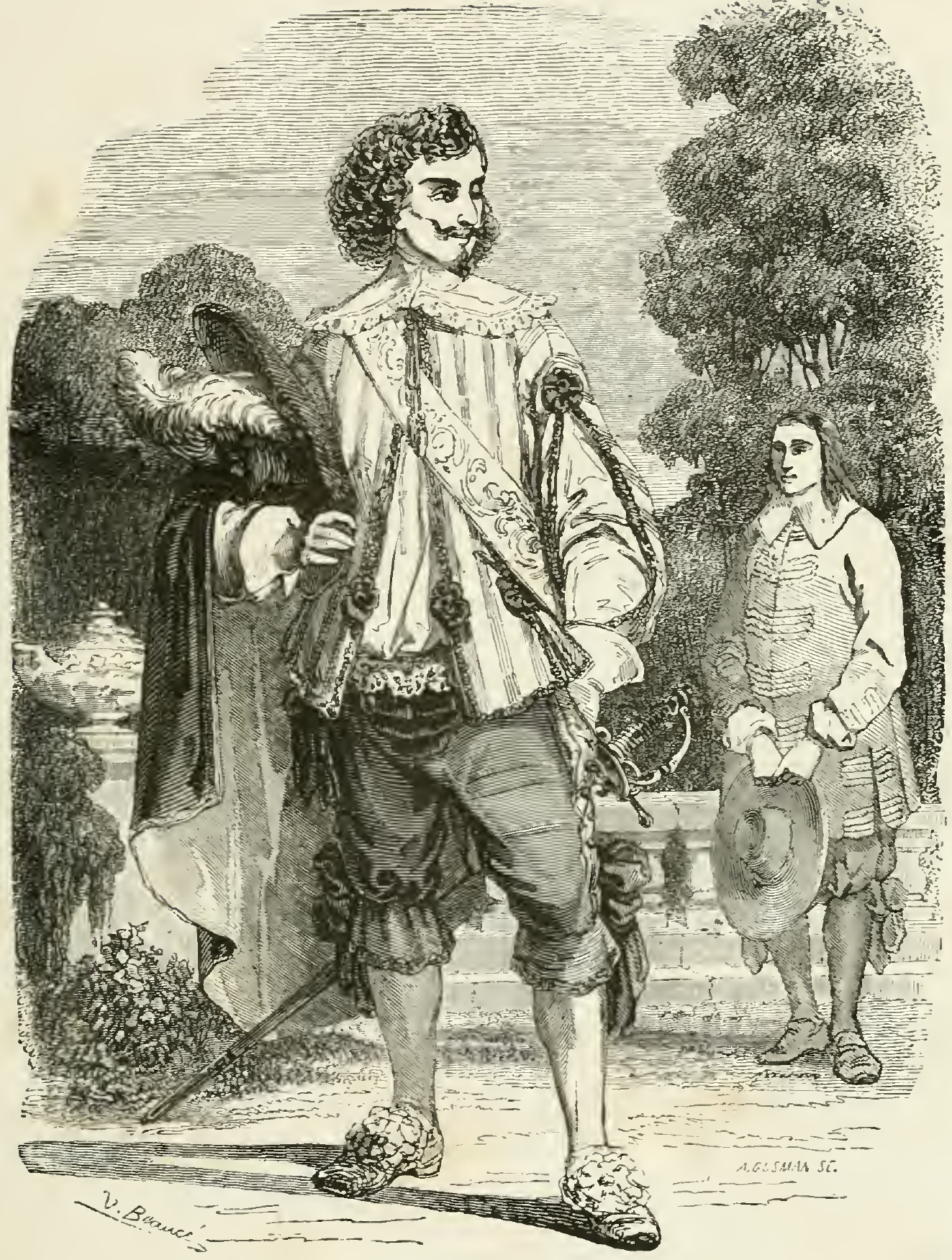
A young man... — let us sketch his portrait with a single stroke of the pen: — picture to yourself Don Quixote at eighteen; Don Quixote unharnessed, without hauberk and without cuissard; Don Quixote clad in a woolen doublet, whose blue color had been transformed into an indefinable shade of wine-lees and celestial azure. A long and brown face; the cheekbone prominent, a sign of cunning; the maxillary muscles enormously developed, an infallible index by which one recognizes the Gascon, even without a béret, and our young man wore a béret adorned with a sort of feather; the eye open and intelligent; the nose hooked, but finely drawn; too large for an adolescent, too small for a grown man, and which an practiced eye would have taken for a farmer's son on a journey, without the long sword which, hung from a leather baldric, beat against its owner's calves when he was on foot, and against the bristling hair of his mount when he was on horseback.
For our young man had a mount, and this mount was even so remarkable that it was remarked upon: it was a bidet of Béarn, aged 12 or 14 years, yellow of coat, without hair on its tail, but not without javarts on its legs, and which, though walking with its head lower than its knees, which made the application of the martingale useless, still gallantly made its eight leagues a day. Unfortunately the hidden qualities of this horse were so well hidden beneath its strange coat and its incongruous gait that, in a time when everyone knew about horses, the appearance of the aforesaid bidet at Meung, where it had entered about a quarter of an hour earlier by the Beaugency gate, produced a sensation whose disfavor redounded even to its rider.
And this sensation had been all the more painful to the young d'Artagnan (for so was called the Don Quixote of this other Rosinante) because he did not hide from himself the ridiculous side that was given him, good horseman though he was, by such a mount. He had therefore sighed greatly in accepting the gift that M. d'Artagnan the father had made him: he was not ignorant that such a beast was worth at least twenty livres. It is true that the words with which the present had been accompanied were beyond price.
— "My son," the Gascon gentleman had said, in that pure patois of Béarn, which Henri IV had never been able to rid himself of, — "my son, this horse was born in your father's house some thirteen years ago, and has remained there ever since, which ought to make you love it. Never sell it, let it die quietly and honorably of old age, and if you make campaign with it, spare it as you would spare an old servant. At court," continued M. d'Artagnan the father, "if indeed you have the honor of going there, an honor to which, moreover, your old nobility gives you rights, sustain worthily your name of gentleman, which has been worthily borne by your ancestors for more than five hundred years; for yourself and for your own, — by your own I mean your relatives and your friends, — never tolerate anything from anyone but M. the cardinal and the king. It is by his courage, understand me well, by his courage alone, that a gentleman makes his way today. Whoever trembles for a second perhaps lets escape the bait that, during that very second, fortune was holding out to him. You are young, you must be brave for two reasons: the first is that you are a Gascon, and the second is that you are my son. Do not fear occasions and seek adventures. I have had you taught to handle the sword; you have a leg of iron, a wrist of steel, fight on every occasion; fight, all the more since duels are forbidden, and consequently there is twice the courage in fighting. I have, my son, only fifteen écus to give you, my horse, and the advice you have just heard. Your mother will add to it the recipe for a certain balm that she has from a gypsy, and which has a miraculous virtue for healing any wound that does not reach the heart. Make your profit of it all, and live happily and long.
"I have only one word more to add, and it is an example that I propose to you, not my own, for I have never appeared at court, and have only made the wars of religion as a volunteer: I mean M. de Tréville, who was my neighbor once, and who had the honor of playing as a child with our king Louis XIII, whom God preserve. Sometimes their games degenerated into battles, and in these battles the king was not always the strongest. The blows he received from them gave him much esteem and friendship for M. de Tréville. Later M. de Tréville fought against others: in his first journey to Paris, five times; from the death of the late king to the majority of the young one, not counting wars and sieges, seven times; and from that majority to today, a hundred times perhaps! — So, in spite of edicts, ordinances, and decrees, there he is, captain of musketeers, that is to say, chief of a legion of Caesars of whom the king makes very great account, and whom M. the cardinal dreads, he who dreads very little, as everyone knows. Moreover, M. de Tréville earns ten thousand écus a year; he is therefore a very great lord. — He began as you do; go and see him with this letter, and model yourself on him, so as to do as he does."
Thereupon M. d'Artagnan the father handed his son a letter he had prepared, girded his own sword upon him, kissed him tenderly on both cheeks, and gave him his blessing.
On leaving the paternal chamber, the young man found his mother waiting for him with the famous recipe, of which the advice we have just reported was bound to require a rather frequent use. The farewells on this side were longer and more tender than they had been on the other, not that M. d'Artagnan did not love his son, who was his only offspring, but M. d'Artagnan was a man, and he would have regarded it as unworthy of a man to let himself give way to his emotion, whereas Mme d'Artagnan was a woman and moreover was a mother. — She wept abundantly, and, let us say it to the praise of M. d'Artagnan the son, whatever efforts he made to remain firm as a future musketeer ought to be, nature prevailed, and he shed copious tears, of which he managed with great difficulty to hide half.
The same day the young man set out, furnished with the three paternal presents, which consisted, as we have said, of fifteen écus, the horse, and the letter for M. de Tréville; as one may well think, the advice had been given into the bargain.
With such a vade mecum, Artagnan found himself, morally and physically, an exact copy of the hero of Cervantes, to whom we so happily compared him when our duties as historian made it necessary for us to sketch his portrait. Don Quixote took windmills for giants and sheep for armies: Artagnan took every smile for an insult and every glance for a provocation. The result was that he kept his fist clenched all the way from Tarbes to Meung, and that, on the whole, he put his hand to the pommel of his sword twice a day;however, the fist never came down on any jaw, and the sword never left its scabbard. It was not that the sight of the sorry yellow nag did not spread many a smile across the faces of passersby; but since above the nag rang out a sword of respectable size, and above that sword shone an eye rather fierce than proud, the passersby repressed their hilarity, or if hilarity got the better of prudence, they at least tried to laugh only on one side, like the masks of antiquity. D'Artagnan therefore remained majestic and intact in his susceptibility until that unfortunate town of Meung.
But there, as he was getting off his horse at the door of the Franc-Meunier without anyone, host, servant, or stable boy, having come to hold his stirrup, d'Artagnan noticed at a half-open window on the ground floor a gentleman of fine stature and lofty bearing, though with a slightly sullen face, who was talking with two people who appeared to be listening to him with deference. D'Artagnan quite naturally believed, as was his habit, that he was the subject of the conversation, and he pricked up his ears. This time d'Artagnan was only half mistaken: it was not of him that they were speaking, but of his horse. The gentleman appeared to be enumerating to his listeners all the qualities of the animal, and as, as I have said, the listeners seemed to have great deference for the narrator, they burst out laughing at every moment. Now, as a half-smile was enough to awaken the young man's irascibility, one can understand what effect so much noisy hilarity produced upon him.
However, d'Artagnan first wished to take stock of the physiognomy of the impertinent fellow who was mocking him. He fixed his proud gaze on the stranger, and recognized a man of forty to forty-five years, with dark and piercing eyes, a pale complexion, a strongly pronounced nose, a black mustache perfectly trimmed: he was dressed in a doublet and trunk hose of violet with aiguillettes of the same color, without any ornament other than the usual slashes through which the shirt passed. This trunk hose and this doublet, though new, appeared wrinkled as the clothes of travel are after being long shut up in a portmanteau. D'Artagnan made all these remarks with the rapidity of the most minute observer, and doubtless from an instinctive feeling that told him this unknown man must have a great influence on his life to come.
Now, as at the moment when d'Artagnan fixed his gaze on the gentleman in the violet doublet, the gentleman was making at the spot of the Béarnese nag one of his most learned and most profound demonstrations, his two listeners burst out laughing, and he himself visibly allowed, against his habit, so to speak, a pale smile to wander over his face. This time there was no longer any doubt: d'Artagnan was really insulted. So, full of this conviction, he pulled his béret down over his eyes, and, trying to copy some of the courtly airs he had caught in Gascony from lords in travel, he advanced with one hand on the guard of his sword and the other resting on his hip. Unfortunately, as he advanced, anger blinded him more and more, and instead of the dignified and haughty speech he had prepared to formulate his provocation, he found at the tip of his tongue only a coarse personal remark, which he accompanied with a furious gesture.
"Hey! monsieur," he cried, "monsieur, you who are hiding behind that shutter; yes, you! tell me a little what you are laughing at, and we will laugh together."
The gentleman slowly raised his eyes from the mount to the rider, as if he needed some time to understand that it was to him that such strange words were addressed; then, when he could no longer preserve any doubt, his eyebrows knitted, and, after a long pause, with an accent of irony and insolence impossible to describe, he replied to d'Artagnan.
"I do not speak to you, monsieur!"
"But I am speaking to you!" cried the young man, exasperated by this mixture of insolence and good manners, of propriety and disdain.
The stranger looked at him for another moment with his slight smile, and, retiring from the window, came slowly out of the inn to plant himself two paces from d'Artagnan, facing the horse. His tranquil countenance and his mocking physiognomy had redoubled the hilarity of those with whom he was talking, and who had remained at the window.
D'Artagnan, seeing him within reach, drew his sword a foot from its scabbard.
"This horse is decidedly, or rather in his youth was, a buttercup," resumed the stranger, continuing the investigations he had begun and addressing his listeners at the window, without appearing in any way to notice d'Artagnan's exasperation. "It is a color well known in botany, but until now very rare in horses."
"Such a one laughs at the horse who would not dare laugh at the master!" cried the emulator of Tréville, furiously.
"I do not laugh often, monsieur," resumed the stranger, "as you can see for yourself from the look on my face; but I nevertheless insist on keeping the privilege of laughing when it pleases me."
"And I," cried d'Artagnan, "I do not wish people to laugh when it displeases me, and especially when it is at my expense that they laugh."
"In truth, monsieur?" continued the stranger, calmer than ever. "Well, that is perfectly just"; and, turning on his heels, he prepared to re-enter the inn by the great door, under which, on arriving, d'Artagnan had noticed a fully saddled horse.
But d'Artagnan was not of a character to let go thus a man who had had the insolence to mock him. He drew his sword entirely from the scabbard and set off in pursuit, crying:
"Turn, turn then, monsieur the mocker, so that I do not strike you from behind!"
"Strike me, me!" said the other, pivoting on his heels and looking at the young man with as much astonishment as contempt. "Come now, my dear fellow, you are mad!" Then, half aloud, and as if speaking to himself: "What a find for His Majesty, who is looking for brave men on all sides to recruit his musketeers! It is unfortunate," he continued, "that he does not know this one."
He had scarcely finished when d'Artagnan lunged at him with so furious a thrust that, had he not swiftly leaped backward, it is probable that he would have jested for the last time. The stranger then saw that the matter was passing beyond raillery, drew his sword, saluted his adversary, and gravely put himself on guard. But at the same moment his two listeners, accompanied by the host, fell upon d'Artagnan with great blows of sticks, shovels, and tongs. This made so rapid and so complete a diversion to the attack that d'Artagnan's adversary, while the latter turned to face this hail of blows, sheathed his sword with the same precision, and from actor that he had nearly been, became once more a spectator of the combat, a role in which he acquitted himself with his usual impartiality, while nevertheless muttering:
"Plague take the Gascons! Put him back on his orange horse, and let him go."
"Not before I have killed you, coward!" cried d'Artagnan, while facing as best he could and without retreating a single step before his three enemies, who were raining blows upon him.
"Another rodomontade!" murmured the gentleman. "On my honor, these Gascons are incorrigible. Continue the dance, then, since he absolutely insists. When he is weary, he will say he has had enough."
But the stranger did not know what kind of obstinate man he was dealing with: d'Artagnan was not a man ever to beg for mercy. The combat therefore continued for a few minutes more; however, d'Artagnan, exhausted, let his sword escape him, which a blow of a stick broke in two pieces; finally another blow cut open his forehead and at the same time felled him, all bloody and almost unconscious.
It was at this moment that from all sides people rushed to the scene; but the host, fearing a scandal, carried the wounded man with the help of his servants into the kitchen, where some care was given him.
As for the gentleman, he had returned to take his place at his window, and was watching with a certain impatience all this crowd which seemed, by remaining there, to cause him a keen annoyance.
"Well! how is that madman?" he asked, turning at the noise of the opening door and addressing the host, who had come to inquire about his health.
"Is Your Excellency safe and sound?" asked the host.
— Yes, perfectly safe and sound, my dear innkeeper, and it is I who ask you what has become of our young man.
— He is better, said the host; he fainted quite away.
— Really, said the gentleman.
— But before fainting, he gathered all his strength to call you and defy you as he called.
— Then this fellow must be the devil in person, exclaimed the stranger.
— Oh! no, Your Excellency; it is not the devil, replied the host with a grimace of contempt, for during his swoon we searched him, and he has in his bundle only a shirt, and in his purse only eleven crowns, which did not prevent him from saying as he fainted that if such a thing had happened to you in

Paris, you would repent of it at once, whereas “since it has happened to us here, you will repent of it only later.”
— Then, said the stranger coldly, he is some prince of the blood in disguise.
— I tell you this, my gentleman, resumed the host, so that, if need be, you may be on your guard.
— And did he name no one in his anger?
— Yes, indeed, he kept striking his pocket and saying: “We shall see what M. de Tréville will think of this insult offered to his protégé.”
“M. de Tréville!” said the unknown, becoming attentive; “he struck his pocket while pronouncing the name of M. de Tréville! Come, my dear host, while your young man was unconscious, you did not fail, I am quite sure, to look into that pocket as well. What was there in it?”
“A letter addressed to M. de Tréville, captain of the Musketeers.”
“Indeed!”
“It is as I have the honor of telling you, Excellency.”
The host, who was not gifted with great perspicacity, did not notice the expression which his words had given to the stranger’s countenance. The latter left the corner of the window against which he had been leaning with his elbow, and frowned like a man who is uneasy.
“The devil!” he muttered between his teeth; “would Tréville have sent me this Gascon? He is very young! But a sword thrust is a sword thrust, whatever the age of him who gives it, and one is less on one’s guard against a child than against anyone else; a slight obstacle is sometimes enough to thwart a great design.”
And the unknown fell into a reverie which lasted some minutes.
“Come, host,” said he, “will you not rid me of this madman? In conscience, I cannot kill him, and yet,” added he, with a coldly threatening expression, “yet he is in my way. Where is he?”
“In my wife’s chamber, where they are dressing his wound, on the first floor.”
“His clothes and his bag are with him? He has not left his doublet?”
“All that, on the contrary, is below, in the kitchen. But since he is in your way, this young madman—”
“Doubtless. He causes a scandal in your inn to which honest people cannot consent to be associated. Go upstairs, make out my account, and warn my lackey.”
“What! monsieur is leaving us already?”
“You know it well, since I had given you orders to saddle my horse. Have they not been obeyed?”
“Yes, indeed, and as Your Excellency may have seen, his horse is under the great gate, all ready to start.”
“Very well, then do what I have told you.”
“Oho!” said the host to himself, “can he be afraid of the little fellow?”
But an imperious glance from the unknown came abruptly to check him. He bowed humbly and went out.
“Milady must not be seen by this fellow,” continued the stranger; “she 1ought not to be long in passing; indeed, she is already late. Decidedly it is better that I mount my horse and go to meet her. If only I could know what was in that letter addressed to Tréville!”
And the unknown, muttering all the while, made his way toward the kitchen.
During this time the host, who did not doubt that it was the presence of the young fellow which drove the unknown from his inn, had gone back upstairs to his wife and had found d’Artagnan at last in possession of his senses. Then, while making him understand that the police might well make a bad business of it for him for having gone to pick a quarrel with a great lord—for, in the host’s opinion, the unknown could only be a great lord—he persuaded him, despite his weakness, to get up and continue on his way. D’Artagnan, half stunned, without his doublet and his head all swathed in linen, therefore rose, and, urged on by the host, began to go down; but on reaching the kitchen, the first thing he perceived was his provocator quietly conversing with a lady at the step of a heavy carriage harnessed with two stout Norman horses.His interlocutress, whose head appeared framed by the carriage window, was a woman of twenty to two-and-twenty. We have already said with what rapidity of investigation d’Artagnan embraced a whole physiognomy; he saw at the first glance, therefore, that the woman was young and beautiful. Now, this beauty struck him all the more because it was perfectly foreign to the southern lands which d’Artagnan had inhabited until then. She was a pale and fair person, with long curly hair falling upon her shoulders, large languishing blue eyes, rosy lips, and alabaster hands; she was conversing very animatedly with the unknown.
“Thus, his Eminence orders me—” said the lady.
“To return at once to England, and to inform him directly if the duke left London, or had already left it.”
“And as for my other instructions?” asked the beautiful traveler.
“They are enclosed in this box, which you will not open until on the other side of the Channel.”
“Very well; and you, what are you doing?”
“I, I am returning to Paris.”
“Without chastising this insolent little fellow?” asked the lady.
The unknown was about to reply, but at the moment he opened his mouth, d’Artagnan, who had heard everything, sprang to the threshold of the door.
“It is this insolent little fellow who chastises others,” cried he, “and I hope indeed that this time the one he has to chastise will not escape him as he did the first time.”
“Will not escape him?” repeated the unknown, frowning.
“No; before a woman, you will not dare to flee, I presume.”
“Think,” cried milady, seeing the gentleman put his hand to his sword, “think that the slightest delay may ruin everything.”
“You are right,” replied the gentleman; “depart, then, on your side; I will depart on mine.”
And bowing to the lady with a nod of his head, he sprang upon his horse, while the coachman of the carriage whipped up his team vigorously. The two interlocutors therefore set off at a gallop, drawing away, each by an opposite side of the street.
“Hey! your reckoning,” vociferated the host, whose affection for his traveler was changing into profound disdain as he saw him ride away without settling his accounts.
“Pay, you rascal,” cried the traveler, still galloping, to his lackey, who threw two or three silver coins at the host’s feet and set off galloping after his master.
“Ah! coward, ah! wretch, ah! false gentleman!” cried d’Artagnan, springing in his turn after the lackey.
But the wounded man was still too weak to bear such a shock. Hardly had he gone ten steps when his ears began to ring, a dizziness seized him, a cloud of blood passed before his eyes, and he fell in the middle of the street, still crying:
“Coward! coward! coward!”
“He is, in truth, very cowardly,” murmured the host, approaching d’Artagnan, and attempting by this flattery to make peace with the poor Gascon, like the heron of the fable with its evening snail.
“Yes, very cowardly,” murmured d’Artagnan; “but she, very beautiful!”
“Who, she?” asked the host.
— "Milady," stammered d'Artagnan, who had heard the gentleman pronounce that name, and he fainted a second time.
"No matter," said the host, "I lose two, but I still have this one left, whom I am sure of keeping for at least a few days. That's always eleven gained."
It is well known that eleven écus made exactly the sum that remained in d'Artagnan's purse.
The host had counted, as we see, on eleven days of illness at one écu per day; but he had counted without his traveler. The next day, at five o'clock in the morning, d'Artagnan rose, went down himself to the kitchen, and asked, besides a few other ingredients whose list has not come down to us, for wine, oil, and rosemary, and, with his mother's recipe in hand, compounded a balm with which he anointed his numerous wounds, renewing his compresses himself and refusing to admit the addition of any physician. Thanks doubtless to the efficacy of the balm of Bohemia, and perhaps also a little to the absence of any doctor, d'Artagnan was on his feet by that very evening, and all but healed the next day.
But when the time came to pay for this rosemary, this oil, and this wine—the only expense of the master, who had kept an absolute diet, while on the contrary the yellow horse, at least according to the host, had eaten three times more than could reasonably have been supposed for its size—d'Artagnan found in his pocket nothing more than his little purse of frayed velvet along with the eleven écus it contained; but as for the letter addressed to M. de Tréville, it had disappeared.
The young man began by searching for that letter with great patience, turning and turning his pockets and fobs twenty times over, rummaging and rummaging again in his bag, opening and closing his purse; but when he had become convinced that the letter was nowhere to be found, he entered into a third fit of rage, which nearly occasioned a fresh consumption of wine and aromatic oil, for on seeing this young hothead grow heated and threaten to cough up the whole establishment if his letter were not found, the host had already seized a boar-spear, his wife a broom handle, and his servant the same sticks that had served the day before.
"— My letter of recommendation!" cried d'Artagnan; "my letter of recommendation! Odds blood, I will spit you all like ortolans!"
Unfortunately, one circumstance prevented the young man from carrying out his threat: it was that, as we have said, his sword had been, in his first struggle, broken in two pieces, which he had perfectly forgotten. The result was that when d'Artagnan in fact tried to draw, he found himself purely and simply armed with a stump of a sword about eight or ten inches long, which the host had carefully thrust back into the scabbard. As for the rest of the blade, the host had cleverly turned it aside to make himself a larding-pin.
However, this disappointment would probably not have stopped our impetuous young man, had not the host reflected that the claim his traveler was making upon him was perfectly just.
"— But, in fact," said he, lowering his sword, "where is that letter?"
"— Yes, where is that letter?" cried d'Artagnan. "First of all, I warn you, that letter is for M. de Tréville, and it must be found again, or if it is not found again, he will know well enough how to make it be found, he will!"
This threat completed the intimidation of the host. After the king and M. the cardinal, M. de Tréville was the man whose name was perhaps most often repeated by the military men and even by the bourgeois. There was indeed Father Joseph, it is true, but his name was never pronounced except in a whisper, so great was the terror inspired by the gray eminence, as the cardinal's familiar was then called.
So, throwing his spit far from him and ordering his wife to do the same with her broom-handle and his servants with their sticks, he set the first example by setting himself to search for the lost letter.
"— Did that letter contain anything valuable?" asked the host after a moment of useless investigations.
"— Mordieux! I should think so," cried the Gascon, who was counting on that letter to make his way at court; "it contained my fortune."
"— Drafts on Spain?" asked the host uneasily.
"— Drafts on His Majesty's private treasury," replied d'Artagnan, who, counting on entering the king's service thanks to this recommendation, believed he could make this somewhat hazardous reply without lying.
"— Devil!" said the host, quite in despair.
"— But it does not matter," continued d'Artagnan with national self-assurance; "it does not matter, money is nothing, and that letter was everything. I would rather have lost a thousand pistoles than lose it."
He was risking no more in saying twenty thousand, but a certain youthful modesty held him back.
A flash of light suddenly struck the host's mind, who was calling himself "the devil" for finding nothing.
"— That letter has not been lost," he cried.
"— Ah!" said d'Artagnan.
"— No: it was taken from you."
"— Taken! and by whom?"
"— By the gentleman of yesterday. He went down to the kitchen where your doublet was. He stayed there alone. I would wager that it was he who stole it."
"— You think so?" replied d'Artagnan, little convinced; for he knew better than anyone the entirely personal importance of that letter, and saw nothing in it that could tempt cupidity. The fact is that none of the servants, none of the travelers present would have gained anything by possessing that paper.
"— You say, then," resumed d'Artagnan, "that you suspect that impertinent gentleman?"
"— I tell you that I am sure of it," continued the host; "when I announced to him that your lordship was the protégé of M. de Tréville and that you even had a letter for that illustrious gentleman, he appeared very uneasy, asked me where that letter was, and went down immediately to the kitchen, where he knew your doublet was."
"— Then, there is my thief found," replied d'Artagnan; "I will complain of him to M. de Tréville, and M. de Tréville will complain of him to the king." Then he majestically drew two crowns from his pocket, gave them to the host, who accompanied him, hat in hand, to the door, remounted his yellow horse, which conducted him without further accident to the Porte Saint-Antoine, in Paris, where, despite his father's recommendation, its owner sold it for three crowns, which was very well paid, considering that d'Artagnan had greatly overworked it during the last stage. So the horse-dealer to whom d'Artagnan ceded it for the said nine livres did not conceal from the young man that he was giving that exorbitant sum only because of the originality of its color.
D'Artagnan therefore entered Paris on foot, carrying his little bundle under his arm, and walked until he found a room to rent that suited the exiguity of his resources. This room was a kind of garret, situated in the Rue des Fossoyeurs, near the Luxembourg.
As soon as the earnest money was given, d'Artagnan took possession of his lodging, spent the rest of the day sewing onto his doublet and hose some passementerie that his mother had detached from an almost new doublet of M. d'Artagnan the father, and that she had given him secretly; then he went to the Quai de la Ferraille to have a blade put on his sword; after which he returned to the Louvre to inquire, of the first musketeer he met, about the situation of M. de Tréville's hôtel. This hôtel was situated in the Rue du Vieux-Colombier, that is to say, precisely in the neighborhood of the room d'Artagnan had taken; a circumstance that seemed to him a happy omen for the success of his journey.
Then, entirely satisfied with the way he had conducted himself at Meung, without remorse for the past, confident in the present, and full of hope for the future, he went to bed and slept the sleep of the brave.
This sleep, still altogether provincial, carried him until nine o'clock in the morning, the hour at which he rose to go to that famous M. de Tréville, the third personage of the kingdom according to contemporary estimation.