THE EXECUTION.
T was nearly midnight; the moon, notched by its waning and blood-reddened by the last traces of the storm, was rising behind the little town of Armentières, which outlined against its pallid glow the dark silhouette of its houses and the skeleton of its high belfry cut out in openwork; opposite, the Lys rolled its waters like a river of molten tin, while on the other bank could be seen the black mass of trees outlined against a stormy sky invaded by great coppery clouds which made a sort of twilight in the middle of the night. On the leftrose an old abandoned mill, its sails motionless, in whose ruins an owl uttered its sharp, periodic, and monotonous cry. Here and there, in the plain, to the right and left of the road followed by the gloomy procession, appeared a few low, squat trees that looked like deformed dwarfs crouching to watch men at this sinister hour.
From time to time a broad flash of lightning opened the horizon across its whole width, wound above the black mass of the trees, and came, like a fearful scimitar, to cut the sky and the water into two parts. Not a breath of wind passed through the heavy atmosphere; a silence of death crushed all nature; the ground was damp and slippery from the rain that had just fallen, and the grass, revived, gave forth its perfume with more energy.
Two valets dragged milady, each holding her by an arm. The executioner walked behind; Lord de Winter, d'Artagnan, Athos, Porthos, and Aramis walked behind the executioner.
Planchet and Bazin came last.
The two valets led milady toward the river; her mouth was mute, but her eyes spoke with their inexpressible eloquence, imploring in turn each of those she looked at.
As she was a few steps ahead, she said to the valets:
"A thousand pistoles to each of you if you protect my escape; but if you deliver me to your masters, I have avengers near at hand who will make you pay dearly for my death."
Grimaud hesitated, Mousqueton trembled in every limb.
Athos, who had heard milady's voice, came up quickly; Lord de Winter did the same.
"Send these valets away," he said; "she has spoken to them; they are no longer to be trusted."
Planchet and Bazin were called, and took the place of Grimaud and Mousqueton.
When they reached the water's edge, the executioner approached milady and bound her feet and hands.
Then she broke the silence to exclaim:
"You are cowards, you are miserable assassins, you set yourselves ten to one to cut the throat of a poor woman; take care, if I am not succored I shall be avenged!..."
"You are not a woman," said Athos, coldly; "you do not belong to the human species: you are a demon escaped from hell, and we are going to send you back there."
"Oh! you virtuous gentlemen," said milady, "make no mistake: whoever among you touches a hair of my head is in his turn an assassin."
"The executioner may kill without being an assassin for that, madame," said the man in the cloak, striking his broad sword; "he is the last judge, that is all. Nachrichter, as our neighbors the Germans say."
And as he bound her while saying these words, milady uttered two or three savage cries that had a somber and strange effect as they flew into the night and lost themselves in the depths of the wood.
"But if I am guilty, if I have committed the crimes of which you accuse me," howled milady, "lead me before a tribunal; you are not judges, you, to condemn me."
"I offered you Tyburn," said my lord de Winter; "why would you not have it?"
"Because I do not want to die," cried milady, struggling, "because I am too young to die!"
"The woman whom you poisoned at Béthune was still younger than you, madame, and yet she is dead," said d'Artagnan.
"I will enter a cloister, I will become a nun," said milady.
"You were in a cloister," said the executioner, "and you came out of it to ruin my brother."
Milady uttered a cry of terror and fell upon her knees.
The executioner raised her under the arms and wanted to carry her toward the boat.
"Oh! my God!" she cried, "my God! are you going to drown me, then!"
These cries had something so heartrending about them that d'Artagnan, who at first had been the most eager in the pursuit of milady, let himself drop onto a tree stump and bowed his head, covering his ears with the palms of his hands; yet, in spite of that, he could still hear her threaten and cry out.
D'Artagnan was the youngest of all these men; his heart failed him.
"Oh! I cannot watch this dreadful spectacle," he said; "I cannot consent to this woman dying thus."
Milady had heard these few words, and had rallied to a glimmer of hope.
"D'Artagnan! D'Artagnan!" she cried, "remember that I loved you!"
The young man rose and took a step toward her.
But Athos drew his sword and stood in his path.
"If you take one step more, d'Artagnan," he said, "we shall cross swords together."
D'Artagnan fell to his knees and prayed.
"Come!" continued Athos, "executioner, do your duty."
"Willingly, my lord," said the executioner, "for, as truly as I am a good Catholic, I firmly believe I am doing right in performing my office upon this woman."
"That is well."
Athos took a step toward milady.
"I forgive you," he said, "for the harm you have done me; I forgive you my ruined future, my lost honor, my sullied love, and my salvation forever compromised by the despair into which you cast me. Die in peace!"
Lord de Winter stepped forward in his turn.
"I forgive you," he said, "the murder of my brother, the murder of His Grace Lord Buckingham; I forgive you the death of poor Felton; I forgive you your attempts upon my person. Die in peace!"
"And I," said d'Artagnan, "forgive me, madame, for having, by a trick unworthy of a gentleman, provoked your anger, and in exchange I forgive you the murder of my poor friend and your cruel vengeance upon me. I forgive you and I weep for you. Die in peace!"
"I am lost!" murmured milady in English. "I must die."
"Yes, yes," murmured Athos, who spoke English as his native tongue; "yes, you are lost, yes, you must die."
Then she rose of her own accord and cast around her one of those clear glances that seemed to dart from an eye of flame.
She saw nothing.
She listened, and heard nothing.
She was surrounded by enemies only.
"Where am I to die?" she asked.
"On the other bank," replied the executioner.
Then he made her enter the boat, and as he was about to set foot in it to follow her, Athos gave him a sum of money.
"Here," he said, "is the price of the execution; let it be clearly seen that we act as judges."
"That is well," said the executioner, "and now let this woman know in her turn that I am not performing my trade, but my duty."
And he threw the money into the river.
"See," said Athos, "this woman has a child, and yet she has not said a single word about her child!"
The boat moved away toward the left bank of the Lys, carrying the guilty woman and the executioner. All the others remained on the right bank, where they had fallen to their knees.
The boat glided slowly along the ferry rope beneath the reflection of a pale cloud that hung over the water at that moment.
They saw it reach the other bank; the figures stood out in black against the reddish horizon.
Milady, during the crossing, had managed to loosen the rope that bound her feet; as she neared the shore, she leaped lightly to the ground and fled.
But the ground was damp: on reaching the top of the slope, she slipped and fell to her knees.
A superstitious thought doubtless struck her: she understood that Heaven refused her its aid, and she remained in the attitude in which she found herself, head bowed and hands clasped.
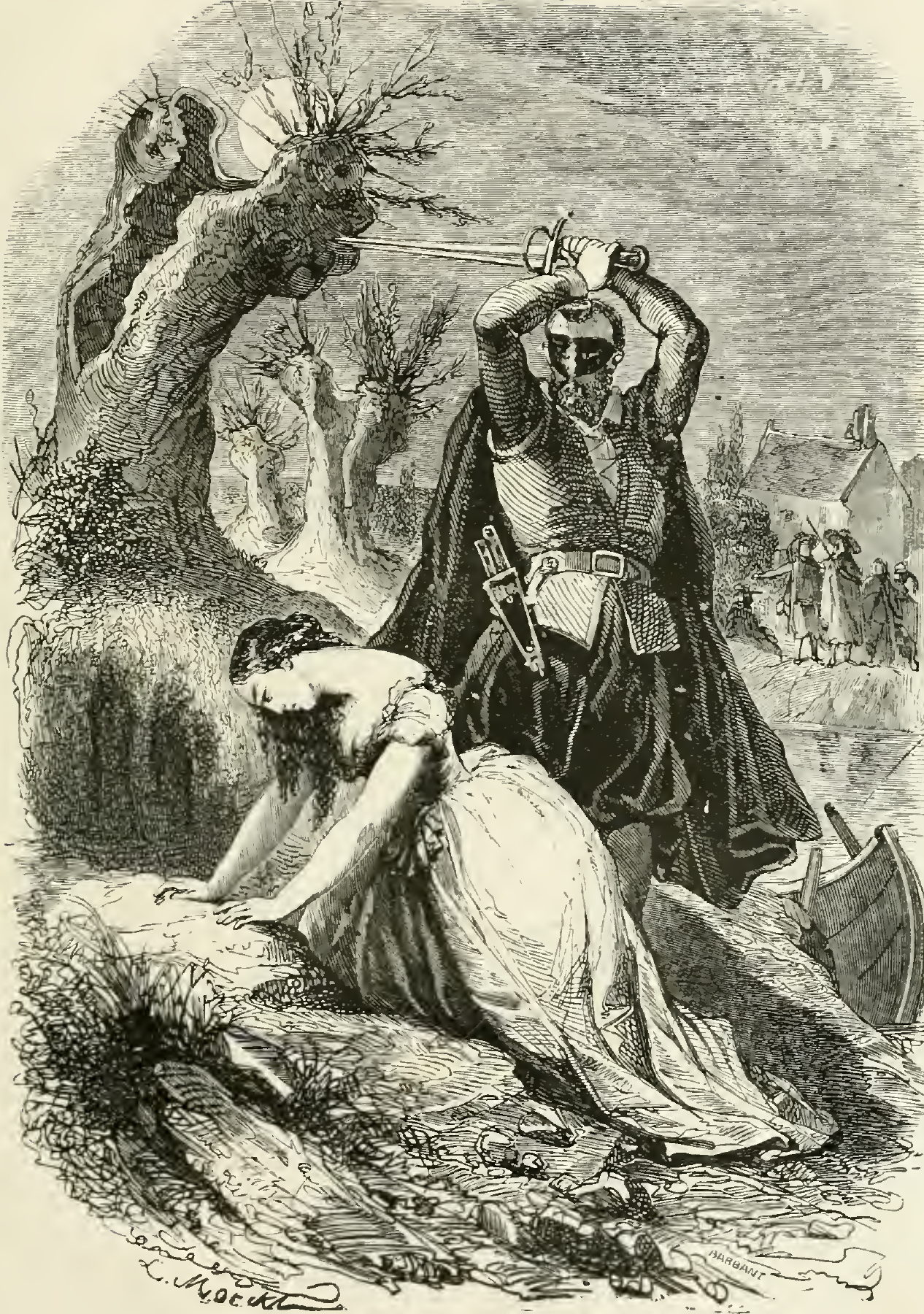
Then, from the other bank, they saw the executioner slowly raise his two arms; a ray of the moon was reflected on the blade of his broad sword; the two arms fell; they heard the whistle of the cutlass and the cry of the victim, then a truncated mass collapsed under the blow.
Then the executioner unfastened his red cloak, spread it on the ground, laid the body upon it, threw the head upon it, tied it by the four corners, loaded it on his shoulder, and climbed back into the boat.
Reaching the middle of the Lys, he stopped the boat, and suspending his burden above the river: "Let the justice of God pass!" he cried aloud. And he let the corpse fall into the deepest part of the water, which closed over it.