FOURTH DAY OF CAPTIVITY.
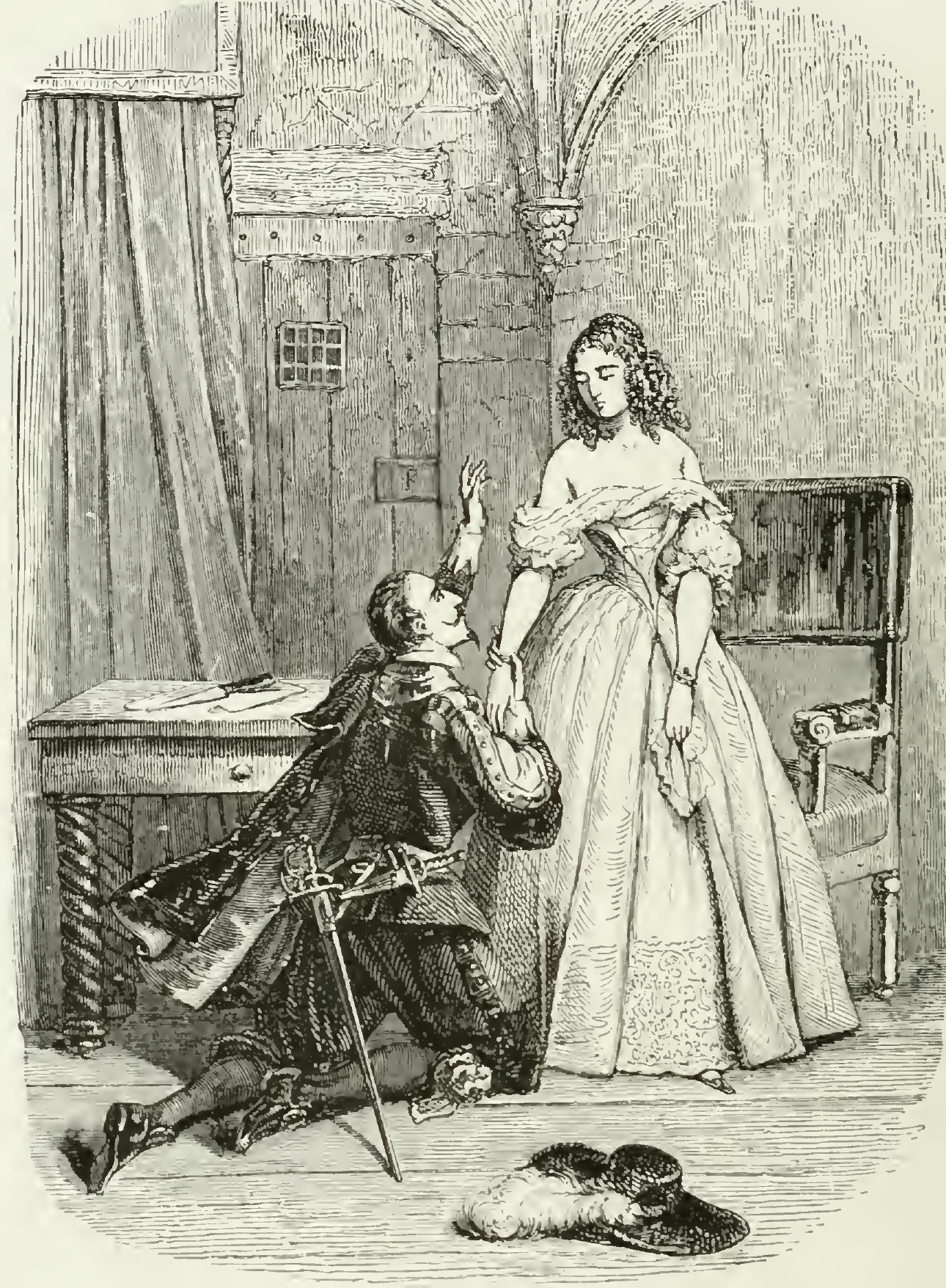
The next day, when Felton entered Milady's room, he found her standing, mounted on a chair, holding between her hands a rope woven from some cambric handkerchiefs torn into strips, braided one with another and tied end to end. At the noise Felton made in opening the door, Milady lightly jumped down from her chair and tried to hide behind her back this improvised rope, which she held in her hand. The young man was even paler than usual, and his eyes, reddened by sleeplessness, showed that he had spent a feverish night. Yet his brow was armed with a more austere serenity than ever.
He advanced slowly toward Milady, who had sat down, and, taking one end of the deadly cord that, through carelessness, or perhaps by design, she had let pass:
"What is that, madame?" he asked coldly.
"That? Nothing," said Milady, smiling with that sorrowful expression she knew so well how to give to her smile. "Boredom, as you are not unaware, is the mortal enemy of prisoners. I was bored, and I amused myself by braiding this cord."
Felton turned his eyes toward the spot on the wall of the room in front of which he had found Milady standing on the chair where she was now seated, and above her head he saw a gilded hook, sealed into the wall, which served to hang either clothes or weapons. He shuddered, and the prisoner saw that shudder, for although she had lowered her eyes, nothing escaped her.
"And what were you doing standing on that chair?" he asked.
"What does it matter to you?" replied Milady.
"But," said Felton, "I wish to know."
"Do not question me," said the prisoner; "you know well that we true Christians are forbidden to lie."
"Well then!" said Felton, "I am going to tell you what you were doing, or rather what you were about to do. You were about to complete the fatal work you were nourishing in your mind. Think of it, madame: if your God forbids lying, he forbids suicide even more severely."
"When God sees one of his creatures unjustly persecuted, placed between suicide and dishonor, believe me, monsieur," replied Milady in a tone of deep conviction, "God forgives her suicide, for then suicide is martyrdom."
"You say too much or too little; speak, madame, in heaven's name, explain yourself!"
"That I should tell you my misfortunes, so that you may call them fables; that I should tell you my plans, so that you may go denounce them to my persecutor! No, monsieur. Besides, what does the life or death of a wretched condemned woman matter to you? You are answerable only for my body, are you not? and provided you present a corpse that is recognized as mine, nothing more will be asked of you, and perhaps you will even have a double reward."
"I! madame; I!" cried Felton; "to suppose that I would ever accept the price of your life! Oh! you do not think what you are saying."
"Let me do it, Felton; let me do it," said Milady, growing exalted; "every soldier must be ambitious, must he not? You are a lieutenant, well then! you will follow my funeral procession with the rank of captain."
"But what have I done to you?" said Felton, shaken, "that you should charge me with such a responsibility before men and before God? In what...""I am a soldier, madame, and I carry out the orders I have received."
"Do you believe that one day, on the day of the last judgment, God will separate blind executioners from iniquitous judges? You do not want me to kill my body, and you make yourself the agent of the one who wants to kill my soul!"
"But I repeat to you," resumed Felton, shaken, "no danger threatens you, and I answer for Lord de Winter as for myself."
"Madman!" cried Milady, "poor madman, who dares answer for another man, when the wisest, when the greatest according to God, hesitate to answer for themselves, and who takes the side of the strongest and happiest to crush the weakest and most unhappy!"
"Impossible, madame, impossible!" murmured Felton, who felt in the depths of his heart the justice of this argument; "a prisoner, you will not recover your liberty through me; alive, you will not lose your life through me.""Yes," cried Milady, "but I shall lose what is far dearer to me than life, I shall lose honor, Felton, and it is you, you whom I shall make responsible before God and before men for my shame and my infamy!"
This time Felton, impassive as he was or pretended to be, could not resist the secret influence that had already taken hold of him. To see this woman so beautiful, white as the most candid vision, to see her by turns tearful and threatening, to undergo at once the ascendancy of grief and of beauty, was too much for a visionary, too much for a brain undermined by the ardent dreams of ecstatic faith, too much for a heart corroded at once by the love of heaven, which burns, and by the hatred of men, which devours.
Milady saw his trouble, she sensed by intuition the flame of opposing passions that burned with the blood in the veins of the young fanatic, and, like a skillful general who, seeing the enemy ready to retreat, marches upon him with a cry of victory, she rose, beautiful as an ancient priestess, inspired as a Christian virgin, and, with her arm outstretched, her neck bare, her hair loose, holding back with one hand her dress modestly drawn up over her breast, her eyes lit with that fire which had already brought disorder into the senses of the young Puritan, she walked toward him, crying in a vehement strain, with her voice so sweet, and to which on occasion she gave so terrible an accent:
Give Baal his victim, Throw the martyr to the lions; God will make you repent!... I cry to Him from the abyss.
Felton stopped as if petrified.
"Who are you! who are you!" he cried, clasping his hands; "are you angel or demon! is your name Eloa or Astarte?"
"Have you not recognized me, Felton? I am neither an angel nor a demon; I am a daughter of the earth, I am a sister in the faith, that is all."
"Yes, yes," he said, "I still doubted, but now I believe."
"You believe, and yet you are the accomplice of that child of Belial who is called Lord de Winter. You believe, and yet you leave me in the hands of my enemies, of the enemy of England, of the enemy of God! You believe, and yet you deliver me over to him who fills and defiles the world with his heresies and his debaucheries, to that infamous Sardanapalus whom the blind call the Duke of Buckingham and whom the faithful call the Antichrist!"
"I, deliver you to Buckingham, I! what are you saying there?"
"They have eyes," cried Milady, "and they will not see; they have ears, and they will not hear."
"Yes, yes," said Felton, passing his hands over his brow covered with sweat, as if to tear from it his last doubt; "yes, I recognize the voice that speaks to me in my dreams; yes, I recognize the features of the angel who appears to me each night, crying to my soul, which cannot sleep: 'Strike, save England, save yourself, for you will die without having disarmed God!' Speak, speak," cried Felton, "I can understand you now."
A flash of terrible but swift-as-thought joy darted from Milady's eyes.
However fugitive that murderous gleam was, Felton saw it and shuddered as if that gleam had illuminated the abysses of that woman's heart.
Felton suddenly recalled Lord de Winter's warnings, milady's seductions, her first attempts upon his arrival; he recoiled a step and lowered his head, but without ceasing to look at her, as if, fascinated by this strange creature, his eyes could not detach themselves from her.
Milady was not a woman to mistake the meaning of this hesitation. Beneath these apparent emotions, her icy composure did not abandon her. Before Felton had replied to her and before she was forced to resume that conversation so difficult to sustain in the same accent of exaltation, she let her hands fall again, as if the weakness of the woman were regaining the upper hand over the enthusiasm of the inspired.
"But no," she said, "it is not for me to be the Judith who will deliver Bethulia from this Holofernes. The sword of the Eternal is too heavy for my arm. Let me then flee dishonor through death, let me take refuge in martyrdom. I ask of you neither liberty, as a guilty woman would, nor vengeance, as a pagan would. Let me die, that is all. I beg you, I implore you on my knees: let me die, and my last sigh will be a blessing for my savior."
At that gentle and suppliant voice, at that timid and cast-down look, Felton drew nearer. Little by little, the enchantress had put on that magical adornment which she resumed and discarded at will, that is to say, beauty, gentleness, tears, and above all the irresistible attraction of mystic voluptuousness, the most devouring of voluptuousnesses.
"Alas!" said Felton, "there is only one thing I can do, pity you if you prove to me that you are a victim. But Lord de Winter has cruel grievances against you. You are a Christian, you are my sister in religion; I feel myself drawn toward you, I who have never loved anything but my benefactor, I who have found in life only traitors and the impious. But you, madame, so beautiful in reality, so pure in appearance, for Lord de Winter to pursue you thus, you must therefore have committed many iniquities?"
"They have eyes," repeated milady with an accent of indescribable sorrow, "and they will not see; they have ears, and they will not hear."
"But then," cried the young officer, "speak, speak then!"
"Confide my shame to you!" cried milady, with the blush of modesty on her face; "for often the crime of one is the shame of another. Confide my shame to you, to you a man, I a woman! Oh!" she continued, modestly bringing her hand back over her beautiful eyes, "oh! never, never will I be able!"
"To me, to a brother!" cried Felton.
Milady looked at him for a long time with an expression that the young officer took for doubt, and which however was only observation and above all the will to fascinate.
Felton, in turn suppliant, clasped his hands.
"Well then!" said milady, "I trust myself to my brother, I will dare."
At that moment the steps of Lord de Winter were heard; but this time milady's terrible brother-in-law did not content himself, as he had done the evening before, with passing before the door and going away: he stopped, exchanged two words with the sentinel, then the door opened and he appeared.
During those two words exchanged, Felton had quickly drawn back, and when Lord de Winter appeared, he was a few paces from the prisoner.
The baron entered slowly, and casting his scrutinizing gaze from the prisoner to the young officer:
"You have been here a very long time, John," he said. "Has this woman told you her crimes? Then I understand the length of the interview."
Felton shuddered, and milady felt that she was lost if she did not come to the aid of the disconcerted Puritan.
"Ah! you fear that your prisoner will escape you!" she said. "Well then! ask your jailer what favor I was soliciting from him a moment ago."
"You were asking a favor?" said the baron suspiciously.
"Yes, milord," replied the young man in confusion.
"And what favor, let us see?" added Lord de Winter.
"A knife which she will return to me through the wicket, a minute after receiving it," replied Felton.
"Is there then someone hidden here whom this gracious person wishes to have her throat cut?" replied Lord de Winter in his mocking and contemptuous voice.
"There is myself," replied milady.
"I gave you the choice between America and Tyburn," resumed Lord de Winter; "choose Tyburn, milady: the rope is, believe me, still safer than the knife."
Felton turned pale and took a step forward, thinking that at the moment he had entered milady was holding a rope.
"You are right," said she, "and I had already thought of it." Then she added in a dull voice: "I will think of it again."
Felton felt a shudder run to the very marrow of his bones. Probably Lord de Winter noticed that movement.
"Be on your guard, John," he said; "John, my friend, I have relied on you; take care, I have warned you. Besides, have good courage; in three days we will be delivered from this creature, and where I am sending her she will harm no one any more."
"You hear him!" cried milady loudly, so that the baron thought she was addressing heaven and Felton understood that it was to him.
Felton lowered his head and mused.
The baron took the officer by the arm, turning his head over his shoulder so as not to lose sight of milady until he had gone out.
"Come, come," said the prisoner when the door had closed again, "I am not yet so far advanced as I thought. Winter has changed his ordinary folly into an unknown prudence; what the desire for vengeance is, and how that desire forms the man. As for Felton, he hesitates. Ah! he is not a resolute man like that accursed d'Artagnan."
However, she waited impatiently, suspecting well that the day would not pass without her seeing Felton again. At last, an hour after the scene we have just related, she heard low voices at the door, then soon the door opened, and she recognized Felton.
The young man advanced rapidly into the room, leaving the door open behind him and signaling to milady to be silent. His face was overwhelmed.
"What do you want of me?" she said.
"Listen," replied Felton in a low voice, "I have just sent the sentinel away so that I might remain here without anyone knowing that I have come, and speak to you without anyone being able to hear what I say to you. The baron has just told me a frightful story."
Milady took on her smile of the resigned victim and shook her head.
"Either you are a demon," continued Felton, "or the baron, my benefactor, my father, is a monster. I have known you for four days, I have loved him for ten years; I can therefore hesitate between you two; do not be frightened by what I say to you; I need to be convinced; tonight, after midnight, I will come to see you, and you will convince me."
— No, Felton, no, my brother, she said, the sacrifice is too great, and I feel what it costs you. No, I am lost; do not lose yourself with me. My death will be far more eloquent than my life, and the silence of the corpse will convince you far better than the words of the prisoner.
— Be silent, madame! cried Felton, and do not speak to me thus; I have come so that you may promise me upon your honor, so that you may swear to me by all that is most sacred to you, that you will not attempt your life.
— I do not wish to promise, said milady, for no one has more respect for an oath than I, and if I promised, I should have to keep it.
— Well then! said Felton, pledge yourself only until the moment you have seen me again. If, when you have seen me again, you still persist, then you will be free, and I myself will give you the weapon you have asked of me.
— So be it! said milady, for you I will wait.
— Swear it.
— I swear it by our God! Are you content?
— Good, said Felton. Tonight.
And he rushed out of the apartment, closed the door, and waited outside, the soldier's half-pike in his hand, as if he had been standing guard.
When the soldier returned, Felton gave him back his weapon.
Then, through the wicket she had approached, milady saw the young man cross himself with a frenzied fervor and go off down the corridor with a transport of joy.
As for her, she returned to her place, a smile of savage contempt on her lips, and repeated, blaspheming, that terrible name of God, by which she had sworn without ever having learned to know it:
— My God, she said, madman, fanatic! My God, it is I, I and the one who will help me to be avenged!