THE COUNCIL OF THE MUSKETEERS.
A S Athos had foreseen, the bastion was occupied only by a dozen dead men, French and Rochelais alike.
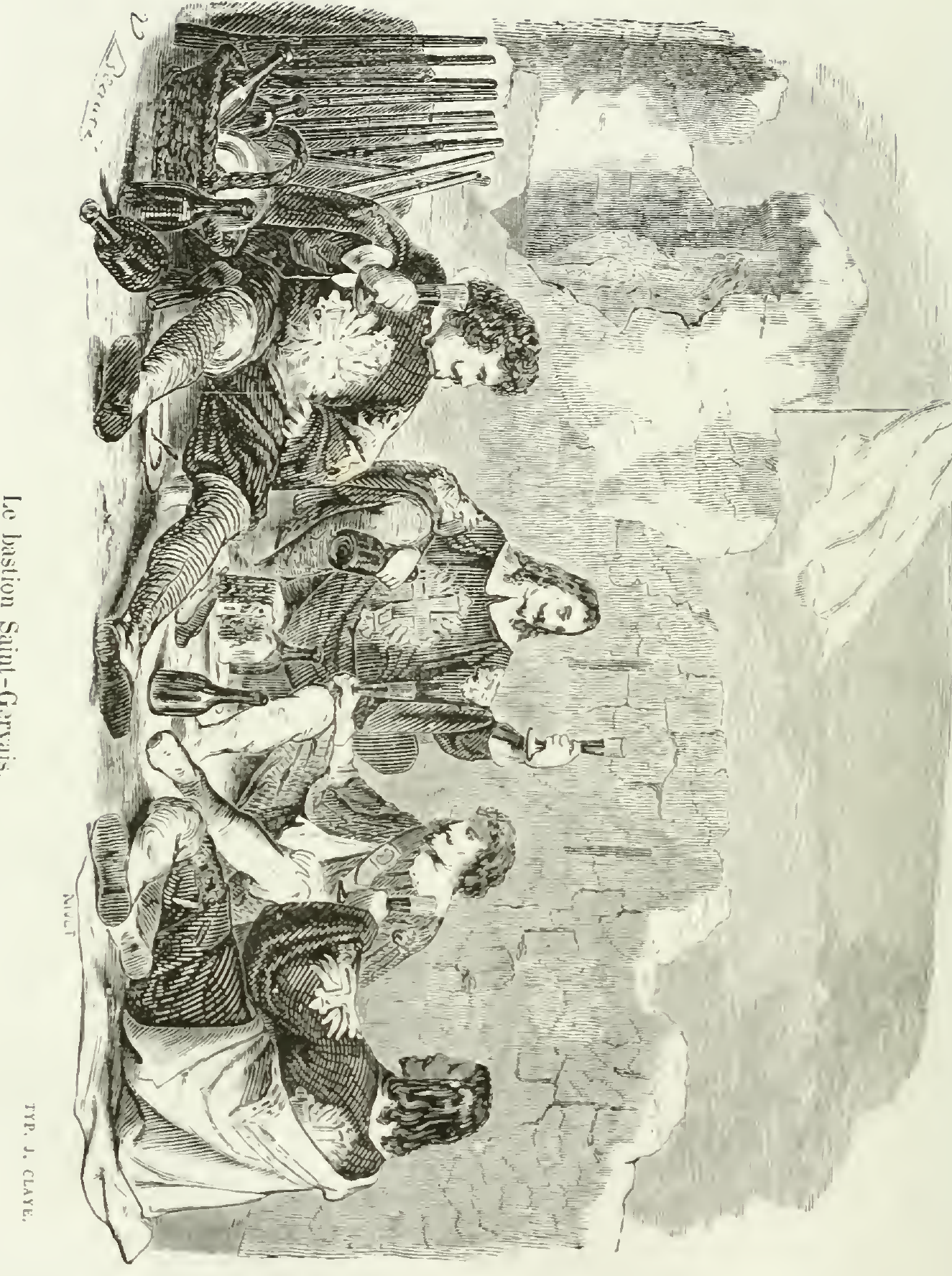
"Gentlemen," said Athos, who had taken command of the expedition, "while Grimaud sets the table, let us begin by gathering up the muskets and cartridges. We can talk while we do this work. These gentlemen," he added, pointing to the dead, "are not listening to us."
"But we could always throw them into the ditches," observed Porthos, "after making sure, however, that they have nothing in their pockets."
"Yes," said Aramis, "but that is Grimaud's business."
"Well then!" said d'Artagnan, "let Grimaud search them and throw them over the walls."
"Let him search them, yes," said Athos; "but throw them over the walls, no, for they may be of use to us."
"These dead men may be of use to us?" said Porthos. "Come now, you are going mad, dear friend."
"Judge not rashly, says the Gospel and M. the cardinal," replied Athos. "How many muskets, gentlemen?"
"Twelve," answered Aramis.
"How many shots to fire?"
"A hundred or so."
"That is as many as we need; let us load the weapons."
The four musketeers set to work. As they finished loading the last musket, Grimaud signaled that lunch was served.
Athos responded, still by gesture, that this was good, and indicated to Grimaud a sort of pepper pot where the latter understood he was to stand sentry.
Only, to soften the tedium of his duty, Athos allowed him to take a loaf of bread, two chops, and a bottle of wine.
"And now, to table!" said Athos.
The four friends sat on the ground, their legs crossed like Turks, or like tailors.
"Come now!" said d'Artagnan, "since we no longer have to fear being overheard, I hope you will share your secret with us, Athos?"
"I flatter myself that I will procure you both pleasure and glory, my sisters," said Athos. "I have taken you on a charming stroll; here is a most succulent lunch, and five hundred people over there, as you can see through the loopholes, who take us for fools or for heroes, two classes of imbeciles who resemble each other closely enough."
"But this secret?" asked d'Artagnan.
"The secret," replied Athos, "is that I saw milady last night."
D'Artagnan was raising his glass to his lips, but at this name of milady his hand trembled so violently that he set it down on the ground so as not to spill its contents.
"You have seen your—?"
"Hush now," Athos interrupted him; "you forget, my dear fellow, that these gentlemen are not initiated as you are into the secret of my domestic affairs. I have seen milady."
"And where was that?" asked d'Artagnan.
"About two leagues from here, at the Red Dovecot inn."
"In that case, I am lost," said d'Artagnan.
"No, not quite yet," replied Athos, "for by this hour she must have left the coasts of France."
D'Artagnan breathed again.
"But after all," asked Porthos, "what is this milady?"
"A charming woman," said Athos, savoring a glass of sparkling wine. "Rascally innkeeper!" he cried, "who gives us Anjou wine for champagne and thinks we will be taken in by it! Yes," he continued, "a charming woman, who has had kindnesses for our friend d'Artagnan, who in exchange played her I know not what nasty trick, for which she tried to take revenge a month ago by having him killed with musket shots; eight days ago by trying to poison him, and yesterday by asking the cardinal for his head."
"What! asking the cardinal for my head?" cried d'Artagnan, pale with terror.
"That," said Porthos, "is as true as the Gospel; I heard it with my own two ears."
"So did I," said Aramis.
"Then," resumed d'Artagnan, letting his arm fall in discouragement, "it is useless to struggle any longer; I might as well blow my brains out and have done with it."
"That is the last foolish thing to do," said Athos, "since it is the only one for which there is no remedy."
"But I will never escape with such enemies," replied d'Artagnan: "first, my stranger of Meung; then de Wardes, to whom I gave three sword thrusts; then milady, whose secret I surprised; finally the cardinal, whose vengeance I thwarted."
"Well!" said Athos, "all that makes only four, and we are four, one against one, by God! If we believe the signs Grimaud is making us, we are going to have to deal with a far greater number of people. What is it, Grimaud? In consideration of the gravity of the circumstance, I permit you to speak, my friend; but be laconic, I beg you. What do you see?"
"A troop."
"Of how many people?"
"Of twenty men."
— What men?
— Sixteen pioneers, four soldiers.
— How many paces away are they?
— Five hundred paces.
— Good! We still have time to finish this fowl and drink a glass of wine. Your health, d'Artagnan!
— Your health, repeated Porthos and Aramis.
— Well then, my health! although I do not believe your wishes will be of much use to me.
— Bah! said Athos, God is great, as the followers of Mahomet say, and the future is in his hands.
Then, having swallowed the contents of his glass, which he next set down beside him, Athos rose nonchalantly, took the first musket that came to hand, and approached a loophole.
Porthos, Aramis, and d'Artagnan did the same. As for Grimaud, he received orders to place himself behind the four friends in order to reload the weapons.
After a moment the troop was seen to appear; it followed a sort of trench hollow which formed a communication between the bastion and the town.
"Faith!" said Athos, "it was hardly worth while to disturb us for a score of fellows armed with picks, hoes, and shovels! Grimaud would only have had to make a sign to them to go away, and I am convinced they would have left us in peace."
"I doubt it," observed d'Artagnan, "for they are advancing very resolutely in this direction. Besides, there are with the workmen four soldiers and a brigadier armed with muskets."
"That is because they have not seen us," replied Athos.
"Faith," said Aramis, "I confess I have a repugnance to firing on those poor devils of bourgeois."
"Wretched priest," replied Porthos, "who has pity on heretics!"
"In truth," said Athos, "Aramis is right, and I will go and warn them."
"What the devil are you about doing?" cried d'Artagnan. "You will get yourself shot, my dear fellow."
But Athos paid no heed to the advice, and mounting on the breach, his musket in one hand and his hat in the other:
"Gentlemen," said he, addressing the soldiers and the workmen, who, astonishedat this apparition, stopped about fifty paces from the bastion, and saluting them courteously, "gentlemen, a few friends and myself are breakfasting in this bastion. Now, you know that nothing is so disagreeable as to be disturbed at one's breakfast; we beg of you, therefore, if you have any absolute business here, to wait until we have finished our meal, or to come back later, unless the salutary desire should take you to quit the party of rebellion and come and drink with us to the health of the King of France."
"Take care, Athos," interrupted d'Artagnan; "do you not see that they are aiming at you?"
"Yes, yes," said Athos, "but they are bourgeois, who fire very badly, and who will take good care not to touch me."
In fact, at the same instant four musket-shots went off, and the balls came and flattened themselves around Athos, but without one of them touching him.
Four musket-shots answered them almost at the same time, but they were better directed than those of the assailants: three soldiers fell dead on the spot, and one of the workmen was wounded.
"Grimaud, another musket!" said Athos, still on the breach.
Grimaud obeyed immediately. On their side, the three friends had reloaded their arms; a second discharge followed the first; the brigadier and two pioneers fell dead, and the rest of the troop took to flight.
"Come, gentlemen, a sortie!" said Athos.
And the four friends, darting out of the fort, reached the field of battle, picked up the four muskets of the soldiers and the half-pike of the brigadier, and, convinced that the fugitives would not stop till they reached the town, took the road back to the bastion, carrying the trophies of their victory.
"Reload the arms, Grimaud," said Athos, "and let us, gentlemen, resume our breakfast and continue our conversation. Where were we?"
"I remember," said d'Artagnan; "you were saying that after having demanded my head of the cardinal, Milady had quitted the coasts of France."
"That is true."
"And where is she going?" added d'Artagnan, who was greatly concerned about the route Milady was to follow.
"She is going to England," replied Athos.
"And with what object?"
"With the object of assassinating or causing to be assassinated Milord Buckingham."
D'Artagnan uttered an exclamation of surprise and indignation.
"But that is infamous!" cried he.
"Oh! as to that," said Athos, "I beg you to believe that I care very little about it. Now that you have finished, Grimaud," continued Athos, "take the half-pike of our brigadier, tie a napkin to it, and plant it at the top of our bastion, so that these rebels of Rochellais may see that they have to do with brave and loyal soldiers of the king."
Grimaud obeyed without replying; a moment after, the white flag was floating above the heads of the four friends. A cry of joy and a thunder of applause greeted its appearance. Half the camp was at the barriers.

"How is this," resumed d'Artagnan, "you care very little whether she kills or causes to be killed Buckingham? But the duke is our friend."
"The duke is English, the duke fights against us; let her do with the duke what she will, I care no more than for an empty bottle." And Athos sent a bottle he held fifteen paces from him, from which he had just poured the last drop into his glass.
"One moment," said d'Artagnan, "I do not abandon Buckingham thus; he gave us some very fine horses."
"And above all some very fine saddles," added Porthos, who at that very moment was carrying to his cloak the lace of his own.
"Amen," said Athos, "and we will come back to that later, if such is your pleasure. But what at present preoccupied me the most, and I am sure you will understand it, d'Artagnan, was to recover from that woman a sort of blank warrant which she had extorted from the cardinal, and by the aid of which she was to rid herself with impunity of you and perhaps of us."
"But is this creature, then, a demon?" asked Porthos, holding out his plate to Aramis, who was carving a fowl. "Pass me the leg, Aramis."
"And that blank warrant," said d'Artagnan, "that blank warrant, has it remained in her hands?"
"No, it has passed into mine; I will not say that it was without difficulty, for example, for I should lie."
"My dear Athos," said d'Artagnan, "I no longer count the times I owe my life to you."
"Then it was two hours to return to her that you left us?" asked Aramis.
"Just so."
"And you have that letter from the cardinal?" continued d'Artagnan.
"Here it is," said Athos.
And he drew the precious paper from the pocket of his surtout.
D'Artagnan unfolded it with a hand whose trembling he did not even attempt to conceal, and read in his turn:
"It is by my order and for the good of the state that the bearer of the present has done what he has done.
"3 August 1628.
"RICHELIEU."
"In truth," said Aramis, "it is an absolution according to all the rules."
"That paper must be torn up," cried d'Artagnan, who seemed to be reading his own death sentence.
"On the contrary," said Athos, "it must be carefully preserved, and I would not give that paper even were it covered with pieces of gold."
— And what is she going to do now? asked the young man.
— Why, said Athos carelessly, she will probably write to the cardinal that a damned musketeer named Athos forcibly tore her safe-conduct from her; in the same letter she will advise him to rid himself of me, and at the sametime of his two friends, Porthos and Aramis. The cardinal will remember that these are the same men he always encounters in his path. Then, one fine morning, he will have d'Artagnan arrested and, so that he will not be bored all alone, he will send us to keep him company in the Bastille.
,
— Come now, said Porthos, it seems to me that you are making some sorry jests there, my dear Athos!... And with that, this fowl is horribly tough.
— I am not jesting, replied Athos.
— Do you know, said Porthos, that to wring the neck of this damned milady would be a lesser sin than to wring it for those poor devils of Huguenots, who have never committed any other crime than to sing in French the psalms we sing in Latin?
— What says the abbé? asked Athos quietly.
— I say that I am of Porthos's opinion, replied Aramis.
— And so am I! said d'Artagnan.
— Fortunately she is far away, observed Porthos, for I confess that she would greatly inconvenience me here.
— She inconveniences me in England as well as in France, said Athos.
— She inconveniences me everywhere, continued d'Artagnan.
— But since you had her, said Porthos, why did you not drown her, strangle her, hang her? — Only the dead do not come back.
— You believe that, Porthos, replied the musketeer with a dark smile that d'Artagnan alone understood.
"I have an idea," said d'Artagnan.
"Let's hear it," said the musketeers.
"To arms!" cried Grimaud.
The young men rose quickly and ran to their muskets.
This time a small troop was advancing, composed of twenty or twenty-five men; but they were no longer those workmen—they were soldiers of the garrison.
"If we returned to camp?" observed Porthos; "it seems to me the game is not even."
"Impossible, for three reasons," replied Athos: "first, we have not finished breakfast; second, we still have matters of importance to discuss; third, there are still ten minutes to go before the hour is up."
"Come," said Aramis, "we must nevertheless settle on a plan of battle."
"It is very simple," replied Athos. "As soon as the enemy is within musket range, we fire; if they continue to advance, we fire again, we fire as long as we have loaded muskets; if what remains of the troop then wishes to mount the assault, we let the besiegers descend into the ditch, and then we push down upon their heads this block of wall that holds together only by a miracle of equilibrium."
"Bravo!" cried Porthos; "decidedly, Athos, you were born to be a general, perhaps, and the cardinal, who thinks himself a great man of war, is a very small thing beside you.
"Massicotres," resumed Athos, "no double duty, I beg you; aim carefully, each at his man."
"I have mine," said d'Artagnan.
"And I mine," said Porthos.
"And I the same," said Aramis.
"Come, fire!" said Athos.
The four musket shots made but a single report, and four men fell.
Instantly the drum beat and the small troop advanced at the charge.
Then the musket shots followed one another without regularity, but always sent with the same accuracy; however, as if they had known the numerical weakness of the enemy, the Rochelois continued to advance at a run.
At three more musket shots, two men fell; nevertheless the march of those still standing did not slacken.
Arrived at the foot of the bastion, the enemies were still twelve or fifteen; a last volley greeted them, but did not stop them; they leaped into the ditch and prepared to scale the breach.
"Come, my friends," said Athos, "let us finish it at a blow. To the wall! to the wall!"
And the four friends, seconded by Grimaud, began to push with the butts of their muskets an enormous panel of wall which leaned as if the wind were pushing it, and, detaching itself from its base, fell with a horrible noise into the ditch; then a great cry was heard, a cloud of dust rose toward the sky, and all was said.
"Have we crushed them from the first to the last?" asked Athos.
"Faith, it looks that way to me," said d'Artagnan.
"No," said Porthos, "there are two or three escaping, all battered."
Indeed, three or four of those wretches, covered with mud and blood, were fleeing along the sunken road and regaining the town: that was all that remained of the small troop.
Athos looked at his watch.
"Gentlemen," said he, "we have been here an hour, and now the wager is won, but we must be good players; besides, d'Artagnan has not told us his idea."
And the musketeer, with his usual coolness, went and sat down before the remains of the breakfast.
"My idea?" said d'Artagnan.
"Yes," replied Athos, "you said you had an idea."
"Ah! I have it," cried d'Artagnan: "I cross to England a second time, I go to find M. de Buckingham, and I warn him of the plot woven against his life."
"You will not do that, d'Artagnan," said Athos coldly.
"And why not? have I not done it already?"
"Yes, but at that time we were not at war; at that time M. de Buckingham was an ally and not an enemy; what you wish to do would be taxed as treason."
D'Artagnan understood the force of the reasoning and fell silent.
"But," said Porthos, "it seems to me that I have an idea in my turn."
"Silence for M. Porthos's idea," said Aramis.
"I ask leave of M. de Tréville under some pretext or other that you will find; I am not strong on pretexts, myself. Milady does not know me, I approach her without her dreading me, and when I find my beauty, I strangle her."
"Eh!" said Athos, "I am not very far from adopting M. Porthos's idea."
"Fie, then!" said Aramis, "to kill a woman—no! Come, I have the true idea."
"Let us hear your idea, Aramis," asked Athos, who had much deference for the young musketeer.
"We should warn the queen."
"Ah! faith, yes!" cried Porthos and d'Artagnan together; "I believe we are coming to the means."
"Warn the queen?" said Athos, "and how? Have we relations at court? Can we send someone to Paris without its being known in camp? From here to Paris is a hundred and forty leagues; our letter will not be at Angers before we are in a dungeon."
"As for safely having a letter delivered to Her Majesty," said Aramis, blushing, "I will undertake it; I know at Tours a clever person—"
Aramis stopped on seeing Athos smile.
"Well! you do not adopt this means, Athos?" said d'Artagnan.
"I do not altogether reject it," replied Athos, "but I only wished to point out to Aramis that he cannot leave the camp, that anyone other than one of us is not safe, that two hours after the messenger has left, all the capuchins, all the alguazils, all the black bonnets of the cardinal will know your letter by heart, and that they will arrest you and your clever person."
"Without counting," objected Porthos, "that the queen will save M. de Buckingham, but will not save us in all this."
"Gentlemen," said d'Artagnan, "what Porthos objects is full of sense."
"Ah! ah! what is happening in the town?" said Athos.
"The general is being beaten."
The four friends listened, and the sound of the drum indeed reached them.
"You'll see, they're going to send an entire regiment against us," said Athos.
"You don't intend to hold out against an entire regiment?" asked Porthos.
"Why not?" said the musketeer; "I feel in form, and I'd hold out against an army, if only we had taken the precaution of bringing a dozen more bottles."
"On my word, the drum is getting closer," said d'Artagnan.
"Let it get closer," replied Athos; "it's a quarter of an hour's march from here to the town, and consequently from the town here. That's more time than we need to settle our plan; if we leave here, we'll never find so suitable a spot again. And look, just now, gentlemen, here's the real idea that has come to me."
"Tell us, then."
"Allow me to give Grimaud a few indispensable orders."
Athos motioned to his valet to come closer.
"Grimaud," said Athos, pointing to the dead men lying in the bastion, "you will take these gentlemen, you will stand them up against the wall, you will put their hats on their heads and their muskets in their hands."
"O great man!" cried d'Artagnan, "I understand you!"
—Do you understand? said Porthos.
—And do you understand, Grimaud? asked Arannis.
Grimaud nodded yes.
—That is all that is needed, said Athos; let us return to my idea.
—I should like to understand, though, observed Porthos.
—It is useless.
—Yes, yes, Athos's idea! said d'Artagnan and Aramis at the same time.
—This milady, this woman, this creature, this demon has a brother-in-law, according to what you have told me, I believe, d'Artagnan.
—Yes, I even know him very well, and I also believe that he does not have a great sympathy for his sister-in-law.
—There is no harm in that, replied Athos, and even if he hated her, so much the better.
—In that case we are served as well as could be wished.
—However, said Porthos, I should very much like to understand what Grimaud is doing.
—Silence, Porthos! said Aramis.
—What is the name of this brother-in-law?
—Lord de Winter.
—Where is he now?
—He returned to London at the first rumor of war.
—Well! that is precisely the man we need, said Athos. It is he whom we ought to warn; we let him know that his sister-in-law is on the point of assassinating someone, and we beg him not to lose sight of her. There is surely in London, I hope, some establishment of the kind of the Magdalenes or the Penitent Girls; he will have his sister-in-law put there, and we shall be at peace.
—Yes, observed d'Artagnan, until she comes out.
—Ah! faith, resumed Athos, you ask too much, d'Artagnan. I have given you all that I had, and I warn you that it is the bottom of my bag.
—I, I think that it is the best there is, said Aramis. We warn the queen and Lord de Winter at the same time.
—Yes, but by whom do we have the letter to Tours and the letter to London carried?
—I will answer for Bazin, replied Aramis.
—And I for Planchet, continued d'Artagnan.
—Indeed, said Porthos, if we cannot absent ourselves from the camp, our lackeys can well leave it.—Doubtless, said Aramis, and this very day we write the letters, we give them money, and they leave.
—We give them money? resumed Athos: have you any, then, of that money?
The four friends looked at one another, and a cloud passed over their brows, which had for a moment cleared.
—Mother, cried d'Artagnan, I see black dots and red dots moving down there. What were you saying, then, about a regiment, Athos? It is a veritable army.
—Faith, yes, said Athos, there they are. Do you see the sly fellows coming without drums or trumpets. Ah! ah! have you finished, Grimaud?
Grimaud nodded yes and showed a dozen dead men whom he had placed in the most picturesque attitudes, some at port arms, others appearing to take aim, others with sword in hand.
—Bravo! resumed Athos, that does honor to your imagination.
—It is all the same, said Porthos, I should nevertheless very much like to understand....
—Let us decamp first, interrupted d'Artagnan, you will understand afterward.
—One moment, gentlemen, one moment, let us give Grimaud time to clear the table.
—Ah! said Aramis, here are the black dots and the red dots growing very visibly, and I am of d'Artagnan's opinion; I believe we have no time to lose in regaining the camp.
—Faith, said Athos, I have nothing more against the retreat; we had prepared for an hour, we have stayed an hour and a half; there is nothing to say; let us go, gentlemen, let us go.
Grimaud had already gone ahead with the basket and the sideboard.
The four friends went out behind him and took about ten steps.
—Eh! cried Athos, what the devil are we doing, gentlemen!
—Have you forgotten something? asked Aramis.
—And the flag, morbleu! we must not leave a flag in the hands of the enemy, even when that flag is only a napkin.
And Athos rushed into the bastion, climbed onto the platform, and took away the flag; only, as the Rochelais had come within musket range, they made a terrible fire upon this man, who, as if for pleasure, was going to expose himself to the shots.
But one would have said that Athos had a charm attached to his person; the bullets passed whistling around him; not one touched him.
Athos waved it while turning his back to the people of the town and saluting those of the camp. On both sides, great cries resounded, on one side cries of anger, on the other cries of enthusiasm.
A second discharge followed the first, and three bullets, finding it, really made a flag of the napkin.
The whole camp could be heard shouting: Come down! come down!
Athos came down; his comrades, who were waiting for him with friendship, saw him reappear with joy.
—Ah! come, Athos, let us go, said d'Artagnan, let us stretch out, let us stretch out; now that we have found everything except money, it would be stupid to be killed.
But Athos continued to walk majestically, and his companions, seeing all observation useless, regulated their pace by his.
Grimaud and his basket had gone ahead and both were out of reach.
After a moment, the noise of an enraged fusillade was heard.
—What is that? asked Porthos, and what are they holding to? I do not hear the bullets whistling and I see no one.
—They are firing at our dead, replied Athos.
—But our dead will not answer.
—Precisely; then they will believe in an ambush, they will deliberate; they will send a parliamentarian, and when they perceive the joke, we shall be out of range of the bullets. That is why it is useless to catch a pleurisy by hurrying.
—Oh! I understand! cried Porthos, marveling.
—It is very fortunate! said Athos, shrugging his shoulders.
For their part, the French, seeing the four friends returning at a walk, uttered cries of enthusiasm.
At last a new volley of musketry was heard, and this time the bullets came flattening themselves against the pebbles around the four friends and whistled dismally in their ears. The Rochelais had just taken possession of the bastion.
"Those are very clumsy fellows," said Athos. "How many did you kill? Twelve?"
"Or fifteen."
"How many did we crush?"
"Eight or ten."
"And in exchange for all that, not a scratch! Ah, yes, indeed! What is that you have in your hand, d'Artagnan? Blood, it seems to me?"
— It is nothing, said d'Artagnan.
— A stray bullet?
— Not even that.
— What is it, then?
We have said it, Athos loved d'Artagnan as his own child, and that somber and inflexible character had sometimes for the young man a mother's solicitude.
— A scratch, resumed d'Artagnan; my fingers were caught between two stones, that of the wall and that of my ring, and so the skin was broken.
— That is what it is to have diamonds, my master! said Athos languidly.
— Ah, come now, cried Porthos, there is a diamond indeed, and why the devil, then, since there is a diamond, do we complain of having no money?
— Well, upon my word! said Aramis.
— Good! Porthos. This time there is an idea.
— No doubt, said Porthos, bridling up at Athos's compliment, since there is a diamond, let us sell it.
— But, said d'Artagnan, it is the queen's diamond.
— All the more reason, resumed Athos. The queen saving M. de Buckingham, her lover, nothing is more just; the queen saving us, her friends, nothing is more moral. Let us sell the diamond. What does M. the abbé think of it? I do not ask Porthos's opinion, he has given it.
— But I think, said Aramis, blushing, that since the ring does not come from a mistress and consequently is not a pledge of love, d'Artagnan can sell it.
— My dear fellow, you speak like theology in person. So your opinion is?—
— To sell the diamond, replied Aramis.
— Well then! said gaily d'Artagnan, let us sell the diamond and say no more about it.
The firing continued, but the friends were out of range, and the Rochelais no longer fired except for the acquittal of their consciences.
— Faith, said Athos, it was time that this idea came to Porthos; here we are at the camp. So, gentlemen, not another word about this whole affair. We are observed, people are coming to meet us, we are going to be carried in triumph.
Indeed, as we have said, the whole camp was in commotion. More than two thousand persons had assisted, as at a spectacle, at the happy bravado of the four friends; a bravado, therefore, of which people were far from suspecting the true motive. Nothing was heard but the cries of: Long live the guards! long live the musketeers! M. de Busigny had come first to shake hands with Athos, and to acknowledge that the wager was lost. The dragoon and the Swiss had followed him; all the comrades had followed the dragoon and the Swiss. There were congratulations, handshakings, embracings without end, inextinguishable laughter at the expense of the Rochelais, in short, such a tumult that M. the cardinal believed there was a riot, and sent La Houdinière, his captain of the guards, to inquire what was going on.
The thing was related to the messenger with all the effervescence of enthusiasm.
— Well! asked the cardinal on seeing La Houdinière.
— Well! monseigneur, said the latter, it is three musketeers and a guardsman who made a wager with M. de Busigny to go and breakfast at the bastion Saint-Gervais, and who, while breakfasting, held out two hours against the enemy, and killed I know not how many Rochelais.
— Did you inform yourself of the names of these three musketeers?
— Yes, monseigneur.
— What are they called?
— They are MM. Athos, Porthos, and Aramis.
— Always my three braves! murmured the cardinal. And the guardsman?
— M. d'Artagnan.
— Always my young rascal! Decidedly, these four men must be mine.
That same evening the cardinal spoke to M. de Tréville of the morning's exploit, which was the talk of the whole camp; M. de Tréville, who had the account from the very lips of those who were its heroes, related the adventure in all its details to His Eminence, without omitting the episode of the napkin.
— Very well, M. de Tréville, said the cardinal; have that napkin brought to me, I beg you; I will have three golden fleurs-de-lis embroidered on it and I will give it as a guidon to your company.
— Monseigneur, said M. de Tréville, there will be an injustice to the guards; M. d'Artagnan is not mine, but M. des Essarts's.
— Well then! take him, said the cardinal; it is not just that, since these four brave soldiers love one another so much, they should not serve in the same company.
The same evening M. de Tréville announced this good news to the three musketeers and to d'Artagnan, inviting all four of them to breakfast the next day. D'Artagnan was beside himself with joy. It is known, the dream of all his life had been to be a musketeer.
The three friends also were very joyful.
— Faith, said d'Artagnan to Athos, you had a triumphant idea there, and, as you said, we have acquired glory by it and have been able to link together a conversation of the highest importance.
— Which we can take up again now without anyone suspecting us, for with the help of God we shall henceforth pass for cardinalists.
The same evening d'Artagnan went to present his respects to M. des Essarts and to inform him of the advancement he had obtained.
M. des Essarts, who was very fond of d'Artagnan, then made him offers of service, this change of corps bringing with it expenses for equipment.
D'Artagnan refused, but finding the occasion good, he begged him to have the diamond appraised, which he handed over to him and for which he wished to get money.
The next day, at eight o'clock in the morning, M. des Essarts's valet entered d'Artagnan's room and handed him a bag of gold containing seven thousand livres.
It was the price of the queen's diamond.