WHAT WAS HAPPENING AT FORTSMOUTH ON AUGUST 23, 1628.
FELTON took leave of milady as a brother about to take a simple walk takes leave of his sister, by kissing her hand.
His whole person appeared in its usual state of calm; only an unwonted gleam shone in his eyes, like the reflection of a fever. His brow was even paler than usual; his teeth were clenched, and his speech had a brief, jerky accent that indicated that something dark was stirring within him.
As long as he remained in the boat that was taking him ashore, he kept his face turned toward milady, who, standing on the deck, followed him with her eyes. Both were sufficiently reassured about the fear of being pursued. No one ever entered milady’s room before nine o’clock, and it took three hours to come from the castle to London.
Felton set foot on land, climbed the little crest that led to the top of the cliff, saluted milady one last time, and set off at a run toward the town.
After a hundred paces, as the ground sloped downward, he could no longer see anything but the mast of the sloop.
He ran at once in the direction of Portsmouth, whose towers and houses he saw opposite him, about half a mile away, outlined in the morning mist.
Beyond Portsmouth, the sea was covered with vessels whose masts, like a forest of poplars stripped by winter, swayed under the breath of the wind. “Felton, in his rapid walk, went over what ten years of ascetic meditations and a long stay among the Puritans had furnished him with as true or false accusations against the favorite of James VI and Charles I.
When he compared the public crimes of this minister—glaring crimes, European crimes, so to speak—with the private and unknown crimes with which milady had charged him, Felton found that the more guilty of the two men Buckingham contained was the one whose life the public did not know. It was because his love, so strange, so new, so ardent, made him see the infamous and imaginary accusations of Lady de Winter as one sees, through a magnifying glass, in the state of frightful monsters, atoms imperceptible in reality beside an ant.
The rapidity of the run further inflamed his blood. The idea that he was leaving behind him, exposed to a frightful vengeance, the woman he loved, or rather adored as a saint; the emotion past, his present fatigue, everything still exalted his soul above human feelings.
He entered Portsmouth around eight o’clock in the morning. The whole population was on foot. The drum beat in the streets and at the port. The embarkation troops were going down toward the sea.
“Urgent message from Lord de Winter,” he said. In the name of Lord de Winter, who was known to be one of His Grace’s closest friends, the head of the post gave the order to let Felton pass, who, moreover, himself wore a naval officer’s uniform.
“Felton rushed into the palace.
At the moment he entered the vestibule, a man also entered, dusty, out of breath, leaving at the door a post horse that fell on its two knees as it arrived.
Felton and he addressed themselves at the same time to Patrick, the duke’s trusted valet. Felton named Baron de Winter. The stranger would not name anyone and claimed that it was to the duke alone that he could make himself known. Both insisted on passing before the other. Patrick, who knew that Lord de Winter was engaged in service matters and in relations of friendship with the duke, gave preference to the one who came in his name.
The other was forced to wait, and it was easy to see how much he cursed this delay.
Felton entered. At that moment Buckingham was throwing onto a sofa a rich dressing gown embroidered with gold in order to put on a blue velvet doublet all embroidered with pearls.
“Why has the baron not come himself?” asked Buckingham. “I was expecting him this morning.”
“He charged me to tell Your Grace,” replied Felton, “that he greatly regretted not having that honor, but that he was prevented by the guard he is obliged to keep at the castle.”
“Yes, yes,” said Buckingham, “I know that: he has a prisoner.”
“It is precisely about that prisoner that I wished to speak to Your Grace,” resumed Felton.
“Well! speak.”
“What I have to say to you can be heard only by you, my lord.”
— Leave us, Patrick, said Buckingham, but stay within reach of the bell; I will call you presently.
Patrick went out.
— We are alone, sir, said Buckingham, speak.
— My lord, said Felton, the Baron de Winter wrote to you lately to beg you to sign an embarkation order concerning a young woman named Charlotte Backson.
— Yes, sir, and I replied that he should bring or send me that order, and that I would sign it.
— Here it is, my lord.
— Give it to me, said the duke.
And taking it from Felton's hands he cast a rapid glance over the paper. Then, perceiving that it was indeed the one that had been announced to him, he laid it on the table, took a pen and prepared to sign it.
— Pardon, my lord, said Felton, stopping the duke, but does Your Grace know that the name of Charlotte Backson is not the real name of this young woman?
— Yes, sir, I know it, replied the duke, dipping his pen in the inkstand.
— Then Your Grace knows her real name? asked Felton in a curt voice.
— I know it.
The duke brought the pen close to the paper. Felton turned pale.
— And knowing this real name, resumed Felton, his lordship will sign all the same?
— Doubtless, said Buckingham, and twice rather than once.
— I cannot believe, continued Felton in a voice that became ever briefer and more jerky, that His Grace knows that this is Lady de Winter.
— I know it perfectly, although I am astonished that you should know it, you.
— And Your Grace will sign this order without remorse?
Buckingham looked at the young man with haughtiness.
— Come now, sir, do you know, he said to him, that you are asking me strange questions, and that I am very simple to answer them.
— Answer them, sir, said Felton; the situation is more serious than you perhaps believe.
Buckingham thought that the young man, coming on behalf of Lord de Winter, was doubtless speaking in his own name, and softened.
"Without any remorse," he said, "and the baron knows as well as I do that Milady de Winter is a great criminal, and that it is almost doing her a favor to limit her punishment to exportation."The duke moistened the pen on the paper.
"You will not sign that order, my lord," said Felton, taking a step toward the duke.
"I will not sign that order?" said Buckingham; "and why not?"
"Because you will descend into yourself, and you will do justice to Milady."
"Justice will be done her by sending her to Tyburn," said Buckingham; "Milady is an infamous woman."
"Monseigneur, Milady is an angel, you know it well, and I ask you for her freedom."
"Come now!" said Buckingham, "are you mad to speak to me thus?"
"My lord, excuse me. I speak as I can; I am restraining myself. However, my lord, think of what you are about to do, and fear to go beyond measure."
"I beg your pardon?... God forgive me," cried Buckingham, "but I believe he is threatening me!"
"No, my lord, I still pray, and I tell you: a drop of water is enough to make a full vessel overflow, a slight fault is enough to bring punishment down upon a head spared until today, despite so many crimes.
"Monsieur Felton," said Buckingham, "you will leave this room and place yourself under arrest at once."
"And you, you will listen to me to the end, my lord. You have seduced that young girl, you have outraged her, sullied her; repair your crimes toward her, let her go free, and I will demand nothing else of you."
"You will demand nothing?" said Buckingham, looking at Felton with astonishment and stressing each of the syllables of the three words he had just pronounced.
"My lord," continued Felton, growing more exalted as he spoke, "my lord, beware, all England is weary of your iniquities; my lord, you are abhorred by men and by God; God will punish you later, but I, I will punish you today."
"Ah! this is too much!" cried Buckingham, taking a step toward the door.
Felton barred his way.
"I ask you humbly: sign the order for the release of Lady de Winter. Remember that it is the woman you have dishonored."
"Stand back, monsieur," said Buckingham, "or I call and have you driven out by my people!"
"You will not call," said Felton, throwing himself between the duke and the bell placed on a small table inlaid with silver; "take care, my lord, you are here in the hands of God."
"In the hands of the devil, you mean!" cried Buckingham, raising his voice to attract people, without however calling directly.
"Sign, my lord, sign the freedom of Lady de Winter," said Felton, pushing a paper toward the duke.
"By force? Are you mocking me? Hallo! Patrick!"
"Sign, my lord!"
"Never!"
"Never?"
"To me!" cried the duke, and at the same time he sprang for his sword.
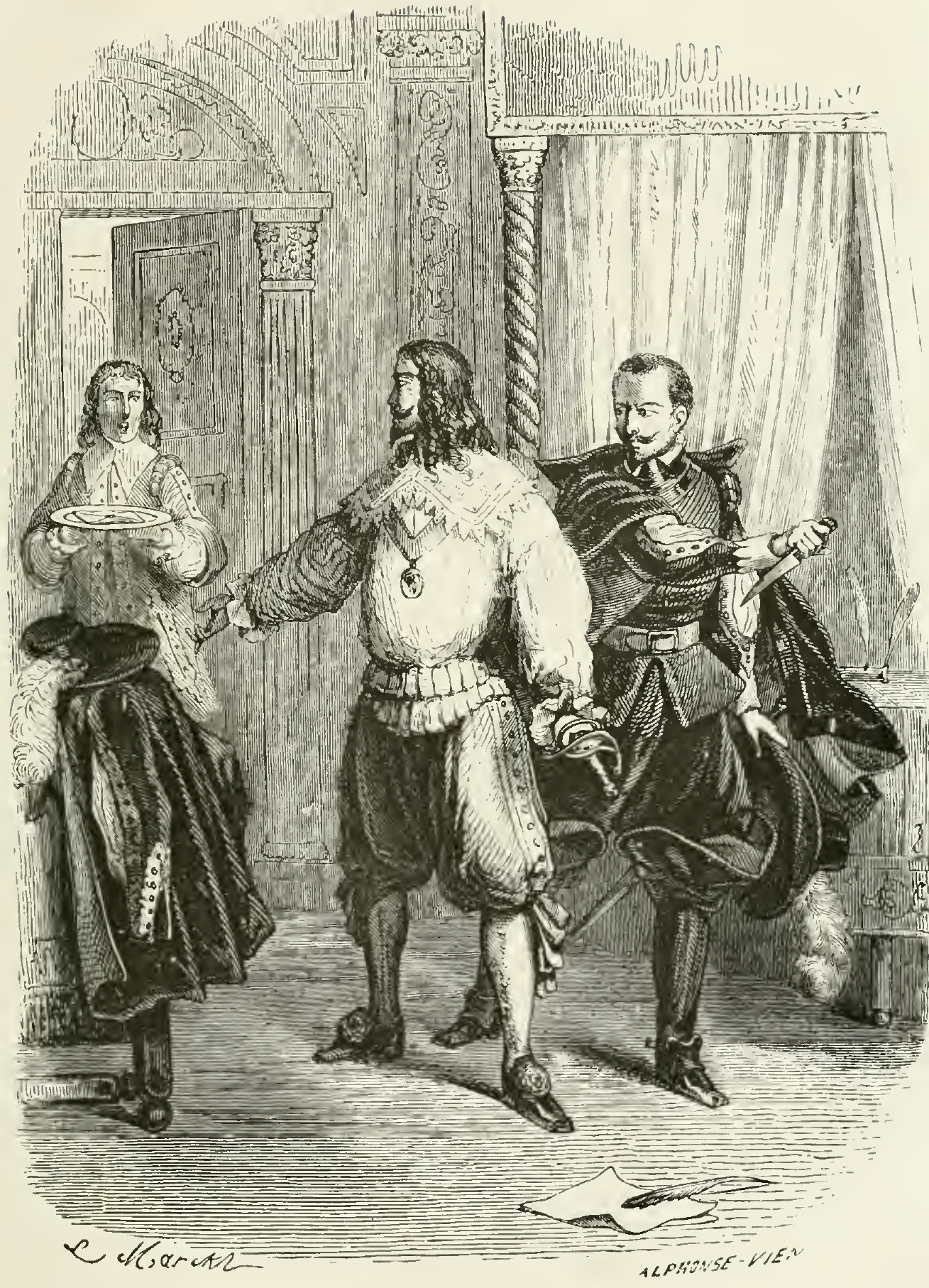
But Felton did not give him time to draw it: he held wide open and hidden beneath his doublet the knife with which Milady had stabbed herself; with a bound he was upon the duke.
At that moment Patrick entered the room, crying:
"My lord, a letter from France."
"From France!" cried Buckingham, forgetting everything in thinking of whom this letter came from.
Felton took advantage of the moment and drove the knife into his side up to the hilt.
"Ah! traitor," cried Buckingham, "you have killed me!"
"Murder!" howled Patrick.
Felton cast his eyes around him to flee, and seeing the door free, rushed into the adjoining room, which was the one where, as we have said, the deputies from La Rochelle were waiting, crossed it at a run, and dashed toward the staircase; but on the first step he met Lord de Winter, who, seeing him pale, wild, livid, stained with blood on his hand and face, threw his arms around his neck, crying:
"I knew it! I had guessed it! and I arrive a minute too late. Oh! wretch, wretch that I am!"
Felton made no resistance. Lord de Winter handed him over to the guards, who led him, while awaiting new orders, onto a small terrace overlooking the sea, and he rushed into Buckingham's cabinet.
At the cry uttered by the duke, at Patrick's call, the man whom Felton had met in the anteroom rushed into the cabinet.
He found the duke lying on a sofa, clutching his wound in his clenched hand.
"Laporte," said the duke in a dying voice, "Laporte, do you come from her?"
"Yes, monseigneur," replied the faithful servant of Anne of Austria; "but too late, perhaps."
"Silence! Laporte, someone might hear you. Patrick, let no one enter. Oh! I shall not know what she has to tell me, my God! I am dying!" And the duke fainted.
Meanwhile Lord de Winter, the deputies, the leaders of the expedition, the officers of Buckingham's household had burst into his room; everywhere cries of despair rang out; the news that filled the palace with complaints and groans soon overflowed everywhere and spread through the city.
A cannon shot announced that something new and unexpected had just occurred.
Lord de Winter tore his hair.
"Too late by a minute!" he cried. "Too late by a minute! Oh my God! my God! what misfortune!"
Indeed, he had been told at seven in the morning that a rope ladder was floating at one of the windows of the castle. He had run at once to Milady's room, had found the room empty, the window open, and the bars sawed through; he had remembered the verbal recommendation that d'Artagnan had sent him through his messenger, he had trembled for the duke, and running to the stable without

taking the time to have his horse saddled, had leaped onto the first one to hand, had galloped at breakneck speed, and leaping down in the courtyard, had rushed precipitately up the stairs, and on the first step had, as we have said, met Felton.
However, the duke was not dead; he came to himself, reopened his eyes, and hope returned to every heart.
"Gentlemen," he said, "leave me alone with Patrick and Laporte... Ah! it is you, de Winter! You sent me a strange madman this morning! see the state in which he has put me!"
"Oh! my lord," cried the baron, "my lord, I shall never console myself for it!"
“And you would be wrong, my good de Winter,” said Buckingham, holding out his hand to him. “I know no man who deserves to be regretted throughout the life of another man. But leave us, I beg you.”
The baron went out sobbing.
There remained in the cabinet only the wounded duke, Laporte, and Patrick. A doctor was being sought, but could not be found.
“You will live, milord, you will live,” repeated, kneeling before the duke’s sofa, the messenger of Anne of Austria.
“What did she write to me?” said Buckingham feebly, all streaming with blood and subduing, in order to speak of the one he loved, atrocious pains; “what did she write to me? Read me her letter.”
“Oh! milord!” said Laporte.
“Well, Laporte, do you not see that I have no time to lose?”
Laporte broke the seal and placed the parchment before the duke’s eyes; but Buckingham tried in vain to distinguish the writing.
“Read, then,” he said, “read, then, I can no longer see! read, then, for soon perhaps I shall no longer hear, and I shall die without knowing what she has written to me.”
Laporte made no further difficulty and read:
“Milord, “By what I have, since I have known you, suffered through you and for you, “I conjure you, if you had any concern for my peace, to interrupt the great “armaments that you are making against France, and to cease a war of which it “is said aloud that religion is the visible cause, and of which it is said “in a whisper that your love for me is the hidden cause. This war can not only “bring upon France and upon England great catastrophes, but also upon you, “milord, misfortunes of which I should never console myself.
"Watch over your life, which is threatened, and which will be dear to me from the moment when I shall no longer be obliged to see in you an enemy.
"Your affectionate, "ANNE."
Buckingham summoned all the remnants of his life to listen to this letter; then, when it was finished, as if he had found therein a bitter disappointment:
"Have you nothing else to tell me by word of mouth, Laporte?" he asked.—"Yes, my lord: the queen had charged me to tell you to watch over yourself, for she had been warned that someone was to assassinate you."
"And that is all? that is all?" repeated Buckingham with impatience.
"She had also charged me to tell you that she loves you still."
"Ah!" said Buckingham, "God be praised! my death, then, will not be for her the death of a stranger!"
Laporte burst into tears.
"Patrick," said the duke, "bring me the casket in which were the diamond studs."
Patrick brought the object demanded, which Laporte recognized as having belonged to the queen.
"Now the white satin bag, on which her cipher is embroidered in pearls."
Patrick obeyed again.
"Here, Laporte," said Buckingham, "here are the only pledges I had from her, this silver casket and these two letters. You will return them to Her Majesty; and for a last remembrance... (He looked about him for some precious object)... you will add to them..."
He looked again; but his eyes, darkened by death, met only the knife that had fallen from Felton's hands, and which still smoked with the crimson blood spread upon its blade.
"And you will add this knife to them," said the duke, pressing Laporte's hand.
He was still able to place the bag at the bottom of the silver casket, let the knife fall into it, making a sign to Laporte that he could no longer speak; then, in a final convulsion, which this time he had no longer the strength to combat, he slid from the sofa onto the parquet floor.
Patrick gave a great cry.
Buckingham tried to smile one last time; but death arrested his thought, which remained engraved upon his lips and on his brow like a last farewell of love.
At that moment the duke's physician arrived all distraught; he was already aboard the flagship; they had been obliged to go and fetch him there.
He approached the duke, took his hand, held it an instant in his own, and let it fall back.
"All is useless," he said; "he is dead!"
"Dead! dead!" cried Patrick.
At this cry the whole crowd came back into the room, and everywhere there was nothing but consternation and tumult.
As soon as Lord de Winter saw Buckingham dead, he ran to Felton, whom the soldiers were still guarding on the terrace of the palace.
"Wretch," said he to the young man, who since Buckingham's death had found that calm and that coolness which were never again to leave him. "Wretch! what have you done?"
"I have avenged myself!" said he.
"You!" said the baron; "say rather that you have served as the instrument of that accursed woman; but I swear to you, this crime shall be her last crime."
"I do not know what you mean," replied Felton quietly, "and I do not know of whom you speak, my lord; I killed the Duke of Buckingham because hetwice refused to name me captain to yourself; I punished him for his injustice, that is all.
De Winter, stupefied, looked at the men who were binding Felton, and knew not what to think of such insensibility.
One thing, however, cast a cloud upon Felton's brow: at every step he heard, the simple-hearted Puritan thought he recognized the steps and the voice of milady coming to throw herself into his arms, to accuse herself and to perish with him.
Suddenly he started; his gaze fixed upon a point of the sea, which from the terrace where he stood he commanded entirely; with that eagle glance of the sailor, he had recognized, where another would have seen only a gull balancing on the waves, the sail of the sloop making for the coast of France.
He turned pale, carried his hand to his heart, which was breaking, and understood the whole treachery.
"One last favor," said he to the baron.
"Which?" asked the latter.
"What time is it?"
The baron drew out his watch.
"Ten minutes to nine," said he.
Milady had advanced her departure by an hour and a half; as soon as she had heard the cannon shot announcing the fatal event, she had given the order to weigh anchor.
The boat was sailing under a blue sky at a great distance from the coast.
"God willed it," said Felton with the resignation of a fanatic; but nevertheless he could not detach his eyes from that skiff on board of which he doubtless believed he could distinguish the white phantom of her to whom his life was about to be sacrificed.
De Winter followed his gaze, questioned his suffering, and divined all.
"Be punished alone first, wretch," said the lord to Felton, who let himself be led away, his eyes turned toward the sea; "but I swear to you by the memory of my brother, whom I loved so dearly, that your accomplice is not saved."
Felton bowed his head without uttering a syllable.
As for de Winter, he descended the staircase rapidly and made his way to the port.