
GEORGE VILLIERS, DUKE OF BUCKINGHAM.
MADAME Bonacieux and the duke entered the Louvre without difficulty; Mme Bonacieux was known to belong to the queen; the duke wore the uniform of the musketeers of M. de Tréville, who, as we have said, were on guard that evening. Besides, Germain was in the queen's interests, and if anything happened, Mme Bonacieux would be accused of having introduced her lover into the Louvre, that was all; she took the crime upon herself: her reputation was lost, it is true, but what value in the world had the reputation of a little mercer's wife?
The duke and the young woman followed along the foot of the wall for the space of about twenty-five paces; that space covered, Mme Bonacieux pushed a small service door, open by day, but ordinarily closed at night; the door yielded; both entered and found themselves in darkness, but Mme Bonacieux knew all the turns and windings of that part of the Louvre set apart for the attendants. She closed the doors behind her, took the duke by the hand, took a few steps groping her way, grasped a railing, touched a step with her foot, and began to climb a staircase; the duke counted two floors. Then she turned right, followed a long corridor, went down a floor again, took a few more steps, inserted a key in a lock, opened a door, and pushed the duke into an apartment lit only by a night lamp, saying to him: "Stay here, milord duke, someone will come." Then she went out by the same door, which she locked with the key, so that the duke found himself literally a prisoner.
However, isolated as he was, it must be said, the Duke of Buckingham did not feel a moment of fear; one of the salient sides of his character was the pursuit of the adventurous and the love of the romantic. Brave, bold, enterprising, it was not the first time he had risked his life in such attempts;he had learned that this supposed message from Anne of Austria, on the faith of which he had come to Paris, was a trap, and instead of returning to England, he had, abusing the position that had been made for him, declared to the queen that he would not leave without having seen her. The queen had positively refused at first, then at last she had feared that the duke, exasperated, might do something foolish. She had already decided to receive him and to beg him to leave at once, when, on the very evening of that decision, Mme Bonacieux, who had been charged with going to fetch the duke and bringing him to the Louvre, was carried off. For two days no one knew at all what had become of her, and everything remained in suspense. But once free, once back in contact with Laporte, things had resumed their course, and she had just accomplished the perilous undertaking which, without her arrest, she would have carried out three days earlier.
Buckingham, left alone, approached a mirror. This musketeer's costume suited him to perfection. At thirty-five years of age, which he then was, he passed justly for the handsomest gentleman and the most elegant cavalier in France and England. A favorite of two kings, rich to the extent of millions, all-powerful in a kingdom which he turned upside down at his fancy and calmed at his caprice, George Villiers, Duke of Buckingham, had entered upon one of those fabulous existences which remain in the course of centuries as an astonishment for posterity. Thus, sure of himself, convinced of his power, certain that the laws which govern other men could not reach him, he went straight to the goal he had set himself, even though that goal were so elevated and so dazzling that it would have been madness for anyone else merely to contemplate it. It was thus that he had come to approach several times the beautiful and proud Anne of Austria and to make himself beloved by her, by dint of dazzlement.
George de Villiers therefore placed himself before a mirror, as we have said, restored to his beautiful blond hair the waves that the weight of his hat had made it lose, curled his mustache, and, his heart swelling with joy, happy and proud to be touching the moment he had so long desired, smiled at himself with pride and hope.
At that moment a door hidden in the tapestry opened, and a woman appeared. Buckingham saw this apparition in the mirror; he uttered a cry—it was the queen.
Anne of Austria was then twenty-six or twenty-seven years old, that is to say, she was in the full splendor of her beauty. Her bearing was that of a queen or a goddess; her eyes, which cast emerald reflections, were perfectly beautiful, and at once full of gentleness and majesty. Her mouth was small and vermilion, and although her lower lip, like that of the princes of the house of Austria, advanced slightly over the other, she was eminently gracious in her smile, but also profoundly disdainful in her contempt. Her skin was cited for its softness and velvety texture, her hand and her arms were of a surprising beauty, and all the poets of the time sang of them as incomparable. Finally her hair, which, from blond as it had been in her youth, had become chestnut, and which she wore curled very lightly and with much powder, framed admirably her face, to which the most rigorous censor could have wished only a little less rouge, and the most exacting sculptor only a little more fineness in the nose.
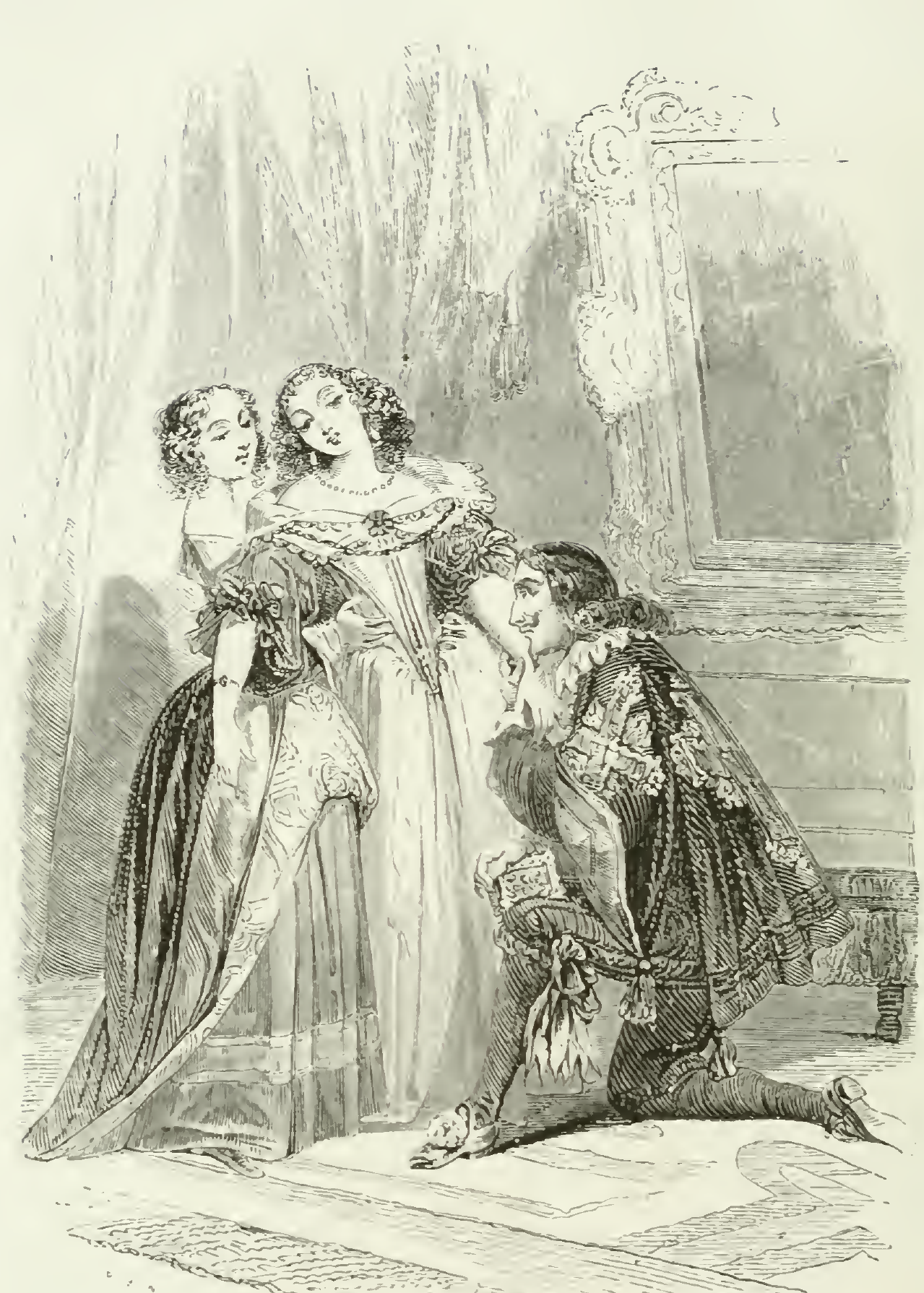
Buckingham remained dazzled for a moment; never had Anne of Austria appeared to him so beautiful, amid balls, festivities, and carrousels, as she appeared to him at this moment, dressed in a simple gown of white satin and accompanied by doña Estefania, the only one of her Spanish women who had not been driven away by the king's jealousy and by Richelieu's persecutions.
Anne of Austria took two steps forward; Buckingham threw himself at her knees, and before the queen could prevent him, he kissed the hem of her gown.
"Duke, you already know that it was not I who had you write."
"Oh! yes, madame, yes, Your Majesty," cried the duke, "I know that I have been a fool, a madman to believe that the snow would come to life, that the marble would grow warm; but what would you have? When one loves, one easily believes in love; besides, I have not lost everything on this journey, since I see you."
"Yes," replied Anne, "but you know why and how I see you, milord. I see you out of pity for yourself; I see you because, insensible to all my sorrows, you have obstinately remained in a city where, in remaining, you run the risk of your life, and make me run the risk of my honor; I see you to tell you that everything separates us—the depths of the sea, the enmity of kingdoms, the sanctity of oaths. It is sacrilege to struggle against so many things, milord. I see you, finally, to tell you that we must see each other no more."
"Speak, madame, speak, queen," said Buckingham; "the sweetness of your voice covers the harshness of your words. You speak of sacrilege! But the sacrilege lies in the separation of hearts that God had formed for one another."
"Milord," cried the queen, "you forget that I have never told you that I loved you."
"But you have never told me either that you did not love me, and truly to say such words to me would be, on Your Majesty's part, too great an ingratitude. For, tell me, where would you find a love like mine—a love that neither time, nor absence, nor despair can extinguish; a love that is content with a stray ribbon, a lost glance, a word that escapes? It is three years, madame, since I saw you for the first time, and for three years I have loved you thus. Would you like me to tell you how you were dressed the first time I saw you? Would you like me to describe each of the ornaments of your attire? Listen, I see you still: you were seated on cushions in the Spanish fashion; you wore a gown of green satin embroidered with gold and silver; hanging sleeves fastened back on your beautiful arms, on those admirable arms, with large diamonds; you wore a closed ruff, a small cap on your head of the color of your gown, and on that cap a heron's feather. Oh! listen, listen, I close my eyes, and I see you as you were then; I open them, and I see you as you are now, that is to say, a hundred times more beautiful still!"
"What madness!" murmured Anne of Austria, who did not have the courage to be angry with the duke for having so well preserved her portrait in his heart; "what madness to nourish a useless passion with such memories!"
"And with what, then, would you have me live? I have only memories. That is my happiness, my treasure, my hope. Each time I see you, it is one more diamond that I shut away in the casket of my heart. This one is the fourth that you have let fall and that I have picked up; for in three years, madame, I have seen you only four times: this first one of which I have just spoken; the second at Mme de Chevreuse's; the third in the gardens of Amiens—"
"Duke," said the queen, blushing, "do not speak of that evening."
"Oh! let us speak of it, on the contrary, madame, let us speak of it; it is the happy and radiant evening of my life. Do you remember the beautiful night it was? How soft and fragrant the air was, how beautiful the sky was, all enameled with stars. Ah! that time, madame, I had been able to be alone with you for a moment; that time you were ready to tell me everything—the isolation of your life, the sorrows of your heart. You were leaning on my arm; listen, on this one. I felt, as I inclined my head toward you, your beautiful hair brush my face, and each time it brushed it, I shuddered from head to foot. Oh! queen! queen! oh! you do not know all the felicities of heaven, all the joys of paradise, enclosed in such a moment. Listen, my goods, my fortune, my glory, all the days I have left to live, for such an instant and for such a night; for that night, madame, that night you loved me, I swear it to you."
"Milord, it is possible, yes, that the influence of the place, the charm of that beautiful evening, the fascination of your gaze, in short, those thousand circumstances that sometimes combine to undo a woman, may have gathered around me on that fatal evening; but you saw it, milord, the queen came to the aid of the woman who was weakening: at the first word you dared to say, at the first boldness to which I had to respond, I called—"
"Oh! yes, yes, that is true, and any love other than mine would have succumbed to that trial; but my love came out of it more ardent and more eternal. You thought to flee me by returning to Paris; you thought that I would not dare leave the treasure that my master had charged me to watch over. Ah! what do I care for all the treasures of the world and all the kings of the earth! Eight days later I was back, madame. That time you had nothing to say to me; I had risked my favor, my life, to see you a second time; I did not even touch your hand; and you forgave me when you saw me so submissive and so repentant."
"Yes, but calumny seized upon all those follies in which I had no part, you know it well, milord. The king, incited by M. the cardinal, made a terrible scene; Mme de Vernet was driven away, Putange exiled; Mme de Chevreuse fell into disfavor; and when you wished to return as ambassador to France, the king himself—remember it, milord—the king himself opposed it."
"Yes, and France will pay with a war for her king's refusal. I can no longer see you, madame; well, then! I want every day that you hear speak of me. What purpose, do you think, did that expedition to Ré and that league with the Protestants of La Rochelle that I am planning have? The pleasure of seeing you. I have no hope of penetrating to Paris by force of arms, I know that well, but this war may bring about a peace; that peace will require a negotiator, and that negotiator will be I. They will no longer dare refuse me then, and I will return to Paris, and I will see you again, and I will be happy for an instant. Thousands of men, it is true, will have paid for my happiness with their lives, but what does it matter to me, provided I see you again? All that is perhaps very mad, perhaps very insane; but tell me, what woman ever had a more amorous lover, what queen ever had a more ardent servant?"
"Milord, milord, you invoke in your defense things that accuse you still more; milord, all these proofs of love that you wish to give me are almost crimes."
"Because you do not love me, madame; if you loved me, you would see all that quite differently; if you loved me—oh! but if you loved me, it would be too much happiness and I would go mad. Ah! Mme de Chevreuse, of whom you spoke just now—Mme de Chevreuse was less cruel than you. Holland loved her, and she responded to his love."
"Mme de Chevreuse was not a queen," murmured Anne of Austria, conquered in spite of herself by the expression of so profound a love.
"You would love me, then, if you were not one, you, madame; tell me, you would love me then? I may therefore believe that it is only the dignity of your rank that makes you cruel to me; I may therefore believe that if you had been Mme de Chevreuse, the poor Buckingham might have hoped? Thank you for those sweet words, oh! my beautiful Majesty, a hundred times thank you!"
— Ah! milord, you misunderstood, you misinterpreted; I did not mean to say...
— Silence! silence! said the duke; if I am happy in an error, do not have the cruelty to take it from me. You said it yourself, I have been drawn into a trap; I shall leave my life there, perhaps, for, believe me, it is strange, for some time now I have had presentiments that I am going to die. And the duke smiled a smile both sad and charming at once.
— Oh! my God, cried Anne of Austria with an accent of fright that proved what greater interest than she wished to admit she took in the duke.
— I do not tell you this to frighten you, madame, no; what I am saying to you is even ridiculous, and believe that I do not concern myself with such dreams. But that word of yours that you have just spoken, that hope that you have almost given me, will have paid for everything, even were it my life.
— Well then! said Anne of Austria, I too, duke, I too have presentiments, I too have dreams. I dreamed that I saw you lying bloody, struck by a wound.
— On the left side, was it not, and with a knife, interrupted Buckingham.
— Yes, that is it, milord, that is it, on the left side with a knife. Who could have told you that I had that dream? I confided it only to God, and even then in my prayers.
— I want no more than that, and you love me, madame; that is well.
— I love you, I?
— Yes, you. Would God send you the same dreams as mine, if you did not love me? Would we have the same forebodings, if our two lives did not touch each other through the heart? You love me, O queen, and you will weep for me!
— Oh! my God! my God! cried Anne of Austria, this is more than I can bear. Come, duke, in heaven's name, leave, withdraw; I do not know whether I love you or whether I do not love you; but what I do know is that I shall not be forsworn. — Take pity on me, then, and leave. Oh! if you are struck down in France, if you die in France, if I could suppose that your love for

me was the cause of your death, I should never console myself: I should go mad from it. Leave, then, leave, I implore you...
— Oh! how beautiful you are like this! Oh! how I love you! said Buckingham.
— Leave! leave! I implore you, and come back later;—come back as ambassador, come back as minister, come back surrounded by guards who will defend you, by servants who will watch over you, and then,—then I shall no longer fear for your life, and I shall be happy to see you again.
— Oh! is it really true, what you say to me?
— Yes...
— Well then, a token of your indulgence, an object that comes from you and that reminds me that I have not been dreaming; something that you have worn and that I may wear in my turn, a ring, a necklace, a chain.
— And will you leave, will you leave, if I give you what you ask?
— Yes.
— This very instant?
— Yes.
— You will leave France, you will return to England?
— Yes, I swear it to you.
— Wait, then, wait.
And Anne of Austria went back into her apartment and came out again almost immediately, holding in her hand a small rosewood casket bearing her monogram, all inlaid with gold.
— Here, milord duke, here, she said, keep this in memory of me.
Buckingham took the casket and fell a second time to his knees.
— You have promised me to leave, said the queen.
— And I keep my word. Your hand, your hand, madame, and I leave.
Anne of Austria held out her hand, closing her eyes and supporting herself with the other on Estefania, for she felt her strength failing her.
Buckingham pressed his lips passionately to that beautiful hand, then, rising:
— Before six months, he said, if I am not dead, I shall have seen you again, madame, even if I must turn the world upside down for it.
And, faithful to the promise he had made, he rushed out of the apartment.
In the corridor, he met Mme Bonacieux, who was waiting for him and who, with the same precautions and the same good fortune, led him back out of the Louvre.