PORTHOS'S MISTRESS.
Instead of going home directly, D'Artagnan dismounted at M. de Tréville's door and rapidly ascended the stairs. This time he was determined to tell him everything that had just happened. Doubtless he would give him good advice in all this affair; then, as M. de Tréville saw the queen almost daily, he might perhaps draw from Her Majesty some information about the poor woman, who was doubtless being made to pay for her devotion to her mistress.
M. de Tréville listened to the young man's account with a gravity that proved he saw something else in all this adventure than a love intrigue; then, when D'Artagnan had finished:
"Hum!" said he, "all this smells of His Eminence a league away."
"But what is to be done?" said D'Artagnan.
"Nothing, absolutely nothing, at this hour, but to leave Paris, as I told you, as soon as possible. I will see the queen, I will tell her the details of the disappearance of this poor woman, which she doubtless does not know; these details will guide her on her side, and, on your return, perhaps I shall have some good news to tell you. Rely on me."
D'Artagnan knew that, although a Gascon, M. de Tréville was not in the habit of promising, and that, when by chance he did promise, he kept more than he had promised. He therefore saluted him, full of gratitude for the past and for the future, and the worthy captain, who on his side felt a lively interest in this young man so brave and so resolute, pressed his hand affectionately, wishing him a good journey.
Decided to put M. de Tréville's advice into practice at once, D'Artagnan went off toward the Rue des Fossoyeurs, in order to see to the packing of his portmanteau. On approaching No. 11, he recognized M. Bonacieux, in morning dress and standing on the threshold of his door. All that prudent Planchet had told him the evening before about the sinister character of his host then came back to D'Artagnan's mind, and he looked at him more attentively than he had yet done. Indeed, besides that yellowish and sickly pallor which indicates the infiltration of bile into the blood, and which might moreover be merely accidental, D'Artagnan noticed something slyly perfidious in the set of the wrinkles of his face. A knave does not laugh in the same way as an honest man, a hypocrite does not shed the same tears as a man of good faith. All falseness is a mask, and however well made the mask may be, one always arrives, with a little attention, at distinguishing it from the face.
So d'Artagnan thought that M. Bonacieux was wearing a mask, and even that this mask was among the most unpleasant to behold.
He was therefore about to pass before him without speaking, overcome by his repugnance for this man, when, as on the previous evening, M. Bonacieux accosted him.
"Well now, young man," he said to him, "it seems that we are having some fine nights? Seven o'clock in the morning, good heavens! It seems to me that you are turning received habits somewhat upside down, and that you are coming home at the hour when others go out."
"No one will make the same reproach to you, Master Bonacieux," said the young man, "and you are the model of orderly people. It is true that when one possesses a young and pretty wife, one has no need to run after happiness; it is happiness that comes to find you, isn't it, Monsieur Bonacieux?"
Bonacieux turned pale as death and grimaced a smile.
"Ah! ah!" said Bonacieux, "you are a merry companion. But where the devil did you go running this night, my young master? It seems that it was not good weather on the cross-roads."
D'Artagnan lowered his eyes to his boots, all covered with mud; but in that movement his gaze fell at the same time on the mercer's shoes and stockings; one would have said they had been dipped in the same mire; both the one and the other were stained with absolutely similar spots.
Then a sudden idea crossed d'Artagnan's mind. This little man, short, stout, and graying, this sort of lackey, dressed in a dark coat, treated without consideration by the men of the sword who made up the escort, was Bonacieux himself. The husband had presided over the abduction of his wife.
A terrible urge came over d'Artagnan to fly at the mercer's throat and strangle him; but, as we have said, he was a very prudent young man, and he restrained himself. However, the revolution that had taken place in his face was so visible that Bonacieux was frightened by it and tried to step back a pace; but just then he happened to be standing in front of the door leaf, which was closed, and the material obstacle he encountered forced him to stay in the same spot.
"Why, then, you who are joking, my good man," said d'Artagnan, "it seems to me that if my boots need a wipe with a sponge, your stockings and shoes are also calling for a touch of the brush. Have you, for your part, been out gallivanting, Master Bonacieux? Good Lord! that would not be at all pardonable in a man of your age, and who, moreover, has a pretty wife like that one of yours."
"Oh! good heavens, no," said Bonacieux, "but yesterday I went to Saint-Mandé to make inquiries about a servant girl whom I absolutely cannot do without, and as the roads were bad, I brought back all this mud, which I have not yet had time to get rid of."
The place that Bonacieux designated as the goal of his errand was a fresh piece of evidence supporting the suspicions d'Artagnan had conceived. Bonacieux had said Saint-Mandé because Saint-Mandé is the point absolutely opposite to Saint-Cloud.
This probability was a first consolation to him. If Bonacieux knew where his wife was, one could always, by employing extreme measures, force the mercer to loosen his teeth and let his secret escape. The only thing was to change this probability into certainty.
"Forgive me, my dear Monsieur Bonacieux, if I make free with you," said d'Artagnan; "but nothing upsets a man like not sleeping, so I have a raging thirst; allow me to take a glass of water at your house; you know, that is never refused between neighbors."
And without waiting for his host's permission, d'Artagnan entered the house briskly and cast a rapid glance at the bed. The bed had not been unmade. Bonacieux had not gone to bed. He had therefore only just come home an hour or two before; he had accompanied his wife to the place where she had been taken, or at least to the first relay.
"Thank you, Master Bonacieux," said d'Artagnan, emptying his glass, "that is all I wanted of you. Now I am going home, I will have Planchet brush my boots, and when he has finished, I will send him to you, if you like, to brush your shoes."
And he left the mercer altogether dumbfounded by this singular farewell, and asking himself whether he had not run himself through.
At the top of the staircase, d'Artagnan found Planchet in a great fluster.
"Ah! monsieur," cried the lackey as soon as he caught sight of his master, "here is another fine to-do, and I was most impatient for you to come home!"
"What is it, then?" asked d'Artagnan.
"Yes, I will give you a hundred guesses, monsieur, I will give you a thousand, to guess the visit I received for you in your absence."
"When was that?"
"Half an hour ago, while you were at Monsieur de Tréville's."
"And who came, then? Come, speak."
"Monsieur de Cavois."
"Monsieur de Cavois?"
"In person."
"The captain of His Eminence's guards!"
"Himself."
"He came to arrest me?"
"I suspected as much, monsieur, despite his wheedling air."
"He had a wheedling air, you say?"
"That is to say, he was all honey, monsieur."
"Really?"
.
"He had come, he said, on behalf of His Eminence, who wishes you a great deal of good, to beg you to follow him to the Palais-Royal."
"And you answered him?"
"That the thing was impossible, seeing that you were out of the house, as he could see for himself."
"Then what did he say?"
"that you do not fail to call on him during the day"; then he added in a low voice: "Tell your master that His Eminence is perfectly disposed toward him, and that his fortune depends on this interview."
"The trap is rather clumsy for the cardinal," replied the young man, smiling.
"So I saw the trap, and I answered that you would be in despair upon your return."
"Where has he gone?" asked M. de Cavois.
"To Troyes, in Champagne," I replied.
"And when did he leave?"
"Last night."
"Planchet, my friend," interrupted d'Artagnan, "you are truly a precious man."
"You understand, monsieur, I thought there would always be time, if you wished to see M. de Cavois, to contradict me by saying that you had not left; in that case it would be I who had told the lie, and since I am not a gentleman, I, I can lie."
"Reassure yourself, Planchet, you will keep your reputation as a truthful man; in a quarter of an hour we leave."
"That is the advice I was about to give monsieur; and where are we going, without being too curious?"
"Faith! in the opposite direction from the one toward which you said I had gone. Besides, have you not as much haste to have news of Grimaud, Mousqueton, and Bazin as I have to know what has become of Athos, Porthos, and Aramis?"
"Yes indeed, monsieur," said Planchet, "and I will leave whenever you wish; the air of the provinces is better for us, I believe, at this moment, than the air of Paris. So then..."
"So then make our bundle, Planchet, and let us go; I will go on ahead, hands in my pockets, so that no one suspects anything. You will join me at the hôtel des gardes. By the way, Planchet, I believe you were right about our host, and that he is decidedly a frightful scoundrel."
"Ah! believe me, monsieur, when I tell you something; I am a physiognomist, I am, go on!"
D'Artagnan went down first, as had been agreed; then, so as to have nothing to reproach himself with, he made his way one last time toward the dwelling of his friends. No news of them had been received; only a very perfumed letter, in an elegant and delicate hand, had arrived for Aramis. D'Artagnan took charge of it. Ten minutes later, Planchet joined him in the stables of the hôtel des gardes. D'Artagnan, so that no time should be lost, had already saddled his horse himself.
"That's good," he said to Planchet, when the latter had added the portmanteau to the equipment; "now saddle the three other mounts, and let us go."
"Do you think we will go faster with two horses each?" asked Planchet with his bantering air.
"No, monsieur the scoffer," replied d'Artagnan, "but with our four horses we will be able to bring back our three friends, if indeed we find them alive."
"Which would be great luck," replied Planchet; "but after all, we must not despair of God's mercy."
"Amen," said d'Artagnan, mounting his horse.
And the two went out from the hôtel des gardes, moving away each by one end of the street, one to leave Paris by the barrière de La Villette and the other by the barrière Montmartre, in order to meet again beyond Saint-Denis—a strategic maneuver which, having been executed with equal punctuality, was crowned with the happiest results. D'Artagnan and Planchet therefore entered Pierrefitte together.
Planchet was braver, he said so himself, by day than by night.
However, his natural prudence did not abandon him for a single moment; he had forgotten none of the incidents of the first journey, and he regarded as enemies all those he met on the road. The result was that he kept his hat in his hand constantly, which earned him severe reprimands from d'Artagnan, who feared that, thanks to this excess of politeness, he might be taken for the valet of a man of little standing.
However, whether the passersby were actually touched by Planchet's urbanity, or whether this time no one had been posted on the young man's road, our two travelers arrived at Chantilly without any accident and alighted at the hôtel du Grand-Saint-Martin, the same one at which they had stopped during their first journey.
The host, seeing a young man followed by a lackey and three spare horses, advanced respectfully to the threshold of the door. Now, as he had already covered eleven leagues, d'Artagnan judged it appropriate to stop, whether Porthos was or was not in the hôtel. Then perhaps it was not prudent to inquire at the first stroke what had become of the musketeer. The result of these reflections was that d'Artagnan, without asking news of anyone, dismounted, commended the horses to his lackey, entered a small room intended for those who wished to be alone, and asked his host for a bottle of his best wine and as good a breakfast as possible—a request which further corroborated the good opinion the innkeeper had formed of his traveler at first sight.
So d'Artagnan was served with miraculous speed. The regiment of guards was recruited from among the foremost gentlemen of the kingdom, and d'Artagnan, followed by a lackey and traveling with four magnificent horses, could not, despite the simplicity of his uniform, fail to make a sensation. The host wanted to serve him himself; seeing this, d'Artagnan had two glasses brought and began the following conversation:
"Faith, my dear host," said d'Artagnan, filling both glasses, "I asked you for your best wine, and if you have deceived me, you are going to be punished in the very place where you sinned, since, as I detest drinking alone, you are going to drink with me. So take this glass and let us drink. To what shall we drink, come now, so as not to wound any sensibility? Let us drink to the prosperity of your establishment."
"Your lordship does me honor," said the host, "and I thank you most sincerely for your good wish."
"But do not be mistaken," said d'Artagnan, "there is perhaps more selfishness than you think in my toast; it is only the establishments that prosper in which one is well received; in hotels that decline, everything goes to ruin, and the traveler is the victim of his host's embarrassments; now I, who travel a great deal and especially on this road, would like to see all innkeepers make their fortune."
"Indeed," said the host, "it seems to me that this is not the first time I have had the honor of seeing monsieur."
"Bah! I have passed through Chantilly perhaps ten times, and out of the ten times I have stopped at your house at least three or four times. Look, I was here again about ten or twelve days ago; I was escorting friends, musketeers, so much so that one of them got into a quarrel with a stranger, an unknown man, a man who picked I know not what quarrel with him."
"Ah! yes, truly!" said the host, "and I remember it perfectly. Is it not of M. Porthos that your lordship wishes to speak to me?"
"That is precisely the name of my traveling companion. My God! my dear host, tell me, has some misfortune befallen him?"
"But your lordship must have noticed that he could not continue his journey."
"Indeed, he had promised to rejoin us, and we have not seen him again."
"He did us the honor of staying here," continued the host.
— What! He has done you the honor of staying here?
— Yes, sir, in this hotel; we are even very worried.
— And about what?
— About certain expenses he has incurred.
— Well! But the expenses he has incurred, he will pay them.
— Ah! sir! You truly put balm in my blood. We have risked very large advances, and this morning still the surgeon declared to us that if M. Porthos did not pay him, it was to me that he would look for payment, since it was I who had sent for him.
— But then Porthos is wounded?
— I could not tell you, sir.
— How, you could not tell me! You should, however, be better informed than anyone.
— Yes, but in our position we do not tell everything we know, sir, especially when we have been warned that our ears must answer for our tongues.
— Well! may I see Porthos?
— Certainly, sir. Take the stairs, go up to the first floor and knock at No. 1. Only, give notice that it is you.
— How, give notice that it is I?
— Yes, for misfortune might happen to you.
— And what misfortune do you suppose might happen to me?
— M. Porthos might take you for someone belonging to the house, and in a movement of anger run his sword through your body or blow your brains out.
— What have you done to him, then?
— We asked him for money.
— Ah! the devil, I understand that; it is a request Porthos receives very badly when he is out of funds, but I know he was bound to have some.
— That is what we thought too, sir; as the house is very regular and we make up our accounts every week, at the end of eight days we presented our bill to him, but it seems we fell at a bad moment, for at the first word we said about the matter he sent us all to the devil; true, he had been gambling the night before.
— How, he had been gambling the night before, and with whom?
— Oh! good heavens, who knows that? with a nobleman who was passing through and to whom he had proposed a game of lansquenet.
— That is it, the poor fellow must have lost everything.
— Down to his horse, sir, for when the stranger was about to leave, we noticed that his lackey was saddling M. Porthos's horse. Then we made the observation to him, but he answered that we were meddling in what did not concern us and that this horse was his. We at once sent word to M. Porthos of what was happening, but he sent back word that we were scoundrels to doubt the word of a gentleman, and that since that man had said the horse belonged to him, it must be so.
— I recognize him there, murmured d'Artagnan.
— Then, continued the host, I sent him word that since we seemed destined not to come to an understanding on the point of payment, I hoped he would at least have the goodness to grant the favor of his custom to my colleague the master of the Aigle-d'Or; but M. Porthos answered me that my hotel being the best, he wished to remain there. That answer was too flattering for me to insist on his departure. I therefore confined myself to begging him to give me back his room, which is the finest in the hotel, and to content himself with a nice little closet on the third floor. But to this M. Porthos answered that as he was expecting from one moment to the next his mistress, who was one of the greatest ladies of the court, I must understand that the room he did me the honor of occupying in my house was still a little too mediocre for such a person. However, while recognizing the truth of what he said, I thought I ought to insist; but, without even taking the trouble to enter into discussion with me, he took his pistol, put it on his night table and declared that at the first word anyone said to him about any moving whatsoever, outside or inside, he would blow out the brains of whoever was so imprudent as to meddle in a thing that concerned only himself. So from that time on, sir, no one enters his room any more, except his servant.
— Mousqueton is here, then?
— Yes, sir; five days after his departure, he came back in a very bad humor on his side; it seems that he too had had unpleasantness on his journey. Unfortunately he is more nimble than his master, which means that, for his master, he turns everything upside down, since, as he thinks they might refuse him what he asks, he takes everything he needs without asking.
— The fact is, replied d'Artagnan, that I have always remarked in Mousqueton a devotion and an intelligence very superior.
— That is possible, sir; but suppose it happens to me only four times a year to come into contact with similar intelligence and devotion, and I am a ruined man.
— No, for Porthos will pay you.
— Hum! said the host in a doubting tone.
— He is the favorite of a very great lady who will not leave him in embarrassment for a trifle like what he owes you.
— If I dared to say what I believe on that subject...
— What you believe?
— I will say more: what I know.
— What you know?
— And even what I am sure of.
— And of what are you sure, come?
— I will say that I know this great lady.
— You?
— Yes, I.
— And how do you know her?
— Oh! sir, may I trust in your discretion?...
— Speak, and on the faith of a gentleman you will not have to repent of your confidence.
— Well! sir, you understand, anxiety makes one do many things.
— What have you done?
— Oh! besides, nothing that is not within a creditor's right.
— Finally?
— M. Porthos handed us a note for this duchess, recommending us to throw it into the post. His servant had not yet arrived. As he could not leave his room, he had to entrust us with his commissions.
— And then?
— Instead of putting the letter in the post, which is never very certain, we took advantage of the occasion of one of my boys who was going to Paris, and we recommended him to deliver it to this duchess herself. That was fulfilling M. Porthos's intentions, who had so strongly recommended this letter to us, was it not?
— More or less.
— Well! sir, do you know what this great lady is?
.
— No; I have heard Porthos speak of her, that is all.
— Do you know what this supposed duchess is?
— I repeat to you, I do not know her.
— She is an old attorney's wife at the Châtelet, sir, named Mme Coquenard, who is at least fifty years old and still gives herself airs of being jealous. That seemed to me also very singular, a princess who lives in the rue aux Ours!
— How do you know that?
— Because she flew into a great rage on receiving the letter, saying that M. Porthos was a fickle man, and that it was still for some woman that he had received that sword thrust.
— But then he has received a sword thrust?
— Ah! good heavens! what have I said!
— You said that Porthos had received a sword thrust.
— Yes, but he had begged me so earnestly not to tell anyone!
— Why was that?
— Good heavens, sir, because he had boasted that he would run that foreigner through—the one you left him quarreling with—and it was that same foreigner, on the contrary, who, despite all his bluster, laid him out on the ground. Now, since M. Porthos is a very proud man—except toward the duchess, whom he believed he had won over by telling her the story of his adventure—he will not admit to anyone that it was a sword thrust he received.
— So it is a sword thrust that is keeping him in bed?
— And a masterly sword thrust, I assure you. Your friend must have his soul nailed fast in his body.
— So you were there?
— Sir, I had followed them out of curiosity, so that I saw the fight without the combatants seeing me.
— And how did it happen?
— Oh! it did not take long, I promise you. They took their guard, the foreigner made a feint and lunged, all so quickly that by the time M. Porthos came to parry, he already had three inches of steel in his breast. He fell backward. The foreigner immediately put the point of his sword to his throat, and M. Porthos, seeing himself at the mercy of his adversary, admitted himself beaten. Whereupon the foreigner asked him his name, and learning that he was called M. Porthos and not M. d'Artagnan, offered him his arm, brought him back to the hotel, mounted his horse, and disappeared.
— So it was M. d'Artagnan this stranger was after?
— It seems so.
— And do you know what became of him?
— No; I had never seen him until that moment, and we have not seen him since.
— Very well, I know what I wanted to know. Now you say Porthos's room is on the first floor, number 1?
— Yes, monsieur, the finest in the inn; a room I would have had ten occasions already to let.

— Bah! set your mind at ease, said d'Artagnan, laughing; Porthos will pay you with the money of the duchesse Coquenard.
— Oh! monsieur, procureuse or duchesse, if she would only loosen the strings of her purse, it would be nothing; but she answered positively that she was tired of the demands and infidelities of M. Porthos, and that she would not send him a single denier.
— And did you give that answer to your guest?
— We took good care not to; he would have seen in what manner we had done the errand.
— So that he is still waiting for his money?
— Oh! mon Dieu, yes! Only yesterday he wrote again; but this time it was his lackey who put the letter in the post.
— And you say the procureuse is old and ugly?
— Fifty years old at least, monsieur, and not at all pretty, so Pathaud said.
— In that case, be easy, she will let herself be softened; besides, Porthos cannot owe you much.
— How, not much! A score of pistoles already, without counting the doctor. Oh! he denies himself nothing, I tell you; one can see he is accustomed to living well.
— Well! if his mistress abandons him, he will find friends, I assure you. So, my dear host, have no uneasiness, and continue to give him all the care his condition requires.
— Monsieur has promised me not to open my mouth about the procureuse and not to say a word about the wound.
— That is agreed, you have my word.
— Oh! the fact is, he would kill me, you see!
— Have no fear, he is not so much of a devil as he looks.
And saying these words, d'Artagnan went up the stairs, leaving his host a little more reassured as to two things to which he appeared to attach great importance: his debt and his life.
At the top of the staircase, on the most conspicuous door in the corridor, was traced, in black ink, a gigantic No. 1; d'Artagnan knocked once, and, at the invitation to come in that came from within, he entered.
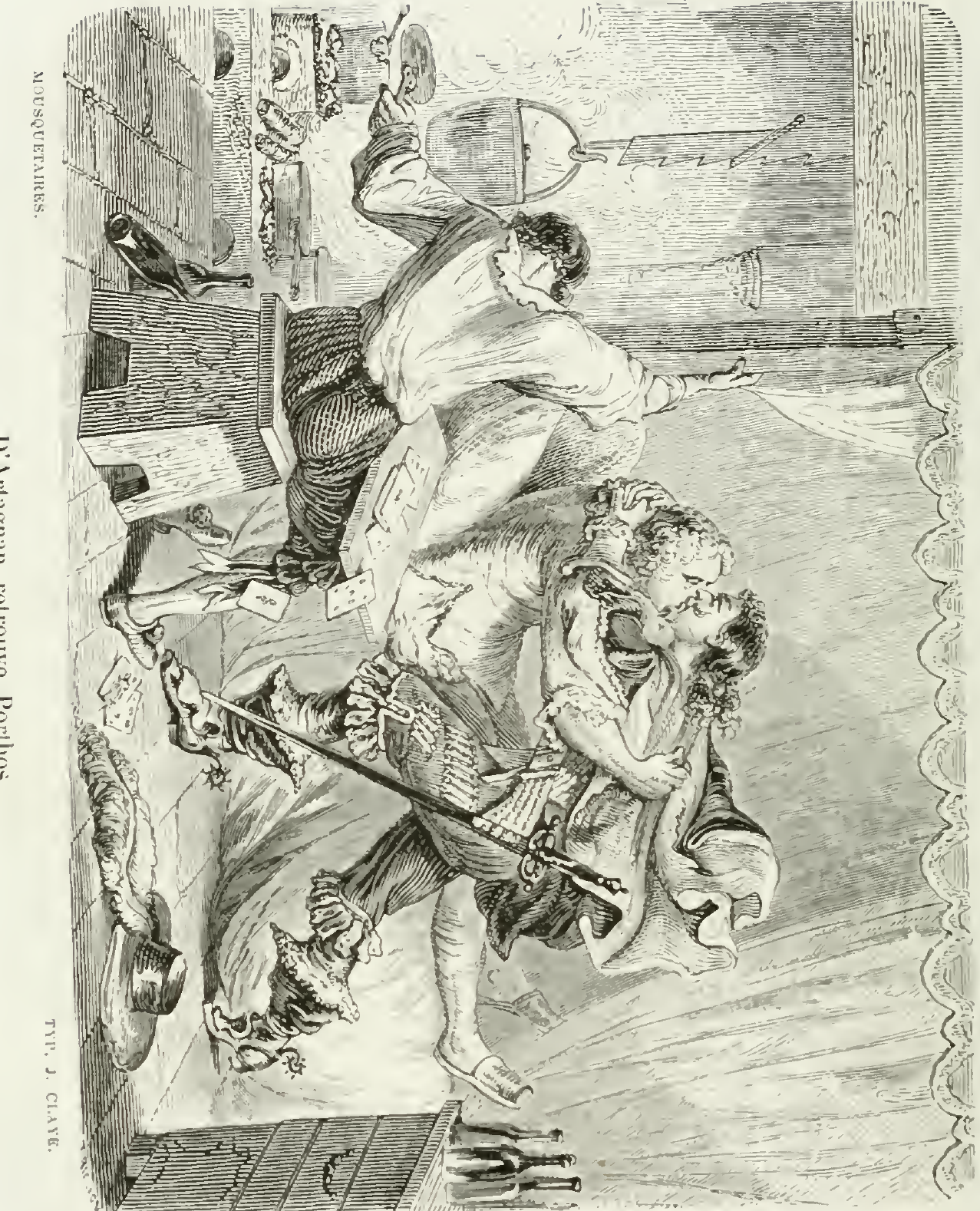
Porthos was in bed and playing a game of backgammon with Mousqueton, to keep his hand in, while a spit loaded with partridges turned before the fire, and at each corner of a great fireplace two saucepans boiled on two stoves, from which rose a double odor of fricassee and of matelote that delighted the sense of smell. Besides, the top of a secretary and the marble of a commode were covered with empty bottles.
At the sight of his friend, Porthos uttered a cry of joy, and Mousqueton, rising respectfully, yielded him his place and went off to cast an eye on the two saucepans, of which he appeared to have the special inspection.
— Ah! by heaven! it is you, said Porthos to d'Artagnan, welcome, and excuse me if I do not come to meet you. But, he added, looking at d'Artagnan with a certain uneasiness, you know what has happened to me?
— No.
— The host told you nothing?
— I asked about you, and knowing that you were here, I came straight up.
Porthos appeared to breathe more freely.
— And what has happened to you, then, my dear Porthos? continued d'Artagnan.
— What has happened is that, in lunging at my adversary, to whom I had already given three sword thrusts and with whom I wanted to finish with a fourth, my foot came down on a stone, and I sprained my knee.
— Really!
— On my honor! Luckily for the rascal, for I would have left him dead on the spot, I assure you.
— And what became of him?
— Oh! I know nothing of it; he had had enough, and he went off without asking for the rest. But you, my dear d'Artagnan, what has happened to you?...
— So that, continued d'Artagnan, this sprain, my dear Porthos, keeps you in bed.
— Ah! mon Dieu, yes, that is all; besides, in a few days I shall be on my feet.
— But why did you not have yourself carried to Paris? You must be cruelly bored here.
— That was my intention; my dear friend, I must confess something to you.
— What?
— It is that, as I was cruelly bored, as you say, and as I had in my pocket the seventy-five pistoles you had distributed to me, I had, to divert myself, a gentleman who was passing through brought up to my room, and I proposed a game of dice to him. He accepted; and, faith, my seventy-five pistoles passed from my pocket into his, without counting my horse, which he carried off into the bargain. But you, my dear d'Artagnan?
— What would you have? my dear Porthos, one cannot be privileged in every way, said d'Artagnan; you know the proverb: "Unlucky at play, lucky in love." You are too lucky in love for play not to take its revenge; but what do the reverses of fortune matter to you? have you not, happy rogue that you are, have you not your duchesse, who cannot fail to come to your aid?
— Well! see, my dear d'Artagnan, how unlucky I am at play, replied Porthos with the most unconcerned air in the world; I wrote to her to send me some fifty louis, of which I had absolute need, given the position in which I found myself.
— Well?
— Well! she must be on her estates, for she has not answered me!
— Really?
— No. So yesterday I sent her a second epistle even more pressing than the first; but here you are, my very dear fellow, let us talk of you. I was beginning, I confess, to be in a certain uneasiness on your account.
Your host treats you well, it seems, my dear Porthos, said d'Artagnan, showing the sick man the full saucepans and the empty bottles."Coussi! cousin!" replied Porthos. "It has already been three or four days since the impertinent fellow reckoned up his account with me, and since I sent them both packing, his account and him; so that I am here like a kind of conqueror, like a manner of conqueror. Also, as you see, always fearing to be forced in my position, I am armed to the teeth."
"However," said d'Artagnan, laughing, "it seems to me that from time to time you make sorties."
And he pointed his finger at the bottles and the saucepans.
"Not I, unfortunately," said Porthos. "This wretched fever keeps me in bed; but Mousqueton scours the countryside and brings back provisions. Mousqueton, my friend," continued Porthos, "you see that reinforcements are arriving; we shall need a supplementary supply of victuals."
"Mousqueton," said d'Artagnan, "you will do me a service, won't you?"
"Which one, sir?"
"It is to give your recipe to Planchet; I might find myself besieged in my turn, and I would not be sorry if he made me enjoy the same advantages you bestow on your master."
"Eh! my God, sir," said Mousqueton with a modest air, "nothing is easier. It is a matter of being skillful, that is all. I was brought up in the country, and my father, in his spare moments, was something of a poacher."
"And the rest of the time, what did he do?"
"Sir, he practiced an industry that I have always found rather fortunate."
"Which one?"
"As it was in the time of the wars between the Catholics and the Huguenots, and as he saw the Catholics exterminating the Huguenots and the Huguenots exterminating the Catholics, all in the name of religion, he had made for himself a mixed belief, which allowed him to be sometimes Catholic, sometimes Huguenot. Now, he usually walked about, his blunderbuss on his shoulder, behind the hedges that border the roads, and when he saw a Catholic coming alone, the Protestant religion immediately prevailed in his mind, he lowered his blunderbuss in the direction of the traveler; then, when he was ten paces from him, he began a dialogue that almost always ended with the traveler's abandoning his purse to save his life. It goes without saying that when he saw a Huguenot coming, he felt seized with such an ardent Catholic zeal that he did not understand how a quarter of an hour earlier he could have had doubts about the superiority of our holy religion. For I, sir, am a Catholic, my father, faithful to his principles, having made my elder brother a Huguenot."
- And how did that worthy man end? asked d'Artagnan.
- Oh! in the most unfortunate way, sir: one day he found himself caught in a sunken road, between a Huguenot and a Catholic with whom he had already had dealings and who both recognized him; so that they joined forces against him and hanged him from a tree, then they came to boast of the fine exploit they had performed, in the tavern of the first village where we were drinking, my brother and I.
- And what did you do? said d'Artagnan.
- We let them talk, replied Mousqueton. Then, as, leaving that tavern, they each took an opposite road, my brother went to lie in ambush on the Catholic's road, and I on the Protestant's. Two hours later, all was over; we had settled each of them, all the while admiring the foresight of our poor father, who had taken the precaution of raising each of us in a different religion.
— Indeed, as you say, Mousqueton, your father seemed to me to be a very intelligent fellow. And you say, then, that in his spare moments the good man was a poacher?
— Yes, sir, and it was he who taught me to tie a snare and to set a ground line. The result is that when I saw that our rascal of a host was feeding us a heap of coarse meats, good for peasants, and which were not suited to two stomachs as weakened as ours, I took up my old trade somewhat again. While walking in the wood, I set snares in the passes; while lying down at the edge of the ponds, I slipped lines into the pools. So that now, thanks to God, we do not lack, as monsieur may assure himself, partridges and rabbits, carp and eels, all light and healthy food, suitable for invalids.
— But the wine, said d'Artagnan, who supplies the wine? Is it your host?
— That is to say, yes and no.
— How, yes and no?
— He supplies it, it is true; but he is unaware that he has that honor.
— Explain yourself, Mousqueton; your conversation is full of instructive things.
— Here it is, sir: chance willed that in my wanderings I met a Spaniard who had seen many countries and among others the New World.
— What connection can the New World have with the bottles that are on this secretary and on this chest of drawers?
— Patience, sir, each thing will come in its turn.
— That is right, Mousqueton; I defer to you and I am listening.
— This Spaniard had in his service a lackey who had accompanied him on his voyage to Mexico. This lackey was my compatriot, so that we became close all the more quickly since there were great similarities of character between us. We both loved hunting above all; he told me, then, how, in the plains of the Pampas, the natives of the country hunt the tiger and the bulls with simple slipknots which they throw around the necks of those terrible animals. At first I did not want to believe that one could reach that degree of skill, of throwing to twenty or thirty paces the end of a rope where one wishes; but faced with the proof I had to acknowledge the truth of the account. My friend placed a bottle at thirty paces, and at each throw he caught its neck in a slipknot. I took up this exercise, and as nature has given me some faculty, today I throw the lasso as well as any man in the world. Well! do you understand? our host has a very well-stocked cellar, but its key never leaves him; only this cellar has a vent. Now, through this vent, I throw the lasso. And as I now know where the good corner is, I draw from it. That, sir, is how the New World comes to be connected with the bottles that are on this chest of drawers and on this secretary. Now, taste our wine, and, without prejudice, you will tell us what you think of it.
— Thank you, my friend, thank you; unfortunately I have just breakfasted.
— Well! said Porthos, set the table, Mousqueton, and while we breakfast, d'Artagnan will tell us what has become of himself, since the ten days he left us.
— Willingly, said d'Artagnan.
While Porthos and Mousqueton were breakfasting with the appetites of convalescents and that cordiality of brothers which brings men together in misfortune, d'Artagnan recounted how Aramis, wounded, had been forced to stop at Crèvecœur, how he had left Athos wasting away at Amiens in the hands of four men who accused him of being a counterfeiter, and how he, d'Artagnan, had been forced to ride roughshod over the Comte de Wardes to reach England.
But there d'Artagnan's confidence stopped; he announced only that on his return from Great Britain he had brought back four magnificent horses, one for himself and another for each of his companions; then he ended by announcing to Porthos that the one intended for him was already installed in the hotel's stable.
At that moment, Planchet entered; he informed his master that the horses were sufficiently rested, and that it would be possible to go and sleep at Clermont.
As d'Artagnan was more or less reassured about Porthos, and as he was impatient to have news of his two other friends, he held out his hand to the invalid and informed him that he was going to set out to continue his search. Besides, as he intended to return by the same road if, in seven or eight days, Porthos was still at the Hôtel du Grand-Saint-Martin, he would pick him up on the way.
Porthos replied that, in all probability, his sprain would not allow him to get up before then. Moreover, he had to stay at Chantilly to await a reply from his duchess.
D'Artagnan wished him that reply prompt and good, and after again commending Porthos to Mousqueton, and paying his expenses to the host, he set out again with Planchet, already relieved of one of his spare horses.