THE OPTICIAN!
One thing, however, preoccupied the cardinal; he was awaiting news from England, but no news arrived, except unfavorable and threatening news.
Although La Rochelle was invested, however certain success might appear, thanks to the precautions taken and especially to the dike that no longer allowed any boat to enter the besieged city, the blockade could still last a long time, and it was a great affront to the king's arms and a great embarrassment to M. the cardinal, who had, it is true, no longer to embroil Louis XIII with Anne of Austria—the thing was done—but to reconcile M. de Bassompierre, who was embroiled with the Duke of Angoulême.
As for Monsieur, who had begun the siege, he left to the cardinal the care of finishing it.
The city, despite the incredible perseverance of its mayor, had attempted a kind of mutiny to surrender. The mayor had had the rioters hanged. This execution calmed the worst heads, who then decided to let themselves die of hunger, this death always appearing to them slower and less certain than death by strangulation.
For their part, from time to time, the besiegers captured messengers whom the Rochelais sent to Buckingham or spies whom Buckingham sent to the Rochelais. In either case the trial was quickly done. M. the cardinal said only this word: Hanged! The king was invited to come see the hanging. The king came languidly, placed himself in a good spot to see the operation in all its details: that always distracted him a little and made him take the siege patiently; but that did not prevent him from being greatly bored, from speaking at every moment of returning to Paris; so that if messengers and spies had failed, His Eminence, despite all his imagination, would have found himself greatly embarrassed.
Nevertheless, time passed, the Rochelais did not surrender. The last spy captured was carrying a letter. This letter indeed told Buckingham that the city was at its last extremity, but instead of adding: "If your help does not arrive within fifteen days, we surrender," it added simply: "If your help does not arrive within fifteen days, we shall all be dead of hunger when it arrives."
The Rochelais therefore had hope only in Buckingham; Buckingham was their messiah. It was evident that if one day they learned in a certain manner that they must no longer count on Buckingham, with hope their courage would fall.
The cardinal therefore awaited with great impatience news from England announcing to him that Buckingham would not come.
The question of taking the city by main force, often debated in the council, [was dismissed] as one awaits a lucky chance. He continued to have the famous dike raised that was to starve La Rochelle, and meanwhile he cast his eyes on that unhappy city which contained so many profound miseries and so many heroic virtues, and recalling the word of Louis XI, his political predecessor, as he himself was the predecessor of Robespierre, he murmured this maxim of the accomplice of Tristan: "Divide and rule."
Henri IV, besieging Paris, had bread and provisions thrown over the walls. The cardinal had little notes thrown over, in which he represented to the Rochelais how unjust, selfish, and barbarous the conduct of their leaders was. These leaders had grain in abundance and did not share it; they adopted as maxims, for they too had maxims, that it mattered little if women, children, and old men died, provided that the men who were to defend the walls remained strong and healthy. Until then, whether from devotion or impotence to react against it, this maxim, without being generally adopted, had nevertheless passed from theory to practice; but the notes came to undermine it. The notes reminded the men that these children, these women, and these old men whom they allowed to die were their sons, their wives, and their fathers; that it would be more just for each to be reduced to the common misery so that one and the same position might lead them to unanimous resolutions.
These notes produced all the effect that he who had written them could expect, in that they determined a great number of inhabitants to open negotiations with the royal army.
But at the moment when the cardinal already saw his means bearing fruit and was congratulating himself on having put it to use, an inhabitant of La Rochelle who had been able to pass through the imperial lines—God knows how, so great was the triple surveillance of Bassompierre, of Schomberg, and of the Duc d'Angoulême, themselves watched over by the cardinal—an inhabitant of La Rochelle, we say, entered the town, coming from Portsmouth and saying that he had seen a magnificent fleet ready to set sail within eight days. Moreover, Buckingham announced to the mayor that at last the great league against France was about to declare itself and that the kingdom was about to be invaded at once by the English, imperial, and Spanish armies. This letter was publicly read in all the squares; copies were posted at the corners of the streets, and even those who had opened negotiations broke them off, resolved to await this succor so promptly announced.
This unforeseen circumstance restored to Richelieu his first anxieties and forced him to turn his eyes once more to the other side of the sea.
Meanwhile, free from the anxieties of its sole and true chief, the royal army led a joyous life, provisions not failing in the camp, nor money either. All the corps vied in boldness and gaiety. To take spies and hang them, to make hazardous expeditions onto the dike or onto the sea, to imagine follies and execute them coldly—such was the pastime that made these days, so long not only for the Rochelais, gnawed by famine and anxiety, but also for the cardinal, who blockaded them so vigorously, seem short to the army.
Sometimes, when the cardinal, always riding like the last gendarme of the army, cast his pensive gaze over those works so slow in the eyes of his desire, which the engineers he summoned from every corner of France were raising under his orders—if he met a musketeer of M. de Tréville's company, he would approach him and look at him in a singular manner, and, not recognizing him as one of our four companions, he would let his deep gaze and his vast thought wander elsewhere.
One day when, devoured by a mortal ennui, without hope in the negotiations with the town, without news from England, the cardinal had gone out with no other goal than to go out, accompanied only by Cahusac and La Houdinière, skirting the sands and mingling the immensity of his dreams with the immensity of the ocean, he came at his horse's slow pace to a hill from the top of which he perceived behind

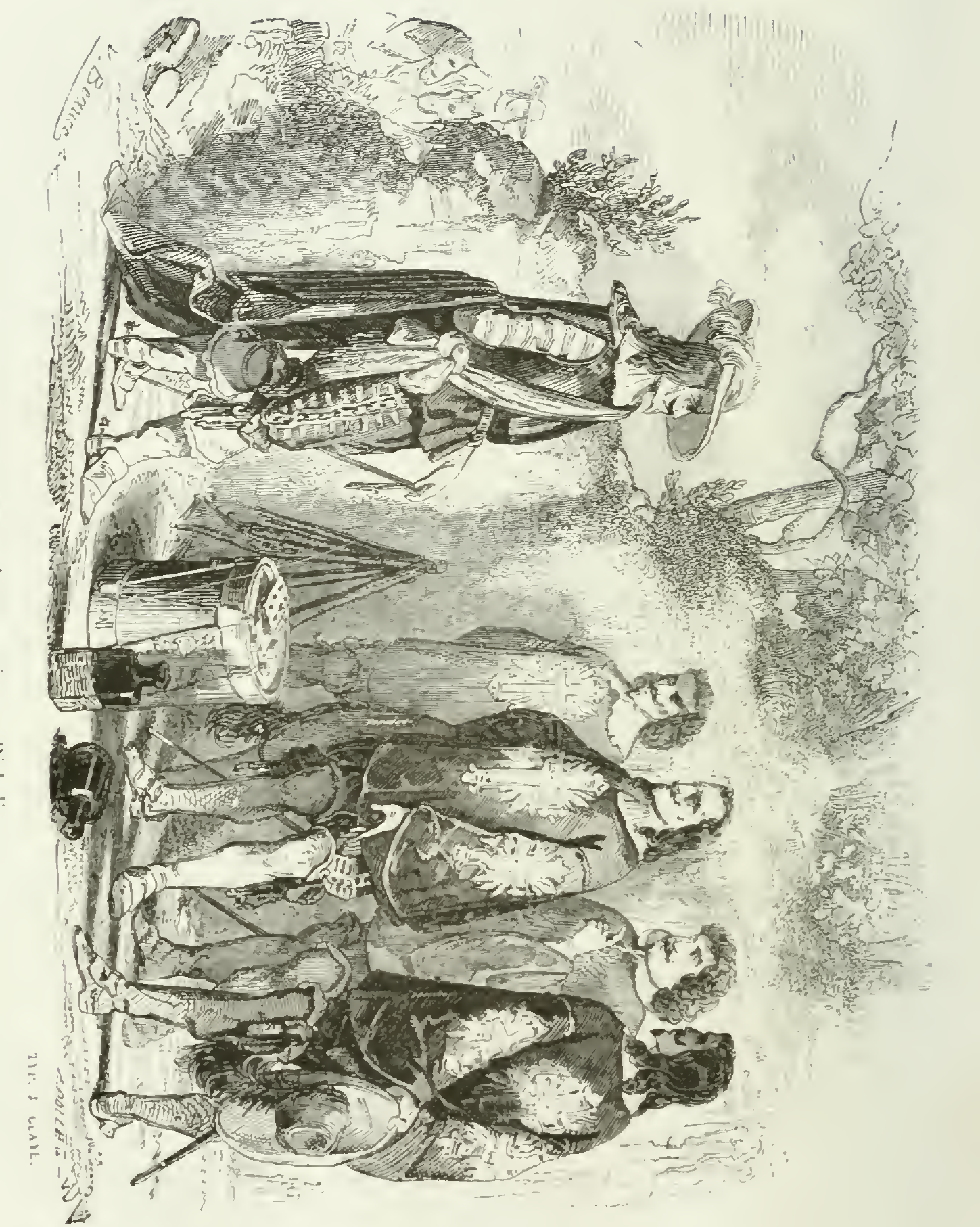
a hedge, lying on the grass and sheltered from the too-great sun beneath a clump of trees, seven men surrounded by empty bottles. Four of these men were our musketeers, preparing to listen to the reading of a letter that one of them had just received. This letter was so important that it had made them abandon on a drum both cards and keys.
The three others were occupied in uncorking an enormous demijohn of Collioure wine; they were the lackeys of these gentlemen.
The cardinal, as we have said, was in a dark humor, and nothing, when he was in that state of mind, redoubled his moroseness so much as the gaiety of others. Besides, he had a singular preoccupation: it was to believe always that the very causes of his sadness excited the gaiety of strangers. Making a sign to La Houdinière and Cahusac to stop, he dismounted and approached these suspicious laughers, hoping that with the help of the sand that deadened his footsteps and the hedge that screened his approach, he might catch a few words of this conversation that seemed to him so interesting. Only ten paces from the hedge, he recognized the Gascon babble of d'Artagnan, and, as he already knew that these men were musketeers, he did not doubt that the other three were those whom people called the inseparables, that is to say Athos, Porthos, and Aramis.
One may judge whether his desire to hear the conversation increased with this discovery; his eyes took on a strange expression, and with a tiger-cat's step he advanced toward the hedge, but he had as yet caught only vague syllables with no positive meaning, when a loud, short cry made him start and drew the attention of the musketeers.
"Officer!" cried Grimaud.
"You are speaking, I believe, you scoundrel," said Athos, raising himself on one elbow and fascinating Grimaud with his flaming gaze.
So Grimaud did not add another word, contenting himself with pointing his index finger in the direction of the hedge, and by this gesture denouncing the cardinal and his escort.
With a single bound the four musketeers were on their feet and saluted respectfully.
The cardinal seemed to be furious.
"It appears that people keep watchmen in the household of the King's musketeers?" said he. "Is the Englishman coming by land, or would it be that the musketeers consider themselves superior officers?"
"Monseigneur," replied Athos, for amid the general fright he alone had preserved that calm and coolness of a great lord which never left him; "monseigneur, the musketeers, when they are not on duty or when their duty is over, drink and play at dice, and they are very superior officers to their lackeys."
"Lackeys," grumbled the cardinal, "lackeys who have orders to warn their masters when anyone passes! They are not lackeys, they are sentinels."
"His Eminence can see very well, however, that if we had not taken this precaution, we would have been exposed to letting him pass without presenting our respects to him and offering him our thanks for the grace he has done us in bringing us together."
"D'Artagnan," continued Athos, "you who a moment ago were asking for this opportunity to express your gratitude to monseigneur, here it is come, make the most of it."
These words were spoken with that imperturbable coolness that distinguished Athos in hours of danger, and that excessive politeness which at certain moments made of him a king more majestic than kings by birth.
D'Artagnan approached and stammered a few words of thanks which soon expired beneath the cardinal's clouded gaze.
"No matter, gentlemen," continued the cardinal, without appearing in the least diverted from his original intention by the incident Athos had raised; "no matter, I do not like mere soldiers, because they have the advantage of serving in a privileged corps, to play the great lords thus, and discipline is the same for them as for everyone else."
Athos let the cardinal finish his sentence perfectly, and bowing in sign of assent, he resumed in his turn:
"Discipline, monseigneur, has in no way, I hope, been forgotten by us. We are not on duty, and we believed that, not being on duty, we could dispose of our time as seemed good to us. If we are fortunate enough that Your Eminence has some particular orders to give us, we are ready to obey him. Monseigneur sees," continued Athos, frowning, for this species of interrogation was beginning to make him impatient, "that in order to be ready for the slightest alarm, we went out with our arms."
And he pointed with his finger to the four muskets stacked near the drum on which were the cards and dice.
"Let Your Eminence be pleased to believe," added d'Artagnan, "that we would have come forward to meet him, if we could have supposed that it was he who was coming toward us in such small company."
The cardinal bit his mustache and a little his lips.
"Do you know what you look like, always together as you are here, armed as you are and guarded by your valets?" said the cardinal. "You look like four conspirators."
"Oh! as to that, monseigneur, it is true," said Athos, "and we are conspiring, as Your Eminence was able to see the other morning; only it is against the Rochelais."
"Ah! gentlemen politicians," resumed the cardinal, frowning in his turn, "perhaps the secret of many things would be found in your brains if one could read there as you were reading in that letter which you hid when you saw me coming."
The color rose to Athos's face; he took a step toward His Eminence.
"One would say that you really suspect us, monseigneur, and that we are undergoing a veritable interrogation. If such is the case, let Your Eminence deign to explain himself, and we will at least know what to think of it."
"And if it were an interrogation!" resumed the cardinal, "others besides you have undergone one, Monsieur Athos, and have answered it."
"That is why, monseigneur, I told Your Eminence that he had only to question, and that we were ready to answer."
"What was that letter you were about to read, Monsieur Aramis, and which you hid?"
"A woman's letter, monsieur."
"Oh! I understand," said the cardinal, "one must be discreet about such letters, but nevertheless one can show them to a confessor, and you know it, I have received the orders."
"Monseigneur," said Athos with a calm all the more terrible because he was risking his head in making this reply, "monseigneur, the letter is from a woman, but it is signed neither Marion de Lorme, nor Mme de Combalet, nor Mme d'Aiguillon."
The cardinal became pale as death. A suave lightning flashed from his eyes. He turned as if to give an order to Cahusac and La Houdinière. Athos saw the movement; he took a step toward the muskets, on which the three friends had their eyes fixed like men ill-disposed to let themselves be arrested. The cardinal was three against them; he judged that the match would be all the less equal since Athos and his companions would really conspire, and by one of those rapid reversals that he always held at his disposal, all his anger melted into a smile.
"Come, come," said he, "you are brave young men, proud in the sunlight, faithful in the darkness, and there is no harm in watching over oneself when one watches so well over others. Gentlemen, I have not forgotten the night when you served me as escort to go to the Colombier-Rouge. If there were any danger to fear on the road I am about to take, I would beg you to accompany me; but, as there is none, remain where you are, finish your bottles, your game, and your letter. Adieu, gentlemen.
And remounting his horse, which Calusac had brought to him, he saluted them with a wave of his hand and rode away.
The four young people, standing motionless, followed him with their eyes without saying a single word until he had disappeared.
Then they looked at each other.
All had consternated faces, for despite His Eminence's friendly farewell, they understood that the cardinal was departing with rage in his heart. Only Athos smiled a powerful and disdainful smile.
When the cardinal was out of earshot and sight:
"That Grimaud shouted very late," cried Porthos, who had a great desire to vent his bad mood on someone.
Grimaud was about to answer to excuse himself; Athos raised his finger, and Grimaud fell silent.
"Would you have returned the letter, Aramis?" asked d'Artagnan.
"I," replied Aramis in his most fluted voice, "I had decided: if he had demanded that the letter be handed over to him, I would have presented the letter with one hand, and with the other I would have run my sword through his body."
"I expected as much," observed Athos; "that is why I threw myself between you and him. In truth, this man is very imprudent to speak thus to other men. One would think he has only ever dealt with women and children."
"My dear Athos," said d'Artagnan, "I admire you; but nevertheless we were in the wrong, after all."
"How, in the wrong?" replied Athos. "To whom does this air we breathe belong? To whom this ocean over which our eyes extend? To whom this sand on which we were lying? To whom this letter from your mistress? Is it the cardinal's? On my honor, this man imagines that the world belongs to him. You were there, bewildered, stupefied, annihilated; one would have said that the Bastille was rising up before you and that the gigantic Medusa was turning you to stone. Is it conspiring, come now, to be in love! You are in love with a woman whom the cardinal has had imprisoned; you want to tear her from the cardinal's hands; it is a game you are playing with His Eminence. This letter is your hand. Why would you show your hand to your opponent? Let him guess it, by all means! We were certainly entitled to know his.
"In fact," said d'Artagnan, "what you say there, Athos, is full of sense." "In that case, let there be no more question of what has just happened, and let Aramis resume the letter from his cousin where M. the cardinal interrupted him.
Aramis drew the letter from his pocket; the three friends drew near him, and the three lackeys again grouped themselves near the jug.
"You had read only a line or two," continued d'Artagnan; "so begin the letter again from the beginning."
"Willingly," said Aramis:
"My dear cousin, I believe I shall decide to leave for Béthune, where my sister has placed our little servant in the convent of the Carmelites. The poor child has resigned herself; she knows she cannot live anywhere else without the salvation of her soul being in danger. However, if our family affairs settle as we wish, I believe she will run the risk of damning herself, and will return near those she regrets, all the more since she knows that she is always thought of. In the meantime, she is not too unhappy; all she desires is a letter from her intended. I know well that such things pass with difficulty through the grilles; but, after all, as I have given you proofs of it, my dear cousin, I am not too clumsy, and I will undertake your commission. My sister thanks you for your kind and astonished remembrance; she has had a time of great worries; but at last she is somewhat reassured now, having sent her agent down there, so that nothing unexpected happens.
"Farewell, my dear cousin, give us news of yourself as often as you can, that is to say, every time you believe you can do so safely. I kiss you. Marie Michoux."
"Oh! what do I not owe you, Aramis!" cried d'Artagnan. "Dear Constance! I have news of her at last! She lives, she is safe in a convent; she is at Béthune! Where do you get Béthune, Athos?"
"Why, on the borders of Artois and Flanders; once the siege is raised, we can go and take a turn in that direction."
"And it will not be long, we must hope," said Porthos; "for this morning they lost another spy, who declared that the Rochelois were reduced to the leather of their shoes. Supposing that after eating the leather they eat the soles, I no longer quite see what will be left to them, unless they eat each other."
"Poor fools!" said Athos, emptying a glass of excellent Bordeaux wine which, without having at that time the reputation it has today, deserved it no less, "poor fools! as if the Catholic religion were not the most advantageous and agreeable of religions! All the same," he resumed, after clacking his tongue against his palate, "they are brave people. But what the devil are you doing, Aramis?" continued Athos, "you are putting that letter back in your pocket."
"Yes," said d'Artagnan, "Athos is right, it must be burned. Still, who knows if M. the cardinal does not have a secret for interrogating ashes."
"He must have one," said Athos.
"But what do you want to do with this letter?" asked Porthos.
"Come here, Grimaud," said Athos.
Grimaud rose and obeyed.
"To punish you for having spoken without permission, my friend, you are going to eat this piece of paper; then, to reward you for the service you have rendered us, you will then drink this glass of wine. Here is the letter first. Chew with energy."
Grimaud smiled, and with his eyes fixed on the glass that Athos had just filled to the brim, he crushed the paper and swallowed it.
"Bravo! Master Grimaud," said Athos, "and now take this. Good. I dispense you from saying thank you."
Grimaud silently swallowed the glass of Bordeaux wine; but his eyes raised to heaven spoke, during all the time that this sweet occupation lasted, a language which, though mute, was no less expressive.
"And now," said Athos, "unless M. the cardinal has the ingenious idea of having Grimaud's belly opened, I believe we can be more or less at ease."
Meanwhile, His Eminence continued his melancholy walk, murmuring between his mustaches: "Decidedly, these four men must be mine!"