
IN WHICH THE EQUIPMENT OF ARAMIS AND PORTHOS IS TREATED.
SINCE the four friends were each hunting for his equipment, there was no longer any fixed meeting among them. They dined one without the other wherever they happened to be, or rather they met wherever they could. The service, on its side, also took its share of that precious time which flowed away so quickly. Only it had been agreed that they would meet once a week, about one o'clock, at Athos's lodgings, since the latter, according to the oath he had made, no longer passed the threshold of his door.It was on the very day when Kitty had come to find d'Artagnan at home, a meeting day.
Scarcely had Kitty gone out when d'Artagnan made his way to the rue Férou. He found Athos and Aramis philosophizing: Aramis had some vague inclination to return to the cassock; Athos, according to his habits, neither dissuaded nor encouraged him. Athos was for leaving each man his free will. He never gave advice unless it was asked of him; and even then it had to be asked twice.
— In general, he said, advice is asked only in order not to follow it, or, if it has been followed, only in order to have someone to whom one can reproach having given it.
Porthos arrived a moment after d'Artagnan. The four friends were therefore complete.
The four faces expressed four different feelings: Porthos's tranquillity, d'Artagnan's hope, Aramis's uneasiness, Athos's indifference.
After a moment of conversation in which Porthos let it be understood that a very highly placed person had been kind enough to undertake to extricate him from his difficulties, Mousqueton entered.
He had come to beg Porthos to go to his lodgings, where, he said with a very pitiful air, his presence was urgent.
— Are these my equipages? asked Porthos.
— Yes and no, answered Mousqueton.
— But what do you mean?…
— Come, monsieur.
Porthos rose, saluted his friends, and followed Mousqueton.
A moment later, Bazin appeared at the threshold of the door.
— What do you want with me, my friend? said Aramis with that gentleness of language that was noticeable in him each time his ideas led him back toward the Church.
— A man is waiting for monsieur at home.
— A man! what man?
— A beggar.
— Give him alms, Bazin, and tell him to pray for a poor sinner.
— This beggar absolutely insists on speaking to you, and claims that you will be well pleased to see him.
— Has he nothing particular for me?
— Yes, indeed. If M. Aramis, he said, hesitates to come find me, you will announce to him that I have just come from Tours.
—From Tours? I'm going! cried Aramis. Gentlemen, a thousand pardons, but doubtless this man brings me the news I was expecting.
And rising at once, he hurried away.
Athos and d'Artagnan remained.
—I believe those fellows have found what they were looking for. What do you think, d'Artagnan? said Athos.
—I know that Porthos was well on his way, said d'Artagnan, and as for Aramis, to tell the truth, I was never seriously worried about him. But you, my dear Athos, you who so generously distributed the Englishman's pistoles, which were your rightful property, what are you going to do?
—I am very glad to have killed that rascal, seeing that he had the foolish curiosity to want to know my real name; but if I had pocketed his pistoles, they would have weighed on me like a remorse.
—Come now, my dear Athos, you truly have inconceivable scruples.
—Enough, enough! What was M. de Tréville telling me, then, when he did me the honor of coming to see me yesterday? That you frequent those suspect English people whom the cardinal protects?
—That is to say, I pay visits to an Englishwoman, the one I told you about.
—Ah! yes, the blonde woman, about whom I gave you advice, which naturally you were very careful not to follow.
—I gave you my reasons. I have acquired the certainty that this woman had something to do with the abduction of Mme Bonacieux.
—Yes, and I understand, to find one woman you court another. That is the longest way, but the most amusing.
D'Artagnan was on the point of telling Athos everything, but a reflection stopped him: Athos was a gentleman severe on the article of honor, and there was in all this little plan that our lover had settled upon with regard to milady certain things which, he was sure in advance, would not obtain the puritan's assent; he therefore preferred to keep silent, and as Athos was the least curious man on earth, d'Artagnan's confidences had remained there.
We shall therefore leave the two friends, who had nothing very important to say to each other, in order to follow Aramis.
At this news that the man who wished to speak to him had just come from Tours, we have seen with what rapidity the young man had followed or rather outstripped Bazin: he therefore made but a single leap from the rue Férou to the rue de Vaugirard.
Entering his home, he indeed found a small man with intelligent eyes, but covered in rags.
"It is you who are asking for me?" said the musketeer.
"That is to say, I am asking for Monsieur Aramis; is it you who are called by that name?"
"Myself. Do you have something to hand over to me?"
"Yes, if you show me a certain embroidered handkerchief."
"Here it is," said Aramis, drawing a key from his breast and opening a small ebony-wood casket inlaid with mother-of-pearl. "Here it is, look."
"That is well," said the beggar. "Send your lackey away."
Indeed, Bazin, curious to know what the beggar wanted with his master, had matched his pace to the man's and had arrived almost at the same time as he. But this haste served him little. At the beggar's request, his master motioned him to withdraw, and he was forced to obey.
Bazin gone, the beggar cast a rapid glance around to be sure that no one could see or hear him, and opening his ragged jacket, poorly cinched by a leather belt, he began to unpick the top of his doublet, from which he drew a letter.
Aramis uttered a cry of joy at the sight of the seal, kissed the handwriting, and with almost religious respect opened the epistle, which contained the following:
"Friend, fate wills that we be separated for some time yet; but the fair days of youth are not lost beyond recall. Do your duty at the camp, I do mine elsewhere. Take what the bearer will hand you; make the campaign as a fine and good gentleman, and think of me. Adieu, or rather, au revoir."
The beggar was still unpicking; he drew one by one from his filthy clothes a hundred and fifty Spanish double pistoles, which he arranged on the table; then he opened the door, bowed, and departed before the young man, stupefied, had dared to address a word to him.
Aramis then reread the letter and noticed that it had a postscript. "P.S. You may welcome the bearer, who is a count and grandee of Spain."
"Golden dreams!" cried Aramis. "O the beautiful life! Yes, we are young! Yes, we shall still have happy days! Oh! to you! to you, my love, my blood, my existence! Everything, everything, everything, my beautiful mistress!"
And he kissed the letter passionately without even looking at the gold glittering on the table.
Bazin was scratching at the door; Aramis no longer had any reason to keep him at a distance, and he allowed him to enter.
Bazin stood stupefied at the sight of this gold and forgot that he was supposed to announce d'Artagnan, who, curious to know what the beggar was, had come to Aramis's lodgings upon leaving Athos's.
Now, as d'Artagnan stood on no ceremony with Aramis, seeing that Bazin forgot to announce him, he announced himself.
"Ah, devil take it! my dear Aramis," said d'Artagnan, "if those are the plums that are sent to you from Tours, you will convey my compliments to the gardener who harvests them."
"You are mistaken, my dear," said Aramis, quite distracted; "it is my bookseller who has just sent me the price of that poem in one-syllable verse that I had begun over there."
"Ah! really?" said d'Artagnan. "Well! your bookseller is generous, my dear Aramis, that is all I can say."
"How, monsieur?" cried Bazin. "A poem sells so dearly? It is incredible! Oh! monsieur, you do whatever you wish; you could become the equal of Monsieur de Voiture and Monsieur de Benserade. I like that, I do. A poet is almost an abbé... Ah! Monsieur Aramis, do make yourself a poet, I beg you."
"Bazin, my friend," said Aramis, "I believe you are meddling in the conversation."
Bazin understood that he was in the wrong; he lowered his head and went out.
"Ah!" said d'Artagnan with a smile, "you sell your productions by weight of gold. You are very happy, my friend! But take care, you are going to lose that letter coming out of your doublet, and which is doubtless also from your bookseller."
Aramis blushed to the whites of his eyes, thrust his letter back, and rebuttoned his doublet.
"My dear d'Artagnan," he said, "we shall, if you will, go find our friends, and since I am rich, we shall begin again today to dine together while waiting for you to be rich in your turn."
"Faith!" said d'Artagnan, "with great pleasure. It has been a long time since we have had a proper dinner, and as I have, for my part, a somewhat hazardous expedition to make this evening, I would not be sorry, I confess, to fortify myself a little with a few bottles of old Burgundy."
"Done for the old Burgundy, I do not dislike it either," said Aramis, from whom the sight of the gold had wiped away, as if with a hand, his ideas of retreat.
And having put three or four double pistoles in his pocket to meet the needs of the moment, he locked the others in the ebony casket inlaid with mother-of-pearl, where already lay the famous handkerchief that had served him as a talisman.
The two friends first went to Athos, who, faithful to the oath he had made not to go out, took it upon himself to have dinner brought to his lodgings. As he understood gastronomic details marvelously well, d'Artagnan and Aramis made no difficulty about leaving this important care to him.
They were on their way to Porthos's when, at the corner of the Rue du Bac, they met Mousqueton, who, with a pitiful air, was driving before him a mule and a horse. D'Artagnan uttered a cry of surprise, which was not exempt from a mingling of joy.
"Ah! my yellow horse!" cried d'Artagnan. "Aramis, look at that horse."
"Oh! the dreadful nag!" said Aramis.
"Well! my dear," resumed d'Artagnan, "it is the horse on which I came to Paris."
"How, monsieur knows this horse?" said Mousqueton.
"It is of an original color," said Aramis; "it is the only one I have seen of that kind."
"I should think so!" resumed d'Artagnan; "and so I sold it for three crowns, and it must indeed be for the coat, for the carcass is certainly not worth eighteen livres. But how does this horse find itself in your hands, Mousqueton?"
"Ah!" said the valet, "do not speak to me of it, monsieur. It is a dreadful trick of our duchess's husband."
"How so, Mousqueton?"
"Yes; we are looked upon very favorably by a woman of quality, the duchess of... But, pardon! my master has recommended discretion to me. She had forced us to accept a little keepsake, a magnificent Spanish genet and an Andalusian mule, which were marvelous to behold. The husband learned of the matter; he confiscated in passing the two magnificent beasts that were being sent to us, and substituted these two horrible animals."
"Which you are bringing back to him?" said d'Artagnan.
"Precisely," resumed Mousqueton. "You understand that we cannot accept such mounts in exchange for those that had been promised to us."
— No, by Heaven! although I should have liked to see Porthos on my Bouton d'or. That would have given me an idea of what I was myself when I came to Paris. But do not let us detain you, Mousqueton; go and do your master's errand, go. Is he at home?
— Yes, sir, said Mousqueton, but in a very bad humor, all-z.
And he continued on his way toward the Quai des Grands-Augustins, while the two friends went to ring at the door of the unfortunate Porthos. The latter had seen them crossing the courtyard and had taken care not to open. They knocked therefore in vain.
Meanwhile Mousqueton continued his route, and crossing the Pont-Neuf, still driving before him his two jades, he reached the Rue aux Ours. Arrived there, he tied, according to his master's orders, horse and mule to the knocker of the procureur's door; then, without troubling himself about their future fate, he returned to Porthos and announced that his commission was done.
After a certain time, the two unhappy beasts, which had not eaten since morning, made such a noise, by lifting up and letting fall the knocker, that the procureur ordered his skipjack to go and inquire in the neighborhood to whom belonged that horse and that mule.
Mme Coquenard recognized her present and did not at first understand this restitution; but soon Porthos's visit enlightened her. The wrath that shone in the musketeer's eyes, despite the constraint he imposed upon himself, terrified the sensitive lover. In fact, Mousqueton had not concealed from his master that he had met d'Artagnan and Aramis, and that d'Artagnan, in the yellow horse, had recognized the Béarnese nag on which he had come to Paris and which he had sold for three écus.
Porthos went out after having made an appointment with the procureuse in the Cloître Saint-Magloire. The procureur, seeing that Porthos was leaving, invited him to dinner, an invitation which the musketeer refused with an air full of majesty.
Mme Coquenard went to the cloister of Saint-Magloire trembling all over, for she guessed the reproaches that awaited her there;
but she was fascinated by Porthos's grand manners. All that a man wounded in his self-esteem can let fall in the way of imprecations and reproaches upon a woman's head, Porthos let fall upon the bowed head of the attorney's wife.
"Alas!" she said, "I did for the best. One of our clients is a horse dealer; he owed money to the office and showed himself recalcitrant; I took this mule and this horse for what he owed us. He had promised me two royal mounts."
"Well, madame," said Porthos, "if he owed you more than five crowns, your horse dealer is a thief."
"It is not forbidden to look for a bargain, Monsieur Porthos," said the attorney's wife, trying to excuse herself.
"No, madame, but those who look for a bargain must allow others to look for more generous friends."
And Porthos, turning on his heels, took a step to withdraw.
"Monsieur Porthos! Monsieur Porthos!" cried the attorney's wife, "I am wrong, I admit it: I should not have haggled when it was a question of equipping a cavalier like you."
Porthos, without replying, took a second step in retreat.
The attorney's wife thought she saw him in a sparkling cloud, surrounded entirely by duchesses and marchionesses, who threw bags of gold at his feet.
"Stop, in heaven's name, Monsieur Porthos!" she cried; "stop and let us talk."
"Talking with you brings me misfortune," said Porthos.
"But tell me, what do you ask?"
"Nothing, for that comes to the same as if I asked you for something."
The attorney's wife hung on Porthos's arm, and in the impulse of her grief she cried out:
"Monsieur Porthos, I am ignorant of all that, myself. Do I know what a horse is! Do I know what harness is!"
"You should have referred to me, who knows about such things, madame; but you wanted to economize, and consequently to lend at usury."
"That is a mistake, Monsieur Porthos, and I will make it good upon my word of honor."
"And how will you do that?" asked the musketeer.
"Listen. This evening, M. Coquenard is going to M. the Duc de Chaulnes, who has sent for him. It is a consultation that will last two hours at least. Come, we shall be alone and we will settle our accounts."
"That's better. That is speaking, my dear."
"You will forgive me?"
"We shall see," said Porthos majestically.
And the two separated, repeating: "This evening!"
"The devil!" thought Porthos as he went away, "it seems to me that I am at last getting near Master Coquenard's strongbox."

Mickl.
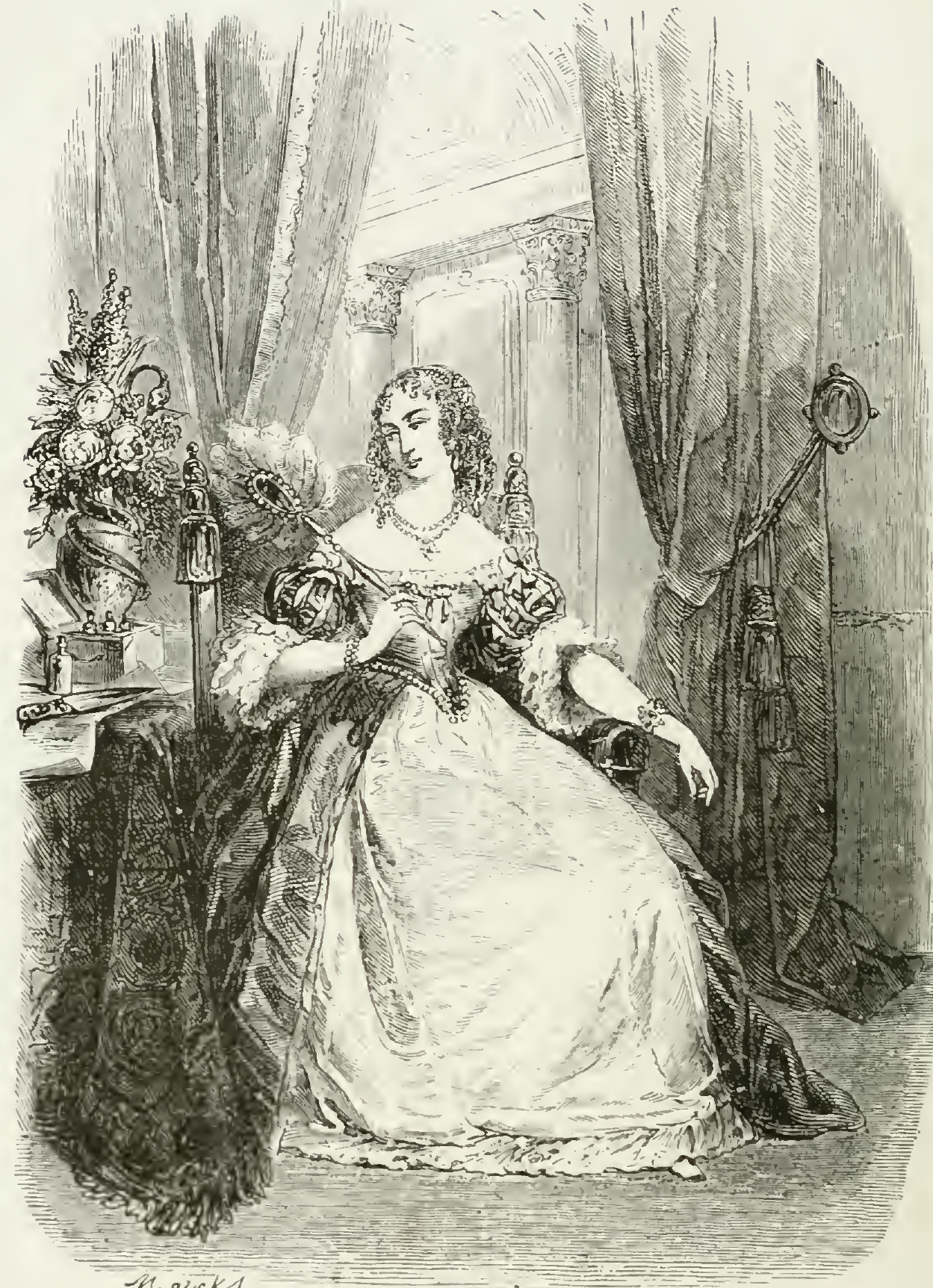
Milady.
....