ESCAPE.
AS Lord de Winter had thought, Milady's wound was not dangerous; so as soon as she found herself alone with the woman whom the baron had called and who hastened to undress her, she opened her eyes again.However, she had to play the part of weakness and pain. These were not difficult things for an actress like Milady. So the poor woman was so completely duped by her prisoner that, in spite of her entreaties, she insisted on watching over her all night.
But the presence of this woman did not prevent Milady from thinking. There was no longer any doubt, Felton was convinced, Felton was hers. Should an angel appear to the young man to accuse Milady, he would certainly take him, in the state of mind in which he was, for a messenger of the devil. Milady smiled at this thought, for Felton was henceforth her only hope, her only means of salvation... But Lord de Winter might have suspected her; and Felton might now be watched himself.
Toward four o'clock in the morning the doctor arrived; but since the time when Milady had struck herself, the wound had already closed. The doctor could therefore measure neither its direction nor its depth; he recognized only from the patient's pulse that the case was not serious.
In the morning, Milady, on the pretext that she had not slept all night and needed rest, sent away the woman who was watching beside her.
Milady had one hope, that Felton would come at the breakfast hour, but Felton did not come.
Had her fears been realized? Was Felton, suspected by the baron, going to fail her at the decisive moment? She had only one day left. Lord de Winter had announced her embarkation for the 23rd, and it was now the morning of the 22nd. Nevertheless she waited still rather patiently until the dinner hour.
Although she had not eaten that morning, dinner was brought at the usual hour; milady then perceived with fright that the uniform of the soldiers guarding her had changed.
Then she ventured to ask what had become of Felton.
She was told that Felton had mounted his horse an hour ago and had left.
She inquired whether the baron was still at the castle; the soldier replied that he was, and that he had orders to notify him if the prisoner wished to speak to him.
Milady claimed that she was too weak at the moment and that her only desire was to remain alone.
The soldier went out, leaving dinner served.
Felton had been removed; the marine soldiers had been changed, so Felton was distrusted.
It was the last blow dealt to the prisoner.
Left alone, she rose. That bed on which she had kept herself out of prudence and so that she might be believed gravely wounded burned her like a blazing furnace. She cast a glance at the door; the baron had had a plank nailed over the wicket, doubtless fearing that through this opening she might still, by some diabolical means, succeed in seducing the guards.
Milady smiled with joy; she could therefore give vent to her transports without being observed. She paced the room with the exaltation of a furious madwoman or of a tigress confined in an iron cage. Certainly, if the knife had remained with her, she would have thought no longer of killing herself, but this time of killing the baron.
At six o'clock Lord de Winter entered; he was armed to the teeth. This man, in whom until then milady had seen only an elegant and polished gentleman, had become an admirable jailer. He seemed to foresee everything, to guess everything, to forestall everything.
A single glance cast at milady told him what was passing in her soul.
"So be it," said he, "but you shall not kill me yet today; you have no more weapons, and besides, I am on my guard. You had begun to pervert my poor Felton; he was already submitting to your baneful influence, but I mean to save him; he shall see you no more. It is all over; gather up your belongings, tomorrow you will depart. I had fixed the embarkation for the 24th, but I thought that the sooner the thing were done, the safer it would be. Tomorrow at noon I shall have the order for your exile, signed by Buckingham. If you say a single word to anyone before you are on the ship, my sergeant will blow your brains out, he has the order. If on the ship you say a word to anyone before the captain permits you, the captain has you thrown into the sea, that is agreed. Farewell; that is what I had to say to you for today. Tomorrow I shall see you again to bid you adieu!"
And with these words the baron went out.
Milady had listened to this whole threatening tirade with the smile of disdain on her lips, but rage in her heart.
Supper was served; milady felt that she needed strength; she did not know what might happen during that night which was approaching threateningly, for heavy clouds were rolling across the sky, and distant lightning announced a storm.
The storm burst forth around ten o'clock in the evening; milady felt a consolation in seeing nature share the disorder of her heart. Thunder rumbled in the air like anger in her thoughts; it seemed to her that the squall, as it passed, was disheveling her brow, like the trees whose branches it bent and whose leaves it tore away; she howled like the hurricane, and her voice was lost in the great voice of nature, which, too, seemed to moan and despair.
From time to time she looked at a ring she wore on her finger. The bezel of this ring contained a subtle and violent poison; it was her last resource.
Suddenly she heard a knock at a pane, and by the light of a flash she saw a man's face appear behind the bars.
She ran to the window and opened it.
"Felton!" she cried, "I am saved!"
"Yes," said Felton, "but silence! silence! I need time to saw through your bars; only take care that they do not see you through the wicket."
"Oh! that is a proof that the Lord is on our side, Felton," replied milady, "they have closed the wicket with a plank."
"So much the better! God has made them senseless," said Felton.
"But what must I do?" asked milady.
"Nothing, nothing, only close the window. Lie down, or at least get into your bed fully dressed; when I have finished, I will knock on the panes. But will you be able to follow me?"
"Oh! yes."
"Your wound?"
"It hurts me, but does not prevent me from walking."
"Then hold yourself ready at the first signal."
Milady closed the window again, extinguished her lamp, and went, as Felton had told her, to huddle in her bed. Amid the moans of the storm, she heard the grating of the file against the bars, and by the light of each flash she saw Felton's shadow behind the panes.
She spent an hour without breathing, panting, sweat on her brow and her heart wrung by a frightful anguish at every movement she heard in the corridor.
There are hours that last a year.
At the end of an hour Felton knocked again.
Milady sprang out of her bed and went to open; two bars removed formed an opening through which a man could pass.
"Are you ready?" asked Felton.
— Yes; do I need to bring anything?
— Gold, if you have any.
— Fortunately, I was left what I had.
— All the better, for I have used all of mine to hire a boat.
— Take it, said Milady, placing a bag full of gold in Felton's hands.
Felton took the bag and threw it at the foot of the wall.
— Now, he said, do you want to come?
— Here I am.
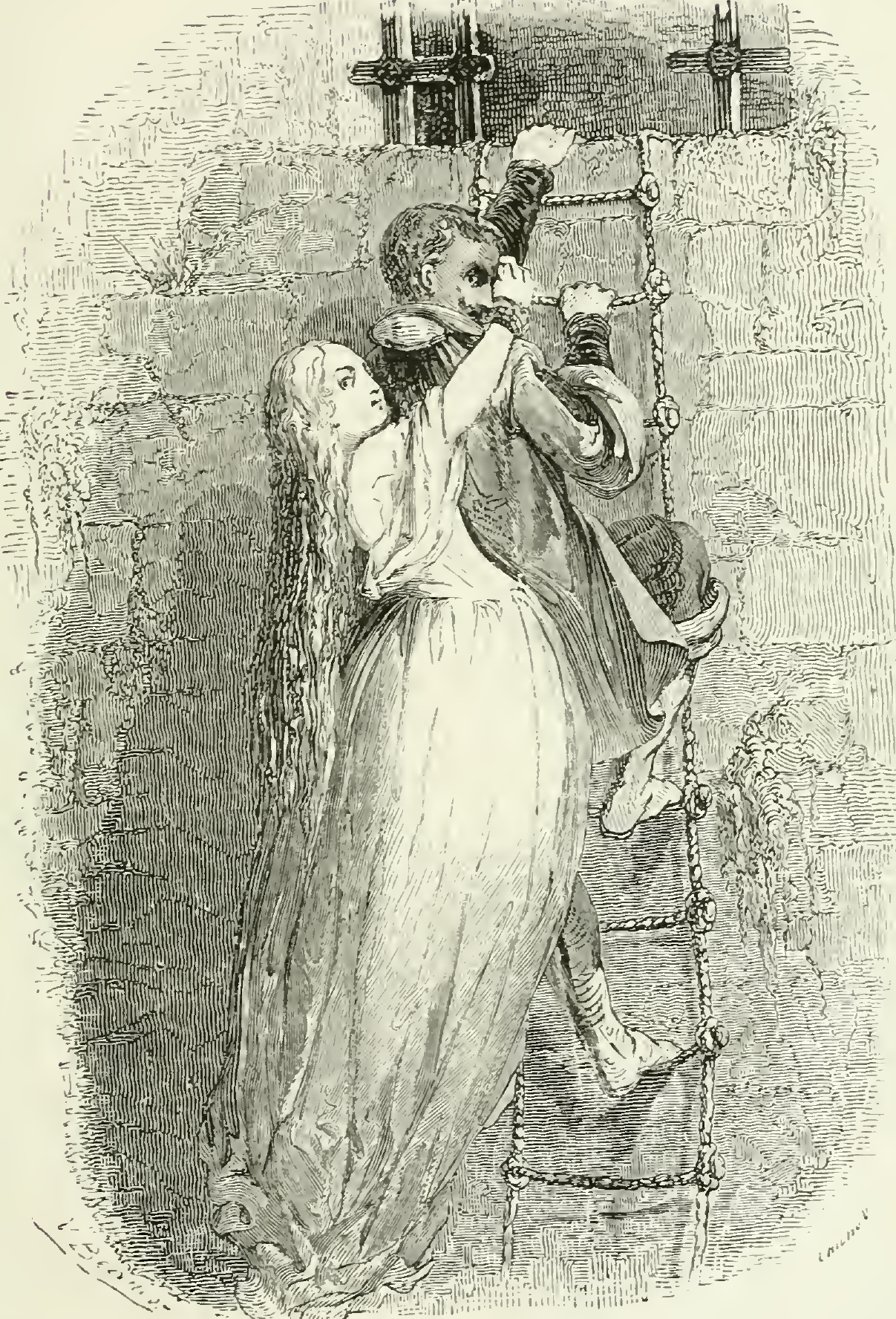
Milady climbed onto a chair and passed the upper part of her body through the window; she saw the young officer suspended above the abyss by a rope ladder.
For the first time, a feeling of terror reminded her that she was a woman.
The void terrified her.
— I suspected as much, said Felton.
— It is nothing, it is nothing, said Milady; I will go down with my eyes closed.
— Do you have confidence in me? said Felton.
— You ask that!
— Bring your hands together; cross them. Good.
Felton bound her two wrists with his handkerchief, then over the handkerchief with a rope.
— What are you doing? asked Milady in surprise.
— Put your arms around my neck, and fear nothing.
— But I will make you lose your balance, and we will both be dashed to pieces.
— Be at ease, I am a sailor.
There was not a second to lose. Milady put both her arms around Felton's neck and let herself slide out of the window.
Felton began to descend the rungs slowly and one by one. Despite the weight of the two bodies, the breath of the hurricane swung them in the air.
Suddenly Felton stopped.
— What is it? asked Milady.
— Silence! said Felton, I hear footsteps.
— Are we discovered?
There was a silence of a few moments.
— No, said Felton, it is nothing.
— But what is that noise?
— That of the patrol, which is going to pass on the rounds.
— Where is the rounds path?
— Just below us.
— It will discover us.
— No, if there is no lightning.
— It will strike the bottom of the ladder.
— Fortunately it is six feet too short.
— Here they are, my God!
— Silence!
Both remained suspended, motionless and breathless, twenty feet from the ground; meanwhile the soldiers passed beneath them, laughing and talking.
There was a terrible moment for the fugitives.
The patrol passed; the sound of footsteps was heard moving away, and the murmur of voices growing fainter.

— Now, said Felton, we are saved!
Milady gave a sigh and fainted.
Felton continued to descend. Having reached the bottom of the ladder, and when he no longer felt any support for his feet, he clung with his hands; finally, arrived at the last rung, he let himself hang by the strength of his wrists, and touched the earth; he bent down, picked up the bag of gold and took it between his teeth.
Then he lifted Milady in his arms and moved swiftly away in the direction opposite to the one the patrol had taken. Soon he left the rounds path, descended through the rocks, and, having reached the edge of the sea, gave a whistle.
A similar signal answered him, and five minutes later he saw a boat appear manned by four men.
The boat approached as near as it could to the shore; but there was not enough depth for it to touch the edge. Felton went into the water up to his waist, not wishing to entrust his precious burden to anyone.
Fortunately, the storm was beginning to calm, and yet the sea was still violent; the little boat bounded on the waves like a walnut shell.
— To the sloop! said Felton, and row briskly.
The four men set to the oars; but the sea was too rough for the oars to have much grip on it.
However, they were moving away from the castle; that was the main thing. The night was profoundly dark, and it was already almost impossible to distinguish the shore from the boat, much less the boat from the shore.
A black dot was swaying on the sea... It was the sloop.
While the boat advanced on its side with all the strength of its four rowers, Felton untied the rope and the handkerchief that bound Milady's hands. Then, when her hands were untied, he took some seawater and threw it in her face. Milady gave a sigh and opened her eyes.
— Where am I? she said.
— Saved! answered the young officer.
— Oh! saved! saved! she cried. Yes, here is the sky, here is the sea! This air that I breathe is that of liberty! Ah!... thank you, Felton, thank you!
The young man pressed her to his heart.
— But what is wrong with my hands? asked Milady; it seems to me that someone has broken my wrists in a vise.
Indeed, Milady raised her arms: her wrists were bruised.
— Alas! said Felton, looking at those beautiful hands and shaking his head sorrowfully.
— Oh! it is nothing, it is nothing! cried Milady; now I remember.
Milady looked around her.
— It is there, said Felton, pushing the bag of gold with his foot.
They were approaching the sloop. The sailor on watch hailed the boat; the boat replied.
“What is that vessel?” asked milady.—“The one I chartered for you.”
“And where is it going to take me?”
“Wherever you wish, provided that you set me down at Portsmouth.”
“What are you going to do at Portsmouth?” asked milady.
“To carry out Lord de Winter’s orders,” said Felton with a dark smile.
“What orders?” asked milady.
“So you do not understand?” said Felton.
“No; explain yourself, I beg you.”
“As he distrusted me, he wished to guard you himself and sent me in his place to have Buckingham sign the order for your deportation.”
“But, if he distrusted you, how did he entrust this order to you?”
“Was I supposed to know what I was carrying, since he had told me nothing and I have the secret from you?”
“That is true. And you are going to Portsmouth?”
“I have no time to lose: tomorrow is the 23rd, and Buckingham leaves tomorrow with the fleet.”
“He leaves tomorrow! Where is he leaving for?”
“For La Rochelle.”
“He must not leave!” cried milady, forgetting her usual presence of mind.
“Be at ease,” replied Felton, “he will not leave.”
Milady trembled with joy: she had just read to the depths of the young man’s heart: Buckingham’s death was written there in plain letters.
“Felton,” she said, “you are as great as Judas Maccabeus! If you die, I die with you; that is all I can say to you.”
“Silence,” said Felton, “we have arrived.”
In fact, they were alongside the sloop.
Felton went up the ladder first and gave his hand to milady, while the sailors supported her, for the sea was still very rough.
A moment later, they were on deck.
“Captain,” said Felton, “this is the person of whom I spoke to you and whom you must convey safe and sound to France.”
“For a thousand pistoles,” said the captain.
“I have given you five hundred.”
“That is right,” said the captain.
“And here are the other five hundred,” replied milady, putting her hand to the bag of gold. “No,” said the captain, “I have only one word, and I have given it to this young man: the other five hundred pistoles are not due to me until we arrive at Boulogne.”
“And we will arrive there?”
“Safe and sound,” said the captain, “as true as my name is Jack Butler.”
“Well!” said milady, “if you keep your word, it is not five hundred, but a thousand pistoles that I will give you.”
“Hurrah for you then, my fair lady!” cried the captain, “and may God send me often such customers as your ladyship!”
“In the meantime,” said Felton, “take us into the little bay of Chichester, off Portsmouth; you know it is agreed that you will take us there!”
The captain replied by ordering the necessary maneuver, and toward seven o’clock in the morning the little vessel cast anchor in the designated bay.
During this crossing, Felton had told milady everything: how, instead of going to London, he had rubbed the little vessel, how he had returned, how he had climbed the wall by placing crampons in the gaps between the stones, and as he climbed, to secure his feet, and how at last, having reached the bars, he had fastened the ladder. Milady knew the rest.
For her part, milady tried to encourage Felton in his plan, but at the first words that came from her mouth, she saw clearly that the young fanatic needed rather to be moderated than strengthened. It was agreed that milady would wait for Felton until ten o’clock; if by ten o’clock he had not returned, she would leave. Then, supposing he was free, he would join her in France, at the convent of the Carmelites of Béthune.