THE INTRIGUE THICKENS.

AFTER the visit to M. de Tréville, d'Artagnan, deep in thought, took the longest way home.
What was d'Artagnan thinking about, that he thus strayed from his route, gazing at the stars in the sky and now sighing, now smiling? He was thinking of Mme Bonacieux. For an apprentice musketeer the young woman was almost an amorous ideal. Pretty, mysterious, initiated into a good number of the court's secrets, which cast so much charming gravity over her graceful features, she was suspected of not being insensible, which is an irresistible attraction for novice lovers; moreover, d'Artagnan had delivered her from the hands of those demons who wanted to search her and maltreat her, and this important service had established between her and him one of those feelings of gratitude that so easily take on a tenderer character.
D'Artagnan already saw himself—so quickly do dreams travel on the wings of imagination—accosted by a messenger from the young woman who handed him some note of assignation, a gold chain, or a diamond. We have said that young cavaliers received from their king without shame; let us add that in that time of easy morals, they had no more shame where their mistresses were concerned, and that the latter almost always left them precious and lasting keepsakes, as if they had tried to conquer the frailty of their sentiments by the solidity of their gifts.
In those days one made one's way through women without blushing for it. Those who were merely beautiful gave their beauty, and thence doubtless comes the proverb that the most beautiful girl in the world can give only what she has. Those who were rich gave in addition a portion of their money, and one could cite a host of heroes of that gallant age who would have won neither their spurs first nor their battles afterward without the more or less well-filled purse that their mistresses attached to the arson of their saddle.
D'Artagnan possessed nothing; the provincial's hesitation, that light varnish, ephemeral flower, down of the peach, had evaporated in the wind of the scarcely orthodox advice that the three musketeers gave their friend. D'Artagnan, following the strange custom of the time, regarded himself in Paris as in the field, and that no more and no less than in Flanders: the Spaniard over there, the woman here.—Everywhere a born enemy to be fought, contributions to be levied.
But, let us say it, for that moment d'Artagnan was moved by a nobler and more disinterested feeling. The mercer had told him that he was rich; the young man could have guessed that with a simpleton like M. Bonacieux, it must be the wife who held the key to the purse. But all that had in no way influenced the feeling produced by the sight of Mme Bonacieux, and self-interest had remained almost foreign to that beginning of love which had been its consequence. We say almost, for the idea that a young woman, beautiful, graceful, witty, is rich at the same time, takes nothing away from that beginning of love, and on the contrary corroborates it. There is in affluence a host of aristocratic cares and caprices that suit beauty well. A fine white stocking, a silk dress, a lace guimpe, a pretty shoe on the foot, a fresh ribbon on the head, do not make an ugly woman pretty, but do make a pretty woman beautiful; not counting the hands, which gain from all that; hands, especially in women, need to remain idle in order to remain beautiful.
Then d'Artagnan, as the reader very well knows, to whom we have not concealed the state of his fortune, d'Artagnan was not a millionaire; he hoped indeed to become one some day; but the time he set himself for that happy change was rather distant. In the meantime, what despair to see a woman one loves desire those thousand trifles of which women compose their happiness, and to be unable to give her those thousand trifles. At least when the woman is rich and the lover is not, what he cannot offer her, she offers herself, and although it is usually with her husband's money that she indulges in that pleasure, it is rare that the gratitude for it comes back to him.
Then d'Artagnan, disposed to be the tenderest of lovers, was in the meantime a very devoted friend. Amid his amorous projects regarding the mercer's wife, he did not forget his own. The pretty Madame Bonacieux was a woman to be paraded on the plain of Saint-Denis or at the Saint-Germain fair in the company of Athos, Porthos, and Aramis, to whom d'Artagnan would be proud to show such a conquest. Then when one has walked a long time, hunger comes; d'Artagnan had noticed that for some hours. One would have those charming little dinners where one touches on one side the hand of a friend, and on the other the foot of a mayoress. Finally, in pressing moments, in extreme positions, d'Artagnan would be the savior of society.
And M. Bonacieux, whom d'Artagnan had thrust into the hands of the sbirri while disowning him loudly and to whom he had promised in a low voice to save him? We must confess to our readers that d'Artagnan did not think of it in any way, or that if he did think of it, it was to say to himself that he was very well where he was, wherever he might be. Love is the most selfish of all the passions.
.
However, let our readers be reassured: if d'Artagnan forgets his host or pretends to forget him, on the pretext that he does not know where he has been taken, we do not forget him, we do, and we know where he is. But for the moment let us do as the amorous Gascon does. As for the worthy mercer, we will return to him later.
D'Artagnan, while reflecting on his future loves, while talking to the night, while smiling at the stars, was going up the rue du Cherche-Midi or Chasse-Midi, as it was then called. As he found himself in Aramis's quarter, the idea had come to him to go pay his friend a visit to give him some explanations about the motives that had made him send Planchet with an invitation to come immediately to the Souricière. Now, if Aramis had been at home when Planchet came there, he had without any doubt run to the rue des Fossoyeurs, and finding no one there but perhaps his two other companions, they had been able, neither the one nor the others, to know what it meant. This disturbance therefore deserved an explanation; that is what d'Artagnan was saying aloud to himself.
Then, lowering his voice, he reflected that this was an opportunity for him to speak of the pretty little Mme Bonacieux, of whom his mind, if not his heart, was already full. It is not concerning a first love that one must ask for discretion; that first love is accompanied by such great joy that this joy must overflow, otherwise it would stifle you.
Paris had been dark for two hours and was beginning to become deserted. Eleven o'clock was striking on all the clocks of the Faubourg Saint-Germain; the weather was mild; d'Artagnan was following a narrow lane situated on the spot where the Rue d'Assas now passes, breathing in the balmy emanations that came with the wind from the Rue de Vaugirard and that were sent forth by the gardens refreshed by the evening dew and the night breeze. In the distance resounded, though muffled by good shutters, a few taverns lost in the plain. Having reached the end of the lane, d'Artagnan turned left. The house in which Aramis lived was situated between the Rue Cassette and the Rue des Jardins-Saint-Sulpice.
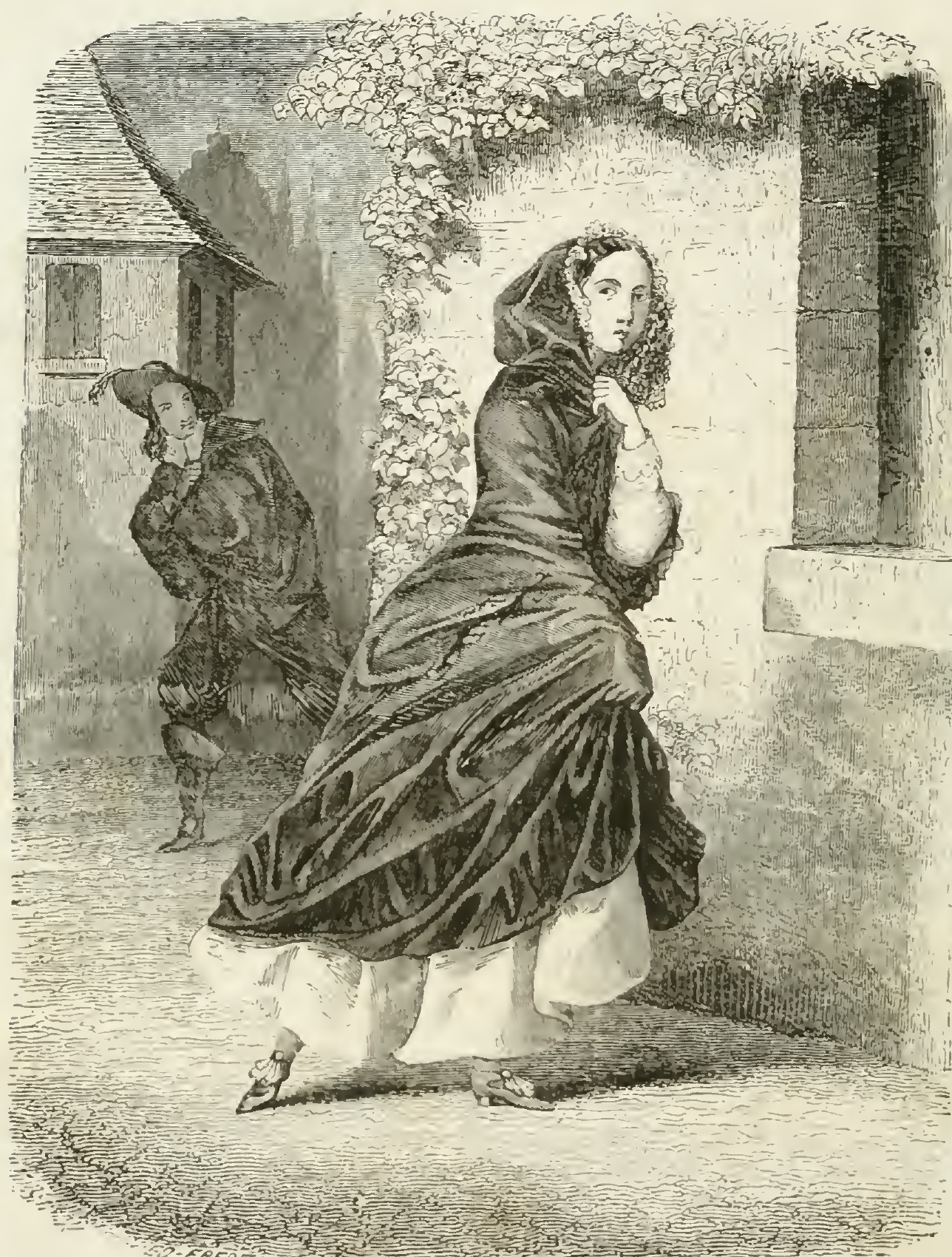
D'Artagnan had just passed the Rue Cassette and was already recognizing the door of his friend's house, buried beneath a mass of sycamores and clematis that formed a vast cushion above it, when he perceived something like a shadow emerging from the Rue des Jardins. This something was wrapped in a cloak, and d'Artagnan at first thought it was a man; but from the smallness of the figure, the uncertainty of the gait, the awkwardness of the step, he soon recognized a woman. Moreover, this woman, as if she were not sure of the house she was looking for, raised her eyes to get her bearings, stopped, turned back, then came forward again. D'Artagnan was intrigued.
— Suppose I go offer her my services! he thought. From her figure, one can see she is young; perhaps she is pretty. Oh! yes. But a woman who runs the streets at this hour hardly goes out except to join her lover. Plague take it! if I were to disturb a rendezvous, that would be a bad door through which to enter into relations.
Meanwhile, the young woman kept advancing, counting the houses and the windows. It was, moreover, neither a long nor a difficult matter. There were only three mansions in that part of the street, and two windows looking out upon it; one was that of a pavilion parallel to the one occupied by Aramis, the other was that of Aramis himself.
— By Jove, said d'Artagnan, to whom the theologian's niece came back to mind; by Jove, it would be funny if this belated dove were seeking our friend's house. But, upon my soul, it looks very much like it. Ah! my dear Aramis, this time I mean to have the truth of it.
And d'Artagnan, making himself as thin as he could, sheltered in the darkest side of the street, near a stone bench situated at the back of a niche.
The young woman continued to advance, for besides the lightness of her step which had betrayed her, she had just let hear a little cough that denounced a voice of the freshest. D'Artagnan thought that this cough was a signal.
However, whether this cough had been answered by an equivalent sign which had fixed the irresolutions of the nocturnal seeker, or whether without any foreign aid she had recognized that she had reached the end of her course, she approached resolutely the shutter of Aramis and struck three times at equal intervals with her bent finger.
— It is indeed at Aramis's, murmured d'Artagnan. Ah! Mr. Hypocrite, I catch you at doing theology!
The three blows were scarcely struck when the inner casement opened and a light appeared through the panes of the shutter.
— Ah! ah! And the listener not at the doors but at the windows, ah! ah! the visit was expected. Come, the shutter is going to open and the lady will enter by climbing. Very good!
But to the great astonishment of d'Artagnan, the shutter remained closed. Moreover, the light which had flamed up for a moment disappeared and everything returned to darkness.
D'Artagnan thought that this could not last thus, and continued to look with all his eyes and listen with all his ears.
He was right: at the end of a few seconds two sharp blows resounded within.
The young woman in the street answered with a single blow and the shutter opened.
One may judge whether d'Artagnan looked and listened with avidity.
Unfortunately the light had been carried into another apartment. But the young man's eyes had grown accustomed to the darkness. Besides, the eyes of Gascons have, so it is asserted, like those of cats, the property of seeing during the night.
D'Artagnan therefore saw that the young woman was drawing from her pocket a white object which she unfolded briskly and which took the form of a handkerchief. This object unfolded, she made its corner remarked to her interlocutor.
This recalled to d'Artagnan that handkerchief which he had found at the feet of Mme Bonacieux, which had recalled to him the one he had found at the feet of Aramis.
What the devil could this handkerchief mean?
Placed where he was, d'Artagnan could not see the face of Aramis—we say of Aramis, because the young man made no doubt that it was his friend who was dialoguing from within with the lady from without; curiosity therefore prevailed over prudence, and profiting by the preoccupation in which the sight of the handkerchief appeared to plunge the two persons we have brought upon the scene, he came out of his hiding place, and, quick as lightning, but stifling the noise of his steps, he went and glued himself to an angle of the wall, from where his eye could perfectly plunge into the interior of Aramis's apartment.

Madame Bonacieux.
1
Arrived there, d'Artagnan thought to utter a cry of surprise: it was not Aramis who was talking with the nocturnal visitor, it was a woman. Only, d'Artagnan could see enough there to recognize the shape of her clothes, but not enough to distinguish her features.
At the same instant, the woman in the apartment drew a second handkerchief from her pocket and exchanged it with the one that had just been shown to her. Then a few words were spoken between the two women; finally, the shutter closed again, the woman who was outside the window turned around and came to pass four paces from d'Artagnan while lowering the hood of her mantle; but the precaution had been taken too late, d'Artagnan had recognized Mme Bonacieux.
Mme Bonacieux! The suspicion that it was she had already crossed his mind when she had drawn the handkerchief from her pocket; but what probability was there that Mme Bonacieux, who had sent for M. Laporte to have herself escorted back by him to the Louvre, would run the streets of Paris alone, at half past eleven at night, at the risk of being carried off a second time?
It must therefore have been for a very important affair; and what is the important affair of a woman of twenty-five? Love.
But was it on her own account or on another person's account that she exposed herself to such hazards? That is what the young man asked himself, whom the demon of jealousy was already biting at the heart no less than a titular lover.
He had, moreover, a very simple means of assuring himself where Mme Bonacieux was going, which was to follow her. This means was so simple that d'Artagnan employed it quite naturally and by instinct.
But at the sight of the young man detaching himself from the wall like a statue from its niche, and at the noise of the steps she heard resounding behind her, Mme Bonacieux gave a little cry and fled.
D'Artagnan ran after her. It was not a difficult thing for him to catch up with a woman embarrassed in her mantle. He therefore caught up with her at a third of the street into which she had turned. The unfortunate woman was exhausted, not with fatigue, but with terror, and when d'Artagnan placed his hand on her shoulder, she fell on one knee crying in a strangled voice:
— Kill me if you wish, but you shall know nothing.
D'Artagnan raised her by passing his arm around her waist; but as he felt from her weight that she was on the point of fainting, he hastened to reassure her with protestations of devotion. These protestations were nothing to Mme Bonacieux, for such protestations can be made with the worst intentions in the world; but the voice was everything. The young woman thought she recognized the sound of that voice; she reopened her eyes, cast a glance at the man who had frightened her so greatly, and recognizing d'Artagnan, she uttered a cry of joy.
— Oh! it is you, it is you, she said; thank God!
— Yes, it is I, said d'Artagnan, I whom God has sent to watch over you.
— Was it with that intention that you followed me? asked with a smile full of coquetry the young woman, whose somewhat mocking character regained the upper hand, and in whom all fear had disappeared from the moment she had recognized a friend in the one she had taken for an enemy.
— No, said d'Artagnan; no, I confess it, it was chance that put me on your road; I saw a woman knocking at the window of one of my friends.
— One of your friends? interrupted Mme Bonacieux.
— Without doubt; Aramis is one of my best friends.
— Aramis? what is that?
— Good! Are you going to tell me now that you do not know Aramis?
— This is the first time I have heard that name pronounced.
— Then this is the first time you have come to this house?
— No doubt.
— And you did not know that it was inhabited by a young man?
— No.
— By a musketeer?
— Not at all.
— So it was not he you were coming to seek?
— Not in the least. Besides, you saw it well enough: the person to whom I spoke is a woman.
— That is true; but that woman is a friend of Aramis.
— I know nothing of that.
— Since she lodges at his place.
— That is no concern of mine.
— But who is she?
— Oh! that is not my secret.
— Dear Madame Bonacieux, you are charming, but at the same time you are the most mysterious woman…
— Do I lose anything by that?
— No, on the contrary, you are adorable.
— Then, give me your arm.
— Very willingly; and now?
— Now take me along.
— Where to?
— Where I am going.
— But where are you going?
— You will see, since you will leave me at the door.
— Will we have to wait for you?
— It will be useless.
— So you will come back alone?
— Perhaps yes, perhaps no.
— But the person who accompanies you next, will it be a man, will it be a woman?
— I do not know yet.
— I will know well enough, myself.
— How is that?
— I will wait for you to see you come out.
— In that case, farewell!
— How is that?
— I have no need of you.
— But you had requested...
— The aid of a gentleman, and not the surveillance of a spy.
— The word is too harsh!
— What does one call those who follow people against their will?
— Indiscreet persons.
— The word is too mild.
— Come, madame, I see clearly that I must do everything you wish.
— Why did you deprive yourself of the merit of doing so at once?
— Is there none, then, in repenting?
— And do you truly repent?
— I do not know myself. But what I do know is that I promise you to do all you wish if you let me accompany you as far as you are going.
— And you will leave me afterward?
— Yes.
— Without spying on me when I come out?
— No.
— Word of honor?
— Faith of a gentleman?
— Take my arm and let us walk, then.
D'Artagnan offered his arm to Mme Bonacieux, who hung upon it half laughing, half trembling, and the two gained the top of the Rue de la Harpe. Arrived there, the young woman seemed to hesitate, as she had already done in the Rue de Vaugirard. However, at certain signs she seemed to recognize a door, and approaching that door:
— Now, monsieur, said she, this is where I have business; a thousand thanks for your honorable company, which has saved me from all the dangers to which I should have been exposed alone; but the moment has come to keep your word. I have arrived at my destination.
— And you will have nothing more to fear on returning?
— I shall have nothing to fear but thieves.
— Is that nothing, then?
— What could they take from me? I do not have a single penny on me.
— You forget that fine handkerchief bearing a coat of arms.
— Which one?
— The one I found at your feet and put back in your pocket.
— Be silent, be silent, wretch! cried the young woman; do you want to ruin me?
— You see clearly that there is still danger for you, since a single word makes you tremble, and you admit that if that word were heard you would be lost. Ah! come, madame, continued d'Artagnan, seizing her hand and covering it with an ardent gaze, come, be more generous, confide in me: have you not read in my eyes that there is nothing but devotion and sympathy in my heart?
— Yes, indeed, replied Mme Bonacieux; so ask me my secrets, and I will tell them to you, but those of others, that is different.
— Tomorrow, said d'Artagnan, I will discover them; since these secrets may have an influence on your life, these secrets must become mine.
— Beware of doing so! cried the young woman with a seriousness that made d'Artagnan shudder in spite of himself. Oh! do not meddle in anything that concerns me, do not seek to help me in what I am accomplishing, and this I ask of you in the name of the interest I inspire in you, in the name of the service you have rendered me and which I shall never forget as long as I live. Believe rather what I tell you: take no further interest in me, let me no longer exist for you, let it be as if you had never seen me.
— Must Aramis do as much as I, madame? said d'Artagnan, piqued.
— This is already the second or third time you have uttered that name, monsieur, and yet I have told you that I do not know him.
— You do not know the man at whose shutter you came knocking? Come now, madame, you believe me far too credulous!
— Admit that it is to make me talk that you invent this story and that you create this personage.
— I invent nothing, madame, I create nothing, I am telling the exact truth.
— And you say that one of your friends lives in this house?
— I say it and I repeat it for the third time, this house is the one inhabited by my friend, and that friend is Aramis.
— All that will be cleared up later, murmured the young woman; now, monsieur, be silent.
— If you could see my heart fully revealed, said d'Artagnan, you would read there so much curiosity that you would have pity on me, and so much love that you would satisfy my curiosity at once. There is nothing to fear from those who love us.
— You speak very quickly of love, monsieur, said the young woman, shaking her head.
— It is that love came to me quickly and for the first time, and that I am not yet twenty.
The young woman looked at him furtively.
— Listen, I am already on the trail, resumed d'Artagnan. Three months ago, I nearly had a duel with Aramis over a handkerchief similar to the one you showed to that woman who was at his home, over a handkerchief marked in the same manner, I am sure of it.
— Monsieur, said the young woman, you tire me greatly, I swear it, with these questions.
— But you are so prudent, madame, think of it, if you were arrested with this handkerchief, and this handkerchief were seized, would you not be compromised?
— Why so, are the initials not mine: C. B. Constance Bonacieux?
— Or Camille de Bois-Tracy.
— Silence, monsieur, once more silence! Ah! since the dangers I run for myself do not stop you, think of those you may run, yourself!
— I?
— Yes, you. There is danger of prison, there is danger to life in knowing me.
— So I'm not leaving you anymore.
"Sir," said the young woman, imploringly, clasping her hands, "sir, in Heaven's name, in the name of a soldier's honor, in the name of a gentleman's courtesy, go away; look, midnight is striking—it is the hour when I am expected."
"Madame," said the young man, bowing, "I know not how to refuse anything to one who asks me thus; be satisfied, I withdraw."
"But you will not follow me, you will not spy on me?"
"I am going home this instant."
"Ah! I knew it well, that you were a brave young man!" cried Mme. Bonacieux, holding out one hand to him and placing the other on the knocker of a little door almost lost in the wall.
D'Artagnan seized the hand held out to him and kissed it ardently.
"Ah! I would rather never have seen you," cried d'Artagnan, with that naive brutality which women often prefer to the affectations of politeness, because it lays bare the depths of thought and proves that feeling prevails over reason.
"Well!" resumed Mme. Bonacieux, in a voice almost caressing, and pressing the hand of d'Artagnan, who had not relinquished hers; "well! I will not say as much as you. What is lost for today is not lost for the future. Who knows if, when I am free one day, I may not satisfy your curiosity."
"And do you make the same promise to my love?" cried d'Artagnan, at the height of joy.
"Oh! on that side, I do not wish to bind myself; it will depend on the feelings you know how to inspire in me."
"Thus today, madame—"
"Today, sir, I am still only at gratitude."
"Ah! you are too charming," said d'Artagnan sadly, "and you abuse my love."
"No, I make use of your generosity, that is all. But believe it well, with certain people everything is found again."
"Oh! you make me the happiest of men. Do not forget this evening, do not forget this promise!"
"Be easy; in time and place I shall remember everything. Well, go then, go, in Heaven's name! I was expected at midnight exactly, and I am late."
"By five minutes."
"Yes, but in certain circumstances five minutes are five centuries."
"When one loves."
"Well, who told you that I have not to do with a lover?"
"It is a man who awaits you," cried d'Artagnan—"a man!"
"Come, here is the discussion about to begin again," said Mme. Bonacieux, with a half-smile that was not exempt from a certain shade of impatience.
"No, no, I am going, I am off; I believe in you, I wish to have all the merit of my devotion, even should that devotion be a stupidity. Adieu! madame, adieu!"
And as if he had felt he could only detach himself from the hand he held by a sudden effort, he went away at a run, while Mme. Bonacieux knocked three slow and regular strokes, as one knocks at a shutter; then, having reached the corner of the street, he turned round: the door had opened and closed again, the pretty mercer had disappeared.
D'Artagnan continued on his way; he had given his word not to spy on Mme. Bonacieux, and had the young man's life depended on the place she was going to or on the person who was to accompany her, d'Artagnan would have gone home, since he had said he was going there. Five minutes later he was in the Rue des Fossoyeurs.
"Poor Athos," he said, "he will not know what that means. He will have fallen asleep waiting for me, or he will have gone home, and on returning he will have learned that a woman had come there. A woman at Athos's! After all," continued d'Artagnan, "there was one at Aramis's. All this is very strange, and I should be curious to know how it will end."
"Badly, sir, badly," replied a voice which the young man recognized as that of Planchet; for, while monologuing aloud, in the manner of very preoccupied people, he had entered the passage at the end of which was the staircase leading to his room.
"How, badly? what do you mean, idiot?" asked d'Artagnan. "And what has happened, then?"
"All sorts of misfortunes."
"Which?"
"First, M. Athos is arrested."
"Arrested! Athos arrested! Why?"
"He was found at your place; he was taken for you."
"And by whom was he arrested?"
"By the guard that the black men went to fetch, whom you put to flight."
"Why did he not give his name? Why did he not say that he had nothing to do with this affair?"
"He took good care not to, sir; on the contrary, he came near me and said: 'It is your master who needs his liberty at this moment, and not I, since he knows everything and I know nothing. They will believe him arrested, and that will give him time; in three days I will say who I am, and they will have to let me out.'"
"Brave Athos! noble heart," murmured d'Artagnan, "I recognize him there! And what did the bailiffs do?"
"Four took him away, I know not where, to the Bastille or to Fort-l'Évêque; two stayed with the black men, who searched everywhere and took all the papers. Finally the last two, during this expedition, stood guard at the door; then, when all was over, they went away, leaving the house empty and everything open."
"And Porthos and Aramis?"
"I had not found them; they have not come."
"But they may come at any moment, for you sent word to them that I was expecting them?"
"Yes, sir."
"Well, do not stir from here; if they come, tell them what has happened to me, that they are to wait for me at the tavern of the Pomme-du-Pin; here there would be danger, the house may be watched. I am running to M. de Tréville's to tell him all this, and I will join them there."
"Very well, sir," said Planchet.
"But you will stay, you will not be afraid?" said d'Artagnan, turning back to recommend courage to his lackey.
"Be easy, sir," said Planchet, "you do not know me yet; I am brave when I set about it, you see; it is all in setting about it; besides, I am a Picard."
"Then it is agreed," said d'Artagnan; "you let yourself be killed rather than leave your post."
"Yes, sir, and there is nothing I would not do to prove to monsieur that I am attached to him."
“Well,” said d’Artagnan to himself, “it appears that the method I employed with this boy is decidedly the right one: I shall use it on occasion.”
And with all the speed of his legs, already somewhat tired, however, by the day’s errands, d’Artagnan made his way toward the rue du Colombier.
M. de Tréville was not at his hotel; his company was on guard at the Louvre; he was at the Louvre with his company.
He had to get to M. de Tréville; it was important that he be warned of what was happening. D’Artagnan resolved to try to enter the Louvre. His guard’s uniform in M. des Essarts’s company ought to serve as a passport.
He therefore went down the rue des Petits-Augustins and went back up the quay to take the Pont Neuf. For a moment he had had the idea of crossing by the ferry; but on reaching the water’s edge he had mechanically put his hand in his pocket and realized that he had nothing with which to pay the ferryman.
As he came level with the rue Dauphine, he saw emerging from that street a group made up of two people, whose appearance struck him.
The two people who made up the group were: one, a man; the other, a woman.
The woman had the figure of Mme Bonacieux, and the man resembled Aramis so closely that one could not mistake him.
Moreover, the woman had that black cloak that d’Artagnan could still see outlined on the shutter in the rue Vaugirard and on the door in the rue de La Harpe.
In addition, the man wore the musketeers’ uniform.
The woman’s hood was pulled down; the man held his handkerchief over his face; both—this double precaution indicated it—both, then, had an interest in not being recognized.
They took the bridge; it was d’Artagnan’s route, since d’Artagnan was going to the Louvre; d’Artagnan followed them. D’Artagnan had not gone twenty paces before he was convinced that this woman was Mme Bonacieux, and that this man was Aramis.
He felt at once all the suspicions of jealousy stirring in his heart.
He was doubly betrayed, both by his friend and by the one he already loved as a mistress. Mme Bonacieux had sworn to him by all the gods that she did not know Aramis, and a quarter of an hour after she had made him that oath, he found her on Aramis’s arm.
D'Artagnan did not reflect that he had known the pretty mercer's wife for only three hours, that she owed him nothing but a little gratitude for having delivered her from the black-clad men who wanted to carry her off, and that she had promised him nothing. He regarded himself as an outraged, betrayed, and mocked lover; blood and anger rushed to his face, and he resolved to clear everything up.
The young woman and the young man had noticed that they were being followed, and they had quickened their pace. D'Artagnan took to running, passed them, then came back toward them at the moment they found themselves in front of the Samaritaine, which was lit by a streetlamp casting its glow over that whole part of the bridge.
D'Artagnan stopped in front of them and they stopped in front of him.
"What do you want, monsieur?" asked the musketeer, stepping back and with a foreign accent that proved to D'Artagnan that he had been mistaken in part of his conjectures.
"It is not Aramis!" he cried.
"No, monsieur, it is not Aramis, and from your exclamation I see that you have taken me for another, and I forgive you."
"You forgive me!" cried D'Artagnan.
"Yes," replied the stranger. "So let me pass, since it is not with me that you have business."
"You are right, monsieur," said D'Artagnan, "it is not with you that I have business, it is with madame."
"With madame! You do not know her," said the stranger.
"You are mistaken, monsieur, I do know her."
"Ah!" said Mme Bonacieux in a tone of reproach; "ah! monsieur, I had your word as a soldier and your faith as a gentleman: I hoped I could count on it."
"And I, madame," said D'Artagnan, embarrassed, "you had promised me..."
"Take my arm, madame," said the stranger, "and let us continue on our way."
Meanwhile D'Artagnan, stunned, shattered, annihilated by all that was happening to him, remained standing with his arms crossed in front of the musketeer and Mme Bonacieux.
The musketeer took two steps forward and pushed D'Artagnan aside with his hand.
D'Artagnan leaped back and drew his sword.
At the same time, with the speed of lightning, the stranger drew his.
"In heaven's name, milord!" cried Mme Bonacieux, throwing herself between the combatants and seizing the swords with both hands.
"Milord!" cried D'Artagnan, illuminated by a sudden idea; "milord! pardon, monsieur; but would you be..."
"Milord, the Duke of Buckingham," said Mme Bonacieux in a half-voice; "and now you can ruin us all."
"Milord, madame, pardon, a hundred times pardon; but I loved her, milord, and I was jealous; you know what it is to love, milord; forgive me, and tell me how I may get myself killed for Your Grace."
"You are a brave young man," said Buckingham, extending to D'Artagnan a hand that the latter clasped respectfully; "you offer me your services, I accept them; follow us at twenty paces as far as the Louvre, and if anyone spies on us, kill him!"
D'Artagnan put his bare sword under his arm, let Mme Bonacieux and the duke get twenty paces ahead, and followed them, ready to carry out to the letter the instructions of the noble and elegant minister of Charles I.
But fortunately the young follower had no occasion to give the duke that proof of his devotion, and the young woman and the handsome musketeer re-entered the Louvre by the little gate of l'Echelle without having been disturbed.
As for D'Artagnan, he went at once to the tavern of the Pomme-du-Pin, where he found Porthos and Aramis waiting for him.
But without giving them any further explanation about the disturbance he had caused them, he told them that he had settled alone the affair for which he had for a moment believed he needed their intervention.
And now, carried away as we are by our narrative, let us leave our three friends to return each to his own home, and let us follow, through the windings of the Louvre, the Duke of Buckingham and his guide.