
A VISION.
AT the appointed hour, the four friends were gathered at Athos's. Their concerns about the equipment had entirely disappeared, and each face now bore only the expression of its own secret anxieties, for behind every present happiness is hidden a fear to come.
Suddenly Planchet entered, bringing two letters addressed to d'Artagnan.
The one was a little note neatly folded lengthwise, with a pretty green wax seal on which was imprinted a dove bearing a green branch.
The other was a large square epistle, resplendent with the terrible arms of His Eminence the cardinal-duke.
At the sight of the little letter d'Artagnan's heart leaped, for he thought he recognized the handwriting, and although he had seen that handwriting only once, the memory of it had remained in the deepest recesses of his heart.
He therefore took the little letter and broke the seal eagerly.
"Take a walk," it said to him, "next Wednesday, from six to seven o'clock in the evening, on the road to Chaillot, and look carefully into the carriages that pass. But if you value your life and the lives of those who love you, do not say a word, do not make a movement that could lead anyone to believe that you have recognized the one who risks everything to catch a glimpse of you for a moment."
No signature.
— It is a trap, said Athos; do not go, d'Artagnan.
— However, observed d'Artagnan, I really seem to recognize the handwriting.
— It may be counterfeited, resumed Athos: at six or seven o'clock, in this season, the road to Chaillot is quite deserted. You might as well go and commit yourself in the forest of Bondy.
— But what if we all went? said d'Artagnan. Devil take it! they will not devour all four of us, plus four lackeys, plus the horses, plus the weapons; they would have an indigestion.
— Besides, it will be an opportunity to show off our equipages, observed Athos.
But if it is a woman who writes, said Aramis, and that woman desires not to be seen, take care that you do not compromise her, d'Artagnan, which would be wrong on the part of a gentleman.
"We will stay behind," said Porthos, "and he alone will ride forward."
"Yes," added Aramis, "but a pistol shot is soon fired from a carriage that is moving at a gallop."
"Bah!" said d'Artagnan, "they will miss me. We will then overtake the carriage and exterminate those who are inside. That will always be so many enemies the fewer."
"He is right," replied Porthos, "battle! besides, we must try our weapons."
"Faith! let us give ourselves that pleasure," added Aramis in his gentle and nonchalant manner.
"As you wish," continued Athos.
"Gentlemen," said d'Artagnan, "it is half past four, and we have barely time to be on the road to Chaillot by six."
"Besides, if we set out too late," observed Porthos, "we would not be seen, which would be a great pity. Let us go and get ready, gentlemen."
"But this second letter," resumed Athos, "you are forgetting it. It seems to me, however, that the seal indicates that it deserves to be opened. As for me, I declare to you, my dear d'Artagnan, that I care about it far more than about the little trinket you have just been quietly slipping over your heart."
D'Artagnan blushed.
"Well then!" said the young man, "let us see, gentlemen, what His Eminence wants with me."
D'Artagnan unsealed the letter and read:
"M. d'Artagnan, guard of the king, company of Essarts, is expected at the Cardinal's palace this evening at eight o'clock.
"La Houdinière.
"Captain of the guards."
—"The devil!" cried Athos. "Here is an appointment far more alarming than the other."
—"I will go to the second after leaving the first," said d'Artagnan. "The one is for seven o'clock, the other for eight. There will be time for everything."
—"Hum! I would not go," continued Aramis. "A gallant knight cannot miss an appointment given by a lady, but a prudent gentleman may excuse himself from calling on His Eminence, especially when he has some reason to believe that it is not to receive compliments there."
—"I am of Aramis's opinion," said Porthos.
—"Gentlemen," replied d'Artagnan, "I have already received from M. de Cavois a similar invitation from His Eminence. I neglected it, and the next day a great misfortune befell me: Constance disappeared. Whatever may come of it, I will go."
—"If your mind is made up," said Athos, "go."
—"But the Bastille?" objected Aramis.
—"Bah! you will get me out of it," said d'Artagnan.
—"No doubt," replied Aramis and Porthos with admirable assurance, and as if it were the simplest thing in the world; "no doubt we will get you out of it; but in the meantime, since we are to leave the day after tomorrow, you would do better not to risk that Bastille."
—"Let us do better," said Athos. "Let us not leave him all evening; let us wait for him, each at a gate of the palace, with three musketeers behind us. If we see any carriage with closed windows and a suspicious appearance come out, we will fall upon it. It is a long time since we have had a brush with the cardinal's guards, and M. de Tréville must think us dead."
—"Decidedly, Athos," said Aramis, "you are made to be an army general. What do you say to the plan, gentlemen?"
—"Admirable!" repeated the young men in chorus.
—"Well, then," said Porthos, "I will run to the hotel, I will warn our comrades to hold themselves ready for eight o'clock; the meeting place will be on the Place du Palais-Cardinal; meanwhile, you have the lackeys saddle the horses."
—"I have no horse myself," observed d'Artagnan, "but I will have one brought from M. de Tréville's."
—"That is unnecessary," said Aramis, "you will take one of mine."
—"How many have you, then?" asked d'Artagnan.
—"Three," replied Aramis, smiling.
—"My dear fellow," said Athos, "you are certainly the best-mounted poet in France and Navarre."
—"Listen, Aramis, you will not know what to do with three horses, will you? I do not even understand why you have bought three horses."
—"And so I have only two of them," said Aramis.
—"Then the third fell from heaven?"
—"No; the third was brought to me this very morning by a servant without livery, who would not tell me to whom he belonged, and who assured me he had received orders from his master—"
—"Or from his mistress," interrupted d'Artagnan.
—"That makes no difference," resumed Aramis, blushing; "and who assured me, I say, that he had received orders from his master or his mistress to put this horse in my stable without telling me where it came from."
—"Such things happen only to poets," resumed Athos gravely.
—"Well, then, in that case, let us do better," said d'Artagnan. "Which of the two horses will you ride? The one you bought or the one that was given to you?"
—"The one that was given to me, unquestionably. You understand, d'Artagnan, that I cannot offer that insult—"
—"To the unknown donor," resumed d'Artagnan.
—"Or to the mysterious donor lady," said Athos.
—"Then the one you bought becomes useless to you."
—"Almost."
—"You chose it yourself?" asked d'Artagnan.
—"With the greatest care. The safety of the rider, you know, depends almost always on his horse."
—"Well, then, let me have it for the price it cost you."
—"I was about to offer it to you, my dear d'Artagnan, giving you all the time you need to repay me this trifle."
—"And how much did it cost you?"
—"Eight hundred livres."
—"Here are forty double pistoles, my dear friend," said d'Artagnan, drawing the sum from his pocket; "I know that is the coin with which your poems are paid."
—"So you are in funds?" asked Aramis.
—"Rich! very rich! my dear fellow!"
And d'Artagnan made the rest of his pistoles jingle in his pocket.
—"Send your saddle to the musketeers' hotel, and your horse will be brought here with ours."
—"Very well! but it is almost five o'clock. Let us hurry."
A quarter of an hour later, Porthos appeared at one end of the Rue Férou on a magnificent genet. Mousqueton followed him on an Auvergne horse, small but sturdy. Porthos was swelling with joy and pride.
At the same time Aramis appeared at the other end of the street, mounted on a superb English steed; Bazin followed him on a roan horse, leading a vigorous Mecklenburg horse by the bridle: that was d'Artagnan's mount.
The two musketeers met at the door; Athos and d'Artagnan watched them from the window.
—"The devil!" said Aramis, "you have a superb horse there, my dear fellow!"
—"Yes," replied Porthos, "it is the one that was to have been sent to me at first. A nasty joke of the husband had substituted the other; but the husband has been well punished since, and I have obtained full satisfaction."
Planchet and Grimaud then appeared in turn, holding their masters' mounts in hand. D'Artagnan and Athos went down, mounted beside their companions, and all four set off toward the quay—Athos on the horse he owed to his wife, Aramis on the horse he owed to his mistress, Porthos on the horse he owed to his procureuse, and d'Artagnan on the horse he owed to his good fortune, the best mistress of all.
The valets followed.
As Porthos had thought, the cavalcade made a fine effect, and if Mme Coquenard had been on Porthos's path and had been able to see what a grand air he had on his fine Spanish genet, she would not have regretted the bleeding she had inflicted on her husband's strongbox.
Near the Louvre the four friends met M. de Tréville, who was returning from Saint-Germain; he stopped them to compliment them on their equipage, which in an instant brought some hundreds of idlers around them.
D'Artagnan took advantage of the circumstance to speak to M. de Tréville about the letter with the great red seal and the ducal arms. It is well understood that of the other he breathed not a word.
M. de Tréville approved the resolution he had taken, and assured him that if on the morrow he had not reappeared, he would know well how to find him, wherever he might be.
At that moment the clock of the Samaritaine struck six. The four friends excused themselves on account of an appointment, and took leave of M. de Tréville.
A quarter of an hour's gallop brought them onto the road to Chaillot. The day was beginning to fade; carriages were passing and repassing. D'Artagnan, kept a few paces back by his friends, plunged his gaze to the very depths of the carriages and perceived therein no familiar face.
At last, after a quarter of an hour of waiting, and as the twilight was falling completely, a carriage appeared, coming at full gallop along the road from Sèvres. A presentiment told D'Artagnan beforehand that this carriage contained the person who had given him the rendezvous. The young man was himself quite astonished to feel his heart beating so violently. Almost at once a woman's head emerged from the carriage door, two fingers on her lips, as if to enjoin silence, or as if to send a kiss. D'Artagnan uttered a faint cry of joy. This woman, or rather this apparition, for the carriage had passed with the rapidity of a vision, was Mme Bonacieux.
By an involuntary movement and despite the recommendation given, D'Artagnan urged his horse to a gallop, and in a few bounds caught up with the carriage; but the little door of the carriage was hermetically closed: the vision had disappeared.
D'Artagnan then recalled that recommendation: "If you value your life and the lives of those who love you, remain motionless, as if you had seen nothing."
He stopped therefore, trembling, not for himself, but for the poor woman who had evidently exposed herself to great peril in giving him this rendezvous.
The carriage continued on its way, and still traveling at full speed, plunged into Paris and disappeared.
D'Artagnan had remained motionless in the same spot, not knowing what to think. If it was Mlle Bonacieux and she was returning to Paris, why this fleeting rendezvous, why this mere exchange of a glance, why this lost kiss? If, on the other hand, it was not she, which was still quite possible, for the little daylight that remained made an error easy; if it was not she, would this not be the beginning of a plot mounted against him with this woman as bait, for whose love his own was known?
The three companions drew closer to him. All three had distinctly seen a woman's head appear at the carriage window, but none of them, except Athos, knew Mlle Roncieux. Athos's opinion, moreover, was that it was indeed she; but, less preoccupied than d'Artagnan with that pretty face, he had thought he saw a second head, a man's head, at the back of the carriage.
"If that is so," said d'Artagnan, "they are doubtless transporting her from one prison to another. But what do they want to do with this poor creature, and how shall I ever reach her?"
"Friend," said Athos gravely, "remember that the dead are the only ones one is not exposed to meeting on earth. You know something of that as well as I, do you not? Now, if your mistress is not dead, if it is she whom we have just seen, you will find her again one day or another. And perhaps, my God," he added with that misanthropic accent peculiar to him, "perhaps sooner than you would wish!1.
Half past seven struck; the carriage was about twenty minutes late for the appointed meeting. D'Artagnan's friends reminded him that he had a visit to pay, while pointing out that there was still time to decline it.
But d'Artagnan was at once obstinate and curious. He had got it into his head that he would go to the Cardinal's palace and would learn what His Eminence wanted to say to him. Nothing could make him change his resolution.
They arrived at the rue Saint-Honoré and the place du Palais-Cardinal; they found the twelve musketeers summoned there walking about while waiting for their comrades. Only there was it explained to them what was at issue.
D'Artagnan was very well known in the honorable corps of the king's musketeers, where it was known that he would one day take his place; he was therefore regarded in advance as a comrade. It followed from this background that everyone accepted with great goodwill the mission for which he was summoned; besides, it was in all probability a matter of playing a bad turn on M. the Cardinal and his people, and for such expeditions these worthy gentlemen were always ready.
Athos therefore divided them into three groups, took command of one, gave the second to Aramis, and the third to Porthos, then each group went to lie in ambush facing one of the exits.
D'Artagnan, for his part, boldly entered by the main door.
Although he felt himself vigorously supported, the young man was not without uneasiness as he climbed the great staircase step by step. His conduct with milady resembled a betrayal somewhat, and he suspected the political relations that existed between that woman and the cardinal; moreover, de Wardes, whom he had handled so badly, was one of His Eminence's faithful, and d'Artagnan knew that if His Eminence was terrible to his enemies, she was very attached to her friends.
"If de Wardes has told the cardinal our whole affair, which is not doubtful, and if he recognized me, which is probable, I must regard myself more or less as a condemned man," said d'Artagnan, shaking his head. "But why has he waited until today? It is quite simple: milady will have lodged a complaint against me with that hypocritical grief that makes her so interesting, and this latest crime will have made the cup overflow... Fortunately," he added, "my good friends are downstairs, and they will not let me be taken away without defending me. However, M. de Tréville's company of musketeers cannot by itself wage war on the cardinal, who has at his disposal the forces of all France, and before whom the queen is without power and the king without will. D'Artagnan, my friend, you are brave, you are prudent, you have excellent qualities, but women will be your ruin!"
He had reached this sad conclusion when he entered the antechamber. He handed his letter to the usher on duty, who had him pass into the waiting room, and who plunged into the interior of the palace.
In that waiting room were five or six guards of M. the Cardinal, who, recognizing d'Artagnan, and knowing that it was he who had wounded Jussac, looked at him smiling a singular smile.
That smile appeared to d'Artagnan an ill omen; only, as our Gascon was not easy to intimidate, or as, thanks to a great pride naturalto the people of his country, he did not easily let show what was passing in his soul when what was passing there resembled fear, he planted himself proudly before Messieurs the guards, and waited with his hand on his hip, in an attitude that was not lacking in majesty.
The usher came back in and signaled to d'Artagnan to follow him. It seemed to the young man that the guards, watching him move away, whispered among themselves.
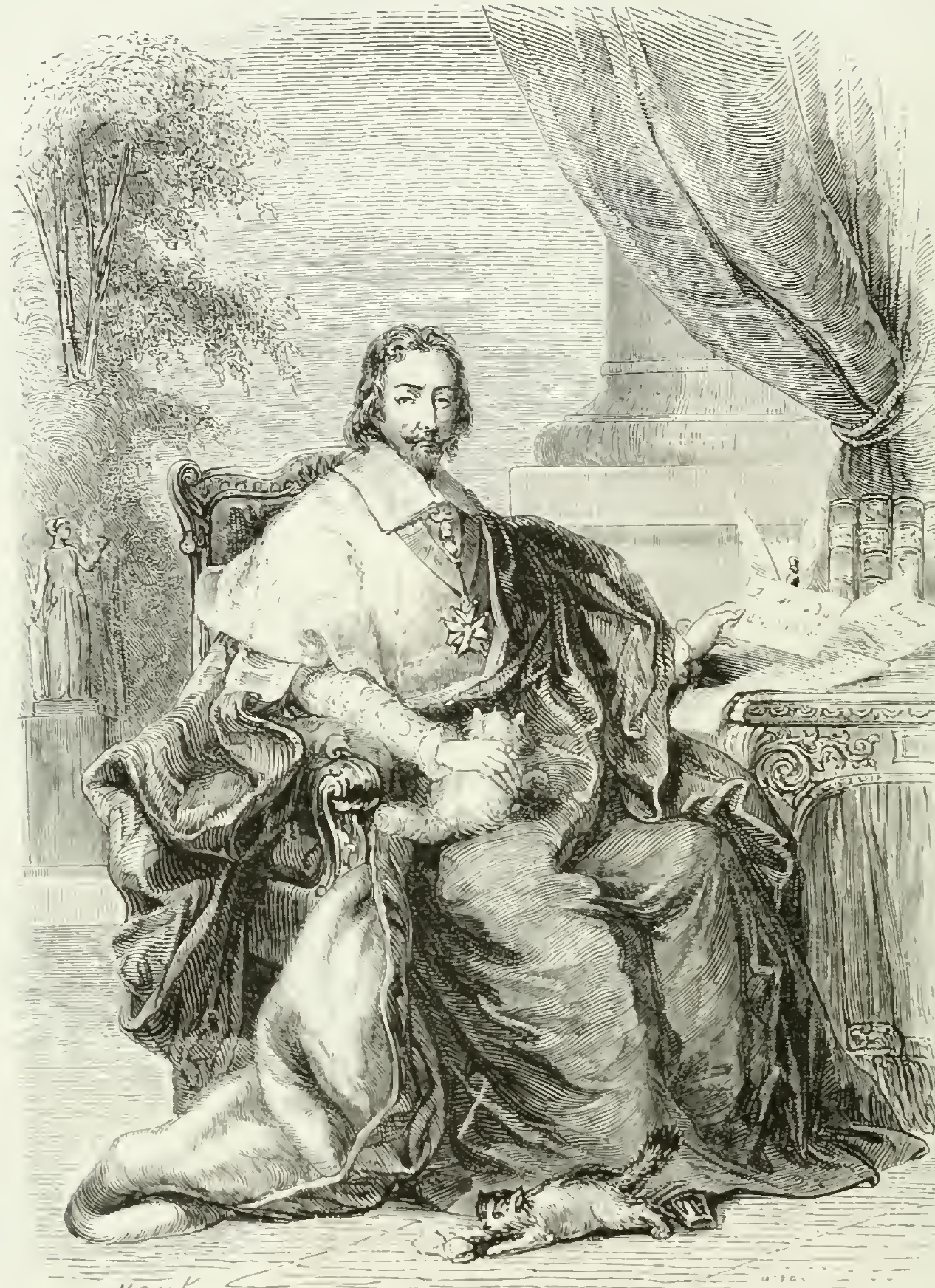
He followed a corridor, crossed a great salon, entered a library, and found himself facing a man seated before a desk and writing.
The usher introduced him and withdrew without saying a word. D'Artagnan remained standing and examined this man.
D'Artagnan at first thought he had to do with some judge examining his dossier, but he perceived that the man at the desk was writing or rather correcting lines of unequal length, scanning words on his fingers; he saw that he was facing a poet. After a moment the poet closed his manuscript, on the cover of which was written Mirare, tragédie en cinq actes, and raised his head.
D'Artagnan recognized the cardinal.

October 1920