SECOND DAY OF CAPTIVITY.
MILADY was dreaming that she finally held d'Artagnan, that she was witnessing his torture; and it was the sight of his hateful blood flowing beneath the executioner's axe that traced that charming smile on her lips.
She slept as a prisoner sleeps, cradled by his first hope.
The next day, when they entered her room, she was still in bed. Felton was in the corridor; he was bringing the woman he had spoken of the day before, who had just arrived. This woman entered and approached milady's bed, offering her services.
Milady was usually pale; her complexion could therefore deceive a person seeing her for the first time.
"I have a fever," she said, "I have not slept a single instant during all this long night. I am suffering horribly; will you be more humane than they were with me yesterday? All I ask, besides, is permission to stay in bed."
"Do you want us to call a doctor?" said the woman.
Felton listened to this dialogue without saying a single word.
Milady reflected that the more people she had around her, the more people she would have to move to pity, and the more Lord de Winter's surveillance would redouble. Besides, the doctor might declare that the illness was feigned; and milady, having lost the first round, did not want to lose the second.
"Fetch a doctor?" she said; "what for? These gentlemen declared yesterday that my illness was a comedy. It would doubtless be the same today; for since last evening there has been time to warn the doctor."
"Then," said Felton, impatient, "tell yourself, madame, what treatment you wish to follow."
"Eh! do I know, my God! I feel that I am suffering, that is all. Let them give me whatever they like, it matters little to me."
"Go and fetch Lord de Winter," said Felton, tired of these eternal complaints. "Oh! no, no!" cried milady; "no, monsieur, do not call him, I beg you; I am well, I need nothing; do not call him."
She put such natural vehemence into this exclamation that Felton, carried away, took a few steps into the room.
"He is moved," thought milady.
"However, madame," said Felton, "if you are really suffering, we will send for a doctor, and if you are deceiving us, well, so much the worse for you; but at least, on our side, we shall have nothing to reproach ourselves with."
Milady did not answer; but throwing her beautiful head back on her pillow, she dissolved in tears and burst into sobs.
Felton watched her for a moment with his usual impassiveness, then, seeing that the crisis threatened to be prolonged, he went out. The woman followed him. Lord de Winter did not appear.
"I believe I am beginning to see clearly," murmured milady with a savage joy, burying herself under the sheets to hide from all who might be spying on her this surge of inner satisfaction.
Two hours passed.
"Now it is time for the illness to cease," she said; "let us get up and obtain some success today. I have only ten days, and this evening two of them will have elapsed."
When the servants had entered milady's room that morning, they had brought her her breakfast. Now she had thought that they would not be long in coming to take it away, and that at that moment she would see Felton again.
Milady was not mistaken; Felton reappeared, and without paying attention to whether or not milady had touched the meal, he made a sign for the table, which was ordinarily brought in fully laid, to be carried out of the room.
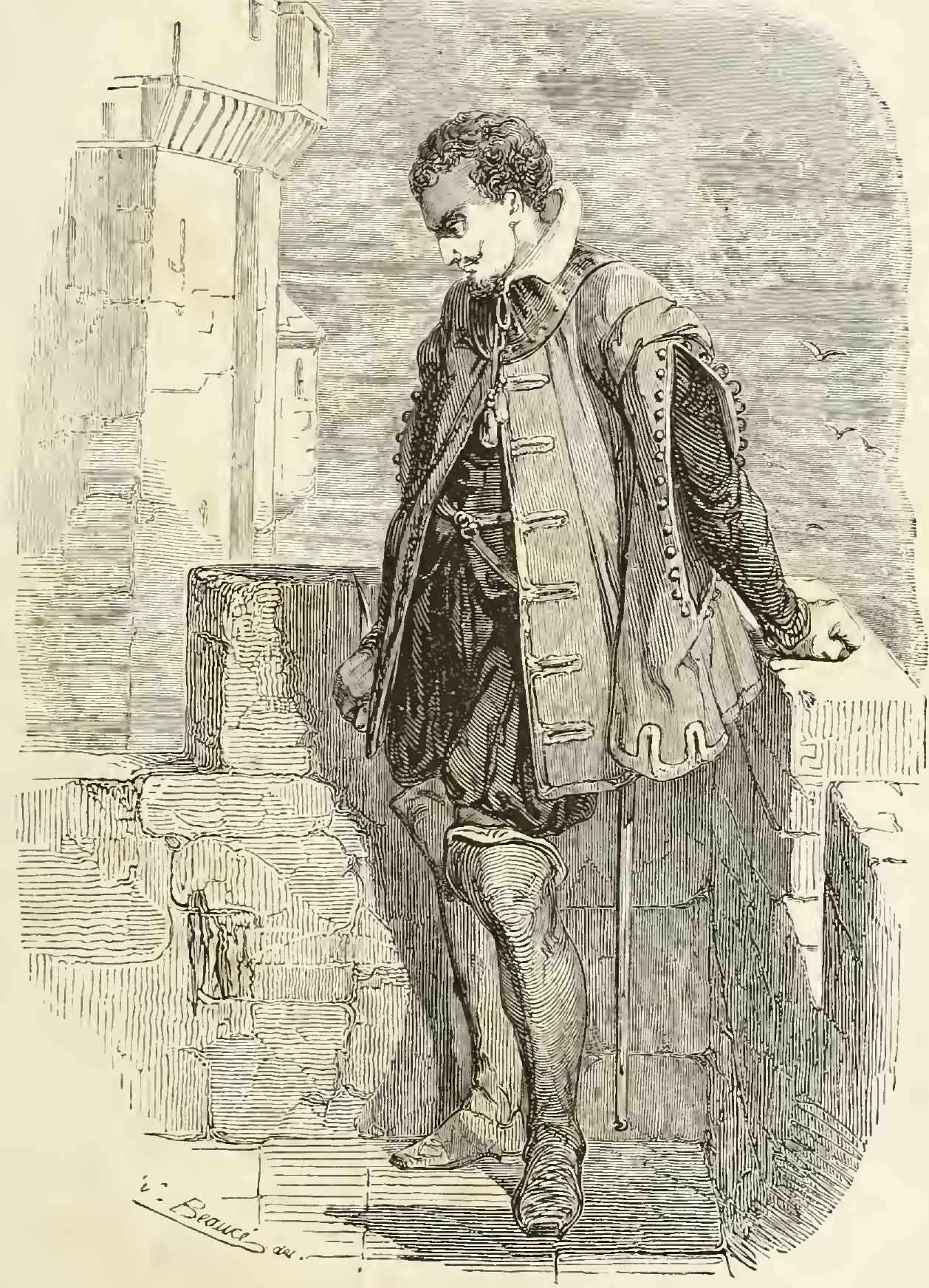
Felton remained last; he held a book in his hand.
Milady, reclining in an armchair near the fireplace, beautiful, pale, and resigned, resembled a holy virgin awaiting martyrdom.
Felton approached her and said:
"Lord de Winter, who is a Catholic like yourself, madame, has thought that being deprived of the rites and ceremonies of your religion may be painful to you; he therefore consents to your reading each day the ordinary of your mass, and here is a book that contains the ritual."
At the air with which Felton laid the book on the little table near which milady was sitting, at the tone in which he pronounced these two words: your mass, at the disdainful smile with which he accompanied them, milady raised her head and looked more attentively at the officer.
Then, from that severe headdress, from that costume of exaggerated simplicity, from that brow as polished as marble, but as hard and impenetrable as it, she recognized one of those somber Puritans whom she had so often encountered, both at the court of King James and at that of the King of France, where, despite the memory of Saint Bartholomew, they sometimes came seeking refuge.She therefore had one of those sudden inspirations which only people of genius receive in great crises, in supreme moments which must decide their fortune or their life.
These two words: your mass, and a single glance cast at Felton had in fact revealed to her all the importance of the answer she was about to give.
But, with the rapidity of intelligence that was peculiar to her, this answer, fully formulated, presented itself on her lips:
"I?" she said, with an accent of disdain pitched in unison with the one she had noticed in the young officer's voice, "I, sir, my mass? Lord de Winter, the corrupt Catholic, knows very well that I am not of his religion, and it is a trap he means to set for me."
"And of what religion are you, then, madame?" asked Felton with an astonishment that, despite his self-control, he could not entirely conceal.
"I will say so," cried milady with feigned exaltation, "on the day when I shall have suffered enough for my faith."
Felton's gaze revealed to milady the whole extent of the space she had just opened for herself by that single word.
However, the young officer remained mute and motionless; only his eyes had spoken.
"I am in the hands of my enemies," she continued with that tone of enthusiasm she knew to be familiar to the Puritans. "Well then! let my God save me, or let me perish for my God! That is the answer I beg you to give to Lord de Winter. And as for this book," she added, pointing to the ritual with the tip of her finger, but without touching it, as if she would have been defiled by that contact, "you may take it back and use it for yourself, for doubtless you are doubly an accomplice of Lord de Winter, an accomplice in his persecution, an accomplice in his heresy."
Felton answered nothing, took the book with the same feeling of repugnance he had already shown, and withdrew, pensive.
Lord de Winter came around five o'clock in the evening. Milady had had time, throughout the day, to trace out her plan of conduct; she received him as a woman who has already regained all her advantages.
"It seems," said the baron, seating himself in an armchair facing the one milady occupied and stretching his feet nonchalantly toward the hearth, "it seems that we have made a little apostasy?"
"What do you mean, sir?"
"I mean that since the last time we saw each other, we have changed religion. Have you by chance married a third Protestant husband?"
"Explain yourself, milord," replied the prisoner with majesty, "for I declare to you that I hear your words, but that I do not understand them."
"Then it is that you have no religion at all; I like that better," resumed Lord de Winter with a sneer.
"It is certain that that is more in accordance with your principles," replied milady coldly.
"Yes, I confess to you that that is perfectly indifferent to me."

"Oh! you would not admit that religious indifference, milord, if your debaucheries and your crimes did not bear witness to it."
"Hey! you speak of debaucheries, Madame Messalina! you speak of crimes, Lady Macbeth! either I have misunderstood, or, by God! you are very impudent."
"You speak thus because we are being listened to, sir," replied milady coldly, "and because you wish to interest your jailers and your executioners against me."
"My jailers! my executioners! Indeed, madame, you take it in the poetic tone, and yesterday's comedy turns this evening into tragedy. Besides, in eight days you will be where you ought to be, and my task will be accomplished."
"Infamous task, impious task!" resumed milady with the exaltation of the victim who provokes her judge.
"I believe, on my word of honor," said de Winter, rising, "that the little madcap is going mad. Come, come, calm yourself, Madame Puritan, or I will have you put in the dungeon. By God! it is my Spanish wine that is going to your head, is it not? but be easy, that drunkenness is not dangerous and will have no consequences."
And Lord de Winter withdrew, swearing, which at that period was an entirely cavalier habit.
Felton was indeed behind the door and had not lost a word of that whole scene.
Milady had guessed rightly.
"Yes, go! go!" she said to her brother, "the consequences are approaching, on the contrary; but you will not know them, imbecile, until it is no longer time to avoid them."
Silence was reestablished; two hours passed; supper was brought, and milady was found occupied in saying her prayers, prayers she had learned from an old servant of her second husband, a most austere Puritan. She seemed in ecstasy, and did not even appear to notice what was happening around her. Felton made a sign that she should not be disturbed, and when everything was ready, he went out noiselessly with the soldiers.
Milady knew that she could be observed, so she continued her prayers to the end, and it seemed to her that the soldier on sentry duty at her door no longer walked with the same step and appeared to be listening.
For the moment she wanted no more; she rose, sat down at the table, ate little, and drank only water.
An hour later they came to remove the table, but milady noticed that this time Felton did not accompany the soldiers.
He was afraid, then, of seeing her too often.
She turned around to smile, for there was in that smile such an expression of triumph that that smile alone would have denounced her.
She let another half hour pass, and as at that moment everything was silent in the old castle, as nothing was heard but the eternal murmur of the swell, that immense breathing of the Ocean, in her pure, harmonious, and vibrant voice she began the first stanza of that psalm then entirely in favor among the Puritans:
Lord, if thou abandonest us,
It is to see if we are strong,
But afterward it is thou who givestFrom thy celestial hand the palm to our efforts.
These verses were not excellent, far from it even, but as is well known, Protestants did not pride themselves on poetry.
While singing, milady listened: the soldier on guard at her door had stopped as if he had been turned to stone. Milady could therefore judge of the effect she had produced.
So she continued her song with a fervor and an emotion beyond expression: it seemed to her that the sounds spread far away beneath the vaults and went like a magic charm to soften the hearts of her jailers. However, it appears that the sentinel soldier, a zealous Catholic no doubt, shook off the charm, for through the wicket which he opened:
"Be quiet, then, madame," he said, "your song is as sad as a De Profundis, and if, on top of the pleasure of being garrisoned here, one must also hear such things, it will be impossible to endure it."
"Silence!" then said a grave voice, which milady recognized as that of Felton; "what business is it of yours, you fool? Was he ordered to prevent this woman from singing? No. He was told to guard her, to shoot her if she tried to escape. Guard her; if she flees, kill her; but do not change the order in any way."
An expression of indescribable joy lit up milady's face; but this expression was fleeting as the flash of lightning, and without appearing to have heard the dialogue, not a word of which she had missed, she resumed, giving her voice all the charm, all the range, and all the seduction that the devil had put into it:
For so many tears and so much misery, For my eye and for my chains, I have my youth, my prayer, And God, who will count the ills I have suffered.
This voice, of an unheard-of range and a sublime passion, gave to the rough and uncultivated poetry of these psalms a magic and an expression that the most exalted Puritans rarely found in the chants of their brethren, and which they were forced to adorn with all the resources of their imagination: Felton thought he heard the angel singing who consoled the three Hebrews in the fiery furnace!
Milady continued:
But the day of deliverance Will come for us, God just and strong. And if it deceives our hope, There still remains to us martyrdom and death.
This stanza, into which the terrible enchantress put her whole soul, completed the disorder in the young officer's heart; he abruptly opened the door, and milady saw him appear pale as always, but with eyes burning and almost distraught.
"Why do you sing like that," he said, "and with such a voice?"
— Excuse me, sir, said Milady gently, I forgot that my songs are notsuitable in this house. I have no doubt offended your beliefs, but I did so without intending it, I swear to you. So forgive me for a fault that is perhaps great, but that is certainly involuntary.
"The old maid, who had left the house, and
Milady was so beautiful in that moment, the religious ecstasy in which she was plunged gave such an expression to her face, that Felton, dazzled, believed he saw the angel whom a moment before he had seemed only to hear.
— Yes, yes, he replied, yes, you disturb, you agitate the people who live in the castle.
And the poor fool did not himself notice the incoherence of his words, while Milady plunged her lynx's eye to the very depths of his heart.
— I will be silent, said Milady, lowering her eyes, with all the gentleness she could give to her voice, with all the resignation she could impress upon her bearing.
— No, no, madam, said Felton, only sing less loudly, at night especially.
And at these words Felton, feeling that he could no longer maintain his severity toward the prisoner, rushed out of her apartment.
— You did well, lieutenant, said the soldier, those songs turn one's soul upside down; however, one ends by growing accustomed to them: the voice is so beautiful!