MILADY’S SECRET.
IN SPITE of Ketty’s urgings, d’Artagnan had left the hotel instead of going up at once to the young girl’s room to wait there for the hour of his interview with milady; and this for two reasons: the first was that in this way he avoided the reproaches, the recriminations, and the entreaties of the pretty maid; the second was that he was not sorry to reflect and to penetrate coldly, if possible, into this woman’s thoughts. What was clearest in all this was that d’Artagnan loved milady like a madman, and that she, on the contrary, did not love him in the least. For a moment he understood that the best thing he could do would be to return home and write milady a long letter in which he would avow to her that he and de Wardes had until now been the same person; that consequently he could not engage, on pain of suicide, to kill de Wardes, of whom she claimed to have reason to complain. But he too was spurred on by a fierce desire for vengeance; he wished in his turn to possess this woman under his own name, and as this vengeance appeared to him to have a certain sweetness, he had no intention of renouncing it.
He walked five or six times around the Place Royale, turning back every ten paces to look at the light in milady’s apartment, which could be seen through the blinds: it was evident that this time the young woman was less in a hurry than the first time to return to her room.
At last the light disappeared.
With that gleam the last irresolution in d’Artagnan’s heart died out. He recalled the details of the first night, and with a beating heart and a burning head he re-entered the hotel and rushed into Ketty’s room.
The young girl, pale as death, trembling in every limb, tried to stop her lover; but milady, with her ear on the watch, had heard the noise d’Artagnan made; she opened the door.
“Come,” she said.
All this was of such incredible impudence, of such monstrous effrontery, that d’Artagnan could scarcely believe what he saw and what he heard. He thought he was being drawn into one of those fantastic intrigues such as one carries out in a dream.
He nonetheless sprang toward milady, yielding to that magnetic attraction which the lodestone exerts on iron.
The door closed behind them.
Ketty in turn rushed against the door.
Jealousy, fury, wounded pride, in short all the passions that contend for the heart of a woman in love, urged her to a revelation; but she was lost if she admitted having had a hand in such a machination, and above all d’Artagnan was lost to her. This last thought of love counseled her to make this last sacrifice.
D’Artagnan, for his part, had reached the height of his wishes. It was no longer a rival whom they loved in him; it was himself whom they seemed to love. A secret voice told him indeed, deep in his heart, that he was but an instrument of vengeance that was being caressed while waiting for him to deal death; but pride, but self-love, but folly, silenced that voice, stifled that murmur. Then our Gascon, with the dose of confidence we know he had, compared himself to de Wardes, and asked himself why, after all, they should not love him too for himself.
He therefore abandoned himself entirely to the sensations of the moment. Milady was no longer for him that woman with fatal intentions who had for a moment terrified him; she was an ardent and passionate mistress, giving herself wholly to a love that she seemed herself to feel.
About two hours passed thus.
Meanwhile the transports of the two lovers calmed; milady, who had not the same motives as d’Artagnan for forgetting, was the first to return to reality and asked the young man whether the measures that were to bring about a meeting between him and de Wardes the next day were well settled in advance in his mind.
But d’Artagnan, whose ideas had taken a wholly different course, forgot himself like a fool, and replied gallantly that it was not with her, when he was wholly given over to the happiness of seeing and hearing her, that he could occupy himself with duels with swords.
This coldness toward the only interests that occupied her frightened milady, whose questions became more pressing.
Then d’Artagnan, who had never seriously thought of this impossible duel, tried to turn the conversation aside, but he had not the strength.
Milady kept the conversation within the limits she had traced in advance with her irresistible mind and her will of iron.
D’Artagnan then thought himself very witty in advising milady to renounce, in pardoning de Wardes, the furious projects she had formed. But at the first words he said, the young woman’s face took on a sinister expression.
— Would you be afraid, dear d’Artagnan? she cried in a sharp and mocking voice that rang strangely in the young man’s ears.
— You do not think so, dear soul, replied d’Artagnan; but after all, if this poor Comte de Wardes were less guilty than you believe?
— In any case, said milady gravely, he has deceived me; from the moment he deceived me he has deserved death.
— He shall die then, since you condemn him, said d’Artagnan in so firm a tone that it appeared to milady the expression of a devotion proof against every trial.
She immediately drew closer to him.
We could not say how long the night lasted for milady; but d'Artagnan believed he had been near her for barely two hours when daylight appeared through the cracks in the blinds and soon flooded the room with its pale glow. Then milady, seeing that d'Artagnan was about to leave her, reminded him of the promise he had made to avenge her on de Wardes.
"I am quite ready," said d'Artagnan; "but first I should like to be certain of one thing."
"Of what?" asked milady.
"That you love me."
"I have given you proof of it, it seems to me," she replied.
"Yes; and so I am yours body and soul. Dispose of my arm!"
"Thank you, my brave defender; but just as I have proved my love to you, you will prove yours to me in turn, will you not?"
"Certainly. But if you love me as you say you do," resumed d'Artagnan, "do you not fear a little for me?"
"What can I fear?"
"But after all, that I may not be dangerously wounded, killed even."
"Impossible," said milady. "You are such a valiant man and such a fine blade!"
"You would not prefer, then," resumed d'Artagnan, "a means that would avenge you just the same, while making the combat unnecessary?"
Milady looked at the young man in silence; that pale glow of the first rays of day gave her clear eyes a strangely fatal expression.
"Truly," she said, "I believe you are hesitating now!"
"No, I am not hesitating, but the fact is that poor Comte de Wardes pains me greatly now that you no longer love him, and it seems to me that a man must be so cruelly punished by the loss of your love alone that he has no need of any other chastisement."
"Who told you that I ever loved him?" asked milady.
"At least I may believe now, without too much fatuity, that you love another," said the young man in a caressing tone, "and, I repeat, I am concerned for the count."
"You?" asked milady.
"Yes, I."
"And why you?"
"Because I alone know—"
"What?"
"That he is far from being, or rather from having been, as guilty toward you as he appears."
"Indeed!" cried milady with an anxious air; "explain yourself, for I truly do not know what you mean."
And she looked at d'Artagnan, who was holding her in his embrace, with eyes that were gradually kindling with a sinister fire.
"Yes, I am a gallant man," said d'Artagnan, resolved to have done with it, "and since you have proved your love to me, since I am quite sure of possessing it—for I do possess it, do I not?"
"Entirely. Continue."
"Well! I feel as though I were transformed: a confession urges me on."
"A confession?"
"Had I not been sure of your love, I would not have made it; but you love me, my beautiful mistress, do you not love me?"
"No doubt."
"Then, if through an excess of love I have made myself guilty toward you, will you forgive me?"
"Perhaps. But this confession," she said, growing pale, "what is this confession?"
"You gave de Wardes a rendezvous last Thursday, in this very room, did you not?"
"I! No! That is not so!" said milady in so firm a tone and with so impassive a face that, had d'Artagnan not had such perfect certainty, he would have doubted.
"Do not lie, my beautiful angel," said d'Artagnan, striving to smile; "it would be useless."
"How is that? Speak, then! You are killing me!"
"Oh! reassure yourself; you are not guilty toward me, and I have already forgiven you."
"And then, and then?" said milady.
"De Wardes cannot boast of anything."
"Why? You yourself told me that that ring—"
"That ring, dear love, it was I who had it. The de Wardes of Thursday and the d'Artagnan of today are the same person."
The imprudent man expected a surprise mingled with modesty, a little storm that would dissolve into tears; but he was strangely mistaken, and his error did not last long!
Pale and terrible, milady drew herself up, and pushing d'Artagnan back with a violent blow to the chest, she sprang out of bed.
It was then almost broad daylight. D'Artagnan held her back by her robe of fine Indian linen to implore her pardon; but she, with a powerful and resolute movement, tried to flee. Then the cambric tore, leaving her shoulders bare, and on one of those beautiful round white shoulders d'Artagnan, with an inexpressible shock, recognized the fleur-de-lys, that indelible mark imprinted by the infamous hand of the executioner.
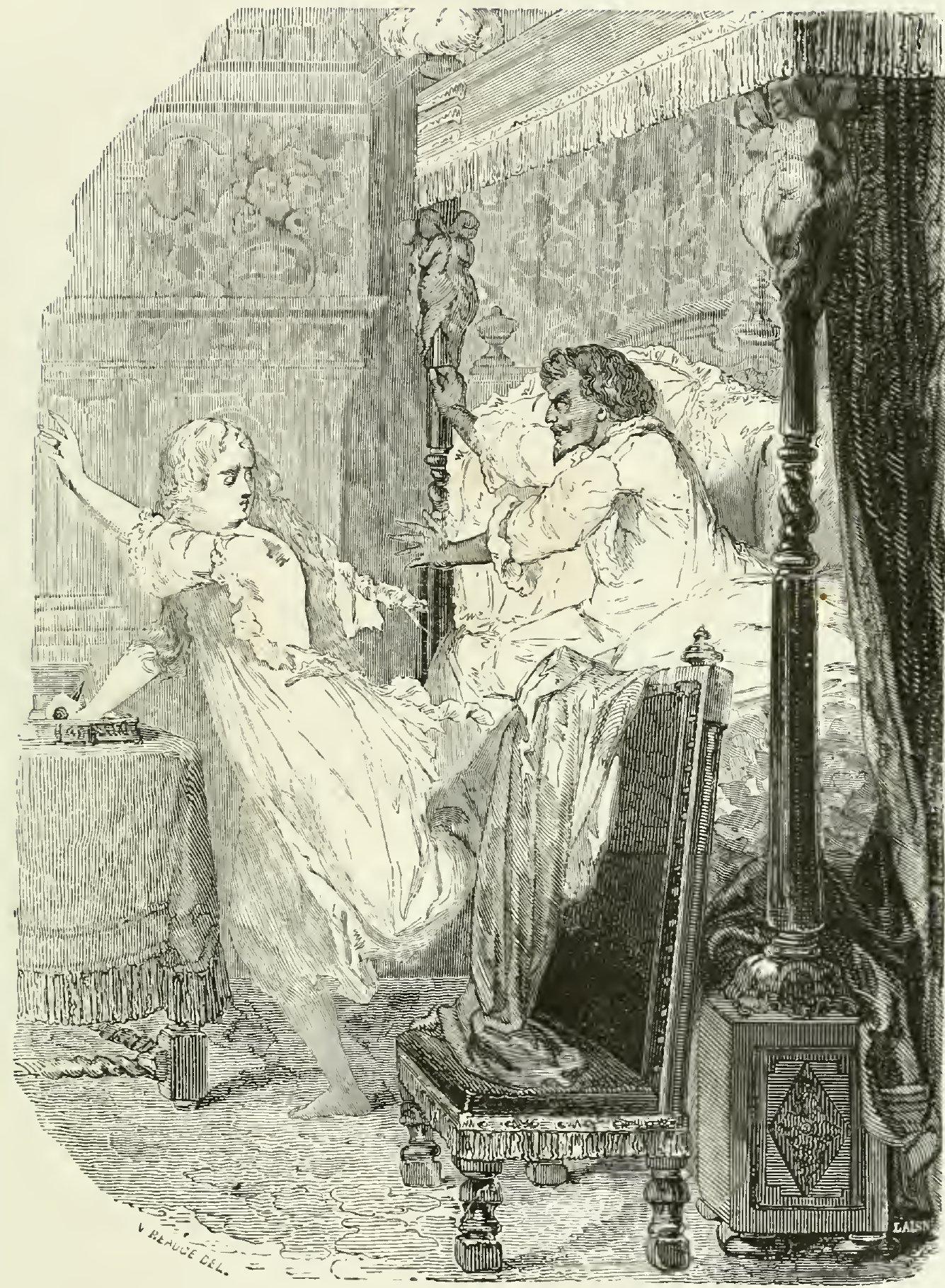

"Great God!" cried d'Artagnan, releasing the robe; and he remained mute, motionless, and frozen in his place.
But milady felt herself denounced by d'Artagnan's very terror. No doubt he had seen everything; the young man now knew her secret, that terrible secret which everyone was ignorant of except him!
She turned around, no longer like a furious woman, but like a wounded panther.
"Ah! wretch!" she said, "you have basely betrayed me, and what is more, you have my secret! You shall die!"
And she ran to a marquetry coffered box placed on her dressing table, opened it with a feverish and trembling hand, drew from it a small dagger with a golden handle and a sharp, slender blade, and sprang back upon d'Artagnan, half naked.
Although the young man was brave, he was terrified by that distorted face, by those horribly dilated pupils, by those pale cheeks and those bloodied lips; he retreated to the bed curtain as he would have done at the approach of a serpent crawling toward him, and his sword, meeting his sweat-moistened hand, he drew it from the scabbard.
But without troubling herself at the sight of the sword, milady continued to advance toward him to strike, and she stopped only when she felt the sharp point against her breast.
Then she tried to seize that sword with her hands, but d'Artagnan kept it always beyond her grasp, and presenting it now to her eyes, now to her throat, he let himself slide down from the bed, seeking, in order to retreat, the door that led to Ketty's room.
Milady, meanwhile, was rushing upon him with dreadful transports, roaring in a formidable manner.
However, as this ended up resembling a duel, d'Artagnan gradually regained his composure.
"Good, fair lady, good," he said, "but, by God! calm yourself, or I shall draw a second fleur-de-lis on your other shoulder."
“Infamous! Infamous!” howled Milady.
But d’Artagnan, still searching for the door, stood on the defensive.
At the noise they made—she overturning the furniture to get at him, and he sheltering behind the furniture to protect himself from her—Kitty opened the door. D’Artagnan, who had continually maneuvered to get closer to that door, was now only three steps from it. With a single bound he sprang from Milady’s room into her maid’s, and, swift as lightning, he shut the door, against which he leaned with all his weight, while Kitty pushed the bolts.
Then Milady tried to force back the barricade that confined her in her room, with strength far beyond that of a woman; then, when she felt that it was impossible, she riddled the door with dagger blows, several of which pierced through the thickness of the wood.
Each blow was accompanied by a terrible curse.
“Quick, quick, Kitty,” said d’Artagnan in a half-voice, once the bolts were shot, “get me out of the hotel, or if we leave her time to turn around, she will have me killed by the lackeys.
(1) Secretariat of the Archives of the Republic. P. 445“But you cannot go out like that,” said Kitty, “you are completely naked.”
“True,” replied d’Artagnan, who only then noticed the costume in which he found himself, “true, dress me as best you can, but let us hurry; do you understand? It is a matter of life and death!”
Kitty understood only too well; in a trice she rigged him out in a flowered dress, a large headdress, and a short cloak; she gave him slippers into which he slipped his bare feet; then she led him down the stairs. It was time: Milady had already rung and awakened the whole hotel; the porter pulled the cord at Kitty’s voice at the very moment when Milady, half naked herself, cried from the window: “Do not open!”
The young man fled, while she still threatened him with an impotent gesture. At the moment when she lost sight of him, Milady fell fainting in her room.