THE MAN IN THE RED CLOAK.
Athos's despair had given way to a concentrated grief which rendered the brilliant qualities of this man still more lucid.
Wholly absorbed in a single thought—that of the promise he had made and the responsibility he had taken upon himself—he withdrew last to his room, asked the host to procure him a map of the province, bent over it, examined the lines traced there, recognized that four different roads led from Béthune to Armentières, and sent for the lackeys.
Planchet, Grimaud, Mousqueton, and Bazin presented themselves and received Athos's clear, precise, and grave orders. They were to set out at daybreak the next morning and make their way to Armentières, each by a different road. Planchet, the most intelligent of the four, was to follow the one taken by the carriage at which the three friends had fired, and which was accompanied, it will be remembered, by Rochefort's servant.
Athos sent the lackeys into the field, first because, since these men had been in his service and that of his friends, he had recognized in each of them different and essential qualities; then because lackeys who ask questions inspire less distrust in peasants than their masters do, and find more sympathy in those they address.
Finally, milady knew the masters, whereas she did not know the lackeys. On the contrary, the lackeys knew milady perfectly.
All four were to meet the next day at eleven o'clock at the appointed place. If they had discovered milady's retreat, three would remain to guard it, and the fourth would return to Béthune to warn Athos and serve as guide to the three friends.
These arrangements made, the lackeys withdrew in their turn.
Athos then rose from his chair, girded on his sword, wrapped himself in his cloak, and left the hotel. It was about ten o'clock; at ten o'clock in the evening, as is well known, the streets of a provincial town are little frequented. Athos, however, was visibly seeking someone to whom he might address a question. At last he met a belated passerby, approached him, and said a few words to him. The man he addressed recoiled in terror; nevertheless he answered the musketeer's words with a direction. Athos offered the man half a pistole to accompany him, but the man refused.

Athos plunged into the street that the informant had pointed out with his finger, but on reaching a crossroads he stopped again, visibly embarrassed. Since, however, this crossroads offered him a better chance than any other place of meeting someone, he stopped there. Indeed, after a moment, a night watchman passed by. Athos repeated to him the same question he had already put to the first person he had met. The night watchman showed the same terror, refused in his turn to accompany Athos, and pointed out with his hand the road he was to follow.
Athos walked in the direction indicated and reached the suburb situated at the end of the town opposite to that by which he and his companions had entered. There he again appeared uneasy and embarrassed, and stopped for the third time.
Fortunately a beggar passed by and approached Athos to ask for alms. Athos offered him a crown to accompany him where he was going. The beggar hesitated a moment, but at the sight of the silver coin gleaming in the darkness he made up his mind and walked ahead of Athos.
Arriving at the corner of a street, he pointed out from afar a small house, isolated, solitary, gloomy; Athos approached it, while the beggar, who had received his pay, hurried away as fast as his legs could carry him.
Athos walked around it before distinguishing the door amid the reddish color with which this house was painted. No light appeared through the cracks of the shutters, no sound could suggest that it was inhabited; it was dark and silent as a tomb.
Three times Athos knocked without anyone answering. At the third knock, however, footsteps approached from within; at last the door opened a little, and a man of tall stature, pale of complexion, with black hair and beard, appeared.
Athos and he exchanged a few words in a low voice, then the tall man signaled to the musketeer that he might enter. Athos took advantage of the permission at once, and the door closed behind him.
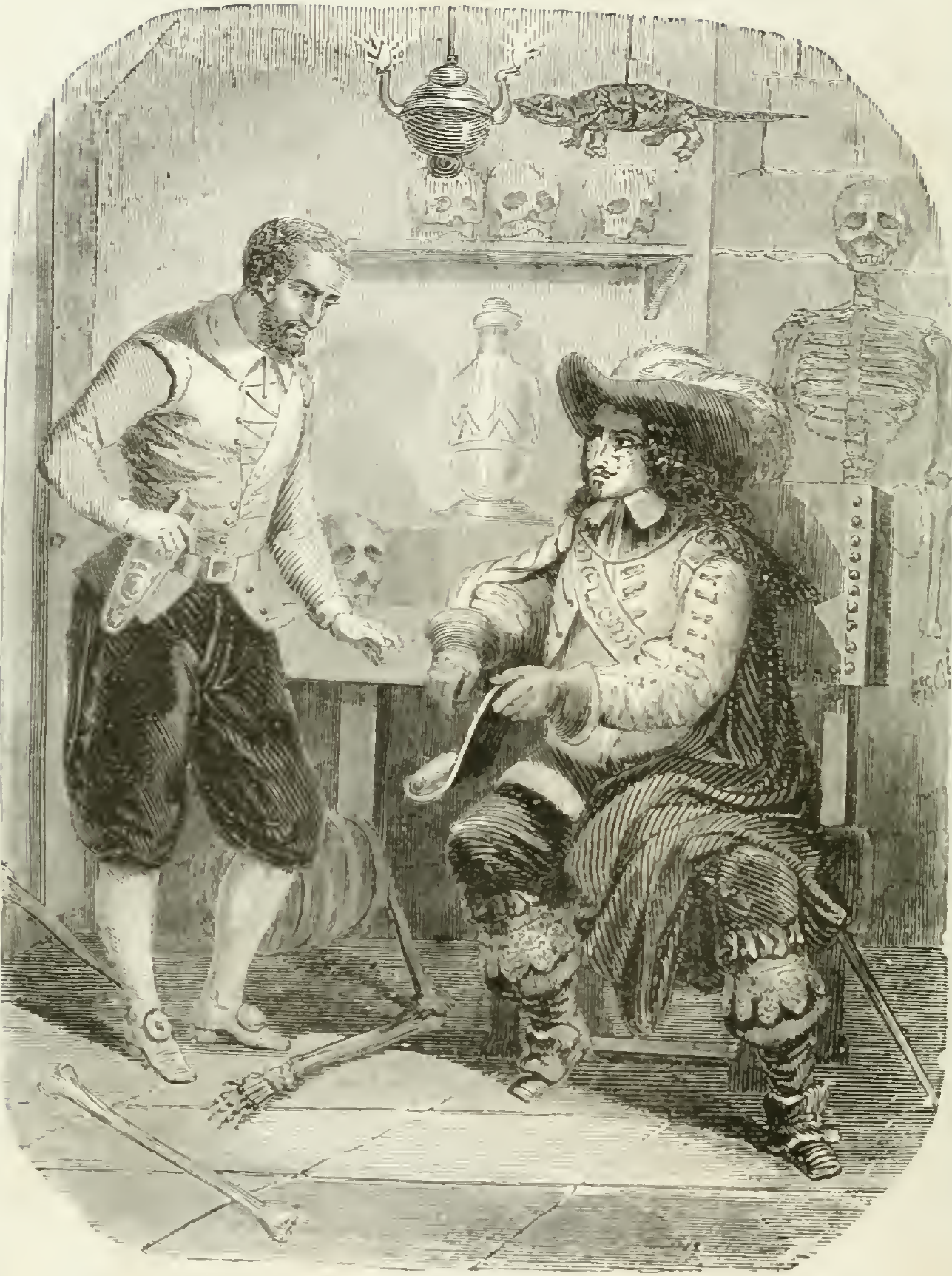
The man whom Athos had come so far to seek and whom he had found with such difficulty led him into a laboratory where he had been occupied in holding together with iron wires the rattling bones of a skeleton. The whole body was already reassembled; only the head was laid on a table.
All the rest of the furnishings indicated that the person whose house this was occupied himself with natural sciences; there were jars full of snakes, labeled according to their species; dried lizards shone like cut emeralds in large frames of black wood. Finally, bunches of wild herbs, fragrant and doubtless endowed with virtues unknown to the common run of men, were hung from the ceiling and descended into the corners of the room.
For the rest, no family, no servants; the tall man lived alone in this house.
Athos cast a cold and indifferent glance over all the objects we have just described, and at the invitation of the man he had come to seek, sat down beside him.
Then he explained the cause of his visit and the service he required; but he had scarcely stated his request when the stranger, who had remained standing before the musketeer, recoiled in terror and refused. Then Athos drew from his pocket a small paper on which were written two lines accompanied by a signature and a seal, and presented it to the man who was giving such premature signs of repugnance. The tall man had scarcely read the two lines, seen the signature, and recognized the seal, when he bowed as a sign that he had no further objection to make and was ready to obey.
Athos asked no more; he rose, went out, retraced on his way back the road he had followed to come, re-entered the hotel, and shut himself in his room.
At daybreak, d'Artagnan entered his room and asked him what was to be done.
"Wait," replied Athos.
A few moments later, the superior of the convent informed the musketeers that the burial of milady's victim would take place at noon. As for the poisoner, no news of her had been received. She must have fled through the garden, on the sand of which the traces of her steps had been recognized, and the gate of which had been found closed; as for the key, it had disappeared.
At the appointed hour, Lord de Winter and the four friends went to the convent: the bells were ringing in full peal, the chapel was open; only the choir grating was closed. In the middle of the choir, the body of the victim, clothed in her novice's habit, was laid out. On each side of the choir and behind gratings opening onto the convent was the whole community of the Carmelites, listening from there to the divine service and mingling their singing with that of the priests, without seeing the profane and without being seen by them.
At the door of the chapel, d'Artagnan felt his courage fleeing once more; he turned to look for Athos, but Athos had disappeared.
Faithful to his mission of vengeance, Athos had had himself conducted to the garden, and there, on the sand, following the light footsteps of that woman who had left a bloody trace everywhere she had passed, he advanced to the gate that opened onto the wood, had it opened for him, and plunged into the forest.
So all his doubts were confirmed: the road by which the carriage had disappeared skirted the forest. Athos followed this road for some time, his eyes fixed on the ground; light spots of blood, coming from a wound inflicted either on the man who accompanied the carriage as a courier or on one of the horses, speckled the road. After about three-quarters of a league, some fifty paces from Festubert, a larger stain of blood appeared; the ground was trampled by the horses. Between the forest and this telltale spot, a little behind the scraped earth, the same trace of small footprints as in the garden was to be found: the carriage had stopped.
At this spot, milady had come out of the woods and got into the carriage.
Satisfied with this discovery, which confirmed all his conjectures, Athos returned to the inn and found Planchet waiting for him impatiently.
Everything was as Athos had foreseen.
Planchet had followed his route, had, like Athos, noticed the spots of blood; like Athos, he had recognized the place where the horses had stopped; but he had gone further than Athos, so that at the village of Festubert, while drinking in an inn, he had, without needing to ask any questions, learned that the previous evening, at half past eight, a wounded man accompanying a lady traveling in a post chaise had been obliged to stop, being unable to go any further. The accident had been attributed to thieves who had supposedly attacked the travelers in the woods. The man had remained in the village; the woman had changed horses and continued on her way.
Planchet set out in search of the postilion who had driven the chaise, and found him. He had driven the lady as far as Fromelles, and from Fromelles she had left for Armentières. Planchet took the shortcut, and at seven in the morning he was at Armentières.
There was only one hotel, the post hotel. Planchet went there to present himself, like a lackey without a place who was looking for a situation. He had not been talking for ten minutes with the people at the inn before he learned that a woman alone had arrived at eleven o'clock at night, had taken a room, had sent for the master of the hotel, and had told him that she wished to stay for some time in the vicinity.
Planchet did not need to know any more. He ran to the rendezvous, found the three lackeys punctual at their posts, brought them along, placed them as sentinels at all the exits of the hotel, and returned to Athos, who was finishing receiving Planchet's information when his friends came back.
All faces were dark, even the gentle face of Aramis.
"What must we do?" asked d'Artagnan.
"Wait," replied Athos.
Each one withdrew to his own room.
At eight o'clock in the evening, Athos gave the order to saddle the horses, and sent word to M. Ter and his friends that they were to prepare for the expedition. All five were ready. Each one inspected his weapons and put them in order. The first to come down found d'Artagnan already on horseback and growing impatient. "Patience," said Athos, "we are still missing someone."
The four horsemen looked around them in astonishment, for they sought in vain in their minds who this someone could be who was missing.
At that moment Planchet brought Athos's horse. The musketeer leaped lightly into the saddle.
"Wait for me," he said, "I will be back."
And he set off at a gallop.
A quarter of an hour later, he indeed returned, accompanied by a masked man wrapped in a large red cloak.
Lord de Winter and the three musketeers exchanged questioning glances. None of them could enlighten the others, for all were ignorant of who this man was.
However, they thought that it must be so, since the thing was being done by Athos's order.
At nine o'clock, guided by Planchet, the little cavalcade set out, taking the road the carriage had followed.
It was a sad sight, that of these six men riding in silence, each plunged in his own thoughts, gloomy as despair, dark as the scaffold.