THE WINE OF ANJOU.
AFTER the almost despairing news of the king, the rumor of his convalescence began to spread through the camp, and as he was in great haste to arrive in person at the siege, it was said that as soon as he could mount a horse again, he would set out on the road.
Meanwhile, Monsieur, who knew that from one day to the next he was going to be replaced in his command, either by the Duc d'Angoulême, or by Bassompierre or by Schomberg, who were disputing the command, did little, wasted his days in gropings, and did not dare risk any great enterprise to drive the English from the island of Ré, where they were besieging the citadel of Saint-Martin and the fort of Prée, while on their side the French were besieging La Rochelle.
D'Artagnan, as we have said, had become calmer again, as always happens after a danger past and when the danger seems to have vanished. He had only one worry left, and that was to receive no news from his friends.
But one morning at the beginning of November everything was explained to him by this letter dated from Villeroy:
"Monsieur d'Artagnan,
"MM. Athos, Porthos and Aramis, after having had a good game at my house and cheered themselves greatly, made so much noise that the provost of the castle, a very rigid man, confined them for a few days. I nonetheless carry out the orders they gave me to send you twelve bottles of my Anjou wine, of which they made great account; they wish you to drink to their health with their favorite wine.
"I have done so, monsieur, with great respect, your very humble and very obedient servant,
"GODEAU, "host of MM. the musketeers."
— At last! cried d'Artagnan, they think of me in their pleasures, as I thought of them in my boredom. Most certainly I shall drink to their health, and with all my heart, but I shall not drink to it alone.
And d'Artagnan ran to two guards with whom he had made more friendship than with the others, in order to invite them to drink with him the delicious little Anjou wine that had just arrived from Villeroy.
One of the two guards was on duty for that very evening, and the other for the next day; the gathering was therefore fixed for the day after.
D'Artagnan, on returning, sent his twelve bottles of wine to the guards' canteen, recommending that they be kept with care; then on the day of the celebration, as the dinner was fixed for the hour of noon, d'Artagnan sent Planchet at nine o'clock to prepare everything.
Planchet, quite proud to be raised to the dignity of master of the household, set about fulfilling his functions as an intelligent man. To this end, he joined to himself the valet of one of his master's guests, named Fourreau, and moreover also Brissemont, that false soldier who had wanted to kill our hero and who, belonging to no corps, had entered the service of d'Artagnan, or rather that of Planchet since d'Artagnan had saved his life.
The hour of the feast having come, the two guests arrived, took their places, and the dishes lined up on the table; Planchet served, napkin on arm; Fourreau uncorked the bottles, and Brissemont, that was the name of the convalescent, decanted into glass carafes the wine which appeared to have settled from the effect of the jolts of the road. The first bottle being a little cloudy toward the end, Brissemont poured the lees into a glass, and d'Artagnan allowed him to drink it, for the poor devil did not yet have much strength.
The guests, after having eaten the soup, were about to carry the first glass to their lips, when suddenly the cannon resounded at Fort Louis and at Fort Neuf. At once the guards, believing it was a matter of some unforeseen attack, either by the besieged or by the English, jumped on their swords; d'Artagnan did as they did and all three went out running to reach their posts.
But scarcely had they got outside the canteen when they were set at ease about this great noise. The cries of Vive le roi! Vive M. le cardinal! resounded on all sides, and the drums beat in every direction.
Indeed, the king, in his impatience, had just doubled two stages and was arriving at that very moment with all his household and a reinforcement of ten thousand troops. His musketeers preceded and followed him. D'Artagnan, placed in line with his company, greeted with an expressive gesture his friends, who answered him with their eyes, and M. de Tréville, who recognized him at once.
The reception ceremony over, the four friends were soon in one another's arms.
— By heaven! cried d'Artagnan, it is not possible to arrive better, and the meats will not yet have had time to grow cold. Is it not so, gentlemen? added the young man, turning to the two guards, whom he presented to his friends.
— Ah! ah! it seems we were banqueting? said Porthos.
— I hope, said Aramis, that there are no women at your dinner?
— Is there any drinkable wine in your bicoque? asked Athos.
— Why, by heaven! there is yours, dear friend, replied d'Artagnan.
— Our wine? said Athos, astonished.
— Yes, the one you sent me.
— We sent you wine?
— But you know well, that little wine from the hillsides of Anjou...
— Yes, I know well what wine you mean...
— The wine you prefer...
— No doubt, when I have neither champagne nor chambertin.
— Well! for want of champagne and chambertin, you will content yourself with that.
— So we had Anjou wine brought, gourmets that we are? said Porthos.
— But no, it is the wine that was sent to me on your behalf.
— On our behalf? said the musketeers.
— Was it you, Aramis, resumed Athos, who sent the wine?
— No; and you, Porthos?
— No; and you, Athos?
— No.
— If it was not you, said d'Artagnan, it was your host.
— Our innkeeper?
— Ha! yes, your innkeeper, Godeau, the innkeeper of the musketeers.
— Faith! let him come from wherever he likes, no matter! said Porthos, let us taste it, and if it is good, let us drink it.
— No indeed, replied Athos, let us not drink wine that comes from an unknown source.
— You are right, Athos, observed d'Artagnan. Did any of you instruct "innkeeper Godeau to send me wine?
— No; and yet he has sent you some on our behalf?
— Here is the letter, said d'Artagnan, and he presented the note to his comrades.
— That is not his handwriting, cried Athos. I know it; it was I who, before leaving, settled the accounts of the community.
— A false letter, said Porthos, we were not confined to quarters.
— D'Artagnan, asked Aramis in a tone of reproach, how could you believe that we had made a noise?...
D'Artagnan turned pale, and a convulsive trembling shook all his limbs.
— You frighten me, said Athos, who used the familiar "tu" with him only on great occasions. What has happened, then?
— Let us run, let us run, my friends, cried d'Artagnan, a horrible suspicion is crossing my mind: could this be another vengeance of that woman?
It was Athos who turned pale in his turn.
D'Artagnan dashed toward the refreshment room; the three musketeers and the two guards followed him.
The first object that struck d'Artagnan's sight on entering the dining room was Briesmont stretched on the ground and writhing in atrocious convulsions.
Planchet and Fourreau, pale as death, were trying to bring him

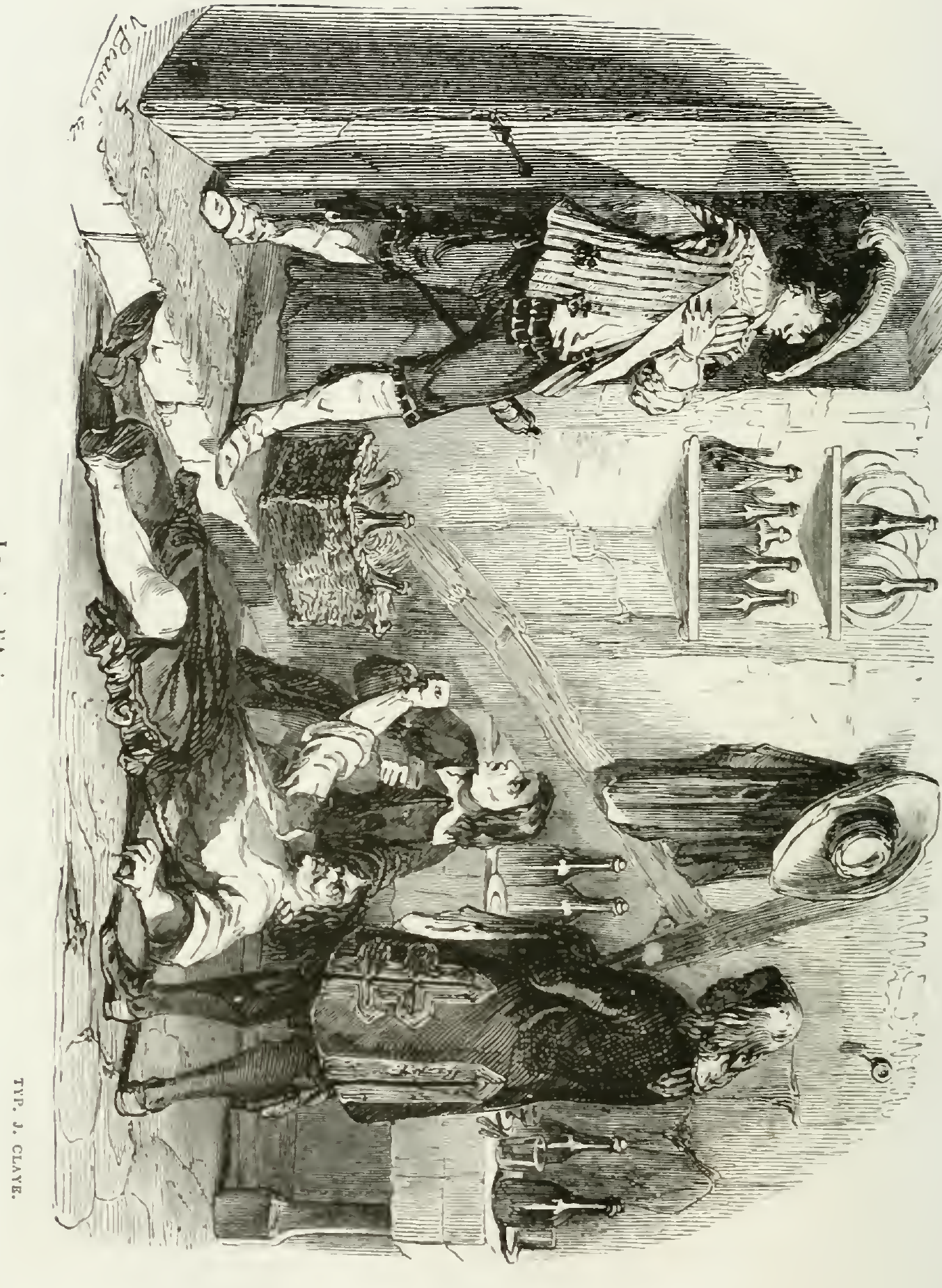
help; but it was evident that all help would be useless: the dying man's features were contorted by agony.
— Ah! he cried when he caught sight of d'Artagnan, ah! it is frightful: you look as though you are granting me mercy, and you are poisoning me!
“I? Answer me!” d’Artagnan said. “I? Wretch that I am! But what are you saying?”
“I say that it was you who gave me this wine; I say that it was you who told me to drink it; I say that you wanted to take your revenge on me; I say that it is horrible!”
“Do not believe it, Brisemont,” d’Artagnan said. “Do not believe it; I swear to you—”
“Oh! but God is there! God will punish you! My God, may he suffer one day what I am suffering!”
“On the Gospel,” d’Artagnan cried, rushing toward the dying man, “I swear to you that I did not know this wine was poisoned, and that I was going to drink it as you did.”
“I do not believe you,” the soldier said, and he expired in a fresh paroxysm of torment.
“Horrible! horrible!” Athos murmured, while Porthos broke the bottles and Aramis gave somewhat belated orders for someone to go and fetch a confessor.
“Oh! my friends,” d’Artagnan said, “you have once again saved my life—and not only mine, but these gentlemen’s. Gentlemen,” he continued, addressing the guards, “I will ask you to keep silent about this whole adventure: great personages may have had a hand in what you have seen, and the harm from all this would fall back on us.”
“Ah! monsieur,” Planchet stammered, more dead than alive, “ah! monsieur, what a narrow escape I had!”
“What, you rascal!” d’Artagnan cried. “So you were going to drink my wine?”
“To the king’s health, monsieur; I was going to drink a poor glass of it, if Fourreau had not told me that I was being called.”
“Alas!” said Fourreau, whose teeth were chattering with terror, “I wanted to get him away so as to drink it all alone.”
“Gentlemen,” d’Artagnan resumed, addressing the guards, “you understand that such a feast could only be very sad after what has just happened; so accept all my apologies and let us put the party off to another day, I beg you.”
The two guards courteously accepted d’Artagnan’s apologies, and, understanding that the four friends wished to remain alone, they withdrew.
When the young guardsman and the three musketeers were without witnesses, they looked at one another in a manner that meant each understood the gravity of the situation.
“First,” Athos said, “let us get out of this room; a dead man is bad company.”
“Planchet,” d’Artagnan said, “I charge you to watch over the corpse of this poor devil; let him be buried in holy ground. He had committed a crime, it is true, but he had repented of it.”
And the four friends left the room, leaving to Planchet and Fourreau the task of paying the last honors to Brisemont.
The host gave them another room, in which they were served boiled eggs and water that Athos went to draw himself from the fountain. In a few words Porthos and Aramis were brought up to date on the situation.
“Well!” d’Artagnan said to Athos, “you see it, dear friend: it is a war to the death.”
Athos shook his head.
“Yes, yes,” he said, “I see it clearly; but do you believe it is she?”
“I am sure of it.”
“And yet I confess to you that I still doubt.”
“But that fleur-de-lis on the shoulder—”
“She is an Englishwoman who must have committed some misdeed in France and been branded in consequence of her crime.”
“Athos, I tell you it is your wife,” d’Artagnan repeated. “Do you not remember how the two descriptions resemble each other?”
“And yet I had thought the other was dead; I had hanged her so thoroughly!”
It was d’Artagnan’s turn to shake his head.
“But after all, what is to be done?” the young man asked.
“The fact is that one cannot remain thus with a sword eternally suspended over one’s head,” Athos said, “and we must get out of this situation.”
“But how?”
“Listen: try to join her and have an explanation with her. Say to her: Peace or war! My word as a gentleman never to say anything of you, never to do anything against you. On your side, a solemn oath to remain neutral with regard to me; otherwise, I shall go to the chancellor, I shall go to the king, I shall go to the executioner; I shall rouse the court against you, I shall denounce you as branded; I shall have you brought to trial, and if you are acquitted, well! I shall kill you, on my honor as a gentleman, at the corner of some post, as I would kill a mad dog.”
“I rather like that means,” d’Artagnan said, “but how are we to join her?”
“Time, dear friend, time brings the opportunity; opportunity is man’s martingale; the more one has staked, the more one gains when one knows how to wait.”
“Yes; but to wait surrounded by assassins and poisoners—”
“Bah!” Athos said. “God has preserved us until now; God will preserve us still.”
“Yes, us. We, besides, are men, and, all things considered, it is our profession to risk our lives; but she!” he added in a low voice.
“Who, she?” Athos asked.
“Constance.”
“Madame Bonacieux? Ah! true,” Athos said. “Poor friend, I forgot that you are in love.”
“Well! but,” Aramis said, “did you not see from the very letter that you found on the wretch who was killed, that she was in a convent? One is very well off in a convent, and as soon as the siege of La Rochelle is over, I promise you that for my part—”
“Good!” Athos said, “good! Yes, my dear Aramis, we know that your vows tend toward religion.”
“I am a musketeer only provisionally,” Aramis said humbly.
“It seems that it is a long time since he has received news from his mistress,” Athos said very quietly; “but do not pay attention, we know all about that.”
“Well!” Porthos said, “it seems to me that there would be a very simple means.”
“Which?” d’Artagnan asked.
“She is in a convent, you say?” Porthos continued.
“Yes.”
“Well! as soon as the siege is over, we will carry her off from that convent.”
“But we still need to know which convent she is in.”
“That is true,” Porthos said.
“But, I think,” Athos said, “do you not claim, dear d’Artagnan, that it was the queen who chose this convent for her?”
“Yes; I believe so, at least.”
— Well then! but Porthos will help us in this.
— How so, if you please? asked Porthos.
— Through your marchioness, your duchess, your princess; she must have a long arm.
— Hush! replied Porthos, putting a finger to his lips; I believe she is a Carpinist, and she must know nothing about it.
— Then, said Aramis, I will take it upon myself to get news of it.
— You, Aramis? exclaimed the three friends; you, and how will you do that?
— Through the queen's almoner, with whom I am very closely connected, said Aramis, blushing.
And upon this assurance the four friends, who had finished their modest meal, separated with a promise to meet again that very evening. D'Artagnan returned to the Minims, and the three musketeers went back to the king's quarter, where they had to see to the preparation of their lodgings.