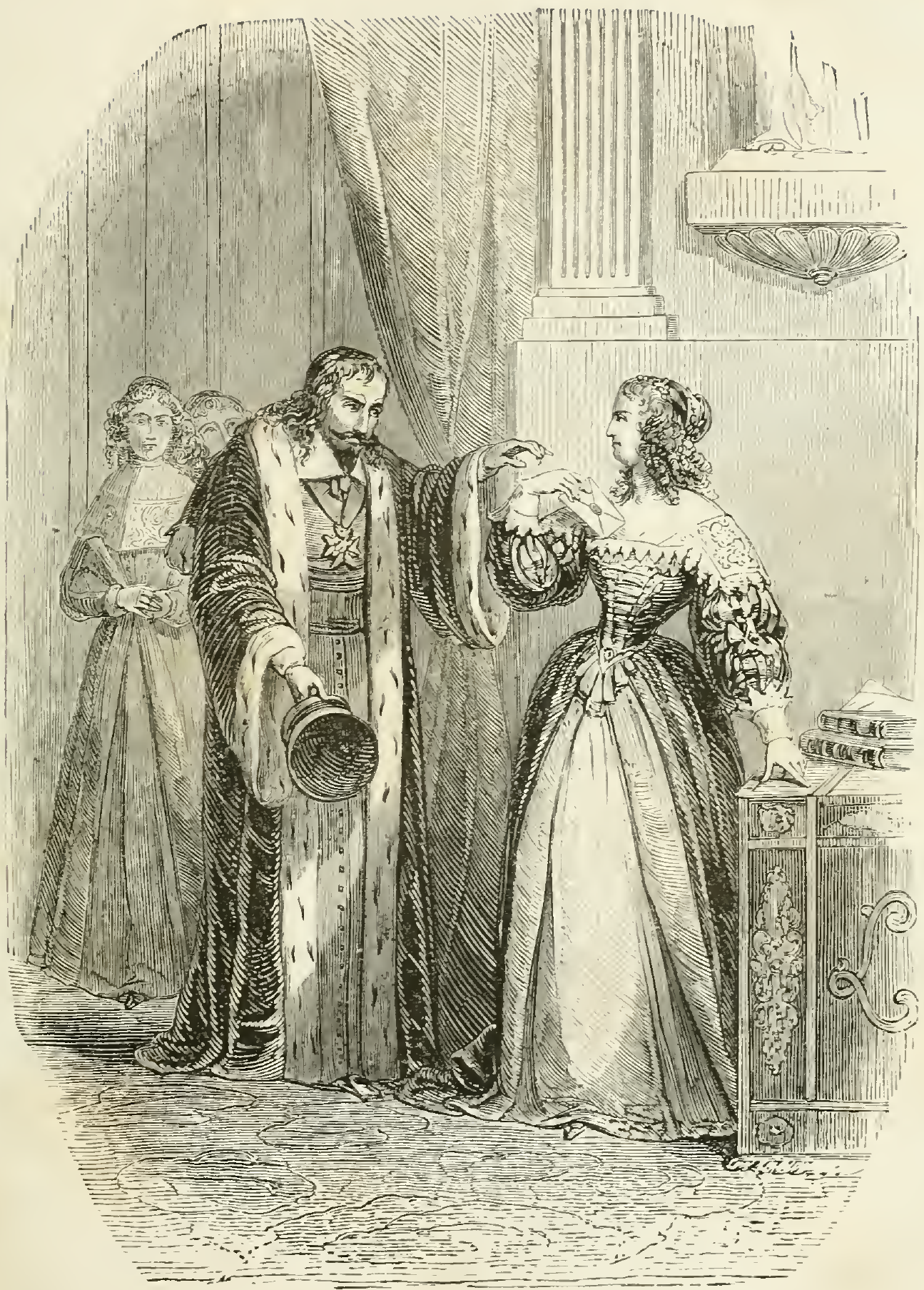
MONSIEUR THE KEEPER OF THE SEALS SÉGUIER SOUGHT MORE THAN ONCE FOR THE BELL TO RING IT, AS HE HAD DONE FORMERLY
It is impossible to form an idea of the impression that these few words produced on Louis XIII; he blushed and paled in turn, and the cardinal saw at once that he had just regained in one stroke all the ground he had lost.
“M. de Buckingham in Paris!” he cried, “and what has he come there to do?”
“Doubtless to conspire with your enemies the Huguenots and the Spaniards.”
“No, by God, no! To conspire against my honor with Mme de Chevreuse, Mme de Longueville, and the Condés!”
“Oh! Sire! what an idea! The queen is too wise, and above all loves Your Majesty too much.”
“Woman is weak, M. the cardinal,” said the king, “and as for loving me much, I have made up my mind about that love.”
— I nonetheless maintain, said the cardinal, that the Duke of Buckingham came to Paris for a wholly political design.
— And I am sure that he came for something else, Monsieur the Cardinal; but if the queen is guilty, let her tremble.
— In fact, said the cardinal, however reluctant I am to fix my mind upon such a treason, Your Majesty makes me think of it: Mme de Lannoy, whom, in accordance with Your Majesty's order, I have questioned several times, told me this morning that on the night before last Her Majesty had stayed up very late, that this morning she had wept a great deal, and that all day she had been writing.
— That is it, said the king; to him without a doubt! Cardinal, I must have the queen's papers—But how are we to take them, Sire? It seems to me that it is neither I nor Your Majesty who can charge ourselves with such a mission.
— How did they go about it with the Maréchale d'Ancre? cried the king, in the highest degree of anger; they searched her cupboards, and in the end they searched her very person.
— The Maréchale d'Ancre was only the Maréchale d'Ancre, a Florentine adventuress, Sire, that is all, whereas the august spouse of Your Majesty is Anne of Austria, queen of France, that is to say, one of the greatest princesses in the world.
— She is only the more guilty for it, Monsieur the Duke! The more she has forgotten the high position in which she was placed, the lower she has stooped. Besides, it is long since I decided to put an end to all these petty intrigues of politics and love. She also has near her a certain Laporte...
— Whom I believe to be the prime mover in all this, I confess, said the cardinal.
— You think, then, as I do, that she is deceiving me? said the king.
"I believe, and I repeat it to Your Majesty, that the queen conspires against the power of her king, but I did not say against his honor."
"And I tell you against both; I tell you that the queen does not love me, I tell you that she loves another, I tell you that she loves that infamous Duke of Buckingham! Why did you not have him arrested while he was in Paris?"
"Arrest the duke! Arrest the prime minister of King Charles I! Do you think of it, Sire? What a scandal! And if at that time Your Majesty's suspicions, which I continue to doubt, had some substance, what a terrible scandal! what a despairing disgrace!"
"But since he exposed himself like a vagabond and a thief, it was necessary to—" Louis XIII stopped himself, frightened by what he was about to say, while Richelieu, stretching out his neck, waited in vain for the word that had remained on the king's lips.
"It was necessary to—?"
"Nothing," said the king, "nothing. But during all the time he was in Paris, you did not lose sight of him?"
"No, Sire."
"Where was he staying?"
"Rue de la Harpe, No. 75."
"Where is that?"
"On the Luxembourg side."
"And you are sure that the queen and he did not see each other?"
"I believe the queen too attached to her duties, Sire."
"But they corresponded; it is to him that the queen wrote all day long; Monsieur the Duke, I must have those letters!"
"Sire, however—"
"Monsieur the Duke, at whatever price, I want them!"
"I shall nevertheless point out to Your Majesty—"
"Do you betray me too, then, Monsieur the Cardinal, to oppose my will thus continually? Are you also in agreement with the Spaniard and with the Englishman, with Mme de Chevreuse and with the queen?"
"Sire," replied the cardinal, smiling, "I believed myself safe from such a suspicion."
"Monsieur the Cardinal, you have heard me: I want those letters!"
"There would be only one means."
"Which?"
"It would be to entrust this mission to M. the Keeper of the Seals Séguier. The matter falls entirely within the duties of his office."
"Have him sent for this very instant!"
"He must be at my house, Sire; I had asked him to call, and when I came to the Louvre, I left orders that if he presented himself, he should be made to wait."
"Have him fetched this very instant!"
"Your Majesty's orders shall be executed; but—"
"But what?"
"But the queen will perhaps refuse to obey."
"My orders?"
"Yes, if she does not know that these orders come from the king."
"Well then! so that she may not doubt it, I shall inform her myself."
"Your Majesty will not forget that I have done all I could to prevent a rupture."
"Yes, Duke, yes, I know that you are very indulgent toward the queen, too indulgent perhaps, and we shall have, I warn you, to speak of that later."
"When it pleases Your Majesty; but I shall always be happy and proud, Sire, to sacrifice myself for the good harmony that I desire to see reign between the king and the queen of France."
"Good, Cardinal, good; but, in the meantime, send for M. the Keeper of the Seals; I myself am going in to the queen."
And Louis XIII, opening the communicating door, entered the corridor that led from his apartments to those of Anne of Austria.
The queen was in the midst of her women, Mme de Guitaut, Mme de Sablé, Mme de Montbazon and Mme de Guéméné. In a corner was that Spanish lady-in-waiting, doña Estefana, who had followed her from Madrid. Mme de Guéméné was reading aloud, and everyone was listening attentively to the reader, with the exception of the queen, who, on the contrary, had prompted this reading so that she might, while pretending to listen, follow the thread of her own thoughts.
These thoughts, though all gilded by a last reflection of love, were none the less sad. Anne of Austria, deprived of her husband's confidence, pursued by the hatred of the cardinal, who could not forgive her for having repulsed a gentler sentiment, having before her eyes the example of the queen mother, whom this hatred had tormented all her life, although Marie de Médicis, if the memoirs of the time are to be believed, had begun by granting the cardinal the sentiment that Anne of Austria always ended by refusing him; Anne of Austria had seen fall around her her most devoted servants, her most intimate confidants, her dearest favorites. Like those unfortunates endowed with a fatal gift, she brought misfortune to everything she touched; her friendship was a fatal sign that called forth persecution. Mme de Chevreuse and Mme de Vernel were exiled; finally Laporte did not hide from his mistress that he expected to be arrested at any moment.
It was at the moment when she was plunged into the deepest and darkest of her reflections that the door of the chamber opened and the king entered.
The reader fell silent at once, all the ladies rose, and a profound silence fell.
As for the king, he made no demonstration of politeness; only, stopping before the queen:
"Madame," he said in an altered voice, "you are about to receive the visit of M. the Chancellor, who will communicate to you certain matters with which I have charged him."
The unfortunate queen, who was ceaselessly threatened with divorce, exile and even trial, paled beneath her rouge and could not help saying:
"But why this visit, Sire? What will M. the Chancellor tell me that Your Majesty cannot tell me himself?"
The king turned on his heel without answering, and almost at the same instant the captain of the guards, M. de Guitaut, announced the visit of M. the Chancellor.
When the chancellor appeared, the king had already gone out through another door.
The chancellor entered half-smiling, half-blushing. As we shall probably meet him again in the course of this story, there is no harm in our readers making his acquaintance from now on.
This chancellor was a pleasant man. It was Des Roches le Masle, a canon of Notre-Dame, who had formerly been the cardinal's valet de chambre, who proposed him to His Eminence as a man wholly devoted. The cardinal trusted him and found himself well served.
Certain stories were told of him, among others this one:
After a stormy youth he had retired to a convent to expiate there, at least for some time, the follies of his adolescence.
But upon entering that holy place, the poor penitent had not been able to close the door so quickly that the passions he was fleeing did not enter with him. He was beset by them without respite, and the superior, to whom he had confided this disgrace, wishing as far as it lay in his power to preserve him from it, had recommended him, in order to conjure away the tempting demon, to resort to the bell rope and pull it with all his might. At the accusing sound, the monks would be forewarned that temptation was besieging a brother, and the whole community would set themselves to prayer.
The advice seemed good to the future chancellor. He conjured the evil spirit with a great abundance of prayers offered by the monks; but the devil does not easily allow himself to be dispossessed of a place where he has installed a garrison; as the exorcisms were redoubled, he redoubled the temptations, so that day and night the bell rang with all its might, announcing the extreme desire for mortification that the penitent was experiencing.
The monks no longer had a moment's rest. By day they did nothing but go up and down the stairs leading to the chapel. At night, besides compline and matins, they were still obliged to leap twenty times out of their beds and prostrate themselves on the tiles of their cells.
It is unknown whether it was the devil who let go or the monks who grew weary, but at the end of three months the penitent reappeared in the world with the reputation of the most terrible possessed man who had ever existed.
On leaving the convent he entered the magistracy, became presiding judge at Mortier in place of his uncle, embraced the cardinal's party, which did not prove little sagacity, became chancellor, served His Eminence with zeal in his hatred against the queen mother and his vengeance against Anne of Austria, spurred on the judges in the Chalais affair, encouraged the efforts of M. de Laffemas, grand gibecier of France, then finally, invested with all the cardinal's confidence, a confidence he had so well earned, he came to receive the singular commission for the execution of which he was presenting himself at the queen's.
The queen was still standing when he entered, but scarcely had she perceived him than she sat down again in her armchair and motioned to her women to sit down again on their cushions and stools, and in a tone of supreme haughtiness:
"What do you desire, monsieur," asked Anne of Austria, "and with what purpose do you present yourself here?"
"To carry out here, in the name of the king, madame, and with all the respect that I have the honor to owe to Your Majesty, an exact search of all your papers."
"What! monsieur, a search of my papers... of mine! But that is an outrageous thing!"
— Pray forgive me, madame; but in this circumstance I am only the instrument of which the king makes use. Has not His Majesty just left this room, and did he not himself invite you to prepare for this visit?
— Search, then, monsieur; I am a criminal, it appears. Estefana, give the keys of my tables and my secretaries.
The chancellor went through the form of searching the furniture, but he well knew that it was not in a piece of furniture that the queen had been obliged to lock up the important letter she had written that day.
When the chancellor had opened and shut twenty times the drawers of the secretary, it was necessary, however much hesitation he felt, it was necessary, I say, to come to the conclusion of the matter, that is to say, to search the queen herself. The chancellor therefore advanced toward Anne of Austria, and in a very perplexed tone and with a very embarrassed air:
— And now, said he, it remains for me to make the principal search.
— Which? asked the queen, who did not understand, or rather who did not wish to understand.
— His Majesty is certain that a letter was written by you during the day; he knows that this letter has not yet been sent to its address. This letter is neither in your table nor in your secretary, and yet this letter is somewhere.
— Would you dare to lay your hand on your queen? said Anne of Austria, drawing herself up to her full height and fixing on the chancellor her eyes, whose expression had become almost threatening.
— I am a faithful subject of the king, madame, and whatever His Majesty orders, I will do.
— Well, it is true, said Anne of Austria, and the spies of M. the cardinal have served him well; I wrote a letter today; that letter has not gone; it is here.
And the queen brought her beautiful hand back to her bodice.
— Then give me that letter, madame, said the chancellor.
— I will give it only to the king, monsieur, said Anne.
— If the king had wished this letter to be delivered to him, madame, he would have asked you for it himself. But, I repeat, it is I whom he has charged to demand it of you, and if you do not give it up...
— Well?
— It is still I whom he has charged to take it from you.
— How? what do you mean?
— That my orders go far, madame, and that I am authorized to search for the suspected paper on the person of Your Majesty herself.
— What horror! cried the queen.
— Be pleased, then, madame, to act more easily.
— This conduct is of an infamous violence; do you know that, monsieur?
— The king commands, madame; excuse me.
— I will not suffer it, no, no, rather die! cried the queen, in whom the imperious blood of the Spaniard and the Austrian revolted.
The chancellor made a deep bow, then with the very patent intention of not retreating a single inch in the accomplishment of the commission with which he had charged himself, and as an executioner's valet might have done in the torture chamber, he approached Anne of Austria, from whose eyes were seen at once to spring tears of rage.
The queen was, as we have said, of great beauty. The commission could therefore pass for delicate, and the king had come, by dint of jealousy of Buckingham, to be jealous of no one.
No doubt Chancellor Séguier at that moment sought with his eyes the cord of the famous bell, but not finding it, he made up his mind and stretched out his hand toward the place where the queen had admitted that the paper was.
Anne of Austria took a step backward, so pale that one would have said she was about to die, and supporting herself with her left hand so as not to fall, against a table that stood behind her, she drew from her bosom with her right a paper and handed it to the keeper of the seals.
— Here, monsieur, there it is, that letter, cried the queen in a broken and trembling voice, take it, and deliver me from your odious presence.
The chancellor, who on his side was trembling with an emotion easy to conceive, took the letter, bowed to the ground, and withdrew.
Hardly had the door closed on him when the queen fell half fainting into the arms of her women.
The chancellor went to carry the letter to the king without having read a single word of it. The king took it with a trembling hand, sought the address, which was missing, became very pale, opened it slowly, then seeing by the first words that it was addressed to the king of Spain, he read it very rapidly.
It was a whole plan of attack against the cardinal. The queen invited her brother and the emperor of Austria to pretend, wounded as they were by the policy of

Richelieu, whose eternal preoccupation was the abasement of the house of Austria, to declare war on France and to impose as a condition of peace the dismissal of the cardinal; but of love, there was not a single word of it in all that letter.
The king, overjoyed, inquired whether the cardinal was still at the Louvre. He was told that His Eminence was waiting in the study for the orders of His Majesty.
The king went at once to him.
— Here, duke, said he, you were right, and it is I who was wrong; the whole intrigue is political, and there was no question at all of love in this letter, which is here. In exchange, there is a great deal about you.
The cardinal took the letter and read it with the greatest attention, then, when he had reached the end, he read it a second time.
— Well! Your Majesty, said he, you see how far my enemies go; you are threatened with two wars if you do not send me away. In your place, in truth, Sire, I would yield to such powerful instances, and it would be on my side with a true happiness that I would withdraw from affairs.
— What are you saying there, duke!
— I say, Sire, that my health is being lost in these excessive struggles and these eternal labors. I say that in all probability I shall not be able to endure the fatigues of the siege of La Rochelle, and that it is better that you appoint there either M. de Condé, or M. de Bassompierre, or finally some valiant man whose profession it is to wage war, and not me, who am a man of the Church and whom they are constantly turning aside from my vocation, to apply me to things for which I have no aptitude. You will be happier at home, Sire, and I do not doubt that you will be greater abroad.
— M. le duc, said the king, I understand, be at ease; all those named in this letter will be punished as they deserve, and the queen herself.
— What are you saying there, Sire! God keep me that, for my sake, the queen should experience the slightest annoyance; she has always believed me her enemy, Sire, although Your Majesty can attest that I have always warmly taken her part, even against you. Oh! if she were betraying Your Majesty in the matter of her honor, that would be another thing, and I would be the first to say: No mercy, Sire, no mercy for the guilty one! Happily it is nothing of the sort, and Your Majesty has just acquired a new proof of it.
“It is true, Monsieur the Cardinal,” said the king, “and you were right, as always, but the queen nonetheless deserves all my anger.”
“It is you, Sire, who have incurred hers, and truly, if she were to sulk seriously at Your Majesty, I would understand it; Your Majesty has treated her with a severity—”
“That is how I will always treat my enemies and yours, duke, however highly placed they may be and whatever peril I may run in acting severely toward them.”
“The queen is my enemy, but she is not yours, Sire; on the contrary, she is a devoted, submissive, and irreproachable wife; allow me, then, Sire, to intercede for her with Your Majesty.”
“Then let her humble herself, and let her come back to me first.”
“On the contrary, Sire, set the example; you were the first to be at fault, since it is you who suspected the queen.”
“I come back first!” said the king; “never!”
“Sire, I beg you.”
“Besides, how would I come back first?”
“By doing something that you know will be pleasing to her.”
“What?”
“Give a ball; you know how much the queen loves dancing; I assure you that her resentment will not withstand such an attention.”
“Monsieur the Cardinal, you know that I do not like all worldly pleasures.”
“The queen will be all the more grateful to you for it, since she knows your antipathy for that pleasure; besides, it will be an occasion for her to wear her beautiful diamond studs that you gave her the other day for her birthday, and which she has not yet had time to adorn herself with.”
“We shall see, Monsieur the Cardinal, we shall see,” said the king, who, in his joy at finding the queen guilty of a crime he cared little about, and innocent of a fault he greatly dreaded, was quite ready to make peace with her; “we shall see, but on my honor you are too indulgent.”
"Sire," said the cardinal, "leave severity to ministers; indulgence is a royal virtue; exercise it, and you will see that you will be the better for it."
Thereupon the cardinal, hearing the clock strike eleven, bowed low, asking leave of the king to retire, and begging him to be reconciled with the queen.
Anne of Austria, who, after the seizure of her letter, expected some reproach, was greatly astonished to see the next day that the king made attempts at reconciliation with her. Her first impulse was to repel him; her womanly pride and her queenly dignity had both been so cruelly offended that she could not come round thus at the first onset; but, overcome by the advice of her women, she at last appeared to begin to forget. The king took advantage of this first moment of relenting to tell her that he intended very shortly to give a fete.
A fete was so rare a thing for poor Anne of Austria that at this announcement, as the cardinal had foreseen, the last trace of her resentments disappeared, if not from her heart, at least from her face. She asked on what day this fete was to take place, but the king replied that he must first come to an understanding with the cardinal on that point.
In fact, every day the king asked the cardinal at what time this fete was to take place, and every day the cardinal, under some pretext or other, deferred fixing it. Ten days passed thus.
On the eighth day after the scene we have related, the cardinal received a letter bearing the London postmark, which contained only these few lines:
"I have them, but I cannot leave London, as I am in want of money; send me five hundred pistoles, and four or five days after receiving them I shall be in Paris."
The very day on which the cardinal had received this letter, the king put his usual question to him.Richelieu counted on his fingers and said to himself:
"'She will arrive,' says she, 'four or five days after receiving the money'; it takes four or five days for the money to go, four or five days for her to return: that makes ten days; now, let us allow for contrary winds, bad luck, and a woman's weakness, and put it down at twelve days."
"Well, Monsieur the Duke," said the king, "have you calculated?"
"Yes, Sire; we are to-day the 20th of September; the aldermen of the city are giving a fete on the 5th of October. That will arrange itself admirably, for you will not appear to be making an advance toward the queen."
Then the cardinal added:
"By the way, Sire, do not forget to tell Her Majesty, on the eve of that fete, that you wish to see how her diamond studs become her."