THE HUNT FOR EQUIPMENT.
The most preoccupied of the four friends was certainly d’Artagnan, although d’Artagnan, in his capacity as a guardsman, was much easier to equip than the gentlemen musketeers, who were lords; but our Gascon cadet was, as has been seen, of a foreseeing and almost avaricious character, and with that (explain the contradictions) vainglorious almost enough to outdo Porthos. To this preoccupation with his vanity, d’Artagnan at this moment joined a less selfish anxiety. However much information he might have soughtabout Mme Bonacieux, no news of her had reached him: M. de Tréville had spoken of her to the queen; the queen did not know where the young linen-draper was and had promised to have her looked for. But that promise was very vague and scarcely reassured d’Artagnan.
Athos did not leave his room; he was resolved not to risk a single step toward equipping himself.
“We have fifteen days left,” he said to his friends. “Well! if at the end of those fifteen days I have found nothing, or rather if nothing has come to find me, since I am too good a Catholic to blow my brains out with a pistol shot, I shall pick a good quarrel with four of His Eminence’s guards or with eight Englishmen, and I shall fight until one of them kills me; which, given the number, cannot fail to happen. It will then be said that I died in the king’s service; so that I shall have done my service without having needed to equip myself.”
Porthos continued to pace with his hands behind his back, nodding his head up and down and saying:
“I shall pursue my idea.”
Aramis, pensive and badly curled, said nothing.
It may be seen from these disastrous details that desolation reigned in the community.
The lackeys, for their part, like Hippolytus’ steeds, shared their masters’ sad thoughts. Mousqueton was laying in provisions of crusts; Bazin, who had always leaned toward devotion, no longer left the churches; Planchet watched the flies fly, and Grimaud, whom the general distress could not induce to break the silence imposed by his master, heaved sighs fit to move stones.
The three friends—for, as we have said, Athos had sworn not to take a single step to equip himself—the three friends therefore went out very early and returned very late. They wandered through the streets, looking at every paving stone to see whether the people who had passed there before them had not left some purse behind. One would have said they were following trails, so attentive were they everywhere they went. When they met, they exchanged desolate looks that meant: Have you found anything?
However, since Porthos had been the first to find his idea and had pursued it persistently, he was the first to act. That worthy Porthos was a man of action. D’Artagnan one day caught sight of him making his way toward the church of Saint-Leu and instinctively followed him; he entered the holy place after twirling his mustache and lengthening his royale, which always announced on his part the most conquering intentions. As d’Artagnan took certain precautions to conceal himself, Porthos believed he had not been seen. D’Artagnan entered behind him. Porthos went and leaned against the side of a pillar; d’Artagnan, still unnoticed, leaned against the other.
It happened that there was a sermon, which made the church very crowded; Porthos took advantage of the circumstance to ogle the women. Thanks to Mousqueton’s good care, his exterior was far from announcing the distress within; his felt hat was indeed a little worn, his plume a little limp, his embroidery a little tarnished, his lace a little frayed; but in the half-light all these trifles disappeared, and Porthos was still the handsome Porthos.
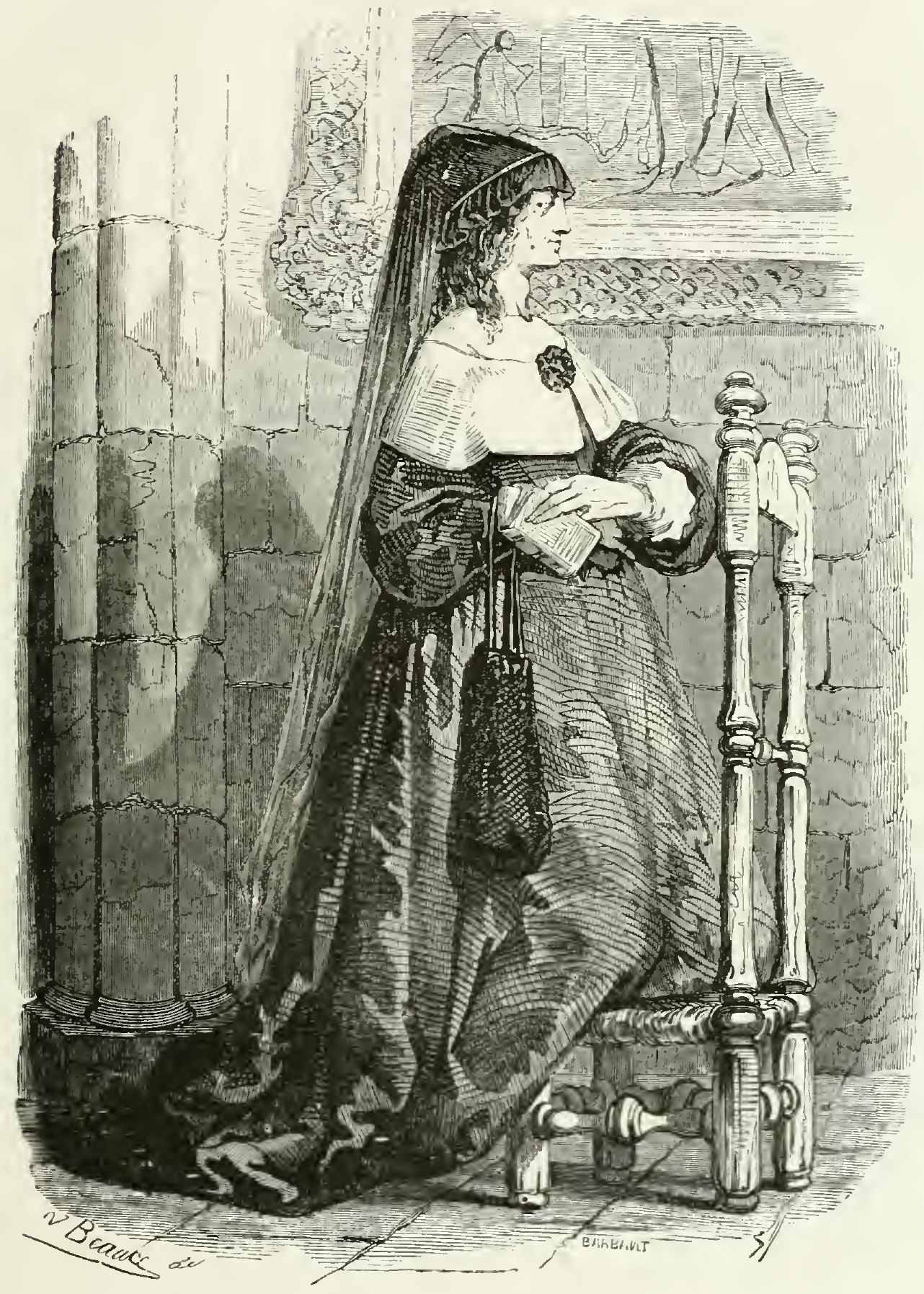
D’Artagnan noticed on the bench nearest the pillar against which Porthos and he were leaning a sort of matronly beauty, a little yellow, a little dry, but stiff and haughty beneath her black headdresses. Porthos’s eyes descended furtively upon this lady, then fluttered broadly about the nave.
For her part, the lady, who from time to time blushed, darted with the swiftness of lightning a glance at the fickle Porthos, and immediately Porthos’s eyes fluttered furiously. It was clear that this was a maneuver that stung the lady in the black headdresses to the quick, for she bit her lips until they bled, scratched the tip of her nose, and fidgeted desperately on her seat.
Seeing this, Porthos twirled his mustache again, lengthened his royale a second time, and began making signals to a beautiful lady who was near the choir, and who was not only a beautiful lady but doubtless also a great lady, for behind her was a little negro boy who had brought the cushion on which she knelt, and a maid who held the armorial bag in which was enclosed the book from which she said her mass.
MUSKETEER.
Madame Coquenard.

The lady in the black headdresses followed Porthos’s gaze through all its windings and recognized that it stopped on the lady with the velvet cushion, the little negro boy, and the maid.
Meanwhile, Porthos played hard: there were winkings of the eyes, fingers laid on lips, little murderous smiles that really murdered the beautiful neglected lady.
So she emitted, in the form of a mea culpa and striking her breast, a hum! so vigorous that everyone, even the lady with the red cushion, turned toward her. Porthos held firm; he had understood perfectly, but pretended not to hear.
The lady with the red cushion produced a great effect, for she was very beautiful: a great effect on the lady in the black headdresses, who saw in her a rival truly to be feared; a great effect on Porthos, who found her much younger and much prettier than the lady in the black headdresses; a great effect on d’Artagnan, who recognized the lady of Meung, of Calais, and of Dover, whom his persecutor, the man with the scar, had saluted by the name of milady.
D’Artagnan, without losing sight of the lady with the red cushion, continued to follow Porthos’s maneuvers, which greatly amused him; he thought he guessed that the lady in the black headdresses was the procurator’s wife of the Rue aux Ours, all the more since the church of Saint-Leu was not very far from that street.
He then guessed by induction that Porthos was seeking to take his revenge for his defeat at Chantilly, when the procurator’s wife had been so recalcitrant regarding the purse.
But in the midst of all this d’Artagnan also noticed that not a single face corresponded to Porthos’s gallantries. They were only chimeras and illusions; but for a real love, for true jealousy, is there any other reality than illusions and chimeras?
The sermon over, the procurator’s wife advanced toward the holy-water font; Porthos got there before her and, instead of one finger, put in his whole hand. The procurator’s wife smiled, believing that it was for her that Porthos was putting himself to such expense; but she was promptly and cruelly undeceived; when she was no more than three steps from him, he turned his head away, fixing his eyes invariably on the lady with the red cushion, who had risen and was approaching, followed by her little negro boy and her chambermaid.
When the lady with the red cushion came near Porthos, Porthos drew his dripping hand from the stoup; the fair devotee touched Porthos's big hand with her slender one, made the sign of the cross with a smile, and left the church.
This was too much for the procurator's wife: she no longer doubted that this lady and Porthos were carrying on a flirtation. Had she been a great lady, she would have fainted; but since she was only a procurator's wife, she contented herself with saying to the musketeer, with concentrated fury:
"Why, Monsieur Porthos, aren't you offering me any holy water?"
At the sound of that voice, Porthos gave a start such as a man might give on waking after a hundred years' sleep.
"Ma—madame!" he cried, "is it really you? How is your husband, that dear Monsieur Coquenard? Is he still as stingy as he used to be? Where were my eyes, then, that I did not even notice you during the two hours that sermon lasted?"—"I was but two steps from you, monsieur," replied the procurator's wife, "but you did not notice me, because you had eyes only for the beautiful lady to whom you have just given holy water!"
Porthos pretended to be embarrassed.
"Ah!" he said, "you noticed..."
"One would have had to be blind not to see it."
"Yes," said Porthos carelessly, "she is a duchess, one of my friends, whom I have great difficulty in meeting, because of her husband's jealousy, and who had sent me word that she would come today solely to see me, in this paltry church, at the back of this out-of-the-way quarter."
“Monsieur Porthos,” said the procurator’s wife, “would you be so kind as to offer me your arm for five minutes? I should be glad to have a talk with you.”
“Certainly, madame,” said Porthos, winking to himself like a gambler laughing at the dupe he is about to fleece.
At that moment d’Artagnan was passing by, pursuing Milady; he cast a sidelong glance at Porthos and saw that triumphant look.
“Eh! eh!” he said to himself, reasoning in accordance with the strangely easy morality of that gallant age, “here is one who might well be equipped for the term desired.”
Porthos, yielding to the pressure of the procurator’s wife’s arm as a boat yields to the rudder, reached the cloister of Saint-Magloire, a little-frequented passage, closed at both ends by a turnstile. By day one saw there only beggars eating or children playing.
“Ah! Monsieur Porthos,” cried the procurator’s wife, when she had made sure that no person foreign to the usual population of the locality could see or hear them, “ah! Monsieur Porthos, you are a great conqueror, it seems!”
“I, madame?” said Porthos, bridling up; “and why so?”
“And the signs of a while ago, and the holy water! Why, she must be a princess at the very least, that lady with her little Negro and her chambermaid!”
“You are mistaken; good heavens, no,” replied Porthos, “it is quite simply a duchess.”
“And that runner who was waiting at the door, and that carriage with a coachman in grand livery who was waiting on his box?”
Porthos had seen neither the runner nor the carriage, but with her jealous woman’s eye Mme Coquenard had seen everything.
Porthos regretted that he had not, at the first stroke, made the lady of the red cushion a princess.
“Ah! you are the darling child of the fair,” resumed the procurator’s wife with a sigh.
“But,” replied Porthos, “you understand that with a physique like that which nature has bestowed on me, I do not lack good fortune.”
“Good heavens! how quickly men forget!” cried the procurator’s wife, raising her eyes to heaven.
“Less quickly than women, it seems to me,” replied Porthos, “for after all, I, madame, I may say that I have been your victim, when wounded, mousino no, mann, I can only say that I had a sorrow, when we, werant, I found myself abandoned by the surgeons; I, the scion of an illustrious family, who had trusted in your friendship,I came near dying of my wounds first, and then of hunger, in a wretched inn at Chantilly, and that without your having deigned to answer a single time the burning letters I wrote you.”
“But, Monsieur Porthos,” murmured the procurator’s wife, who felt that, judging by the conduct of the greatest ladies of that time, she was in the wrong.
“I who had sacrificed for you the baroness of—”
“I know it well.”
“The countess of—”
“Monsieur Porthos, do not overwhelm me.”
“The duchess of—”
“Monsieur Porthos, be generous!”
“You are right, madame, and I shall not finish.”
“But it is my husband who will not hear of lending.”
“Madame Coquenard,” said Porthos, “recall the first letter you wrote me, which I keep engraved in my memory.”
The procurator’s wife uttered a groan.
“But it is also,” she said, “that the sum you asked to borrow was a little too large.”
“Madame Coquenard, I gave you the preference. I had only to write to the duchess of— I do not wish to say her name, for I do not know what it is to compromise a woman; but what I do know is that I had only to write to her for her to send me fifteen hundred.”
The procurator’s wife shed a tear.
“Monsieur Porthos,” she said, “I swear to you that you have greatly punished me, and that if in the future you should find yourself in a like pass, you would have only to apply to me.”
“Fie, then, madame!” said Porthos, as if revolted, “let us not speak of money, if you please; it is humiliating.”
“So you no longer love me!” said the procurator’s wife slowly and sadly.
Porthos kept a majestic silence.
“Is that how you answer me? Alas! I understand.”
“Think of the offense you have done me, madame: it has remained there,” said Porthos, placing his hand on his heart and pressing it there forcefully.
“I will repair it; come, my dear Porthos!”
“Besides, what was I asking of you?” resumed Porthos with a shrug full of good nature; “a loan, nothing else. After all, I am not an unreasonable man. I know that you are not rich, Madame Coquenard, and that your husband is obliged to bleed poor litigants to draw from them a few poor crowns. Oh! if you were a countess, a marquise, or a duchess, it would be another thing, and you would be unpardonable.”
The procurator’s wife was stung.
“Learn, Monsieur Porthos,” she said, “that my strongbox, procurator’s strongbox though it is, is perhaps better furnished than that of all your ruined minxes.”
“Then it is a double offense you have done me,” said Porthos, withdrawing theprocurator’s wife’s arm from under his; “for if you are rich, Madame Coquenard, then your refusal has no longer any excuse.”
“When I say rich,” resumed the procurator’s wife, who saw that she had let herself be carried too far, “the word must not be taken literally. I am not precisely rich, I am comfortably off.”
“Look here, madame,” said Porthos, “let us speak no more of all that, I beg you. You have misunderstood me; all sympathy is extinguished between us.”
“Ungrateful man that you are!”
“Ah! I advise you to complain!” said Porthos.
“Go, then, with your beautiful duchess! I no longer detain you.”
“Eh! she is not so very torn, I believe!”
— Come, Monsieur Porthos, once more—it is the last time: do you still love me?
— Alas! madame, said Porthos, in the most melancholy tone he could assume, when we are about to enter upon a campaign—a campaign in which my presentiments tell me I shall be killed—
— Oh! do not say such things! cried the procurator's wife, bursting into tears.
— Something tells me so, continued Porthos, growing more and more melancholy.
— Say rather that you have a new love.
— Not so; I speak frankly to you. No new object touches me, and even here, at the bottom of my heart, I feel something that speaks in your favor. But in a fortnight, as you know, or as you do not know, this fatal campaign opens; I shall be frightfully taken up with my equipment. Then I am going on a journey to my family, in the depths of Brittany, to raise the sum necessary for my departure.
Porthos noticed a last struggle between love and avarice.
— And as, he continued, the duchess whom you just saw at church has her lands near mine, we will make the journey together. Journeys, you know, seem much less long when one makes them in company.
— Have you no friends, then, in Paris, Monsieur Porthos? said the procurator's wife.
— I thought I had, said Porthos, assuming his melancholy air, but I have seen plainly that I was mistaken.
— You have friends, Monsieur Porthos, you have friends, replied the procurator's wife, in a transport that surprised even herself; come back to the house tomorrow. You are my aunt's son, my cousin consequently; you come from Noyon in Picardy, you have several lawsuits in Paris, and no procurator. Will you remember all that?
— Perfectly, madame.
— Come at dinnertime.
— Very well.
— And stand firm before my husband, who is shrewd, in spite of his seventy-six years.
— Seventy-six years! zounds! what a fine age! replied Porthos.
— A great age, you mean, Monsieur Porthos. So the poor dear man may leave me a widow at any moment, continued the procurator's wife, casting a significant glance at Porthos. Fortunately, by our marriage contract, we have made everything over to the survivor.
— Everything? said Porthos.
— Everything.
— You are a woman of precaution, I see, my dear Madame Coquenard, said Porthos, tenderly pressing the procurator's wife's hand.
— So we are reconciled, dear Monsieur Porthos, said she, with a simper.
— For life, replied Porthos, in the same tone.
— Farewell, then, my traitor.
— Farewell, my forgetful one.
— Till tomorrow, my angel.
— Till tomorrow, flame of my life!