A MOUSETRAP IN THE SEVENTEENTH CENTURY.
THE invention of the mousetrap does not date from our own days; as soon as societies, in forming, had invented any kind of police, that police in its turn invented mousetraps.
As perhaps our readers are not yet familiar with the slang of the Rue de Jérusalem, and as this is, since we began writing—and that is some fifteen years ago—the first time we have employed this word as applied to this thing, let us explain to them what a mousetrap is.
When, in a house, whatever it may be, an individual suspected of some crime has been arrested, the arrest is kept secret; four or five men are placed in ambush in the first room; the door is opened to all who knock, and closed upon them, and they are arrested; in this way, at the end of two or three days, one holds nearly all the frequenters of the establishment.
—That is what a mousetrap is.
A mousetrap was therefore made of Master Bonacieux's apartment, and whoever appeared there was taken and questioned by the cardinal's people. It goes without saying that, as a private passage led to the first floor, which was d'Artagnan's dwelling, those who came to his rooms were exempt from all visits.
Besides, the three musketeers came there alone; they had set out in search, each on his own side, and had found nothing, discovered nothing. Athos had even gone so far as to question M. de Tréville, a thing which, given the worthy musketeer's habitual taciturnity, had greatly astonished his captain. But M. de Tréville knew nothing, except that the last time he had seen the cardinal, the king, and the queen, the cardinal had looked very anxious, that the king was uneasy, and that the queen's red eyes indicated that she had been watching or weeping. This last circumstance, however, had struck him but little; the queen, since her marriage, had watched and wept a great deal.
M. de Tréville recommended to Athos in any case the service of the king and especially that of the queen, begging him to make the same recommendation to his comrades.
As for d'Artagnan, he did not stir from his home. He had converted his chamber into an observatory. From the windows he saw those who came to be taken; then, as he had removed the tiles from the floor, dug up the boards, and a simple ceiling separated him from the ground-floor room where the interrogations took place, he heard everything that passed between the inquisitors and the accused.
The interrogations, preceded by a minute search made upon the person arrested, were almost always thus conceived:
"Has Mme. Bonacieux given you anything for her husband or for any other person?"
"Has M. Bonacieux given you anything for his wife or for any other person?"
"Have either of them made any verbal communication to you?"
"If they knew anything, they would not question in this manner," said D'Artagnan to himself. "Now, what is it they are trying to find out? Whether the Duc de Buckingham is not in Paris, and whether he has not had, or is not to have, some interview with the queen?"
D'Artagnan stopped at this idea, which, from all he had heard, was not wanting in probability.
"In the meantime, the mousetrap was in permanence, and D'Artagnan's vigilance also."
On the evening of the day after the arrest of poor Bonacieux, as Athos had just left D'Artagnan to go to M. de Tréville's, as nine o'clock had just struck, and as Planchet, who had not yet made the bed, was beginning his work, they heard a knock at the street door; immediately that door opened and closed again: someone had just been caught in the mousetrap.
D'Artagnan rushed to the place thus disclosed, lay flat on his stomach, and listened.
Cries soon resounded, then groans which someone was trying to stifle. Of interrogation, there was no question.
"The devil!" said D'Artagnan to himself. "It seems to me it is a woman; they are searching her, she resists—they are using force.—The wretches!"
And D'Artagnan, in spite of his prudence, had to hold himself with all four limbs to keep from joining in the scene taking place below him.
"But I tell you I am the mistress of the house, gentlemen; I tell you I am Mme. Bonacieux; I tell you I belong to the queen!" cried the unfortunate woman.
"Mme. Bonacieux!" murmured D'Artagnan; "should I be fortunate enough to have found what everybody is seeking?"
"It is precisely you we were waiting for," resumed the interrogators.
The voice became more and more stifled; a tumultuous movement made the woodwork resound. The victim resisted as much as a woman can resist four men.
"Pardon, gentlemen, par—," murmured the voice, which then made only inarticulate sounds.

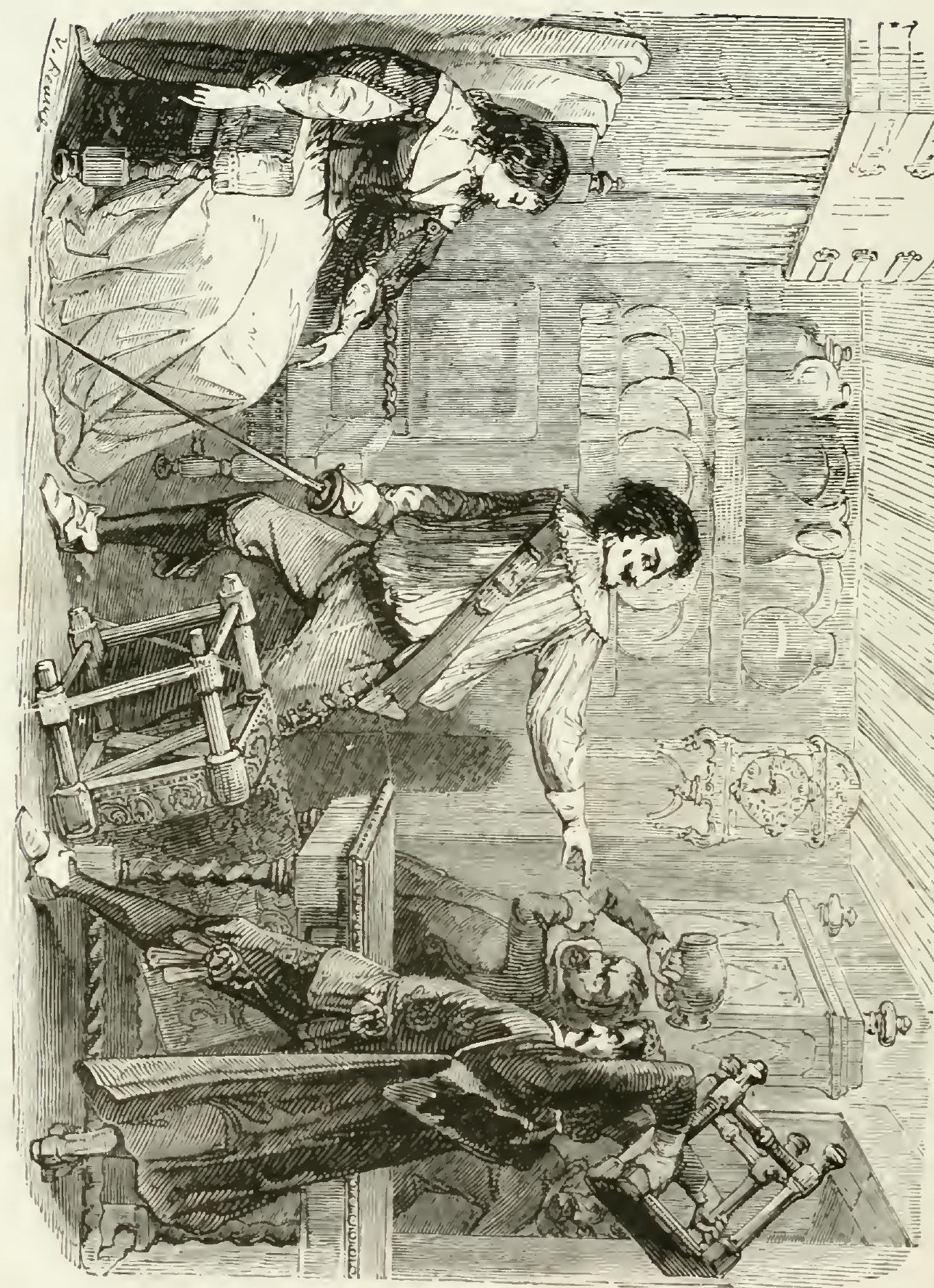
"They are gagging her, they are going to drag her away," cried D'Artagnan, springing up as if by a spring. "My sword! Good, it is at my side. Planchet!"
"Monsieur."
"Run and fetch Athos, Porthos, and Aramis. One of the three will surely be at home, perhaps all three will have returned. Let them take arms and come, let them run. Ah! I remember, Athos is at M. de Tréville's."
"But where are you going, monsieur, where are you going?"
"I am going down by the window," cried D'Artagnan, in order to arrive sooner; "you, put back the panes, sweep the floor, go out by the door, and run where I tell you."
"Oh! monsieur, monsieur, you will kill yourself," cried Planchet.
"Hold your tongue, idiot," said D'Artagnan. And catching hold of the edge of the casement with his hand, he let himself drop from the first floor, which fortunately was not high, without scratching himself.
Then he went at once and knocked at the door, murmuring:
"I am going to be caught in the mousetrap in my turn, and woe to the cats who rub against such a mouse."
Scarcely had the hammer resounded under the young man's hand when the tumult ceased, steps approached, the door opened, and D'Artagnan, with his sword drawn, rushed into master Bonacieux's apartment, whose door, doubtless moved by a spring, closed of itself after having given him passage.
Then those who still inhabited poor Bonacieux's house, and the nearest neighbors, heard loud cries, stamping, a clashing of swords, and a prolonged breaking of furniture. Then, a moment later, those who, surprised by this noise, had gone to their windows to learn the cause, could see the door open again and four men dressed in black, not come out, but fly away like frightened crows, leaving on the ground and at the corners of the tables feathers from their wings, that is to say, rags of their clothes and shreds of their cloaks.
D'Artagnan was victor without much difficulty, it must be said, for only one of the alguazils was armed, and even he defended himself only for form's sake. It is true the other three had tried to knock the young man down with chairs, stools, and pottery; but two or three scratches made by the Gascon's blade had frightened them. Ten minutes had sufficed for their defeat, and D'Artagnan remained master of the field of battle.
The neighbors, who had opened their windows with the coolness peculiar to the inhabitants of Paris in those times of perpetual riots and brawls, closed them again as soon as they saw the four black men flee; their instinct told them that for the moment all was over.
Besides, it was growing late, and then as today people went to bed early in the Luxembourg quarter.
D'Artagnan, left alone with Mme. Bonacieux, turned toward her: the poor woman was reclining in an armchair and half fainting. D'Artagnan examined her with a rapid glance.
She was a charming woman of twenty-five or twenty-six, dark with blue eyes, having a slightly turned-up nose, admirable teeth, a complexion marbled with rose and opal. There, however, stopped the signs that might make her mistaken for a great lady. The hands were white, but without finesse; the feet did not announce the woman of quality. Fortunately D'Artagnan was not yet at the point of troubling himself about these details.
"While D'Artagnan was examining Mme. Bonacieux, and had come to the feet, as we have said, he saw on the ground a fine cambric handkerchief, which he picked up, according to his habit, and in the corner of which he recognized the same cipher he had seen on the handkerchief which had nearly caused him to have his throat cut by Aramis.
Since that time D'Artagnan had been mistrustful of embroidered handkerchiefs; he therefore put back without saying anything the one he had picked up into Mme. Bonacieux's pocket.
At this moment Mme. Bonacieux was recovering her senses. She opened her eyes, looked with terror around her, saw that the apartment was empty, and that she was alone with her liberator. She at once held out her hands to him, smiling.—Mme. Bonacieux had the most charming smile in the world.
"Ah! monsieur," said she, "it is you who have saved me; permit me to thank you."
"Madame," said D'Artagnan, "I have done only what every gentleman would have done in my place; you owe me no thanks therefore."
"Yes, indeed, monsieur, yes, indeed, and I hope to prove to you that you have not rendered service to an ingrate. But what did those men want with me, whom I took at first for thieves, and why is M. Bonacieux not here?"
— Madame, these men were far more dangerous than thieves could ever be, for they are agents of Monsieur the Cardinal; and as for your husband, Monsieur Bonacieux, he is not here because yesterday they came and took him away to the Bastille.
— My husband at the Bastille! cried Mme Bonacieux; oh! my God! what has he done, poor dear man! he who is innocence itself!
And something like a smile pierced through the young woman's still frightened face.
— What has he done, madame? said d'Artagnan. I believe his only crime is to have at once the good fortune and the misfortune of being your husband.
— But, monsieur, you know then...
— I know that you were carried off, madame.
— And by whom? Do you know? Oh! if you know, tell me.
— By a man of forty to forty-five years, with black hair, a swarthy complexion, with a scar on his left temple.
— That is it, that is it; but his name?
— Ah! his name? That is what I do not know.
— And did my husband know that I had been carried off?
— He had been informed of it by a letter written to him by the abductor himself.
— And does he suspect, asked Mme Bonacieux with embarrassment, the cause of this abduction?
— He attributed it, I believe, to a political cause.— I doubted it at first, and now I think as he does. So then, this dear Monsieur Bonacieux did not suspect me for a single moment
— Ah! far from it, madame, he was too proud of your wisdom and especially of your love.
A second smile, almost imperceptible, brushed the rosy lips of the beautiful young woman.
— But, continued d'Artagnan, how did you escape?
—I took advantage of a moment when I was left alone, and since I had known since this morning what to think of my abduction, with the help of my sheets I climbed down through the window; then, as I believed my husband was here, I ran over.
—To put yourself under his protection.
—Oh! no, I knew very well that he was incapable of defending me; but as he could be of use to us in another way, I wanted to warn him.
—Of what?
—Oh! that is not my secret, so I cannot tell you.
—Besides, said d'Artagnan (forgive me, madame, if, cautious as I am, I call you back to prudence), besides, I believe we are not in a suitable place here for confidences. The men I put to flight will return with reinforcements, and if they find us here, we are lost. I did send word to three of my friends, but who knows whether they will have been found at home.
—Yes, yes, you are right, cried Mme Bonacieux in fright; let us flee, let us save ourselves.
At these words she passed her arm under d'Artagnan's and drew him along quickly.
—But where shall we flee? said d'Artagnan; where shall we take refuge?
—Let us first get away from this house, and afterward we will see.
And the young woman and the young man, without taking the trouble to close the doors, went quickly down the rue des Fossoyeurs, turned into the rue des Fossés-Monsieur-le-Prince, and did not stop until they reached the place Saint-Sulpice.
—And now what are we going to do? asked d'Artagnan, and where do you want me to take you?
—I am very much at a loss to answer you, I confess, said Mme Bonacieux; my intention was to have M. Laporte warned by my husband, so that M. Laporte could tell us exactly what had happened at the Louvre during the last three days and whether there was any danger in my presenting myself there.
—But I, said d'Artagnan, I can go and warn M. Laporte.
—No doubt, only there is one misfortune: M. Bonacieux is known at the Louvre, and they would let him pass, whereas they do not know you, and they will shut the door in your face.
—Ah, bah! said d'Artagnan; surely at some wicket of the Louvre you have a porter devoted to you who, thanks to a watchword...
Mme Bonacieux looked fixedly at the young man.
—And if I gave you that watchword, she said, would you forget it as soon as you had made use of it?
—On my word of honor, on the faith of a gentleman, said d'Artagnan, with an accent whose truth there was no mistaking.
—Here, I believe you; you look like a brave young man. Besides, your fortune perhaps lies at the end of your devotion.
—I will do without promise, and in all conscience, everything I can to serve the king and to be agreeable to the queen, said d'Artagnan; dispose of me, then, as of a friend.
—But I, where will you put me in the meantime?
—Have you not a friend to whose house M. Laporte could come back to fetch you?
—No, I do not wish to trust anyone.
—Wait, said d'Artagnan; we are at Athos's door. Yes, that is it.
—What is Athos?
—One of my friends.
—But if he is at home, and he sees me?
—He is not there, and I will take the key after I have shown you into his apartment.
—But if he returns?
—He will not return; besides, he would be told that I brought a woman, and that this woman is at his place.
—But that will compromise me very seriously, you know!
—What does it matter to you, no one knows you; besides, we are in a situation where we must overlook a few proprieties.
—Let us go to your friend, then. Where does he live?
—Rue Férou, two steps from here.
—Let us go.
And both resumed their race. As d'Artagnan had foreseen, Athos was not at home; he took the key, which they were in the habit of giving him as to a friend of the house, went up the stairs, and introduced Mme Bonacieux into the little apartment of which we have already given a description.
—You are at home, he said; wait, close the door inside and do not open to anyone unless you hear three knocks like this, you see; and he knocked three times, two knocks close together and rather loud, one knock farther apart and lighter.
—Very well, said Mme Bonacieux, now it is my turn to give you my instructions.
—I am listening.
—Present yourself at the wicket of the Louvre, on the side of the rue de l'Échelle, and ask for Germain.
—Very well. After that?
—He will ask what you want, and then you will answer him with these two words:—Tours and Brussels.—At once he will place himself at your orders.
—And what shall I order him?
—To go and fetch M. Laporte, the queen's cloak-bearer.
—And when he has gone to fetch him and M. Laporte has come?
—You will send him to me.
—Very well, but where and how shall I see you again?
—Do you care very much about seeing me again?
—Certainly.
—Well! leave that care to me, and be easy.
—I rely on your word.
—Rely on it.
D'Artagnan bowed to Mme Bonacieux, casting at her the most loving glance he could possibly concentrate upon her charming little person, and while he went down the stairs he heard the door close behind him with a double turn of the key. In two bounds he was at the Louvre; as he entered the wicket of l'Échelle, ten o'clock was striking. The numerous events we have just related had followed one another in half an hour.
Everything was carried out as Mme Bonacieux had announced. At the agreed watchword, Germain bowed; ten minutes later, Laporte was in the lodge; in two words d'Artagnan put him in the know and indicated to him where Mme Bonacieux was. Laporte made sure twice of the accuracy of the address and set off at a run. However, when he had gone about ten paces, he came back.
—Young man, he said to d'Artagnan, a piece of advice—will you allow me?
—Which one?
—You might be troubled on account of what has just happened.
— You think so?
— Yes.
— Do you have some friend whose clock runs slow?
— Well?
— Go and see him so that he can testify that you were at his house at nine-thirty. In legal terms, that is called an alibi.
D'Artagnan found the advice prudent; he took to his heels and arrived at M. de Tréville's; but instead of going into the drawing room with everyone else, he asked to be admitted to his study. As d'Artagnan was one of the regular visitors to the house, no difficulty was made about granting his request, and someone went to inform M. de Tréville that his young compatriot, having something important to tell him, was requesting a private audience. Five minutes later, M. de Tréville was asking d'Artagnan what he could do in his service, and what had earned him a visit at such a late hour.
— Pardon, monsieur, said d'Artagnan, who had taken advantage of the moment when he was left alone to set the clock back three quarters of an hour, but I thought that, since it was only nine twenty-five, there was still time to present myself at your house.
— Nine twenty-five! cried M. de Tréville, looking at his clock; but that is impossible!
— Just look, monsieur, said d'Artagnan, that proves it.
— That is true, said M. de Tréville, I would have thought it was later. But come, what do you want with me?
Then d'Artagnan told M. de Tréville a long story about the queen. He set out for him the fears he had conceived regarding Her Majesty; he told him what he had heard said of the cardinal's designs with respect to Buckingham, and all this with a composure and self-assurance of which M. de Tréville was all the more easily the dupe since he himself, as we have said, had noticed that something new was passing between the cardinal, the king, and the queen.
At ten o'clock striking, d'Artagnan left M. de Tréville, who thanked him for his information and urged him always to keep the service of the king and queen at heart, and who went back into the salon. But at the foot of the staircase, d'Artagnan remembered that he had forgotten his cane: accordingly, he went back up hurriedly, re-entered the study, with a turn of his finger set the clock back to its proper time, so that no one could notice the next day that it had been disturbed, and, now certain that there was a witness to prove his alibi, he went back down the staircase and soon found himself in the street.