THE AUDIENCE.
MONSIEUR DE TRÉVILLE was at that moment in a very bad humor; nevertheless, he politely bowed to the young man, who bowed to the ground, and he smiled as he received his compliment, whose Béarnese accent reminded him at once of his youth and of his country—a double memory that makes a man smile at every age. But, drawing almost immediately nearer to the antechamber and making d'Artagnan a sign with his hand, as if to ask his permission to finish with the others before beginning with him, he called three times, raising his voice each time, so that he ran through every tone between the imperious accent and the irritated accent:
"Athos! Porthos! Aramis!"
The two musketeers with whom we have already become acquainted, and who answered to the last two of these three names, immediately left the groups of which they were part and advanced toward the study, whose door closed behind them as soon as they had crossed the threshold. Their bearing, although it was not entirely calm, nevertheless aroused d'Artagnan's admiration by its abandon, at once full of dignity and submission, for he saw in these men demigods, and in their chief an Olympian Jupiter armed with all his thunderbolts.
When the two musketeers had entered, when the door had closed behind them, when the buzzing murmur of the antechamber—to which the call that had just been made had doubtless given fresh fuel—had begun again, when at last M. de Tréville had paced three or four times, silent and with frowning brow, the whole length of his study, passing each time before Porthos and Aramis, stiff and mute as if on parade, he stopped short in front of them, and covering them from head to foot with an irritated look:"Do you know what the king said to me," he cried, "and that no later than last night? Do you know it, gentlemen?"
"No," answered the two musketeers after a moment of silence; "no, monsieur, we do not know it."
"But I hope you will do us the honor of telling us," added Aramis, in his most polite tone and with the most gracious bow.
"He told me that from now on he would recruit his musketeers from among M. le cardinal's guards."
"From among M. le cardinal's guards! And why so?" asked Porthos eagerly.
"Because he saw clearly that his thin wine needed to be bucked up by a mixture of good wine."
The two musketeers blushed to the whites of their eyes. D'Artagnan no longer knew where he stood and would have liked to be a hundred feet under ground.
"Yes, yes," continued M. de Tréville, growing animated, "yes, and His Majesty was right, for, on my honor, it is true that the musketeers cut a sorry figure at court. M. le cardinal was telling yesterday at the king's gaming table, with an air of condolence that greatly displeased me, that the day before these damned musketeers, these devil's four, and he dwelt on those words with an ironical accent that displeased me still more; these swashbucklers, he added, looking at me with his tiger-cat's eye, had lingered in the rue Férou, in a tavern, and that a patrol of his guards—I thought he was going to laugh in my face—had been forced to arrest the disturbers of the peace. Morbleu! you must know something about it! Arrest musketeers! You were among them, you others, do not deny it, you were recognized, and the cardinal named you. It is my own fault, yes, my fault, since it is I who choose my men. Come now, you, Aramis, why the devil did you ask me for the uniform when you were going to be so well off in the cassock! Come now, you, Porthos, have you such a fine gold baldric only to hang a straw sword from it! And Athos? I do not see Athos. Where is he?"
"Monsieur," answered Aramis sadly, "he is ill, very ill."
"Ill, very ill, you say? And with what illness?"
"It is feared it may be smallpox, monsieur," answered Porthos, wishing to put in a word in the conversation in his turn, "which would be unfortunate, in that it would certainly spoil his face."
"Smallpox! There is another fine story you are telling me, Porthos! Ill with smallpox at his age? No! Ill? Wounded, no doubt, killed perhaps. Ah! if I knew it!... Sangdieu, messieurs the musketeers, I do not intend that you should haunt disreputable places in this way, that you should pick quarrels in the street, and that you should play with your swords at street corners. I do not want, in short, that you should give M. le cardinal's guards something to laugh at, for they are brave folk, quiet, skillful, who never get themselves into a position to be arrested, and who, besides, would not let themselves be arrested—I am sure of it. They would rather die on the spot than take a single step backward. To run away, to scamper off, to flee, is all very well for the king's musketeers, that is!"
Porthos and Aramis trembled with rage. They would gladly have strangled M. de Tréville if, at the bottom of all this, they had not felt that it was the great affection he bore them that made him speak to them thus. They stamped their feet on the carpet, bit their lips until they bled, and gripped with all their strength the hilts of their swords. Outside, Athos, Porthos, and Aramis had been heard called, as we have said, and from the tone of M. de Tréville's voice it had been guessed that he was perfectly furious. Ten curious heads were pressed against the tapestry and turned pale with fury, for their ears, glued to the door, did not lose a syllable of what was being said, while their mouths repeated, one by one, the captain's insulting words to the whole population of the antechamber. In an instant, from the door of the study to the street door, the whole hôtel was in a ferment.
"Ah! the king's musketeers let themselves be arrested by M. le cardinal's guards!" continued M. de Tréville, as furious within as his soldiers, but punctuating his words and plunging them one by one, so to speak, like so many dagger thrusts into the breasts of his hearers. "Ah! six guards of His Eminence arrest six musketeers of His Majesty! Morbleu! I have made up my mind. I shall go this very moment to the Louvre; I shall resign my commission as the king's captain to ask for a lieutenancy in the cardinal's guards, and if he refuses me, morbleu! I shall become an abbé."
At these words, the murmur outside became an explosion: nothing was heard everywhere but oaths and blasphemies. The morbleu! the sangdieu! the deaths of all the devils! crossed one another in the air. D'Artagnan looked for a tapestry behind which to hide, and felt an immoderate desire to crawl under the table.
"Well, my captain," said Porthos beside himself, "the truth is that we were six against six, but we were taken by treachery, and before we had time to draw our swords, two of us had fallen dead, and Athos, grievously wounded, was scarcely any better off. For you know him, Athos; well then, captain, he tried to rise twice, and twice he fell back. However, we did not surrender, no! we were dragged away by force. On the way we escaped. As for Athos, he was thought dead, and he was left quite peacefully on the field of battle, not thinking it worth the trouble to carry him off. That is the story. What the devil, captain, one does not win every battle. The great Pompey lost that of Pharsalus, and King Francis I lost that of Pavia."
— And I have the honor to assure you that I killed one of them with his own sword, said Aramis, for mine broke at the first parry; — killed or stabbed, monsieur, just as you please.
— I did not know that, replied M. de Tréville in a slightly softened tone. The cardinal had exaggerated, from what I see.
— But, for mercy's sake, monsieur, continued Aramis, who, seeing his captain calm down, dared to venture a plea, for mercy's sake, monsieur, do not say that Athos is wounded: he would be in despair if that reached the king's ears, and as the wound is of the gravest, since after passing through the shoulder it penetrates into the chest, it would be feared...
At that same instant the carriage door lifted, and a noble and handsome head, but frightfully pale, appeared beneath the fringe.

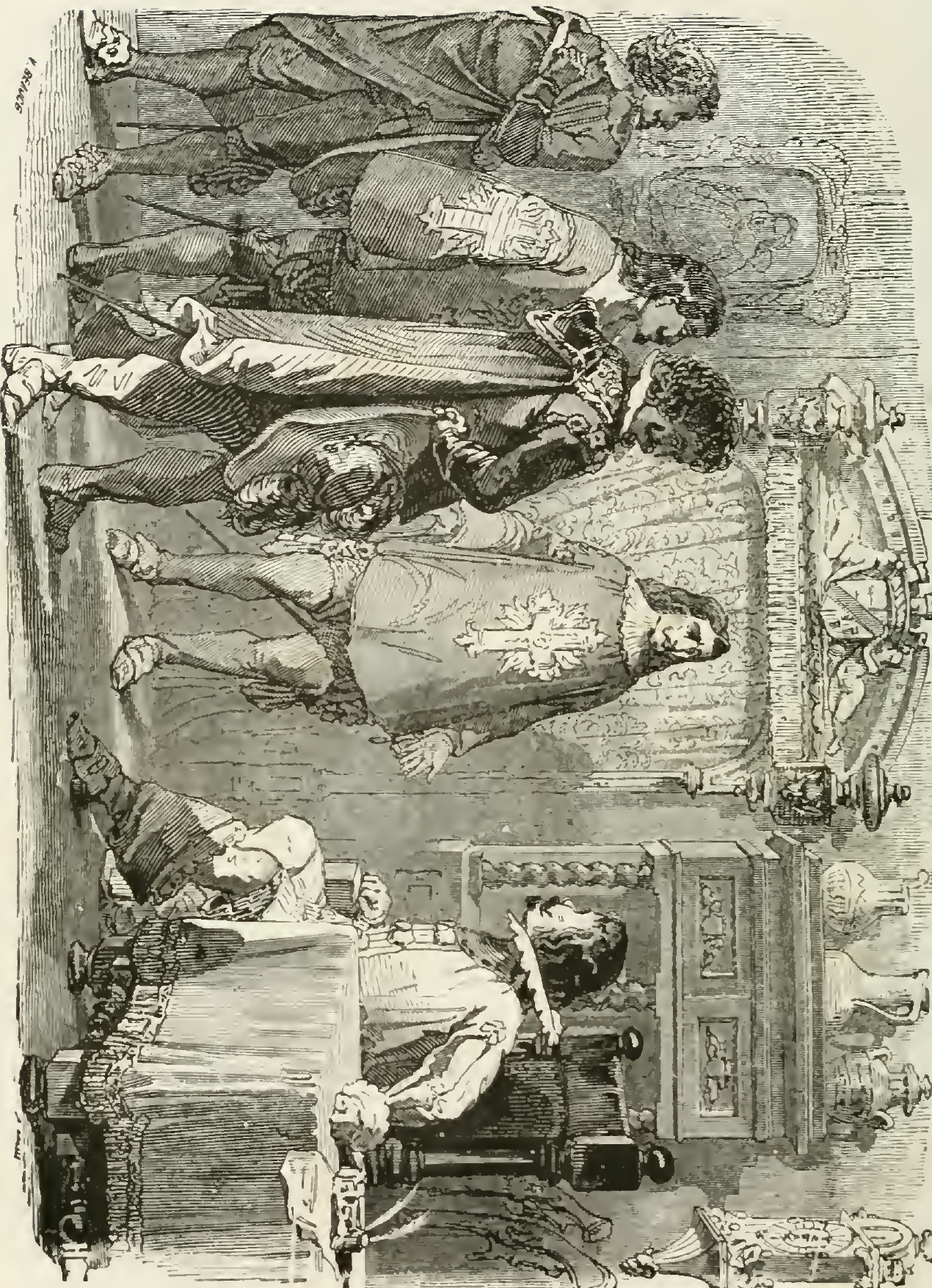
— Athos! cried the two musketeers.
— Athos! repeated M. de Tréville himself.
— You sent for me, monsieur, said Athos to M. de Tréville in a weakened but perfectly calm voice, you sent for me, so our comrades told me, and I hasten to present myself to your orders; here I am, monsieur, what do you want of me?
And at these words the musketeer, in irreproachable attire, tightly belted as usual, entered the cabinet with a rather firm step. M. de Tréville, moved to the bottom of his heart by this proof of courage, rushed toward him.
"I was just telling these gentlemen," he added, "that I forbid my musketeers to expose their lives without necessity, for brave men are very dear to the king, and the king knows that his musketeers are the bravest men on earth. Your hand, Athos."
And without waiting for the newcomer to respond to this proof of affection, M. de Tréville seized his right hand and squeezed it with all his strength, without noticing that Athos, whatever his command over himself, let escape a movement of pain and turned still paler, which one would have thought impossible.
The door had remained ajar, so much had Athos's arrival produced a sensation, for despite the secret kept, his wound was known to all. A murmur of satisfaction greeted the captain's last words, and two or three heads, carried away by enthusiasm, appeared through the openings of the tapestry. Doubtless M. de Tréville was about to repress with sharp words this infraction of the laws of etiquette, when he suddenly felt Athos's hand clench in his own, and casting his eyes upon him, he perceived that he was about to faint. At the same instant, the musketeer, who had gathered all his strength to struggle against the pain, at last vanquished by it, fell to the floor as if dead.
"A surgeon!" cried M. de Tréville, "mine, the king's, the best! A surgeon! or, by heaven! my brave Athos will die."
At M. de Tréville's cries, everyone rushed into his cabinet without his thinking to close the door to anyone, each pressing around the wounded man. But all this eagerness would have been useless if the doctor sent for had not been in the hôtel itself; he parted the crowd, approached Athos still unconscious, and as all this noise and movement greatly bothered him, he requested as the first and most urgent thing that the musketeer be carried into a neighboring room. Immediately M. de Tréville opened a door and showed the way to Porthos and Aramis, who carried their comrade in their arms. Behind this group walked the surgeon, and behind the surgeon the door closed again.
Then M. de Tréville's cabinet, that place so ordinarily respected, momentarily became an annex of the antechamber. Each discoursed, harangued, spoke loudly, swearing, cursing, consigning the cardinal and his guards to all the devils.
An instant later, Porthos and Aramis returned; the surgeon and M. de Tréville alone had remained near the wounded man.
At last M. de Tréville returned in his turn. The wounded man had regained consciousness; the surgeon declared that the musketeer's condition had nothing in it that could alarm his friends, his weakness having been purely and simply caused by the loss of blood.
Then M. de Tréville made a sign with his hand and each withdrew, except d'Artagnan, who did not forget that he had an audience and who, with his Gascon temerity, had remained in the same place.
When everyone had gone out and the door was closed again, M. de Tréville turned around and found himself alone with the young man. The event that had just occurred had somewhat made him lose the thread of his ideas. He therefore inquired what the obstinate solicitor wanted of him. D'Artagnan then gave his name, and M. de Tréville, recalling in a single stroke all his memories of the present and the past, found himself abreast of the situation.
"Pardon me," he said to him smiling, "pardon me, my dear compatriot, but I had perfectly forgotten you. What do you expect! a captain is nothing but a father of a family charged with a greater responsibility than an ordinary father of a family. The soldiers are great children; but as I am determined that the king's orders, and above all those of M. the cardinal, be executed..."
D'Artagnan could not conceal a smile. At this smile, M. de Tréville judged that he had not to do with a fool, and coming straight to the point, while changing the conversation:
"I greatly loved monsieur your father," he said. "What can I do for his son? Hurry, my time is not my own."
"Monsieur," said d'Artagnan, "in leaving Tarbes and coming here, I proposed to ask of you, in remembrance of that friendship of which you have not lost memory, a musketeer's cloak; but after all that I have seen during the past two hours, I understand that such a favor would be enormous, and I tremble at not deserving it."
"It is a favor indeed, young man," replied M. de Tréville; "but it may not be so far above you as you believe or as you appear to believe. However, a decision of His Majesty has provided for this case, and I announce to you with regret that no one is received as a musketeer before the preliminary test of a few campaigns, of certain brilliant actions, or of two years' service in some other regiment less favored than ours."
D'Artagnan bowed without answering. He felt himself still more eager to don the musketeer uniform since there were such great difficulties in obtaining it.
"But," continued Tréville, fixing on his compatriot a look so piercing that one would have said he wished to read to the bottom of his heart; "but, in favor of your father, my former companion, as I have told you, I wish to do something for you, young man. Our cadets of Béarn are ordinarily not rich, and I doubt that things have greatly changed their face since my departure from the province. You must therefore not have too much, to live on, of the money you have brought with you."
D'Artagnan drew himself up with a proud air that meant he asked alms of no one.
"That is well, young man, that is well," continued Tréville, "I know those airs; I came to Paris with four crowns in my pocket and I would have fought anyone who told me I was not in a position to buy the Louvre."
D'Artagnan drew himself up more and more; thanks to the sale of his horse, he was beginning his career with four crowns more than M. de Tréville had begun his.
"You must therefore, I was saying, have need to preserve what you have, however large that sum may be; but you must also have need to perfect yourself in the exercises befitting a gentleman. I will write this very day a letter to the director of the Royal Academy, and tomorrow he will receive you without any fee. Do not refuse this little comfort. Our best-born and richest gentlemen sometimes solicit it without being able to obtain it. You will learn horsemanship, fencing, and dancing; you will make good acquaintances there, and from time to time you will come back to see me to tell me where you stand and whether I can do anything for you."
D'Artagnan, however much still a stranger to court ways, noticed the coldness of this reception.
"Alas, monsieur," he said, "I see how much the letter of recommendation that my father had given me for you fails me today."
"Indeed," replied M. de Tréville, "I am astonished that you undertook so long a journey without that obligatory viaticum, our only resource, we others of Béarn."
"I had it, monsieur, and, thank God, in good form," cried d'Artagnan, "but it was perfidiously stolen from me."
And he recounted the whole scene of Meung, depicted the unknown gentleman in his slightest details, all with a warmth, a truth that charmed M. de Tréville.
"That is strange," said the latter, meditating; "you had therefore spoken of me aloud?"
— Yes, sir, no doubt I had committed that imprudence; what would you have, a name like yours had to serve me as a shield along the way. Judge for yourself whether I often took cover.
Flattery was very much in order at that time, and M. de Tréville loved incense like a king or a cardinal. He could not therefore help smiling with visible satisfaction, but this smile soon faded, and returning of his own accord to the adventure at Meung:
— Tell me, he continued, did this gentleman not have a slight scar on his cheek?
— Yes, like the graze of a bullet.
— Was he not a man of fine appearance?
— Yes.
— Pale of complexion and dark of hair?
— Yes, yes, that's it. How is it, sir, that you know this man? Ah! if ever I find him again, and I will find him again, I swear it to you, even if it be in hell...
— He was waiting for a woman? Tréville continued.
— He at least left after having spoken for a moment with the one he was waiting for.
— You do not know what the subject of their conversation was?
— He was handing her a box, telling her that this box contained his instructions, and recommending that she not open it until London.
— This woman was English?
— He called her milady.
— It is he! murmured Tréville, it is he! I thought he was still in Brussels.
— Oh! sir, if you know who this man is, cried d'Artagnan, tell me who he is and where he is from, and then I hold you quit of everything, even of your promise to get me into the musketeers, for before anything else I want to avenge myself.
— Beware of doing so, young man! cried Tréville; if you see him coming, on the contrary, from one side of the street, pass to the other; do not dash yourself against such a rock, it would break you like glass.
— That does not prevent, said d'Artagnan, that if ever I find him again...
— In the meantime, resumed Tréville, do not look for him, if I may give you a piece of advice.
Suddenly Tréville stopped, struck by a sudden suspicion. This great hatred that the young traveler manifested so loudly for this man, who, a thing sufficiently improbable, had stolen from him his father's letter—did this hatred not conceal some perfidy? Was this young man not sent by His Eminence? Was he not coming to set a trap for him? Was this so-called d'Artagnan not an emissary of the cardinal whom someone was seeking to introduce into his house, and whom they were placing near him to surprise his confidence and to ruin him later, as had been practiced a thousand times? He looked at d'Artagnan more fixedly still this second time than the first. He was but moderately reassured by the aspect of that face sparkling with astute wit and affected humility.
— I know well that he is Gascon, thought he, but he may be so for the cardinal as well as for me. Come, let us test him. My friend, he said to him slowly, I wish, as to the son of my old friend, for I hold as true the story of that lost letter—I wish, I say, to repair the coldness that you at first noticed in my welcome, by disclosing to you the secrets of our policy. The king and the cardinal are the best friends in the world; their apparent disputes are only to deceive fools. I do not claim that a compatriot, a handsome cavalier, a brave lad, made to advance, should be the dupe of all these feints and go like a simpleton into the snare, following so many others who have been lost in it. Consider well that I am devoted to these two all-powerful masters, and that my serious steps will never have any other aim than the service of the king and that of M. the cardinal, one of the most illustrious geniuses that France has produced. Now, young man, govern yourself accordingly, and if you have, whether from family, or through connections, or even by instinct, any of those enmities against the cardinal, such as we see burst forth among our gentlemen, tell me adieu and let us part. I will help you in a thousand circumstances, but without attaching you to my person. I hope that my frankness, in any case, will make you my friend, for you are so far the only young man to whom I have spoken as I am doing.
Tréville said to himself aside:
— If the cardinal has sent me this young fox, he will certainly not have failed, knowing as he does to what degree I execrate him, to tell his spy that the best wayto court me is to say worse than hanging of him; so, despite my protestations, the cunning fellow will most certainly answer me that he holds the Eminence in horror.
It turned out quite otherwise than Tréville expected: d'Artagnan answered with the greatest simplicity:
— Sir, I arrive in Paris with intentions entirely similar. My father recommended me to suffer nothing except from the king, from M. the cardinal, and from you, whom he holds to be the three first in France.
D'Artagnan added M. de Tréville to the other two, as may be perceived, but he thought that this addition ought not to spoil anything.
— I have therefore the greatest veneration for M. the cardinal, he continued, and the deepest respect for his acts. So much the better for me, sir, if you speak to me, as you say, with frankness, for then you will do me the honor of esteeming this resemblance of taste; on the contrary, if you have had some distrust, moreover quite natural, I feel that I lose myself in telling the truth; but so much the worse, you will not fail to esteem me, and that is what I hold to more than anything in the world.
M. de Tréville was surprised to the last degree. So much penetration, so much frankness finally, caused him admiration, but did not entirely remove his doubts: the more this young man was superior to other young men, the more he was to be feared if he was mistaken. Nevertheless he pressed d'Artagnan's hand and said to him:
— You are an honest lad, but at this moment I cannot do what I offered you just now. My house will always be open to you. Later, being able to ask me at any hour and consequently to seize all occasions, you will probably obtain what you desire to obtain.
— That is to say, sir, resumed d'Artagnan, that you will wait until I have made myself worthy of it. Well! be at ease, added he with the familiarity of the Gascon, you will not wait long. And he bowed to withdraw, as if henceforth the rest concerned him.
— But wait, then, said M. de Tréville, stopping him, I promised you a letter for the director of the Academy. Are you too proud to accept it, my young gentleman?
— No, sir, said d'Artagnan, and I answer you that it will not be with this one as with the other. I will keep it so well that it will arrive, I swear to you, at its address, and woe to him who would attempt to take it from me!
M. de Tréville smiled at this bravado, and leaving his young compatriot in the embrasure of the window where they were and where they had talked together, he went to sit at a table and began to write the promised letter of recommendation. During this time d'Artagnan, who had nothing better to do, began to beat a march against the windowpanes, watching the musketeers who went away one after another, and following them with his eyes until they had disappeared at the turn of the street.
M. de Tréville, after having written the letter, sealed it, and rising approached the young man to give it to him; but at the very moment when d'Artagnan stretched out his hand to receive it, M. de Tréville was greatly astonished to see his protégégive a start, redden with anger, and dash out of the cabinet crying: — Ah, by God! he will not escape me, this time.
— And who is that? asked M. de Tréville.
— Him, my thief! answered d'Artagnan. Ah! traitor!
And he disappeared.
— Devil of a madman! murmured M. de Tréville. Unless, however, he added, it is not a clever way of slipping away, seeing that he has missed his stroke!