THE INTERIOR OF THE MUSKETEERS.
WHEN D'ARTAGNAN had left the Louvre and consulted his friends as to the use he ought to make of his share of the forty pistoles, Athos advised him to order a good meal at the Pomme-du-Pin, Porthos to take a lackey, and Aramis to provide himself with a suitable mistress.
The meal was carried out the same day, and the lackey served at table. The meal had been ordered by Athos, and the lackey furnished by Porthos. He was a Picard, whom the glorious musketeer had hired that very day, and on that occasion, on the Pont de la Tournelle, while he was making circles in the water by spitting into it. Porthos had maintained that this occupation was the proof of a reflective and contemplative organization, and he had taken him away without any other recommendation. The fine appearance of this gentleman, in whose service he believed himself engaged, had won over Planchet—for that was the Picard's name;—there was a slight disappointment in store for him when he saw that the place was already taken by a fellow named Mousqueton, and when Porthos had informed him that his establishment, although large, could not accommodate two servants, and that he must enter the service of d'Artagnan. However, when he attended the dinner given by his master and saw him draw a handful of gold from his pocket in payment, he believed his fortune made and thanked Heaven for having fallen into the possession of such a Croesus; he persisted in this opinion until after the feast, from the remnants of which he repaired long abstinences. But when, in the evening, he made his master's bed, Planchet's chimeras vanished. The bed was the only one in the apartment, which consisted of an antechamber and a bedroom. Planchet slept in the antechamber on a blanket taken from d'Artagnan's bed, and which d'Artagnan did without from that time on.
Athos for his part had a lackey whom he had trained to his service in a wholly peculiar fashion, and who was called Grimaud. He was very silent, this worthy gentleman—we are speaking of Athos, of course. In the five or six years that he had lived in the deepest intimacy with his companions Porthos and Aramis, the latter remembered having often seen him smile, but they had never heard him laugh. His words were brief and expressive, always saying what they meant to say, nothing more; no embellishments, no embroidery, no arabesques. His conversation was a fact without any episodes.
Although Athos was barely twenty-eight and was of great beauty of body and mind, no one knew him to have a mistress. He never spoke of women. Only he did not prevent others from speaking of them before him, although it was easy to see that this kind of conversation, in which he took part only with bitter words and misanthropic observations, was particularly disagreeable to him. His reserve, his savagery and his muteness made him almost an old man; thus, so as not to depart from his habits, he had accustomed Grimaud to obey him on a mere gesture or a mere movement of the lips. He spoke to him only in supreme circumstances. Sometimes Grimaud, who feared his master like fire, while having for his person a great attachment and for his genius a great veneration, believed he had perfectly understood what he desired, would rush off to execute the order received and would do precisely the opposite. Then Athos would shrug his shoulders, and, without getting angry, would thrash Grimaud. On those days he spoke a little.
Porthos, as we have been able to see, had a character entirely opposed to that of Athos: not only did he talk a great deal, but he talked loudly; little did it matter to him, moreover—we must do him this justice—whether people listened to him or not: he talked for the pleasure of talking and for the pleasure of hearing himself. He talked of all things except the sciences, making an exception in that regard on account of the inveterate hatred he had borne, he said, since his childhood toward learned men. He had less grand an air than Athos, and the feeling of his inferiority in this respect had, at the beginning of their acquaintance, often made him unjust toward this gentleman, whom he had then endeavored to surpass by his splendid attire. But, with his simple musketeer's jacket and merely by the way he threw his head back and advanced his foot, Athos took at once the place that was due him and relegated the sumptuous Porthos to the second rank. Porthos consoled himself for this by filling M. de Tréville's antechamber with the noise of his conquests, of which Athos never spoke, and for the moment, after having passed from the nobility of the robe to the nobility of the sword, from the robine to the baroness, nothing less was in question for Porthos than a foreign princess who wished him an enormous amount of good.
An old proverb says: "Like master, like valet." Let us therefore pass from Athos's valet to Porthos's valet, from Grimaud to Mousqueton.
Mousqueton was a Norman whose master had changed his peaceful name of Boniface into the infinitely more sonorous and more bellicose one of Mousqueton. He had entered Porthos's service on the condition that he would be clothed and lodged only, but in a magnificent fashion; he demanded only two hours a day to devote to an industry that was to suffice to provide for his other needs. Porthos had accepted the bargain; the thing suited him marvelously. He had Mousqueton cut doublets from his old clothes and from his spare cloaks

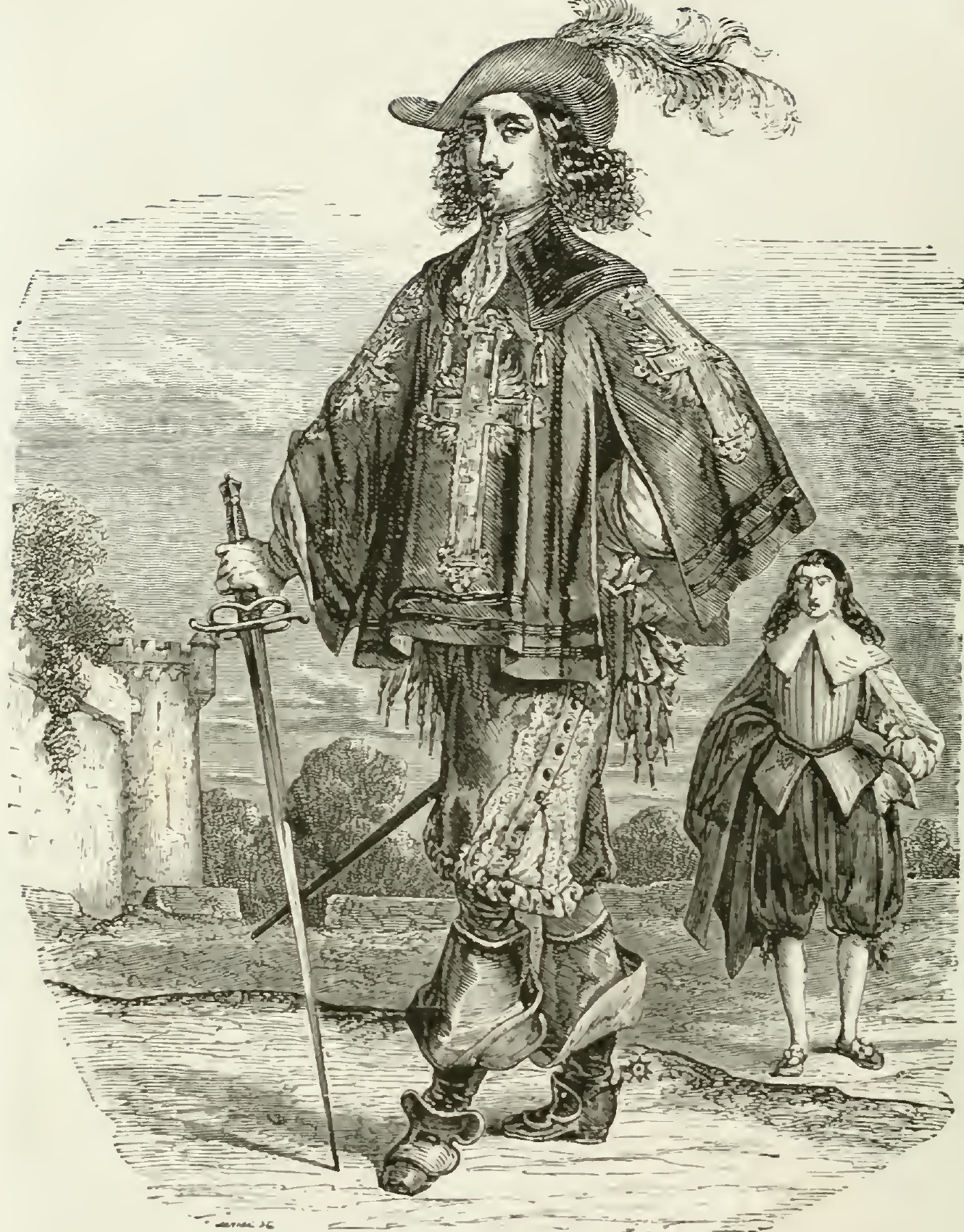
, and, thanks to a very intelligent tailor who made his garments new again by turning them, and whose wife was suspected of making Porthos descend from his aristocratic habits, Mousqueton cut a very good figure in his master's train.
As for Aramis, whose character we believe we have sufficiently set forth—a character, moreover, which, like that of his companions, we shall be able to follow in its development—his lackey was called Bazin. Thanks to the hope his master had of one day entering the orders, he was always dressed in black, as the servant of a churchman must be. He was a Berrichon of thirty-five to forty years, gentle, peaceable, somewhat plump, occupying in reading pious works the leisure his master left him, making, at a pinch, for two a dinner of few dishes but excellent. Moreover, mute, blind, deaf, and of a fidelity proof against all trials.
Now that we know, superficially at least, the masters and the valets, let us pass to the dwellings occupied by each of them.
Athos lived in the rue Férou, two steps from the Luxembourg; his apartment consisted of two small chambers, very neatly furnished, in a furnished house whose hostess, still young and truly still beautiful, made sweet eyes at him in vain. A few fragments of a great past splendor glittered here and there on the walls of this modest lodging: a sword, for example, richly damascened, which in its fashion went back to the reign of Francis I, whose hilt alone, incrusted with precious stones, might be worth two hundred pistoles, and which nevertheless, in his moments of greatest distress, Athos had never consented to pawn or to sell. This sword had long been the ambition of Porthos. Porthos would have given ten years of his life to possess this sword.
One day when he had an assignation with a duchess, he even tried to borrow it from Athos. Athos, without saying a word, emptied his pockets, gathered up all his jewels: purses, aiguillettes and gold chains, he offered everything to Porthos; but as for the sword, he told him, it was sealed in its place, and was to leave it only when its master himself left his lodging. Besides this sword, there was also a portrait representing a lord of the time of Henry III, dressed with the greatest elegance, and who wore the order of the Holy Spirit, and this portrait had with Athos certain resemblances of line, certain family similitudes, which indicated that this great lord, knight of the king's orders, was his ancestor. Finally, a coffer of magnificent goldsmith's work with the same arms as the sword and the portrait made a center of the mantelpiece that clashed frightfully with the rest of the furnishings. Athos always carried the key of this coffer on him. But one day he had opened it before Porthos, and Porthos had been able to assure himself that this coffer contained only letters and papers—love letters and family papers, doubtless.
Porthos occupied a very vast apartment of a very sumptuous appearance, in the rue du Vieux-Colombier. Each time he passed with some friend before his windows, at one of which Mousqueton always stood in great livery, Porthos raised his head and his hand, and said: "There is my dwelling." But he was never found at home, he never invited anyone to go up, and no one could form an idea of what this sumptuous appearance contained in real riches.
Aramis, for his part, inhabited a small lodging consisting of a boudoir, a dining room and a bedroom, which bedroom, situated like the rest of the apartment on the ground floor, looked out upon a small garden, fresh, green, shady and impenetrable to the eyes of the neighborhood.
As for d'Artagnan, we know how he was lodged, and we have already made the acquaintance of his lackey, master Planchet.
D'Artagnan, who was very curious by nature, as people are, moreover, who have the genius of intrigue, made every effort to learn what exactly Athos, Porthos and Aramis were; for under these names of war, each of the young men concealed his gentleman's name, Athos especially, who smelled of the great lord a league away. He therefore addressed himself to Porthos to obtain information about Athos and Aramis, and to Aramis to know Porthos.
Unfortunately Porthos himself knew of the life of his silent comrade only what had transpired of it. It was said that he had had great misfortunes in his love affairs, and that a frightful betrayal had forever poisoned the life of this gallant man. What was this betrayal? Everyone was ignorant of it.
As for Porthos, on the contrary, except for his real name, which M. de Tréville alone knew, as well as that of his two comrades, his life was easy to know. Vain and indiscreet, one saw through him as through crystal. The only thing that could have misled an investigator would have been to have believed all the good he said of himself.
But for Aramis, while seeming to have no secrets at all, he was a young man steeped in mysteries, answering little to the questions asked about others, and evading those asked about himself. One day d'Artagnan, after having long questioned him about Porthos, and having learned that rumor which was circulating about the musketeer's good fortune with a princess, wished also to know what to make of his interlocutor's love affairs.
"And you, my dear companion," he said to him, "you who speak of the baronesses, countesses, and princesses of others?"
"Pardon me," interrupted Aramis, "I spoke because Porthos speaks of it himself, because he shouted all those fine things in front of me. But rest assured, my dear Monsieur d'Artagnan, that if I had them from another source or if he had confided them to me, there would have been no confessor more discreet than I."
"I do not doubt it," replied d'Artagnan; "but after all, it seems to me that you yourself are rather familiar with coats of arms, as witness a certain embroidered handkerchief to which I owe the honor of your acquaintance."
Aramis this time did not fly into a passion, but he put on his most modest air and replied affectionately:
"My dear fellow, do not forget that I mean to be a churchman, and that I avoid all worldly occasions. That handkerchief you saw had not been entrusted to me, but had been forgotten at my house by one of my friends. I had to take it back so as not to compromise him and the lady he loves. As for me, I have no mistress and want none, following in this the very judicious example of Athos, who has no more of one than I do."
"But hang it all! you are not an abbé, since you are a musketeer."
"A musketeer for the time being, my dear fellow, as the cardinal says; a musketeer against my will, but a churchman at heart, believe me. Athos and Porthos dragged me into this to keep me occupied; I had, at the moment of being ordained, a little difficulty with— But that can hardly interest you, and I am taking up your precious time."
"Not at all, it interests me greatly," cried d'Artagnan, "and at this moment I have absolutely nothing to do."
"Yes, but I have my breviary to say," replied Aramis, "and then a few verses to compose, which Mme d'Aiguillon has asked of me; then I must go to the rue Saint-Honoré to buy some rouge for Mme de Chevreuse: you see, my dear friend, that if nothing presses you, I am very much pressed, I am."
And Aramis affectionately held out his hand to his young companion and took leave of him.
D'Artagnan could not, whatever pains he took, learn anything more about his three new friends. He therefore made up his mind to believe for the present all that was said of their past—hoping for surer and more extensive revelations from the future. In the meantime, he regarded Athos as an Achilles, Porthos as an Ajax, and Aramis as a Joseph.
For the rest, the life of the four young men was merry: Athos played and always unfortunately. Yet he never borrowed a sou from his friends, although his purse was continually at their service; and when he had played on his word, he always had his creditor woken at six in the morning to pay him the debt of the day before. Porthos had his fits of temper: on those days he was seen insolent and splendid; if he lost, he disappeared completely for some days, after which he reappeared with a pale face and a long countenance, but with money in his pockets. As for Aramis, he never played. He was indeed the worst musketeer and the most disagreeable boon companion that could be seen. He always had need of work. Sometimes, in the middle of a dinner, when everyone, carried along by the wine and the heat of conversation, believed they still had two or three hours to stay at table, Aramis looked at his watch, rose with a gracious smile, and took leave of the company to go, he said, to consult a casuist with whom he had an appointment; other times, he returned home to write a thesis, and begged his friends not to distract him. Yet Athos smiled with that charming melancholy smile, so fitting to his noble face, and Porthos drank while swearing that Aramis would never be anything but a village curé.
Now that we have cast a glance at the four friends, let us resume the course of our narration.
Planchet, d'Artagnan's valet, bore good fortune nobly; he received thirty sous a day, and for a month he came home gay as a linnet and affable toward his master. When the wind of adversity began to blow over the household in the rue des Fossoyeurs, that is to say, when the ten pistoles of King Louis XIII had been eaten up or nearly so, he began complaints that Athos found nauseating, Porthos indecent, and Aramis ridiculous. Athos therefore advised d'Artagnan to dismiss the rascal; Porthos wanted him to be beaten first; and Aramis claimed that a master should hear only the compliments people paid him.
"That is easy enough for you to say," replied d'Artagnan, "to you, Athos, who live mute with Grimaud, who forbid him to speak, and who consequently never have bad words with him; to you, Porthos, who keep up a magnificent establishment and who are a god to your valet Mousqueton; to you finally, Aramis, who, always distracted by your theological studies, inspire a profound respect in your servant Bazin, a gentle and religious man; but I, who am without substance and without resources, I who am not a musketeer nor even a guardsman, I—what should I do to inspire affection, terror, or respect in Planchet?"
"The matter is serious," answered the three friends; "it is a question of internal affairs; valets are like women, they must be put at once on the footing on which one wishes them to remain. Reflect, then."
D'Artagnan reflected and resolved to thrash Planchet by way of provision, which was carried out with the conscientiousness d'Artagnan put into everything; then, after having soundly beaten him, he forbade him to leave his service without his permission; for, he added, the future cannot fail me; I inevitably expect better times. Your fortune is therefore assured if you stay near me, and I am too good a master to make you miss your fortune by granting you the leave you ask of me.
This manner of acting gave the musketeers much respect for d'Artagnan's policy. Planchet was likewise struck with admiration and no longer spoke of leaving.
The life of the four young men had become common. D'Artagnan, who had no habits, since he came from his province and fell into a world entirely new to him, at once took up the habits of his friends.
They rose about eight o'clock in winter, about six in summer, and went to take the watchword and the air of affairs at M. de Tréville's. D'Artagnan, although he was not a musketeer, did duty there with touching punctuality; he was always on guard because he always kept company with whichever of his three friends was mounting his. He was known at the musketeers' hotel and everyone held him for a good comrade. M. de Tréville, who had appreciated him at first glance and who bore him a genuine affection, never ceased recommending him to the king.
For their part, the three musketeers loved their young comrade greatly. The friendship that united these four men, and the need to see one another three or four times a day, whether for a duel, for business, or for pleasure, made them continually run after one another like shadows, and one always met the inseparables seeking one another from the Luxembourg to the place Saint-Sulpice or from the rue du Vieux-Colombier to the Luxembourg.
Meanwhile, M. de Tréville's promises went their way. One fine day the king commanded M. le chevalier des Essarts to take d'Artagnan as a cadet in his company of guards. D'Artagnan, sighing, put on this uniform, which he would have wished, at the price of ten years of his existence, to exchange for the musketeer's jacket. But M. de Tréville promised this favor after a novitiate of two years—a novitiate which could be shortened, moreover, if the occasion arose for d'Artagnan to render some service to the king or to perform some brilliant action. D'Artagnan withdrew on this promise, and the very next day began his service.
Then it was the turn of Athos, Porthos, and Aramis to mount guard with d'Artagnan when he was on guard. The company of M. le chevalier des Essarts thus took four men instead of one on the day it took d'Artagnan.