
About this book
Fogg bets his fortune he can circle the globe in eighty days. Verne's 1872 novel, French original, Hetzel edition, free to read online.
Opening
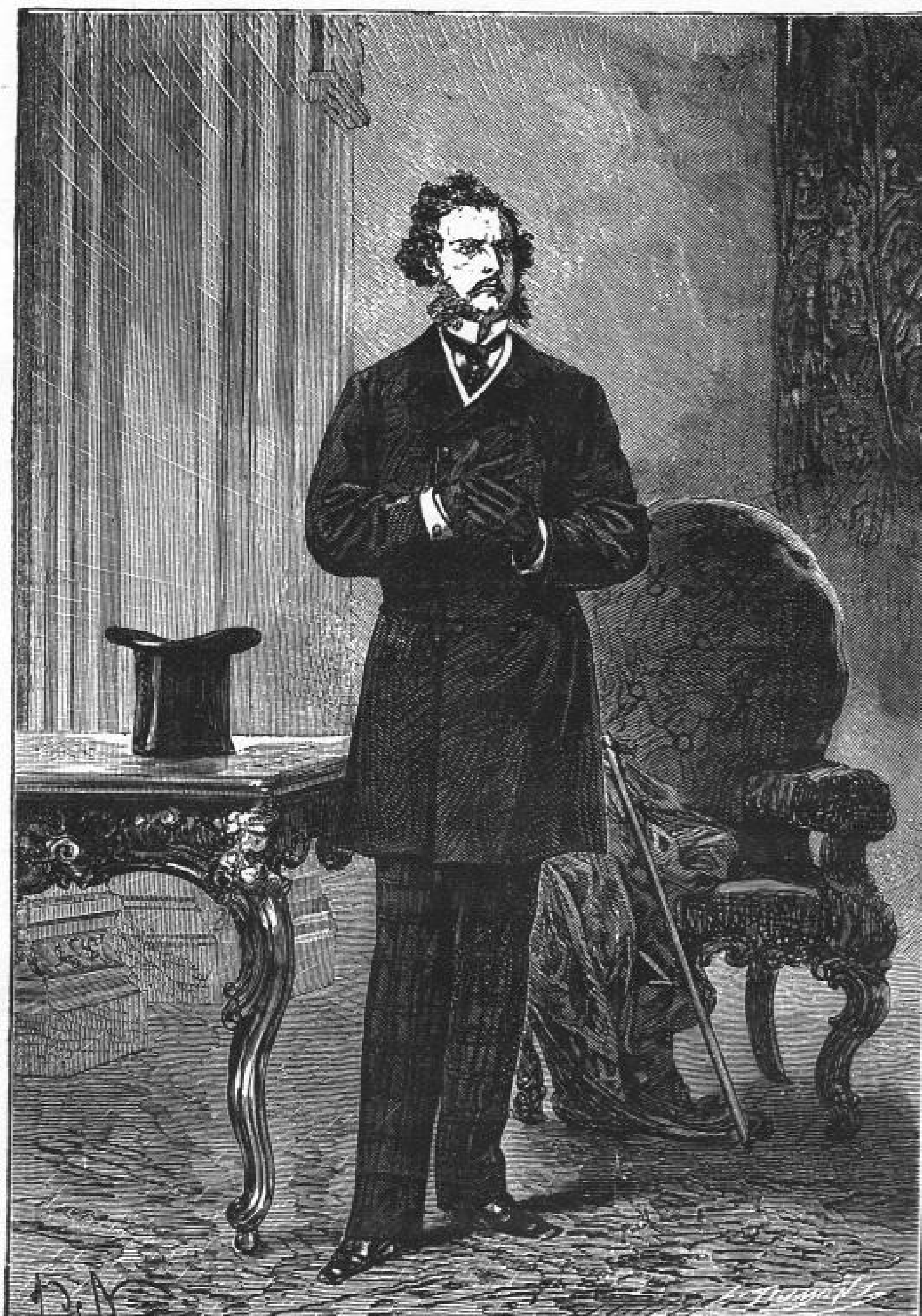
Phileas Fogg.
IN WHICH PHILEAS FOGG AND PASSEPARTOUT ACCEPT EACH OTHER, THE ONE AS MASTER, THE OTHER AS MAN.
In the year 1872, the house bearing the number 7 in Saville Row, Burlington Gardens—the house in which Sheridan died in 1814—was occupied by Phileas Fogg, Esq., one of the most singular and most noticed members of the Reform Club of London, although he seemed to set himself the task of doing nothing that could attract attention.
To one of the greatest orators who honor England, there succeeded, then, this Phileas Fogg, an enigmatic personage of whom nothing was known, except that he was a very gallant man and one of the handsomest gentlemen of English high society.
It was said that he resembled Byron—in the head, for he was irreproachable as to his feet—but a Byron with moustaches and side-whiskers, an impassive Byron, who would have lived a thousand years without growing old.
English, to be sure, Phileas Fogg was perhaps not a Londoner. He had never been seen either at the Stock Exchange, or at the Bank, or in any of the counting-houses of the City. Neither the basins nor the docks of London had ever received a ship having Phileas Fogg for owner. This gentleman figured on no board of directors. His name had never resounded in a college of lawyers, nor at the Temple, nor at Lincoln's Inn, nor at Gray's Inn. He never pleaded either in the Court of Chancery, or in the Queen's Bench, or in the Exchequer, or in the Ecclesiastical Court. He was neither manufacturer, nor merchant, nor trader, nor farmer. He was a member neither of the Royal Institution of Great Britain, nor of the Institution of London, nor of the Institution of Artisans, nor of the Russell Institution, nor of the Western Literary Institution, nor of the Institution of Law, nor of that Institution of Arts and Sciences united, which is placed under the direct patronage of Her Gracious Majesty. He belonged, in short, to none of the numerous societies that swarm in the capital of England, from the Harmonica Society to the Entomological Society, founded principally for the purpose of destroying noxious insects.
Phileas Fogg was a member of the Reform Club, and that was all.
To anyone who would wonder that a gentleman so mysterious counted among the members of this honorable association, the answer will be that he was passed on the recommendation of Messrs. Baring Brothers, with whom he had an open credit. Hence a certain "standing," due to the fact that his checks were regularly paid at sight from the debit of his current account, invariably in credit.
Was this Phileas Fogg rich? Incontestably. But how he had made his fortune, that is what the best informed could not say, and Mr. Fogg was the last person to whom it was fitting to apply to learn it. In any case, he was prodigal of nothing, but not avaricious, for wherever an accompaniment was lacking for a noble, useful, or generous thing, he supplied it silently and even anonymously.
In short, nothing less communicative than this gentleman. He spoke as little as possible, and seemed all the more mysterious because he was silent. Nevertheless his life was up to date, but what he did was so mathematically always the same thing that the dissatisfied imagination sought beyond it.
Had he traveled? It was probable, for no one possessed the map of the world better than he. There was no place so remote of which he did not appear to have a special knowledge. Sometimes, but in few words, brief and clear, he corrected the thousand remarks circulating in the club on the subject of lost or strayed travelers; he indicated the true probabilities, and his words had often seemed as if inspired by a second sight, so much did the event always end by justifying them. He was a man who must have traveled everywhere—in mind, at least.
What was certain, however, is that for many long years Phileas Fogg had not left London. Those who had the honor of knowing him a little more than others attested that—except on that direct path he traveled each day to come from his house to the club—no one could claim to have ever seen him elsewhere. His only pastime was reading the newspapers and playing whist. At this game of silence, so well suited to his nature, he often won, but his winnings never entered his purse and figured for an important sum in his charity budget. Moreover, it must be noted, Mr. Fogg evidently played to play, not to win. Play was for him a combat, a struggle against a difficulty, but a struggle without movement, without displacement, without fatigue, and that suited his character.
No wife or children were known to Phileas Fogg—which can happen to the most honest people—nor relatives nor friends—which is rarer in truth. Phileas Fogg lived alone in his house in Saville Row, where no one penetrated. Of his interior, never was there any question. A single servant sufficed to serve him. Dining and lunching at the club at chronometrically determined hours, in the same room, at the same table, not dealing with his colleagues, not inviting any stranger, he returned home only to sleep, at midnight precisely, without ever using those comfortable rooms that the Reform Club keeps at the disposal of the members of the circle. Out of twenty-four hours, he passed ten at his domicile, whether he slept or occupied himself with his toilet. If he walked, it was invariably, with an even step, in the entrance hall parqueted in marquetry, or on the circular gallery above which there curves a dome with blue stained-glass windows, supported by twenty Ionic columns of red porphyry. If he dined or lunched, it was the kitchens, the pantry, the buttery, the fish-larder, the dairy of the club that furnished his table with their succulent reserves; it was the servants of the club, grave personages in black coats, shod in shoes with quilted soles, who served him in a special porcelain and on an admirable linen of Saxony cloth; it was the molded crystal of the club that contained his sherry, his port, or his claret mixed with cinnamon, capillaire, and cinnamomum; it was finally the ice of the club—ice brought at great expense from the lakes of America—that kept his drinks in a satisfactory state of freshness.
If living under these conditions is to be an eccentric, it must be admitted that eccentricity has its good side!
The house in Saville Row, without being sumptuous, was commendable for an extreme comfort. Moreover, with the invariable habits of the tenant, the service there was reduced to little. Nevertheless, Phileas Fogg demanded of his only servant an extraordinary punctuality and regularity. That very day, October 2, Phileas Fogg had given notice to James Forster—this boy having made himself guilty of bringing him for his shaving water at eighty-four degrees Fahrenheit instead of eighty-six—and he was awaiting his successor, who was to present himself between eleven o'clock and half past eleven.
Phileas Fogg, squarely seated in his armchair, his two feet close together like those of a soldier on parade, his hands resting on his knees, his body straight, his head high, was watching the hand of the clock move—a complicated apparatus that indicated the hours, the minutes, the seconds, the days, the dates, and the year. At half past eleven striking, Mr. Fogg was to, following his daily habit, leave the house and go to the Reform Club.
At that moment, there was a knock at the door of the small drawing room in which Phileas Fogg was sitting.
James Forster, the dismissed servant, appeared.
"The new servant," he said.
A boy about thirty years of age showed himself and bowed.
"You are French and your name is John?" Phileas Fogg asked him.
“Jean, if monsieur does not object,” replied the newcomer, “Jean Passepartout, a nickname that has stuck to me, and which my natural knack for getting myself out of scrapes justified. I believe I am an honest fellow, monsieur, but, to be frank, I have done several trades. I was a traveling singer, a rider in a circus, doingvoltige like Léotard, and dancing on the tightrope like Blondin; then I became a gymnastics teacher, so as to make my talents more useful, and, lastly, I was a sergeant of firefighters in Paris. I even have some remarkable fires in my record. But it has been five years since I left France, and, wanting to taste family life, I am a valet in England.” Now, finding myself without a place and having learned that Mr. Phileas Fogg was the most exact and most sedentary man in the United Kingdom, I presented myself at monsieur’s with the hope of living there quietly and of forgetting even that name of Passepartout...
.
“Passepartout suits me,” replied the gentleman. “You come recommended to me. I have good information about you. Do you know my conditions?”
“Yes, monsieur.”
“Good. What time do you have?”
“Eleven twenty-two,” replied Passepartout, drawing from the depths of his fob a huge silver watch.
“You are slow,” said Mr. Fogg.
“May monsieur forgive me, but that is impossible.”
“You are four minutes slow. No matter. It is enough to note the discrepancy. So, from this moment, eleven twenty-nine in the morning, this Wednesday, October 2, 1872, you are in my service.”
That said, Phileas Fogg rose, took his hat with his left hand, placed it on his head with an automaton’s movement, and disappeared without adding another word.
Passepartout heard the street door close for the first time: it was his new master going out; then a second time: it was his predecessor, James Forster, departing in his turn.
Passepartout remained alone in the house in Saville Row.