
About this book
Fogg bets his fortune he can circle the globe in eighty days. Verne's 1872 novel, French original, Hetzel edition, free to read online.
IN WHICH FIX, THE DETECTIVE, SHOWS A VERY LEGITIMATE IMPATIENCE.
Here is the translation: The following were the circumstances under which this dispatch concerning the gentleman Phileas Fogg had been sent.
On Wednesday, October 9, the steamer Mongolia, of the Peninsular and Oriental Company, an iron screw steamer with a spar deck, of two thousand eight hundred tons burden and five hundred nominal horse-power, was expected at eleven o'clock in the morning at Suez. The Mongolia made regular passages from Brindisi to Bombay by way of the Suez Canal. It was one of the fastest vessels of the Company, and the regulation speeds—ten miles an hour between Brindisi and Suez, and nine miles fifty-three hundredths between Suez and Bombay—it had always exceeded.
While awaiting the arrival of the Mongolia, two men were walking on the quay amid the crowd of natives and foreigners that throngs into this town, formerly a mere village, to which the great work of M. de Lesseps assures a considerable future.
Of these two men, one was the consular agent of the United Kingdom established at Suez, who—despite the unfavorable prognostics of the British government and the gloomy predictions of the engineer Stephenson—saw English ships passing through this canal every day, thus shortening by half the former route from England to the Indies by way of the Cape of Good Hope.
The other was a small, thin man, of a rather intelligent appearance, nervous, who contracted his brow muscles with remarkable persistence. Through his long eyelashes shone a very bright eye, but one whose ardor he knew how to extinguish at will. At this moment he was giving certain signs of impatience, going to and fro, unable to keep still.
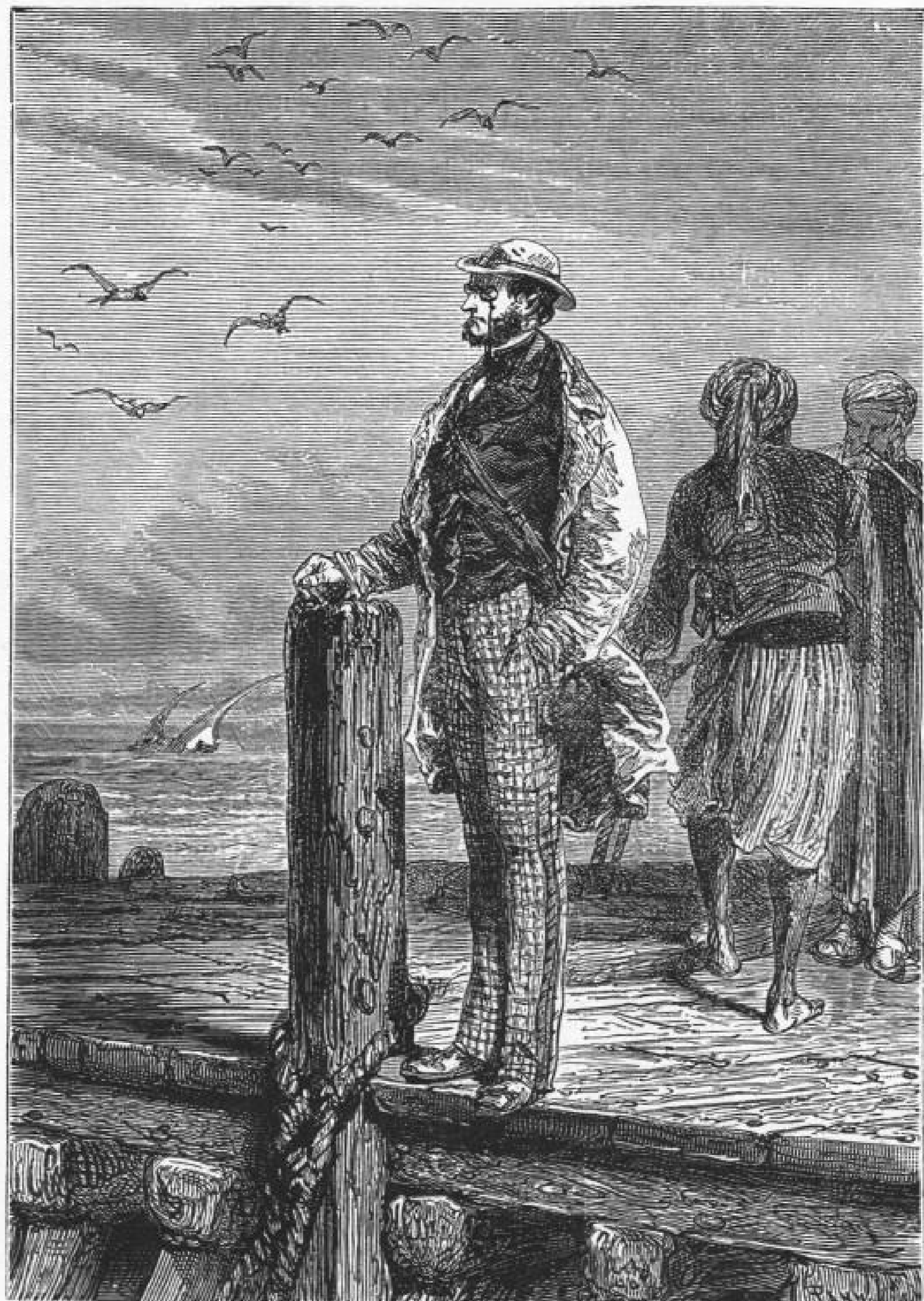
This man's name was Fix, and he was one of those "detectives," or English police agents, who had been sent to the various ports after the robbery committed at the Bank of England. This Fix was to keep the most careful watch over all travelers taking the route to Suez, and if any one of them seemed suspicious to him, to "shadow" him while awaiting a warrant of arrest.
Precisely, for two days, Fix had received from the director of the metropolitan police the description of the presumed author of the theft. It was that of this distinguished and well-dressed personage who had been observed in the paying hall of the Bank.
The detective, very much enticed obviously by the substantial reward promised in case
of success, was therefore awaiting with an impatience easy to understand the arrival of the Mongolia.
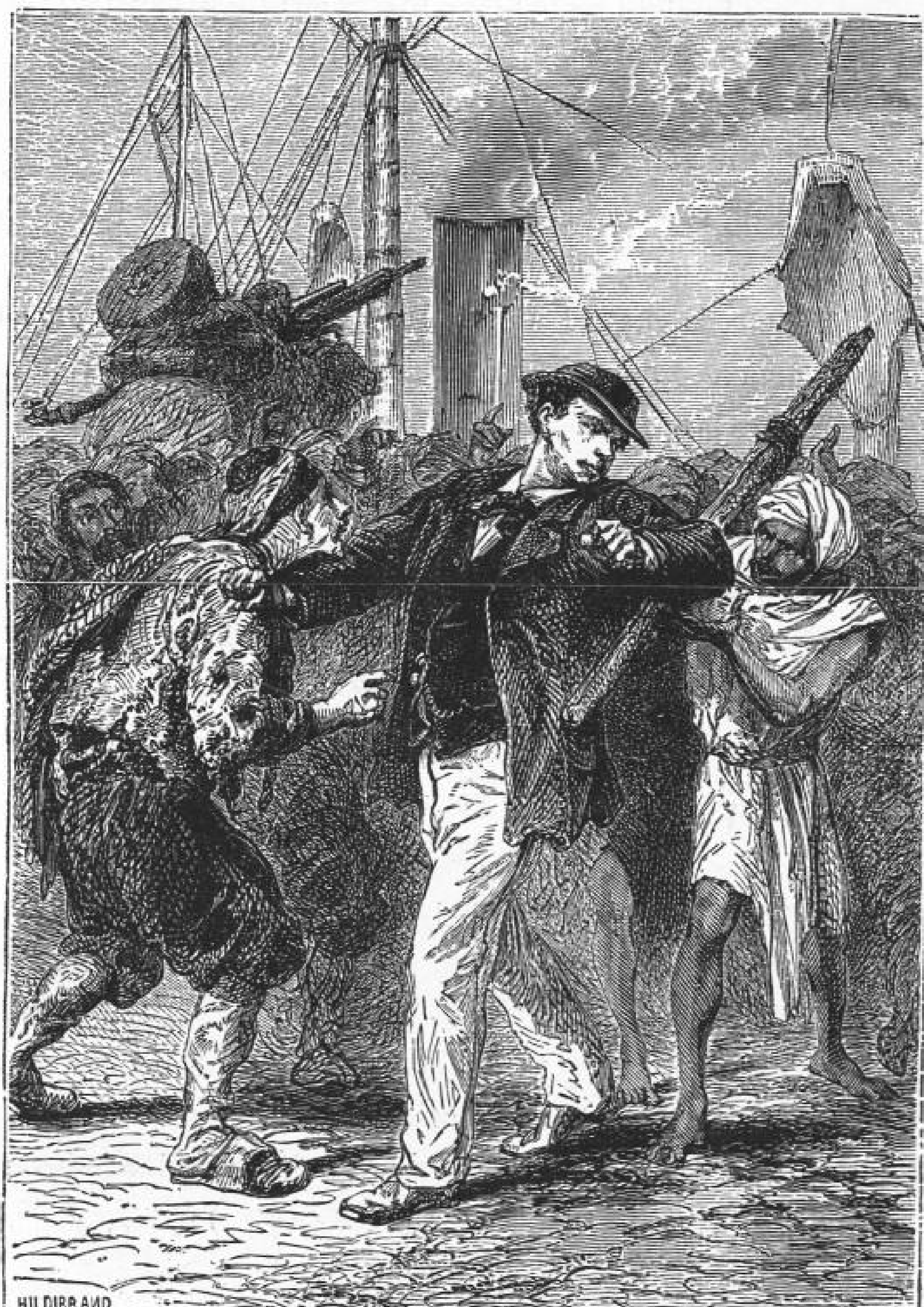
After having vigorously pushed back.... (Page 27.)
"And you say, Mr. Consul," he asked for the tenth time, "that this boat cannot be long?
— No, Mr. Fix," replied the consul. "It was sighted yesterday off Port Said, and the hundred and sixty kilometers of the canal do not count for such a walker. I repeat to you that the Mongolia has always won the prize of twenty-five pounds that the government grants for each advance of twenty-four hours over the regulation times.
— This steamer comes directly from Brindisi?" asked Fix.
"— From Brindisi itself, where it took on the India mail, from Brindisi which it left Saturday at five o'clock in the evening. So have patience, it cannot be long in arriving. But I really do not know how, with the description you have received, you will be able to recognize your man, if he is on board the Mongolia.
— Mr. Consul," replied Fix, "these people, one senses them rather than recognizes them. It is flair that one must have, and flair is like a special sense to which hearing, sight and smell all contribute. I have arrested more than one of these gentlemen in my life, and provided my thief is on board, I assure you he will not slip between my hands.
— I hope so, Mr. Fix, for it is a question of an important theft.
— A magnificent theft," replied the agent enthusiastically. "Fifty-five thousand pounds! We do not often have such windfalls! Thieves are becoming petty! The race of the Sheppards is wasting away! People get themselves hanged now for a few shillings!
— Mr. Fix," replied the consul, "you speak in such a way that I sincerely wish you success; but, I repeat to you, in the conditions in which you are, I fear that it will be difficult. Do you realize that, according to the description you have received, this thief looks absolutely like an honest man."
“Mr. Consul,” replied the police inspector dogmatically, “great thieves always look like honest men. You surely understand that those who have the faces of scoundrels have only one course to take, and that is to remain honest, otherwise they would be arrested. It is the honest faces that must be stared at above all. A difficult task, I admit, and one that is no longer a matter of the trade, but of art.”
It will be seen that the said Fix did not lack a certain dose of self-esteem.
Meanwhile the quay was gradually coming to life. Sailors of various nationalities, merchants, brokers, porters, and fellahs flocked there. The arrival of the steamer was obviously imminent.
The weather was rather fine, but the air was cold, with that east wind. A few minarets stood out above the town beneath the pale rays of the sun. Toward the south, a jetty two thousand meters long stretched out like an arm over the harbor of Suez. On the surface of the Red Sea rolled several fishing or coasting boats, some of which have retained in their build the elegant lines of the ancient galley.
While moving among this crowd, Fix, by a habit of his profession, scrutinized the passersby with a rapid glance.
;
It was then half past ten.
“But that steamer won’t arrive!” he exclaimed upon hearing the harbor clock strike.
“It cannot be far off,” replied the consul.
“How long will it stay at Suez?” asked Fix.
“Four hours. Just long enough to take on coal. From Suez to Aden, at the tip of the Red Sea, is thirteen hundred and ten miles, and it must lay in fuel.”
“And from Suez, does this ship go directly to Bombay?” asked Fix.
“Directly, without breaking bulk.”
“Well,” said Fix, “if the thief has taken this route and this ship, it must be part of his plan to disembark at Suez, so as to reach by another route the Dutch or French possessions in Asia. He must surely know that he would not be safe in India, which is English soil.”
“Unless he is a very clever man,” replied the consul. “You know it, an English criminal is always better hidden in London than he would be abroad.”
At this reflection, which gave the agent much to think about, the consul returned to his offices, located a short distance away. The police inspector remained alone, seized by a nervous impatience, with the rather strange presentiment that his thief must be aboard the Mongolia—and in truth, if that rascal had left England with the intention of reaching the New World, the route to the Indies, less watched or harder to watch than that of the Atlantic, must have obtained his preference.
Fix was not left long to his reflections. Sharp blasts of whistles announced the arrival of the steamer. The whole horde of porters and fellahs rushed toward the quay in a tumult somewhat alarming for the limbs and clothes of the passengers. About ten boats cast off from the shore and went to meet the Mongolia.
Soon the gigantic hull of the Mongolia came into view, passing between the banks of the canal, and eleven o’clock was striking when the steamer came to anchor in the harbor, while its steam hissed loudly through the exhaust pipes.
The passengers were quite numerous aboard. Some remained on the spardeck contemplating the picturesque panorama of the town; but most disembarked in the boats that had come alongside the Mongolia.
Fix scrupulously examined all those who set foot ashore.
At that moment, one of them approached him, after vigorously pushing back the fellahs who were assailing him with their offers of service, and asked him very politely whether he could direct him to the offices of the English consular agent. And at the same time this passenger presented a passport on which he doubtless wished to have the British visa affixed.
Fix instinctively took the passport, and with a rapid glance read the description in it.
An involuntary movement nearly escaped him. The sheet trembled in his hand. The description written on the passport was identical to the one he had received from the director of the metropolitan police.
“This passport is not yours?” he said to the passenger.
“No,” replied the latter, “it is my master’s passport.”
“And your master?”
“He remained aboard.”
“But,” resumed the agent, “he must present himself in person at the consulate offices in order to establish his identity.”
“What, is that necessary?”
“Indispensable.”
“And where are those offices?”
“There, at the corner of the square,” replied the inspector, indicating a house two hundred paces away.
“Then I will go and fetch my master, though he will hardly like being disturbed!”
Thereupon the passenger bowed to Fix and returned aboard the steamer.