
About this book
Fogg bets his fortune he can circle the globe in eighty days. Verne's 1872 novel, French original, Hetzel edition, free to read online.
IN WHICH THE BAG OF BANK-NOTES IS LIGHTENED STILL BY A FEW THOUSAND POUNDS.
The train had stopped in the station. Passepartout got down from the carriage first, and was followed by Mr. Fogg, who helped his young companion to set foot on the platform. Phileas Fogg intended to go directly to the Hong Kong steamer, in order to install Mrs. Aouda comfortably there, whom he did not wish to leave as long as she would be in this country so dangerous for her.
As Mr. Fogg was about to leave the station, a policeman approached him and said:
"Mr. Phileas Fogg?"
"That is I."
"Is this man your servant?" added the policeman, pointing to Passepartout.
"Yes."
"Be so good as to follow me, both of you."
Mr. Fogg made no movement that could betray any surprise on his part. This agent was a representative of the law, and for every Englishman the law is sacred. Passepartout, with his French habits, wanted to argue, but the policeman touched him with his baton, and Phileas Fogg signaled to him to obey.
"Can this young lady accompany us?" asked Mr. Fogg.
"She may," replied the policeman.
The policeman led Mr. Fogg, Mrs. Aouda, and Passepartout toward a palki-ghari, a sort of four-wheeled, four-seated carriage drawn by two horses. They set off. No one spoke during the journey, which lasted about twenty minutes.
The carriage first crossed the "black town," with its narrow streets lined with hovels in which swarmed a cosmopolitan, dirty, and ragged population; then it passed through the European town, enlivened by brick houses, shaded by coconut trees, bristling with masts, and already traversed, despite the early hour, by elegant horsemen and magnificent equipages.
The palki-ghari stopped in front of a dwelling of simple appearance, but which could not have been intended for domestic uses. The policeman made his prisoners descend—one could truly give them that name—and he led them into a room with barred windows, saying to them:
"It is at half past eight that you will appear before Judge Obadiah."
Then he withdrew and closed the door.
"Come now! We are caught!" exclaimed Passepartout, letting himself fall onto a chair.
Mrs. Aouda, turning at once to Mr. Fogg, said to him in a voice whose emotion she sought in vain to disguise:
"Sir, you must abandon me! It is for me that you are being pursued! It is for having saved me!"
Phileas Fogg contented himself with replying that this was not possible. Pursued for this sutty affair! Inadmissible! How would the plaintiffs dare to present themselves? There was a mistake. Mr. Fogg added that, in any case, he would not abandon the young woman, and that he would conduct her to Hong Kong.
"But the boat leaves at noon!" Passepartout pointed out.
"Before noon we shall be on board," replied the impassive gentleman simply.
This was affirmed so clearly that Passepartout could not help saying to himself:
"By Jove! that is certain! before noon we shall be on board!" But he was not reassured at all.
At half past eight, the door of the room opened. The policeman reappeared, and he led the prisoners into the adjoining room. It was an audience chamber, and a rather numerous public, composed of Europeans and natives, already occupied the courtroom.
Mr. Fogg, Mrs. Aouda and Passepartout sat down on a bench facing the seats reserved for the magistrate and the clerk.
This magistrate, Judge Obadiah, entered almost immediately, followed by the clerk. He was a big, round man. He unhooked a wig hanging from a nail and promptly put it on.
"The first case," he said.
But, raising his hand to his head:
"Hey! that is not my wig!"
"Indeed, Mr. Obadiah, it is mine," replied the clerk.
"Dear Mr. Oysterpuf, how do you expect a judge to render a good sentence with a clerk's wig!"
The exchange of wigs was made. During these preliminaries, Passepartout was boiling with impatience, for the needle seemed to him to be moving terribly fast on the dial of the large clock in the courtroom.
"The first case," Judge Obadiah then resumed.
"Phileas Fogg?" said the clerk Oysterpuf.
"Here I am," replied Mr. Fogg.
"Passepartout?"
"Present!" replied Passepartout.
"Good!" said Judge Obadiah. "For two days now, accused, you have been watched at all the trains from Bombay."
"But what are we accused of?" cried Passepartout, impatiently.
"You are about to learn," replied the judge.
"Sir," Mr. Fogg then said, "I am an English citizen, and I have the right—"
"Has anyone shown you disrespect?" asked Mr. Obadiah.
"Not at all."
"Good! Bring in the plaintiffs."
At the judge's order, a door opened, and three Hindu priests were shown in by a bailiff.
"That's it!" murmured Passepartout, "it is those scoundrels who wanted to burn our young lady!"
The priests stood before the judge, and the clerk read aloud a complaint for sacrilege, filed against Mr. Phileas Fogg and his servant, accused of having violated a place consecrated by the Brahmanic religion.
"You have heard?" the judge asked Phileas Fogg.
"Yes, sir," replied Mr. Fogg, consulting his watch, "and I admit it."
"Ah! you admit it?—I admit it and I await the moment when these three priests admit in their turn what they intended to do at the pagoda of Pillaji."
The priests looked at one another. They seemed to understand nothing of the accused's words.
"No doubt!" cried Passepartout impetuously, "at that pagoda of Pillaji, before which they were going to burn their victim!"
Fresh stupefaction of the priests, and profound astonishment of Judge Obadiah.
"What victim?" he asked. "Burn whom! In the middle of the city of Bombay?"
"Bombay?" cried Passepartout.
"No doubt. It is not a question of the pagoda of Pillaji, but of the pagoda of Malabar Hill, in Bombay."
"And as a piece of evidence, here are the profaner's shoes," added the clerk, placing a pair of shoes on his desk.
"My shoes!" cried Passepartout, who, surprised beyond measure, could not restrain this involuntary exclamation.
One may imagine the confusion that had taken place in the minds of master and servant. This incident at the pagoda of Bombay they had forgotten, and it was precisely that one which was bringing them before the magistrate of Calcutta.
Indeed, the agent Fix had understood all the advantage he could draw from this unfortunate affair. Delaying his departure by twelve hours, he had made himself the counsel of the priests of Malabar Hill; he had promised them considerable damages, knowing well that the English government showed itself very severe toward this kind of offense; then, by the following train, he had sent them on the trail of the sacrilege. But, in consequence of the time employed in the deliverance of the young widow, Fix and the Hindus arrived at Calcutta before Phileas Fogg and his servant, whom the magistrates, informed by telegram, were to arrest as they left the train. One may judge of Fix's disappointment when he learned that Phileas Fogg had not yet arrived in the capital of India. He had to believe that his thief, stopping at one of the stations of the Peninsular Railway, had taken refuge in the northern provinces. For twenty-four hours, amid mortal anxieties, Fix watched for him at the station. What then was his joy when, that very morning, he saw him descend from the carriage, in the company, it is true, of a young woman whose presence he could not explain to himself. At once he set a policeman on him, and that is how Mr. Fogg, Passepartout and the widow of the rajah of Bundelkund were brought before Judge Obadiah.
And if Passepartout had been less preoccupied with his affair, he would have perceived, in a corner of the courtroom, the detective, who was following the debate with an interest
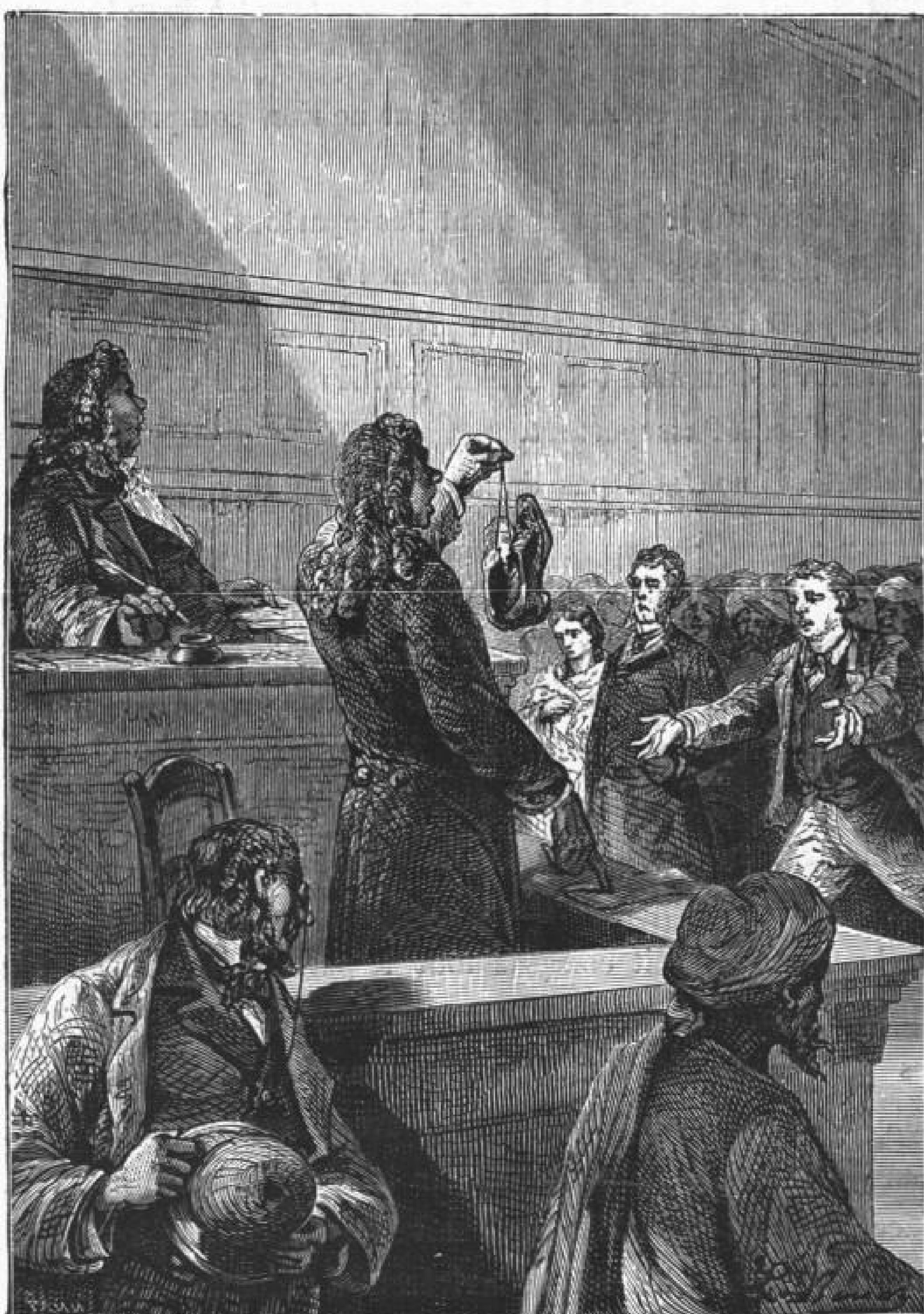
easy to understand—for at Calcutta, as at Bombay, as at Suez, the warrant for arrest was still lacking.
Meanwhile Judge Obadiah had taken note of the admission that had escaped Passepartout, who would have given all he possessed to take back his imprudent words.
"The facts are admitted?" said the judge.
"Admitted," replied Mr. Fogg coldly.
— "Whereas," resumed the judge, "whereas the English law is intended to protect equally and rigorously all religions of the populations of India, the offense being admitted by the said Passepartout, convicted of having sacrilegiously violated with his foot
the pavement of the pagoda of Malabar Hill, at Bombay, on the day of October 20, condemns the said Passepartout to fifteen days in prison and a fine of three hundred pounds (7,500 fr.).
— "Three hundred pounds?" exclaimed Passepartout, who was truly sensitive only to the fine.
— "Silence!" cried the usher in a shrill voice.
— "And," added Judge Obadiah, "whereas it has not been materially proven that there was no collusion between the servant and the master, and that in any case the latter must be held responsible for the acts and deeds of a servant in his pay, retains the said Phileas Fogg and condemns him to eight daysin prison and a fine of one hundred and fifty pounds. Clerk, call another case!"
Fix, in his corner, felt an indescribable satisfaction. Phileas Fogg detained eight days at Calcutta was more than enough time for the warrant to reach him.
Passepartout was stunned. This conviction ruined his master. A wager of twenty thousand pounds lost, and all because, like a true simpleton, he had entered that accursed pagoda!
Phileas Fogg, as self-possessed as if this conviction did not concern him, had not even frowned. But at the moment when the clerk was calling another case, he rose and said:
"I offer bail."
"That is your right," replied the judge.
Fix felt a chill down his spine, but he regained his assurance when he heard the judge, "whereas Phileas Fogg and his servant are foreigners," fix the bail for each of them at the enormous sum of one thousand pounds (25,000 fr.).
That was two thousand pounds it would cost Mr. Fogg if he did not serve out his sentence.
"I pay," said the gentleman.
And from the bag carried by Passepartout he took a packet of bank-notes which he deposited on the clerk's desk.
"This sum will be returned to you upon your release from prison," said the judge. "In the meantime, you are free on bail."
"Come," said Phileas Fogg to his servant.
"But at least, let them give back the shoes!" exclaimed Passepartout in a fury.
They returned his shoes to him.
"These are expensive!" he murmured. "More than a thousand pounds each! Not to mention that they pinch me!"
Passepartout, absolutely pitiful, followed Mr. Fogg, who had offered his arm to the young woman. Fix still hoped that his thief would never decide to abandon this sum of two thousand pounds and that he would serve his eight days in prison. He therefore threw himself in Fogg's tracks.
Mr. Fogg took a carriage, into which Mrs. Aouda, Passepartout and he immediately climbed. Fix ran behind the carriage, which soon stopped on one of the quays of the town.
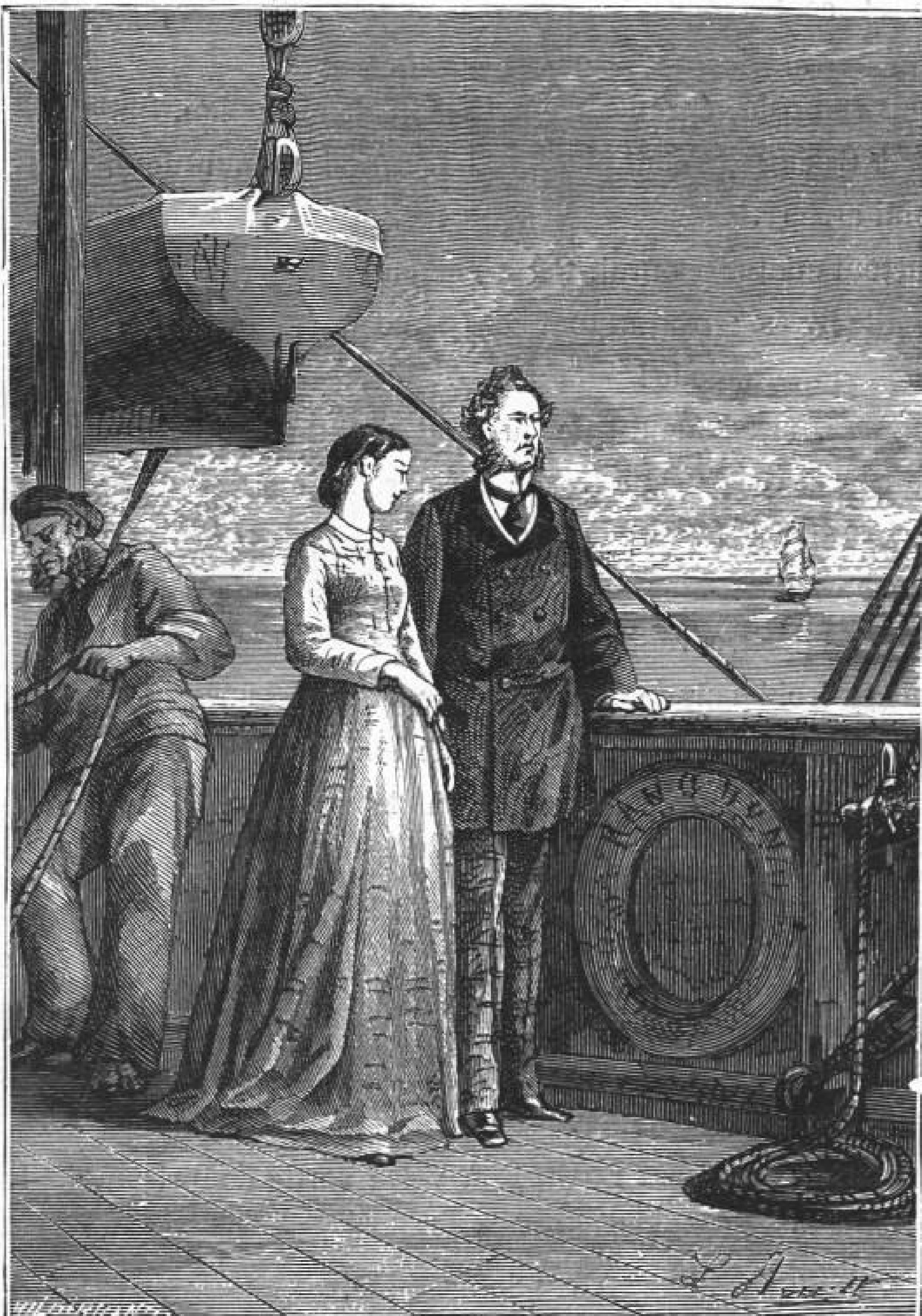
Half a mile out in the roads, the Rangoon lay at anchor, her departure flag hoisted at the masthead. Eleven o'clock was striking. Mr. Fogg was an hour early. Fix saw him get down from the carriage and embark in a boat with Mrs. Aouda and his servant. The detective stamped his foot on the ground.
"The wretch!" he cried. "He's leaving! Two thousand pounds sacrificed! Prodigal like a thief! Ah! I'll track him to the ends of the earth if I must; but at the rate he's going, all the money from the theft will have gone into it!"
The police inspector was justified in making this reflection. Indeed, since he had left London, as much in travel expenses as in bonuses, in the purchase of an elephant, in bail and in fines, Phileas Fogg had already strewn more than five thousand pounds (123,000 fr.) along his route, and the percentage of the recovered sum, allotted to the detectives, was continually diminishing.