
About this book
Fogg bets his fortune he can circle the globe in eighty days. Verne's 1872 novel, French original, Hetzel edition, free to read online.
IN WHICH A SLIGHT GLIMPSE IS GIVEN OF SAN FRANCISCO, ON A MEETING DAY.
It was seven o'clock in the morning when Phileas Fogg, Mrs. Aouda and Passepartout set foot on the American continent—if, that is, one can give that name to the floating quay on which they landed. These quays, rising and falling with the tide, facilitate the loading and unloading of ships. There the clippers of every dimension come to moor, the steamers of every nationality, and those multi-decked steamboats which serve the Sacramento and its tributaries. There, too, are piled up the products of a commerce which extends to Mexico, Peru, Chile, Brazil, Europe, Asia, and all the islands of the Pacific Ocean.
Passepartout, in his joy at finally touching American soil, had believed it his duty to carry out his disembarkation by executing a somersault of the finest style. But when he fell back onto the quay, whose planks were worm-eaten, he nearly went through it. Quite disconcerted by the manner in which he had "set foot" on the new continent, the honest fellow uttered a formidable cry, which sent flying an innumerable troop of cormorants and pelicans, the usual guests of the movable quays.
Mr. Fogg, as soon as he had landed, inquired at what hour the first train for New York left. It was at six o'clock in the evening. Mr. Fogg therefore had a whole day to spend in the Californian capital. He had a carriage brought for Mrs. Aouda and for himself. Passepartout climbed onto the seat, and the vehicle, at three dollars the trip, headed for the International Hotel.
From the elevated seat he occupied, Passepartout observed with curiosity the great American city: broad streets, low houses well aligned, churches and temples of an Anglo-Saxon Gothic, immense docks, warehouses like palaces, some of wood, others of brick; in the streets, numerous carriages, omnibuses, tramway "cars," and on the crowded sidewalks, not only Americans and Europeans, but also Chinese and Indians—in short, enough to compose a population of more than two hundred thousand inhabitants.
Passepartout was quite surprised by what he saw. He was still in the legendary city of 1849, the city of bandits, incendiaries, and murderers who had rushed in to conquer the nuggets, an immense chaos of every sort of outcast, where gold dust was gambled away with a revolver in one hand and a knife in the other. But "those fine days" were over. San Francisco presented the appearance of a great commercial city. The tall tower of the city hall, where the watchmen keep vigil, dominated that whole assemblage of streets and avenues intersecting at right angles, between which verdant squares blossomed, and then a Chinese town that seemed to have been imported from the Celestial Empire in a toy box. No more sombreros, no more red shirts in the fashion of the placer miners, no more feathered Indians, but silk hats and black coats, worn by a great many gentlemen endowed with devouring activity. Certain streets, among others Montgomery Street—the Regent Street of London, the Boulevard des Italiens of Paris, the Broadway of New York—were lined with splendid shops offering the products of the entire world in their displays.
When Passepartout arrived at the International Hotel, it did not seem to him that he had left England.
The ground floor of the hotel was occupied by an immense "bar," a sort of buffet open free of charge to any passerby. Dried meat, oyster soup, biscuit and Chester cheese were dispensed there without the consumer having to loosen his purse strings. He paid only for his drink—ale, port, or sherry—if his fancy led him to refresh himself. This seemed "very American" to Passepartout.
The hotel restaurant was comfortable. Mr. Fogg and Mrs. Aouda settled themselves before a table and were abundantly served on Lilliputian plates by negroes of the most beautiful black.
After lunch, Phileas Fogg, accompanied by Mrs. Aouda, left the hotel to go to the offices of the English consul in order to have his passport visaed there. On the sidewalk, he found his servant, who asked him whether, before taking the Pacific railway, it would not be prudent to buy a few dozen Enfield carbines or Colt revolvers. Passepartout had heard talk of Sioux and Pawnees, who stop trains like simple Spanish thieves. Mr. Fogg replied that this was a useless precaution, but he left him free to act as he saw fit. Then he made his way toward the offices of the consular agent.
Phileas Fogg had not gone two hundred paces when, "by the greatest of chances," he met Fix. The inspector appeared extremely surprised. What! Mr. Fogg and he had made the crossing of the Pacific together, and they had not met on board! In any case, Fix could only be honored to see again the gentleman to whom he owed so much, and, his business recalling him to Europe, he would be delighted to continue his journey in such agreeable company.
Mr. Fogg replied that the honor would be his, and Fix—who was determined not to lose sight of him—asked permission to visit with him this curious city of San Francisco. Which was granted.
So here were Mrs. Aouda, Phileas Fogg, and Fix strolling through the streets. They soon found themselves in Montgomery Street, where the crowd of people was enormous. On the sidewalks, in the middle of the roadway, on the tramway rails, despite the incessant passage of coaches and omnibuses, at the thresholds of the shops, at the windows of all the houses, and even up on the roofs, an innumerable crowd. Sandwich men circulated among the groups. Banners and streamers floated in the wind. Shouts broke out on all sides.
"Hurrah for Kamerfield!
"Hurrah for Mandiboy!"
It was a meeting. At least, that was Fix's thought, and he communicated his idea to Mr. Fogg, adding:
"We might do well, sir, not to mix ourselves up in this mob. There are only bad blows to be received.
"Indeed," replied Phileas Fogg, "and blows with the fist, for being political, are none the less blows with the fist!"
Fix thought it proper to smile on hearing this observation, and, in order to see without being caught in the scuffle, Mrs. Aouda, Phileas Fogg, and he took their places on the upper landing of a staircase served by a terrace situated above Montgomery Street. Before them, on the other side of the street, between the wharf of a
coal merchant and the store of a petroleum dealer, there extended a large open-air bureau, toward which the various currents of the crowd seemed to converge.
And now, why this meeting? On what occasion was it being held? Phileas Fogg was absolutely ignorant of it. Was it a question of the nomination of a high military or civil official, of a state governor or a member of Congress? It was permissible to conjecture so, seeing the extraordinary animation that impassioned the city.
At that moment a considerable movement took place in the crowd. All hands were in the air. Some, solidly clenched, seemed to
rise and fall rapidly amid the shouts—an energetic manner, doubtless, of formulating a vote. Eddies agitated the mass, which flowed back. The barriers swayed, disappeared for an instant, and reappeared in rags. The undulations of the swell propagated as far as the staircase, while all the heads billowed on the surface like a sea suddenly stirred by a squall. The number of black hats diminished visibly, and most seemed to have lost their normal height.
"It is evidently a meeting," said Fix, "and the question that provoked it must be thrilling. I would not be surprised if it were still a question of the Alabama affair, although it is settled.
"Perhaps," simply replied Mr. Fogg.
"In any case," resumed Fix, "two champions are facing each other, the honorable Kamerfield and the honorable Mandiboy."
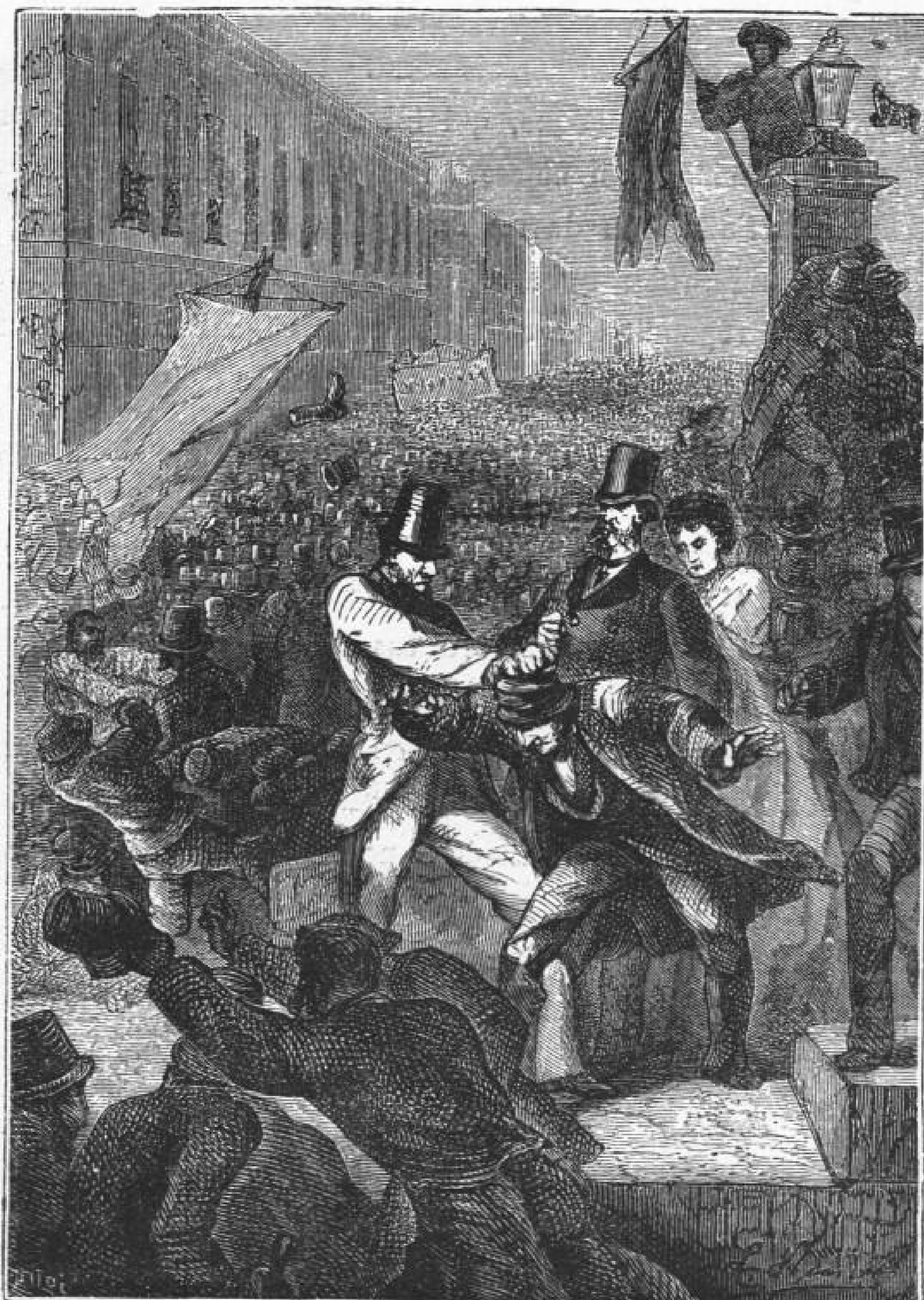
Mrs. Aouda, on Phileas Fogg's arm, was watching this tumultuous scene with surprise, and Fix was about to ask one of his neighbors the reason for this popular effervescence, when a more pronounced movement became apparent. The hurrahs, garnished with insults, redoubled. The shafts of the banners turned into offensive weapons. No more hands—fists everywhere. From the tops of stopped carriages and of omnibuses braked in their course, heavy blows were exchanged. Everything served as projectiles. Boots and shoes described very tense trajectories in the air, and it even seemed that a few revolvers mingled their national detonations with the vociferations of the crowd.
The mob drew nearer to the staircase and flowed back over the first steps. One of the parties was evidently being repulsed, without the simple spectators being able to recognize whether the advantage remained with Mandiboy or with Kamerfield.
"I believe it prudent to withdraw," said Fix, who did not want "his man" to receive a bad blow or get into a bad business. "If England is in question in all this and we are recognized, we will be greatly compromised in the scuffle!
"An English citizen..." replied Phileas Fogg.
But the gentleman could not finish his phrase. Behind him, from that terrace preceding the staircase, frightful howls broke out. They were shouting: "Hurrah! Hip! Hip! for Mandiboy!" It was a troop of electors arriving to the rescue, taking the partisans of Kamerfield in flank.
Mr. Fogg, Mrs. Aouda, and Fix found themselves between two fires. It was too late to escape. That torrent of men, armed with loaded canes and life-preservers, was irresistible. Phileas Fogg and Fix, while protecting the young woman, were horribly jostled. Mr. Fogg, no less phlegmatic than usual, wished to defend himself with those natural weapons that nature has placed at the end of the arms of every Englishman, but in vain. An enormous fellow with a red goatee, a high complexion, broad-shouldered, who appeared to be the chief of the band, raised his formidable fist over Mr. Fogg, and he would have greatly damaged the gentleman if Fix, out of devotion, had not received the blow in his place. An enormous bump instantly developed under the detective's silk hat, transformed into a simple cap.
"Yankee!" said Mr. Fogg, casting a look of profound contempt at his adversary.
"Englishman!!" replied the other.
"We shall meet again!"
"When you please.
"Your name?"
"Phileas Fogg. Yours?"
"Colonel Stamp W. Proctor."
Then, that said, the tide passed. Fix was knocked down and got up again, his clothes torn, but without serious bruising. His traveling coat had separated into two unequal parts, and his trousers resembled those breeches which certain Indians—a matter of fashion—wear only after having first removed the seat. But, on the whole, Mrs. Aouda had been spared, and Fix alone was the one with his punch.
"Thank you," said Mr. Fogg to the inspector, as soon as they were out of the crowd.
"There is no need," replied Fix, "but come.
"Where?"
"To a ready-made clothes dealer."
Indeed, this visit was opportune. The clothes of Phileas Fogg and Fix were in rags, as if these two gentlemen had fought on behalf of the honorable Kamerfield and Mandiboy.
An hour later they were suitably clothed and hatted. Then they returned to the International Hotel.
There, Passepartout was waiting for his master, armed with half a dozen six-shot dagger-revolvers with central firing. When he perceived Fix in Mr. Fogg's company, his brow darkened. But Mrs. Aouda, having in a few words given an account of what had happened, Passepartout was reassured. Evidently Fix was no longer an enemy; he was an ally. He had kept his word.
After dinner, a coach was brought around to take the travelers and their packages to the station. Just as they were getting into the carriage, Mr. Fogg said to Fix:
"You haven't seen that Colonel Proctor again?"
"No," replied Fix.
"I'll come back to America to find him," said Phileas Fogg coldly. "It wouldn't be proper for an English citizen to let himself be treated that way."
The inspector smiled and made no reply. But, as one can see, Mr. Fogg was of that breed of Englishmen who, while they do not tolerate dueling at home, fight abroad when it comes to defending their honor.
At a quarter to six, the travelers reached the station and found the train ready to depart.
Just as Mr. Fogg was about to board, he noticed an employee and, going up to him, said:"My friend, were there not some disturbances today in San Francisco?"
"It was a meeting, sir," replied the employee.
"However, I thought I noticed a certain liveliness in the streets."
"It was simply a meeting organized for an election."
"The election of a commander-in-chief, no doubt?" asked Mr. Fogg.
"No, sir, of a justice of the peace."
At this reply, Phileas Fogg climbed into the car, and the train departed at full steam.