
About this book
Fogg bets his fortune he can circle the globe in eighty days. Verne's 1872 novel, French original, Hetzel edition, free to read online.
IN WHICH PHILEAS FOGG ENTERS INTO A DIRECT STRUGGLE AGAINST ILL LUCK.
On leaving, the China seemed to have carried away with it Phileas Fogg's last hope.
Indeed, none of the other steamers that provide direct service between America and Europe—neither the French Transatlantiques, nor the ships of the "White Star Line," nor the steamers of the Imman Company, nor those of the Hamburg line, nor others—could serve the gentleman's plans.
Indeed, the Pereire, of the French Transatlantic Company—whose admirable vessels equal in speed and surpass in comfort those of all the other lines, without exception—was not leaving until two days later, December 14. And besides, like those of the Hamburg Company, it did not go directly to Liverpool or to London, but to Havre, and this additional crossing from Havre to Southampton, by delaying Phileas Fogg, would have nullified his last efforts.
As for the Imman steamers, one of which, the City of Paris, was putting to sea the next day, there was no use thinking of them. These ships are particularly assigned to the transport of emigrants, their engines are weak, they sail as much by sail as by steam, and their speed is mediocre. They employed on this crossing from New York to England more time than remained to Mr. Fogg to win his wager.
Of all this the gentleman rendered himself perfectly aware by consulting his Bradshaw, which gave him, day by day, the movements of transoceanic navigation.
Passepartout was crushed. To have missed the steamer by forty-five minutes—that killed him. It was his fault, his, who, instead of helping his master, had never ceased to sow obstacles in his path! And when he reviewed in his mind all the incidents of the journey, when he calculated the sums spent in pure loss and in his own interest alone, when he thought that this enormous wager, added to the considerable expenses of this journey now become useless, completely ruined Mr. Fogg, he heaped abuse upon himself.
Mr. Fogg, however, made him no reproach, and, on leaving the pier of the transatlantic steamers, he said only these words:
"We will see about it tomorrow. Come."
Mr. Fogg, Mrs. Aouda, Fix, and Passepartout crossed the Hudson on the Jersey City ferryboat and got into a cab, which took them to the Hotel Saint-Nicolas on Broadway. Rooms were placed at their disposal, and the night passed—short for Phileas Fogg, who slept a perfect sleep, but very long for Mrs. Aouda and her companions, whose agitation did not allow them to rest.
The next day was December 12. From December 12 at seven in the morning to December 21 at eight forty-five in the evening, there remained nine days, thirteen hours, and forty-five minutes. If, therefore, Phileas Fogg had left the day before on the China, one of the best sailers of the Cunard line, he would have arrived in Liverpool, and then in London, within the required time!
Mr. Fogg left the hotel alone, after having instructed his servant to wait for him and to warn Mrs. Aouda to be ready at any moment.
Mr. Fogg went to the banks of the Hudson, and among the ships moored at the quay or anchored in the river, he carefully searched for those that were about to depart. Several vessels had their departure pennant flying and were preparing to put to sea on the morning tide, for in that immense and admirable port of New York, there is not a day when a hundred ships do not set out for every point in the world; but most were sailing vessels, and they could not suit Phileas Fogg.
This gentleman seemed bound to fail in his latest attempt, when he caught sight of a merchant ship with a screw propeller, of slender lines, moored before the Battery, no more than a cable's length away, whose funnel, emitting great flakes of smoke, indicated that it was preparing to get under way.
Phileas Fogg hailed a boat, got into it, and with a few strokes of the oars found himself at the ladder of the Henrietta, a steamer with an iron hull, all of whose upper works were of wood.
The captain of the Henrietta was on board. Phileas Fogg went up on deck and asked to see the captain. The latter presented himself at once.
He was a man of fifty, a sort of sea wolf, a grumbler who could not have been easy to deal with. Big eyes, complexion of oxidized copper, red hair, thick neck—nothing of the appearance of a man of the world.
"The captain?" asked Mr. Fogg.
"That's me."
"I am Phileas Fogg, of London."
"And I, Andrew Speedy, of Cardiff."
"You are about to sail?..."
"In an hour."
"You are bound for...?
"Bordeaux."
"And your cargo?"
"Stones in the hold. No freight. I am sailing in ballast."
"Have you any passengers?"
"No passengers. Never any passengers. Bulky and noisy merchandise."
"Does your ship go well?"
"Between eleven and twelve knots. The Henrietta, well known."
"Will you take me to Liverpool, me and three persons?"
"To Liverpool? Why not to China?"
"I say Liverpool."
"No!"
"No?"
"No. I am about to sail for Bordeaux, and I am going to Bordeaux."
"At any price?"
"At any price."
The captain had spoken in a tone that admitted no reply.
"But the owners of the Henrietta..." resumed Phileas Fogg.
"The owners are me," replied the captain. "The ship belongs to me."
"I charter it from you."
"No."
"I buy it from you."
"No."
Phileas Fogg did not raise an eyebrow. Nevertheless the situation was serious. Things were not at New York as at Hong Kong, nor was the captain of the Henrietta like the master of the Tankadère. Until now the gentleman's money had always overcome obstacles. This time, money was failing.
Yet he had to find a means of crossing the Atlantic by boat—unless he crossed it by balloon—which would have been highly venturesome, and which, moreover, was not practicable.
It appears, however, that Phileas Fogg had an idea, for he said to the captain:
"Well then, will you take me to Bordeaux?"
"No, even if you paid me two hundred dollars!"
"I offer you two thousand (10,000 fr.)."
"Per person?"
"Per person."
"And you are four?"
"Four."
Captain Speedy began to scratch his forehead, as if he wanted to tear off the skin. Eight thousand dollars to be earned, without altering his voyage, that was well worth the trouble of setting aside his pronounced antipathy for any
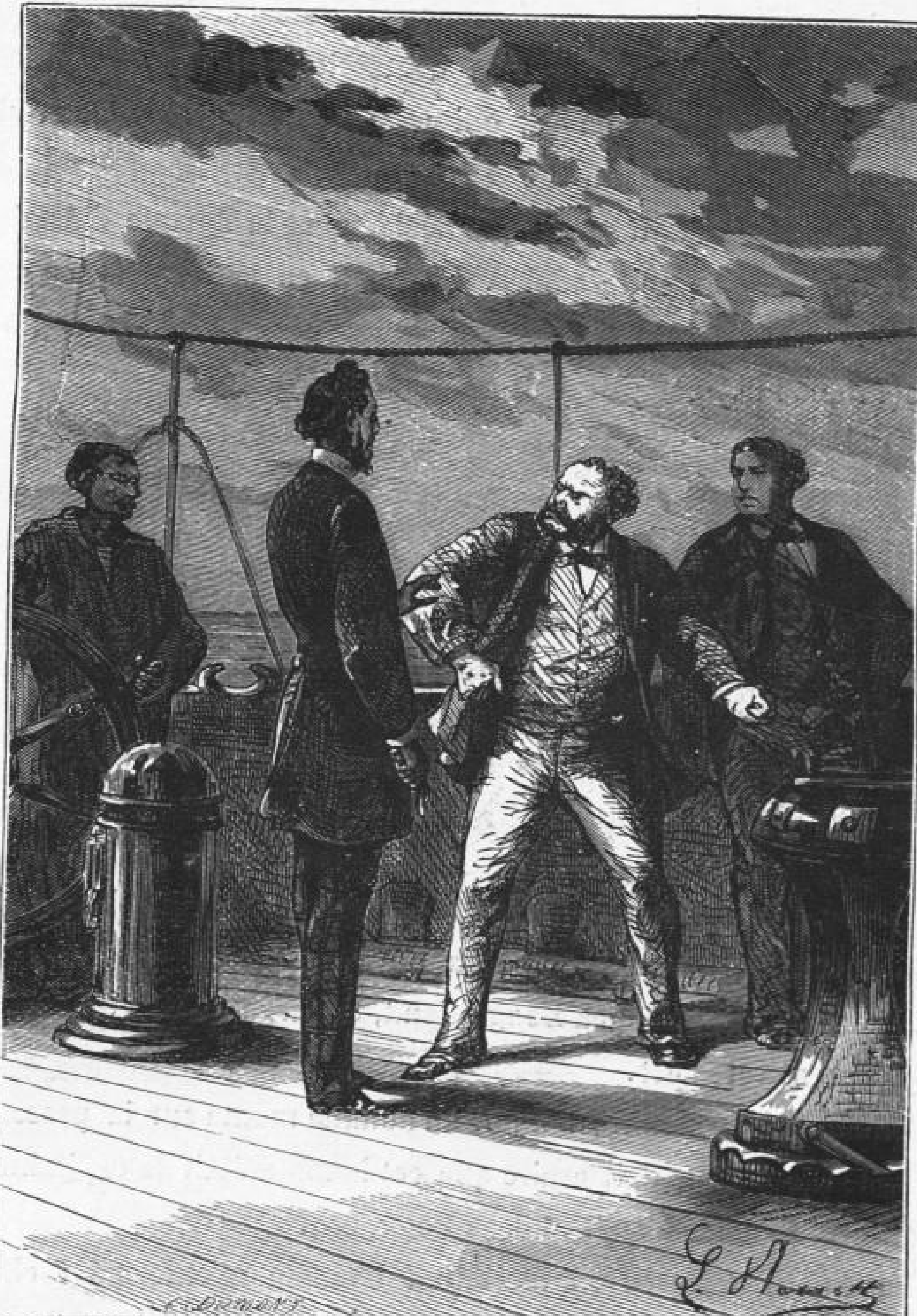
kind of passenger. Passengers at two thousand dollars, besides, are no longer passengers; they are valuable merchandise.
"Pirate!" cried Andrew Speedy. (Page 198.)
"I sail at nine o'clock," said Captain Speedy simply, "and if you and your people are there?..."
"At nine o'clock we will be on board!" replied Mr. Fogg no less simply.
It was half past eight. To disembark from the Henrietta, get into a carriage, go to the Hotel Saint-Nicolas, bring back Mrs. Aouda, Passepartout, and even the inseparable Fix, to whom he graciously offered passage, all this was done by the gentleman with that calm which never deserted him under any circumstances.
At the moment when the Henrietta got under way, all four were on board.
When Passepartout learned what this last crossing would cost, he uttered one of those prolonged "Oh!"s that run through all the intervals of the descending chromatic scale!
As for Inspector Fix, he told himself that decidedly the Bank of England would not come out of this affair unscathed. Indeed, on arrival, and admitting that the said Fogg did not still throw a few handfuls of it into the sea, more than seven thousand pounds (175,000 fr.) would be missing from the bag of bank-notes!