About this book
Fogg bets his fortune he can circle the globe in eighty days. Verne's 1872 novel, French original, Hetzel edition, free to read online.
IN WHICH IT IS PROVED THAT PHILEAS FOGG GAINED NOTHING BY MAKING THIS TOUR OF THE WORLD, EXCEPT HAPPINESS.
Yes! Phileas Fogg himself.
It will be remembered that at five minutes past eight in the evening—about twenty-five hours after the travelers' arrival in London—Passepartout had been charged by his master with notifying the Reverend Samuel Wilson concerning a certain marriage which was to be concluded the very next day.
Passepartout had therefore set out, delighted. He proceeded at a rapid pace to the residence of the Reverend Samuel Wilson, who had not yet returned. Naturally, Passepartout waited, but he waited a good twenty minutes at least.
In short, it was five minutes past eight when he left the reverend's house. But in what a state! His horses in disarray, hatless, running, running, as no one had ever been seen to run in the memory of man, knocking over passersby, rushing like a whirlwind onto the sidewalks!
In three minutes, he was back at the house in Saville-row, and he fell, out of breath, into Mr. Fogg's room.
He could not speak.
"What is the matter?" asked Mr. Fogg.
— "Master..." stammered Passepartout... "marriage... impossible."
— "Impossible?"
— "Impossible... for tomorrow."
— "Why?"
— "Because tomorrow... is Sunday!"
— "Monday," replied Mr. Fogg.
— "No... today... Saturday."
— "Saturday? Impossible!"
— "Yes, yes, yes, yes!" cried Passepartout. "You've made a mistake of a day! We've arrived twenty-four hours ahead... but there are only ten minutes left!..."
Passepartout had seized his master by the collar, and was dragging him along with irresistible force!
Phileas Fogg, thus carried off, without having time to reflect, left his room, left his house, jumped into a cab, promised a hundred pounds to the driver, and after having run over two dogs and grazed five carriages, he arrived at the Reform Club.
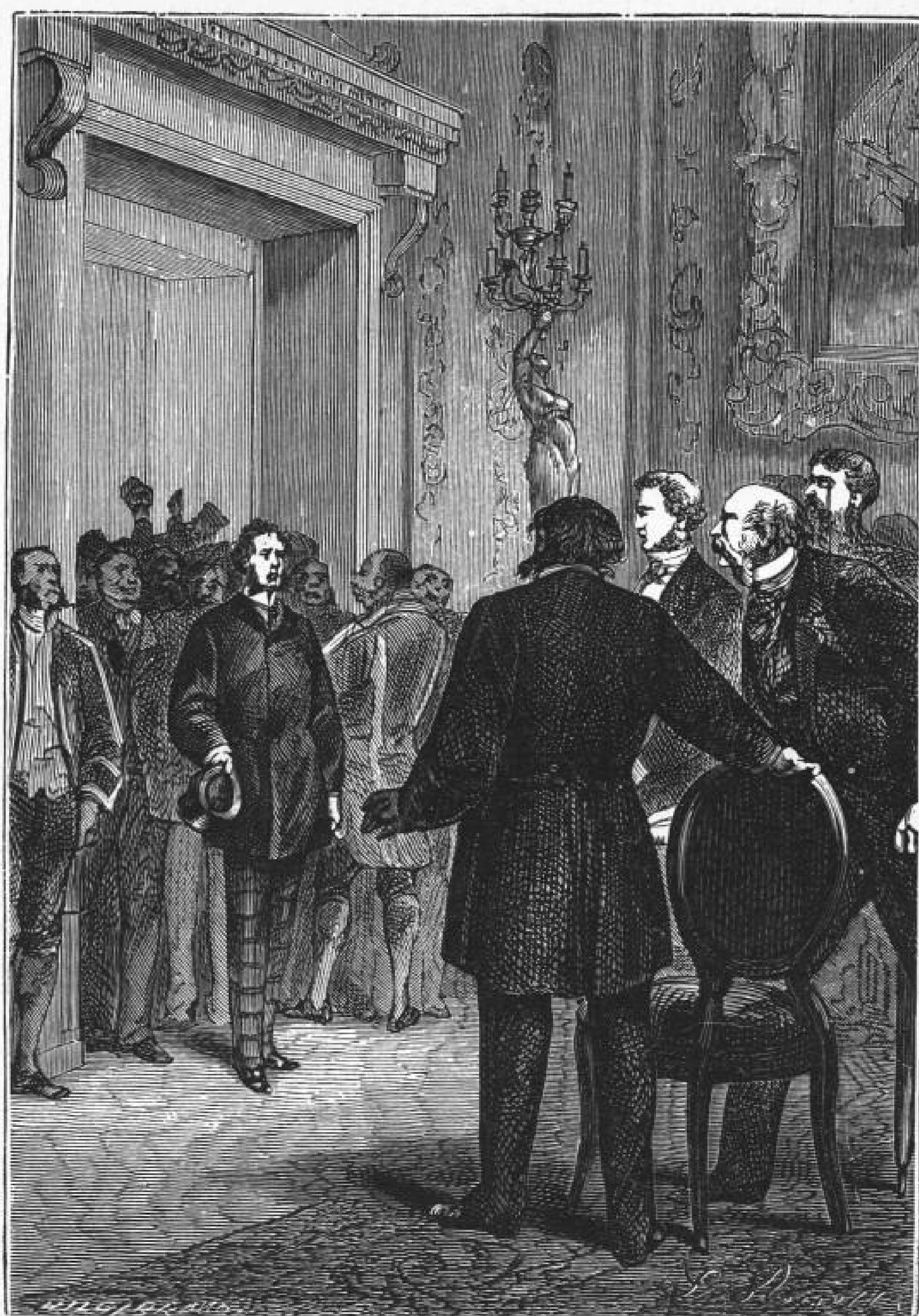
The clock marked eight forty-five when he appeared in the grand salon...
Phileas Fogg had accomplished this tour of the world in eighty days!...
Phileas Fogg had won his bet of twenty thousand pounds!
And now, how had a man so exact, so meticulous, been able to commit this error of a day? How did he believe himself to be on Saturday evening, December 21, when he landed in London, when it was only Friday, December 20, merely seventy-nine days after his departure?
Here is the reason for this error. It is very simple.
Phileas Fogg had, "without suspecting it," gained a day on his itinerary—and that solely because he had traveled around the world going eastward, and he would, on the contrary, have lost this day by going in the opposite direction, that is, westward.
Indeed, in traveling eastward, Phileas Fogg was going toward the sun, and consequently the days diminished for him by four minutes each time he crossed a degree in that direction. Now, there are three hundred and sixty degrees in the earth's circumference, and these three hundred and sixty degrees, multiplied by four minutes, give precisely twenty-four hours—that is to say, this day unconsciously gained. In other words, while Phileas Fogg, traveling eastward, saw the sun pass the meridian eighty times, his colleagues remaining in London saw it pass only seventy-nine times. That is
why, on that very day, which was Saturday and not Sunday, as Mr. Fogg believed, they were waiting for him in the salon of the Reform Club.
And this is what Passepartout's famous watch—which had always kept London time—would have confirmed if, at the same time as the minutes and hours, it had also marked the days!
Phileas Fogg had therefore won the twenty thousand pounds. But as he had spent about nineteen thousand of it along the way, the financial result was mediocre. However, as has been said, the eccentric gentleman had, in this bet, sought only the struggle, not fortune. And even the thousand pounds remaining, he shared between the honest Passepartout and the unfortunate Fix, toward whom he was incapable of bearing a grudge. Only, and for the sake of regularity, he deducted from his servant the cost of the nineteen hundred and twenty hours of gas consumed through his fault.
That very evening, Mr. Fogg, as impassive, as phlegmatic as ever, said to Mrs. Aouda:
"Does this marriage still suit you, madame?"
— "Mr. Fogg," replied Mrs. Aouda, "it is for me to ask you that question. You were ruined, and here you are rich..."
— "Forgive me, madame, this fortune belongs to you. If you had not had the thought of this marriage, my servant would not have gone to the Reverend Samuel Wilson, I would not have been informed of my error, and..."
— "Dear Mr. Fogg..." said the young woman.
— "Dear Aouda..." replied Phileas Fogg.
It is easy to understand that the marriage took place forty-eight hours later, and Passepartout, superb, resplendent, dazzling, figured there as witness for the young woman. Had he not saved her, and was this honor not owed to him?
Only, the next day, at dawn, Passepartout was banging noisily on his master's door.
The door opened, and the impassive gentleman appeared.
"What is it, Passepartout?"
— "What is it, sir! It is that I have just learned this very instant..."
— "What, then?"
— "That we could have made the tour of the world in only seventy-eight days."
— "No doubt," replied Mr. Fogg, "by not crossing India. But if I had not crossed India, I would not have saved Mrs. Aouda, she would not be my wife, and..."
And Mr. Fogg quietly closed the door.
Thus Phileas Fogg had won his bet. He had accomplished this journey around the world in eighty days! He had employed for this purpose every means of transportation—steamships, railways, carriages, yachts, merchant vessels, sledges, elephant. The eccentric gentleman had displayed in this affair his marvelous qualities of coolness and exactitude. But after that? What had he gained from this displacement? What had he brought back from this voyage?
Nothing, one will say? Nothing, so be it, if not a charming woman, who—however improbable that may appear—made him the happiest of men!
In truth, would one not go Around the World for less than that?
THE END