
About this book
Fogg bets his fortune he can circle the globe in eighty days. Verne's 1872 novel, French original, Hetzel edition, free to read online.
IN WHICH PHILEAS FOGG AND HIS COMPANIONS VENTURE THROUGH THE FORESTS OF INDIA, AND WHAT FOLLOWS.
The guide, in order to shorten the distance to be traveled, left on the right the line of the track whose works were in course of execution. This track, much thwarted by the capricious ramifications of the Vindhia mountains, did not follow the shortest path, which Phileas Fogg had an interest in taking. The Parsi, very familiar with the roads and paths of the country, claimed to gain about twenty miles by cutting through the forest, and they relied on him.
Phileas Fogg and Sir Francis Cromarty, buried up to their necks in their howdahs, were greatly shaken by the stiff trot of the elephant, to which its mahout gave a rapid pace. But they endured the situation with the most British phlegm, talking little besides, and scarcely seeing each other.
As for Passepartout, posted on the beast's back and directly subject to the blows and counter-blows, he took good care, on a recommendation from his master, to keep his tongue between his teeth, for it would have been cut clean off. The brave fellow, sometimes thrown onto the elephant's neck, sometimes tossed back onto its rump, performed acrobatics like a clown on a trampoline. But he joked, he laughed amid his somersaults, and from time to time he drew from his bag a piece of sugar, which the intelligent Kiouni took with the tip of its trunk, without interrupting for an instant its regular trot.
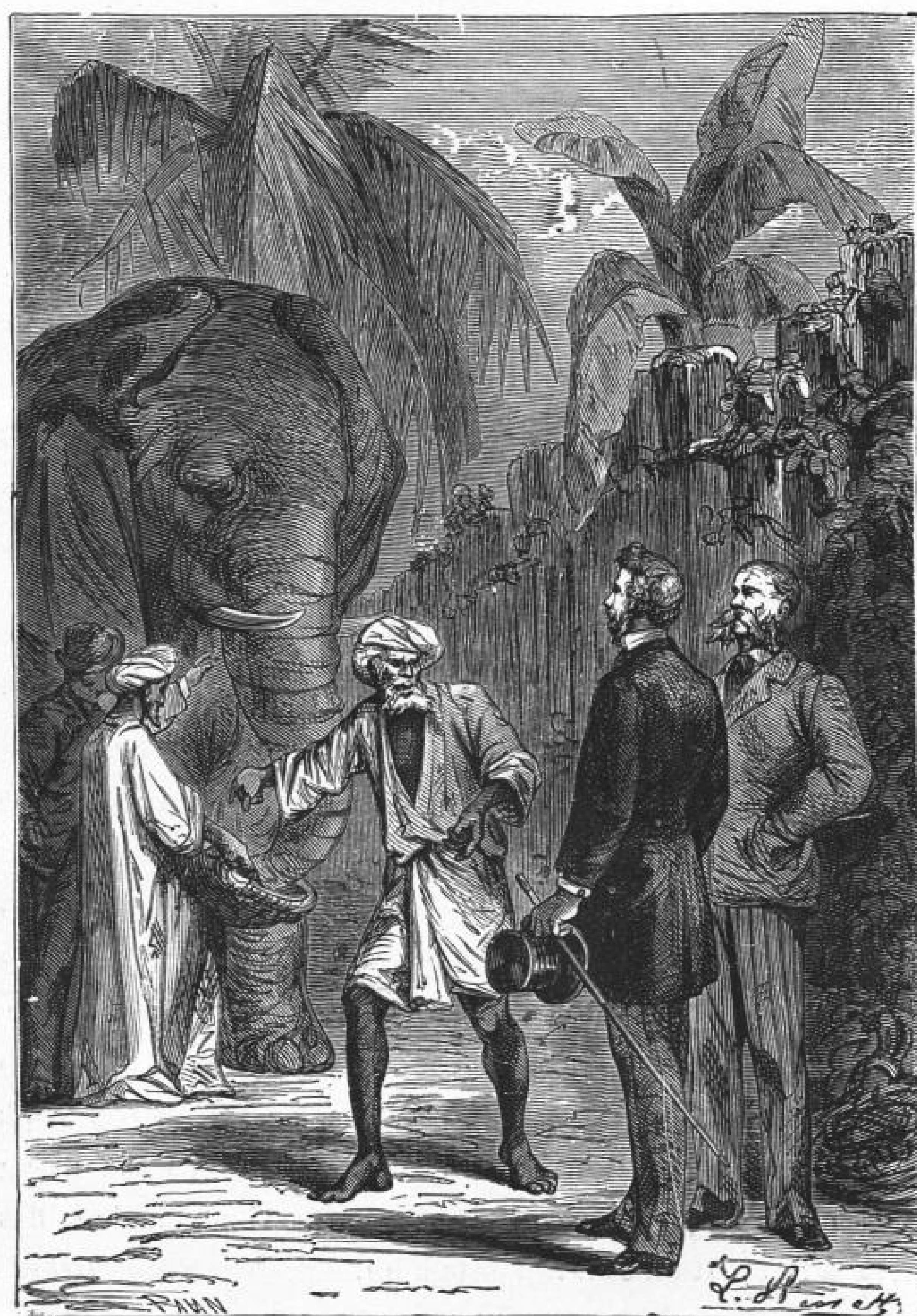
There, they found themselves in the presence of an animal... (Page 53.)
After two hours of walking, the guide stopped the elephant and gave it an hour's rest. The animal devoured branches and shrubs, after first quenching its thirst at a nearby pond. Sir Francis Cromarty did not complain of this halt. He was broken. Mr. Fogg appeared to be as fit as if he had come out of his bed.
"But he is made of iron!" said the brigadier general, looking at him with admiration.
"Wrought iron," replied Passepartout, who set about preparing a light lunch.
At noon, the guide gave the signal for departure. The country soon took on a very
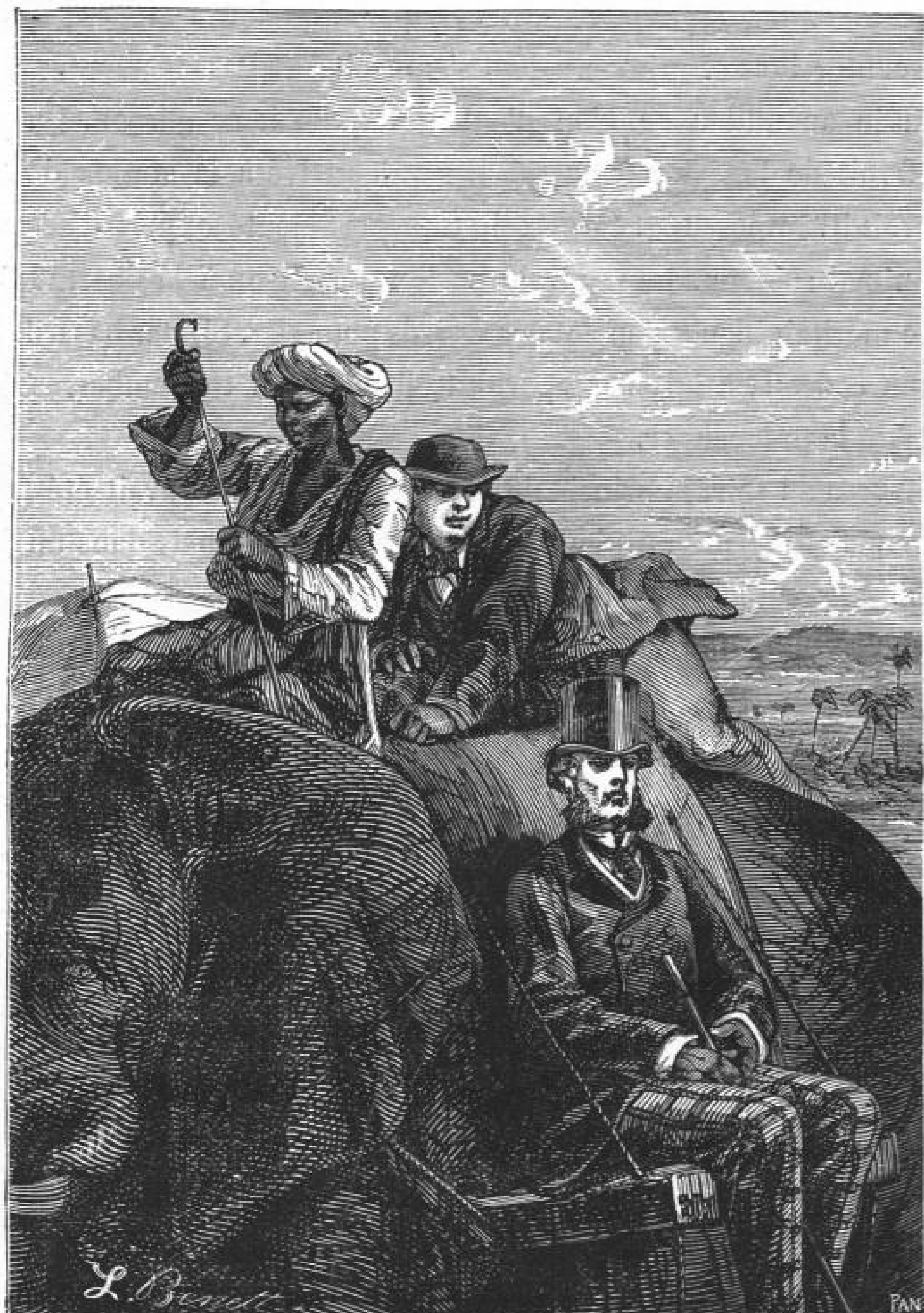
He laughed amid his somersaults. (Page 55.)savage aspect. The great forests were succeeded by thickets of tamarinds and dwarf palms, then by vast arid plains, bristling with scrawny shrubs and strewn with large blocks of syenite. All this part of upper Bundelkund, little frequented by travelers, is inhabited by a fanatical population, hardened in the most terrible practices of the Hindu religion. English domination has not been able to establish itself regularly over a territory subject to the influence of the rajahs, whom it would have been difficult to reach in their inaccessible retreats of the Vindhias.
Several times, bands of fierce Indians were seen, who made a gesture of anger on seeing the rapid quadruped pass. Besides, the Parsi avoided them as much as possible, taking them for people of bad encounter. Few animals were seen during this day, barely a few monkeys, who fled with a thousand contortions and grimaces at which Passepartout was greatly amused.
One thought amid many others worried this boy. What would Mr. Fogg do with the elephant when he arrived at the Allahabad station? Would he take it with him? Impossible! The cost of transport added to the purchase price would make it a ruinous animal. Would they sell it, return it to freedom? This estimable beast deserved that consideration be shown to it. If, by chance, Mr. Fogg made him a gift of it, to him, Passepartout, he would be very embarrassed. That did not fail to preoccupy him.
At eight o'clock in the evening, the principal chain of the Vindhias had been crossed, and the travelers halted at the foot of the northern slope, in a bungalow in ruins.
The distance traveled during this day was about twenty-five miles, and as much remained to be done to reach the Allahabad station.
The night was cold. Inside the bungalow, the Parsi lit a fire of dry branches, whose heat was greatly appreciated. Supper consisted of the provisions bought at Kholby. The travelers ate like harassed and exhausted people. The conversation, which began with a few broken phrases, soon ended with sonorous snoring. The guide watched near Kiouni, who fell asleep standing up, leaning against the trunk of a large tree.
No incident disturbed that night. A few roars from cheetahs and panthers occasionally broke the silence, mingled with the shrill chuckling of monkeys. But the carnivores confined themselves to cries and made no hostile demonstration against the bungalow's guests. Sir Francis Cromarty slept heavily like a brave soldier worn out with fatigue. Passepartout, in a restless sleep, went through the tumbling of the previous day all over again in a dream. As for Mr. Fogg, he rested as peacefully as if he had been in his quiet house in Saville-row.
At six in the morning they set out again. The guide hoped to reach the Allahabad station that same evening. In this way, Mr. Fogg would lose only a part of the forty-eight hours saved since the beginning of the journey.
They descended the last slopes of the Vindhias. Kiouni had resumed his rapid pace. Toward noon, the guide turned aside from the village of Kallenger, situated on the Cani, one of the sub-tributaries of the Ganges. He always avoided inhabited places, feeling safer in those deserted countrysides which mark the first depressions of the great river's basin. The Allahabad station was not twelve miles to the northeast. They halted under a clump of banana trees, whose fruit, as wholesome as bread, "as succulent as cream," say travelers, was extremely appreciated.
At two o'clock, the guide entered the shelter of a dense forest, which he had to cross for a distance of several miles. He preferred to travel thus under the cover of the woods. In any case, he had so far met with no unpleasant encounter, and the journey seemed bound to be accomplished without accident, when the elephant, giving some signs of uneasiness, suddenly stopped.
It was four o'clock then.
"What is the matter?" asked Sir Francis Cromarty, who had raised his head above his cacolet.
"I do not know, my officer," replied the Parsi, listening to a confused murmur that passed beneath the thick foliage.
A few moments later, this murmur became more definable. It might have been taken for a concert, still quite distant, of human voices and brass instruments.
Passepartout was all eyes and ears. Mr. Fogg waited patiently, without uttering a word.
The Parsi leaped to the ground, tied the elephant to a tree, and plunged into the thickest part of the copse. A few minutes later, he returned, saying:
"A procession of Brahmins coming this way. If possible, let us avoid being seen."
The guide untied the elephant and led it into a thicket, instructing the travelers not to set foot on the ground. He himself held himself ready to mount quickly, should flight become necessary. But he thought that the troop of the faithful would pass without perceiving him, for the thickness of the foliage completely concealed him.
The discordant noise of voices and instruments drew nearer. Monotonous chants mingled with the sound of drums and cymbals. Soon the head of the procession appeared beneath the trees, about fifty paces from the post occupied by Mr. Fogg and his companions. Through the branches they could easily distinguish the curious personnel of this religious ceremony.
In the first line advanced priests, coiffed with mitres and dressed in long embroidered robes. They were surrounded by men, women, and children, who uttered a sort of funeral psalmody, interrupted at regular intervals by strokes of tom-toms and cymbals. Behind them, on a chariot with broad wheels whose spokes and felly formed an interlacing of serpents, appeared a hideous statue, drawn by two pairs of zebus richly caparisoned. This statue had four arms, its body colored a dark red, its eyes haggard, its hair tangled, its tongue hanging out, its lips stained with henna and betel.Around its neck was coiled a necklace of skulls, at its flanks a belt of severed hands. It stood upright on a vanquished giant lacking its head.
Sir Francis Cromarty recognized this statue.
"The goddess Kali," he murmured, "the goddess of love and death."
"Of death, I grant, but of love, never!" said Passepartout. "The ugly woman!"
The Parsi signaled him to be silent.
Around the statue stirred, struggled, and convulsed a group of old fakirs, striped with bands of ochre, covered with crucial incisions that let their blood escape drop by drop, stupid energumens who, in the great Hindu ceremonies, still rush beneath the wheels of the chariot of Juggernaut.
Behind them, some Brahmins, in all the sumptuousness of their Oriental costume, dragged a woman who could scarcely support herself.
This woman was young, white as a European. Her head, neck, shoulders, ears, arms, hands, and toes were overloaded with jewels, necklaces, bracelets, earrings, and rings. A tunic laminated with gold, covered with a light muslin, outlined the contours of her figure.
Behind this young woman—a violent contrast to the eyes—guards, armed with naked sabers passed through their belts and long damascened pistols, carried a corpse on a palanquin.
It was the body of an old man, clad in his opulent rajah's garments, having, as in his life, the turban embroidered with pearls, the robe woven of silk and gold, the cashmere belt set with diamonds, and his magnificent arms of an Indian prince.
Then musicians and a rear guard of fanatics, whose cries sometimes covered the deafening uproar of the instruments, closed the procession.
Sir Francis Cromarty looked at all this pomp with a singularly saddened air, and turning to the guide:
"A sutty!" he said.
The Parsi made an affirmative sign and put a finger on his lips. The long procession unrolled slowly beneath the trees, and soon its last ranks disappeared in the depths of the forest.
Little by little, the chants died away. There were still a few bursts of distant cries, and at last to all this tumult succeeded a profound silence.
Phileas Fogg had heard this word, pronounced by Sir Francis Cromarty, and as soon as the procession had disappeared:
"What is a sutty?" he asked.
"A sutty, Mr. Fogg," replied the brigadier general, "is a human sacrifice, but a voluntary sacrifice. That woman you have just seen will be burned tomorrow at the first hours of the day."
"Ah! the scoundrels!" cried Passepartout, who could not restrain this cry of indignation.
"And that corpse?" asked Mr. Fogg.
"It is that of the prince, her husband," replied the guide, "an independent rajah of Bundelkund."
"How is it," resumed Phileas Fogg, without his voice betraying the slightest emotion, "that these barbarous customs still exist in India, and the English have not been able to destroy them?"
"In the greater part of India," replied Sir Francis Cromarty, "these sacrifices are no longer performed, but we have no influence over these savage countries, and principally over this territory of Bundelkund. The entire northern slope of the Vindhias is the theater of incessant murders and pillages."
"The unfortunate woman!" murmured Passepartout, burned alive!"
"Yes," resumed the brigadier general, "burned alive, and if she were not, you could not believe to what a miserable condition she would be reduced by her relatives. Her hair would be shaved, she would be fed scarcely a few handfuls of rice, she would be repulsed, she would be considered an unclean creature and would die in some corner like a mangy dog. So the prospect of this frightful existence often drives these unfortunate women to the torment, far more than love or religious fanaticism. Sometimes, however, the sacrifice is truly voluntary, and the energetic intervention of the government is needed to prevent it. Thus, a few years ago, I was residing in Bombay, when a young widow came to ask the governor for authorization to burn herself with the body of her husband. As you may well think, the governor refused. Then the widow left the city, took refuge with an independent rajah, and there she consummated her sacrifice."
During the brigadier general's account, the guide shook his head, and when the account was finished:
"The sacrifice that will take place tomorrow at daybreak is not voluntary," he said.
"How do you know?"
"It is a story that everyone knows in Bundelkund," replied the guide.
"However, this unfortunate woman did not appear to make any resistance," observed Sir Francis Cromarty.
"That is because she has been intoxicated with the smoke of hemp and opium."
"But where are they taking her?"
"To the pagoda of Pillaji, two miles from here. There she will pass the night awaiting the hour of the sacrifice."
"And this sacrifice will take place?..."
— Tomorrow, at the first appearance of daybreak."
After this reply, the guide brought the elephant out of the dense thicket and hoisted himself onto the animal's neck. But just as he was about to urge it on with a particular whistle, Mr. Fogg stopped him and, addressing Sir Francis Cromarty:
"What if we saved this woman?" he said.
"Save this woman, Mr. Fogg!..." exclaimed the brigadier general.
"I still have twelve hours to spare. I can devote them to that."
"Well now! But you are a man of heart!" said Sir Francis Cromarty.
"Sometimes," Phileas Fogg replied simply. "When I have the time."