
About this book
Fogg bets his fortune he can circle the globe in eighty days. Verne's 1872 novel, French original, Hetzel edition, free to read online.
IN WHICH PHILEAS FOGG, PASSEPARTOUT, FIX, EACH ON HIS OWN SIDE, GOES ABOUT HIS BUSINESS.
During the last days of the crossing, the weather was rather bad. The wind became very strong. Fixed in the northwest quarter, it hindered the progress of the steamer. The Rangoon, too unstable, rolled considerably, and the passengers were entitled to bear a grudge against those long sagging swells that the wind raised from the open sea.
During the days of November 3 and 4, it was a sort of tempest. The squall beat the sea with vehemence. The Rangoon had to heave to for half a day, maintaining itself with only ten turns of the propeller, so as to edge along with the waves. All sails had been furled, and even that was too much of this rigging which whistled amid the gusts.
The speed of the steamer, one may conceive, was notably diminished, and it could be estimated that it would arrive at Hong Kong twenty hours behind the regulation time, and even more, if the storm did not cease.
Phileas Fogg witnessed this spectacle of a furious sea, which seemed to struggle directly against him, with his usual impassibility. His brow did not darken for an instant, and yet a delay of twenty hours could compromise his journey by making him miss the departure of the Yokohama steamer. But this man without nerves felt neither impatience nor annoyance. It really seemed that this storm was part of his program, that it had been foreseen. Mrs. Aouda, who spoke with her companion of this setback, found him as calm as in the past.
Fix, however, did not see these things in the same light. Quite the contrary. This tempest pleased him. His satisfaction would even have been boundless if the Rangoon had been forced to flee before the storm. All these delays suited him, for they would oblige the said Mr. Fogg to remain a few days at Hong Kong. In short, the sky, with its squalls and its gales, was playing into his hand. He was indeed a little ill, but what did it matter! He did not count his bouts of nausea, and when his body twisted under seasickness, his mind rejoiced with an immense satisfaction.
As for Passepartout, one can imagine in what barely concealed anger he passed this time of trial. Until then everything had gone so well! Land and water seemed to be at his master's devotion. Steamers and railways obeyed him. Wind and steam united to favor his journey. Had the hour of setbacks finally struck? Passepartout, as if the twenty thousand pounds of the wager were to come out of his own purse, was no longer living. This tempest exasperated him, this squall threw him into a fury, and he would gladly have whipped this disobedient sea! Poor fellow! Fix carefully concealed from him his personal satisfaction, and he did well, for if Passepartout had guessed Fix's secret contentment, Fix would have had a bad quarter of an hour.
Passepartout, throughout the duration of the gale, remained on the deck of the Rangoon. He could not have stayed below; he climbed into the rigging; he astonished the crew and helped with everything with the agility of a monkey. A hundred times he questioned the captain, the officers, the sailors, who could not help laughing at seeing a lad so disconcerted. Passepartout absolutely wanted to know how long the storm would last. He was then referred to the barometer, which would not make up its mind to rise. Passepartout shook the barometer, but nothing did any good, neither the shakes nor the insults with which he overwhelmed the irresponsible instrument.
At last the storm subsided. The state of the sea changed during the day of November 4th. The wind jumped two points to the south and became favorable again.
Passepartout regained his composure with the weather. The topsails and lower sails could be set, and the Rangoon resumed her course with marvelous speed.
But they could not make up all the lost time. They had to resign themselves to it, and land was not sighted until the 6th, at five o'clock in the morning. Phileas Fogg's itinerary called for the steamer's arrival on the 5th. But it was arriving only on the 6th.
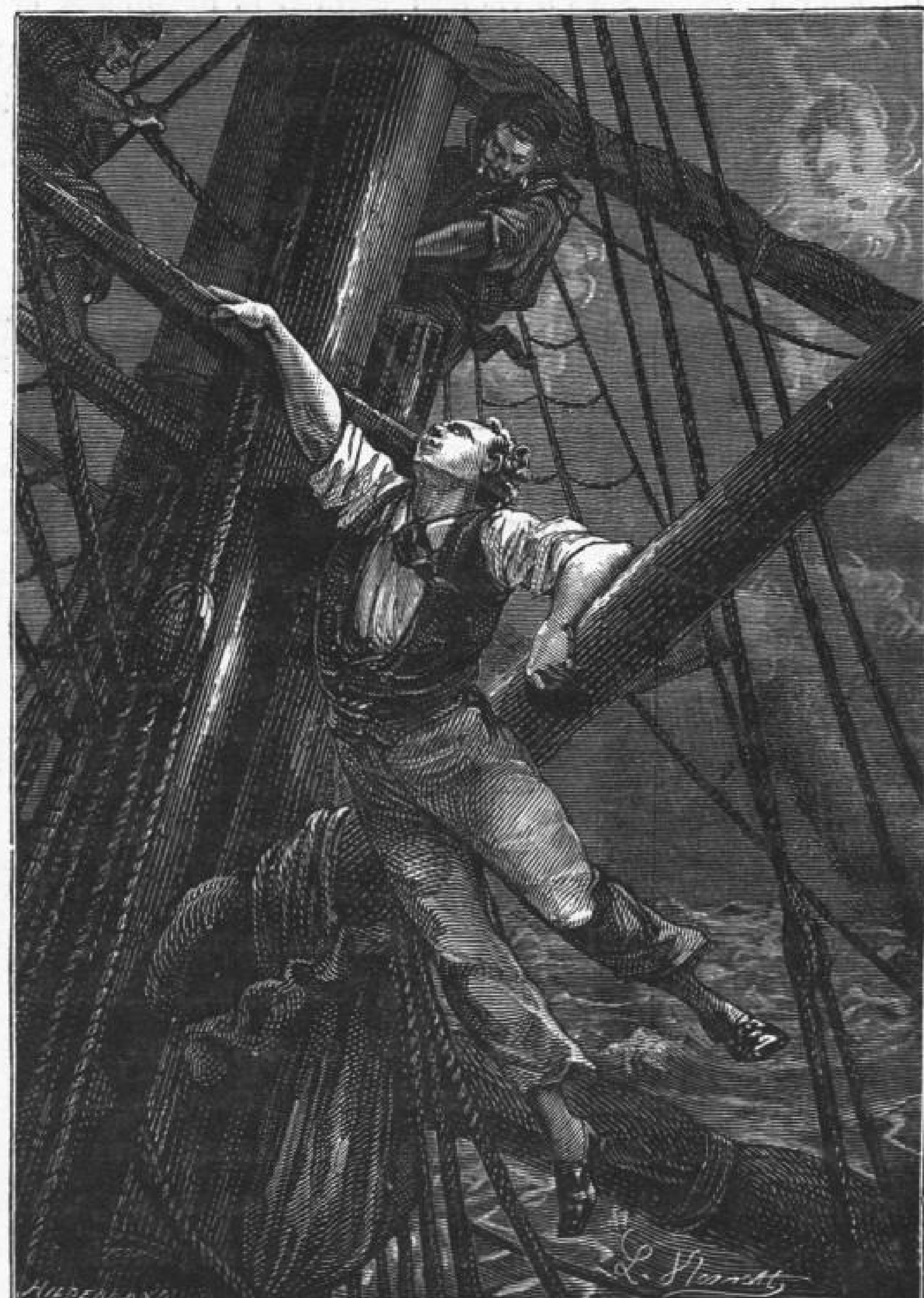
He astonished the crew and helped with everything... Page 05.)
It was therefore twenty-four hours late, and the departure for Yokohama would necessarily be missed.
At six o'clock, the pilot came aboard the Rangoon and took his place on the bridge, in order to guide the ship through the passages as far as the port of Hong Kong.
Passepartout was dying to question this man, to ask him whether the steamer for Yokohama had left Hong Kong. But he did not dare, preferring to keep a little hope until the last moment. He had confided his worries to Fix, who—the sly fox—tried to console him by saying that Mr. Fogg would simply have to take the next steamer. Which put Passepartout in a towering rage.
.
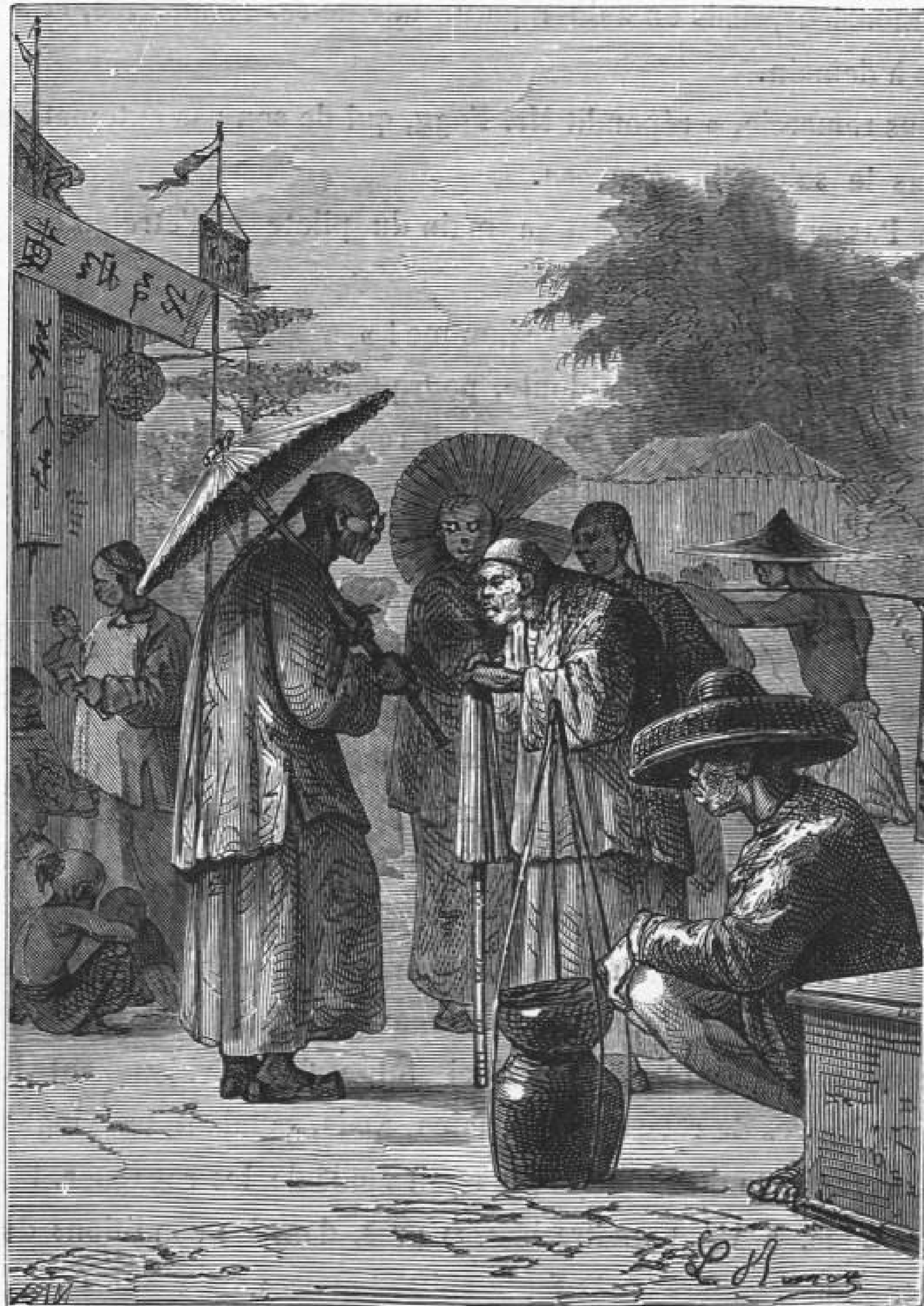
But if Passepartout did not venture to question the pilot, Mr. Fogg, after consulting his Bradshaw, asked the said pilot, with his calm air, whether he knew when a ship would leave Hong Kong for Yokohama.
"Tomorrow, at the morning tide," replied the pilot.
"Ah!" said Mr. Fogg, without showing any astonishment.
Passepartout, who was present, would gladly have embraced the pilot, whose neck Fix would have liked to wring.
"What is the name of that steamer?" asked Mr. Fogg.
"The Carnatic," replied the pilot.
"Was it not supposed to leave yesterday?"

"Yes, sir, but one of her boilers had to be repaired, and her departure was postponed until tomorrow."
"I thank you," replied Mr. Fogg, who with his automatic step went back down into the Rangoon's saloon.
As for Passepartout, he seized the pilot's hand and shook it vigorously, saying:
"You, pilot, you are a fine fellow!"
The pilot doubtless never knew why his answers had earned him this friendly outburst. At a whistle blast, he went back up onto the bridge and guided the steamer through the midst of that flotilla of junks, tankas, fishing boats, and vessels of every kind that crowded the passages of Hong Kong.
At one o'clock, the Rangoon was at the dock, and the passengers disembarked.
In this circumstance, chance had singularly served Phileas Fogg, it must be admitted. Without this necessity of repairing her boilers, the Carnatic would have left on the date of November 5th, and travelers for Japan would have had to wait eight days for the departure of the next steamer. Mr. Fogg, it is true, was twenty-four hours late, but this delay could have no unfortunate consequences for the rest of the journey.
Indeed, the steamer that makes the crossing of the Pacific from Yokohama to San Francisco was in direct connection with the steamer from Hong Kong, and it could not leave before the latter had arrived. Obviously there would be a twenty-four-hour delay at Yokohama, but during the twenty-two days that the Pacific crossing lasts, it would be easy to make them up. Phileas Fogg therefore found himself, to within twenty-four hours, in the conditions of his program, thirty-five days after having left London.
The Carnatic not being due to leave until five o'clock the next morning, Mr. Fogg had sixteen hours before him to attend to his affairs, that is to say, those concerning Mrs. Aouda. On disembarking from the ship, he offered her his arm and led her toward a palanquin. He asked the bearers to indicate a hotel, and they directed him to the Hotel du Club. The palanquin set off, followed by Passepartout, and twenty minutes later it arrived at its destination.
An apartment was engaged for the young woman, and Phileas Fogg saw to it that she lacked nothing. Then he told Mrs. Aouda that he was going immediately to set about searching for that relative into whose care he was to leave her at Hong Kong. At the same time he gave Passepartout orders to remain at the hotel until his return, so that the young woman should not stay there alone.
The gentleman had himself taken to the Exchange. There, a personage such as the honorable Jejeeh, who counted among the richest merchants in the city, would inevitably be known.
The broker to whom Mr. Fogg applied did indeed know the Parsi merchant. But for two years the latter had no longer lived in China. Having made his fortune, he had settled in Europe—in Holland, it was believed—which was explained by the numerous relations he had had with that country during his commercial life.
Phileas Fogg returned to the Hotel du Club. At once he asked Mrs. Aouda's permission to present himself before her, and, without further preamble, he informed her that the honorable Jejeeh no longer resided in Hong Kong, and that he probably lived in Holland.
To this, Mrs. Aouda said nothing at first. She passed her hand over her forehead and remained a few moments in thought. Then, in her gentle voice:
"What should I do, Mr. Fogg?" she said.
"It is very simple," replied the gentleman. "Return to Europe."
"But I cannot abuse..."
"You are not abusing anything, and your presence in no way interferes with my program. — Passepartout?"
"Sir," replied Passepartout.
"Go to the Carnatic, and reserve three cabins."
Passepartout, delighted to continue his journey in the company of the young woman, who was very gracious to him, immediately left the Hotel du Club.